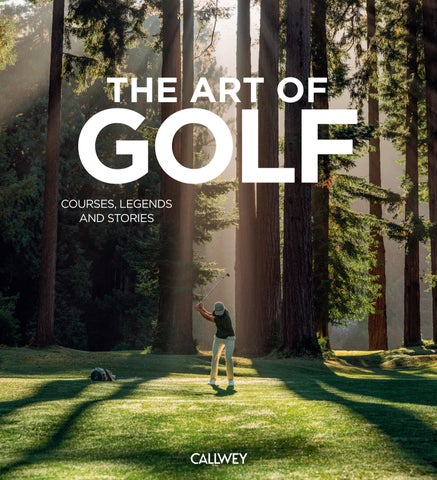
THE ART OF
GOLF
COURSES, LEGENDS AND STORIES
CONTENTS 4
INTRODUCTION
10
THE GAME
46
THE PLACES
118
THE GREAT ARCHITECTS
6
12 18 24 30 34 40
48 50 56 60 66 70 72 78 84 90 94 98 100 106 112 120 124 128 132 136 140
2
THE FASCINATION OF GOLF
PRO GOLF IN THE SPOTLIGHT WHY GOLF HAS NO DESIRE TO BE PERFECT NO OPPONENT, NO TIE MATCH PLAY VERSUS STROKE PLAY RISK VS. CONTROL CLIMBING THE LADDER
WHERE IT ALL BEGAN ST ANDREWS OLD COURSE MUSSELBURGH LINKS PRESTWICK ROYAL DORNOCH THE ICONS AUGUSTA NATIONAL PEBBLE BEACH PINEHURST NO. 2 ROYAL COUNTY DOWN TURNBERRY AILSA CONNOISSEURS’ FAVORITE COURSES MUIRFIELD CYPRESS POINT SHINNECOCK HILLS ALISTER MACKENZIE DONALD ROSS PETER DYE TOM DOAK COORE & CRENSHAW HARRY COLT
144
THE PSYCHOLOGY OF THE COURSE
172
EQUIPMENT AND STYLE
192
GOLF AS CULTURE
216
SPECIAL ADDRESSES
252
GLOSSARY FOR INSIDERS
256
IMPRINT
146 152 156 160 164 168
174 182 186 190
194 200 204 210
218 222 226 232 238 244 248
GOLF AS A MIND GAME ROUTING: PATHS, WIND, TRANSITIONS SHAPING: THE INVISIBLE WORK THE BRAIN OF THE COURSE: THE GREENS BUNKERS AS A WEAPON OPTICAL ILLUSIONS
CLUBS THE EQUIPMENT STYLE ON THE COURSE MANTRA GOLF
AWAY FROM THE GLAMOR ETIQUETTE AND MINDSET DESIGN AS THE CULTURAL LANGUAGE OF GOLF FLIGHTS, FAIRWAYS, FIRST-LIGHT TEE-OFFS
LOFOTEN LINKS ADARE MANOR SEEZEITLODGE HOTEL & SPA GOLFPLATZ WÖRTHSEE DAS GOLDBERG TERRE BLANCHE GRAN HOTEL SON NET
3
INTRODUCTION
6
THE FASCINATION OF GOLF
THE FASCINATION OF GOLF A GOLF COURSE THAT IS “FAIR”—IN THE SENSE OF “PREDICTABLE”—WOULD BE A RECIPE FOR BOREDOM.
This book is not about how to play golf. It’s about on the “important moments.” In golf, there are no unimportant moments. how to understand golf. The walk from the green to the next tee, the minExperience golf for the first time—not on a screen, but out on the course, in the breeze, amid the scent of utes spent waiting, the views over the landscape— fresh-mown grass and the sound of a perfectly struck all of that is part of the game. Dismiss those interim ball—and you will immediately sense that this game is moments as wasted time, and you reveal your lack of more than a mere sport. It’s an invitation to embrace understanding. See them as part of the experience, something that cannot be rushed. A game in which and you’re starting to read the game. Some golf books start off with technique, from grip patience is not rewarded, but expected. A game that promises control, only to deliver pure chance. That to swing plane. Others rank courses and compare ratoffers perfection, while systematically obstructing it. ings. Still others tell of heroic feats—the final putt at And yet, for centuries, people have kept returning the Masters, the impossible shot from the bunker, the to the fairways. Partly because they want to improve, tragic collapse on the last holes. to relive that one perfect shot from their last round. This book, on the other hand, starts where most This promise, which golf makes to every player and golf books end: with the question of why golf is the so rarely fully delivers, is one of the game’s strong- way it is. Why an unforgettable round can take place est incentives. But it is not the only one. Players on a course that does not appear on any ranking list. return because every round is different: the light, the Why a lay-up can be bolder than an aggressive shot wind, the decisions at the same familiar spot. After over water. And why certain places create an atmosfour hours on the course, they often take home more phere that cannot be photographed, measured, or than a scorecard. Four hours of focus, decisions, dis- reproduced. This book is for golfers seeking to underappointments, small wins and big humiliations do stand the fascination behind the sport, and nonsomething to the mind with an intensity few other players who sense that golf is about more than just sports can match.Golf is a slow game in a fast world. It sport. It’s about distinctive, unique landscapes. About thwarts acceleration. A round takes as long as it takes; architecture that only comes into its own after years. no cutting it short, no rushing it, no merely focusing About rituals passed down through generations that
7
THE GAME
MATCH PLAY VERSUS STROKE PLAY
30
MATCH PLAY VERSUS STROKE PLAY
Most golfers around the world play stroke play, or one of its variations: scramble, Chapman, classic foursome. Scores are totaled over 18 holes, and the lowest score wins. This format is efficient, easy to compare, and TV-friendly. It has shaped modern tournament golf and become the standard way to measure performance. Yet it is not the original form of the game.
For centuries, golf was played as match play: hole by hole, player against player. The crucial factor was not the total number of strokes, but who won more holes. This format is older than stroke play; it is more direct, more confrontational.
31
THE GAME
BY CHRISTOPH GÜNTHER
40
CLIMBING THE LADDER
CLIMBING THE LADDER THE TIER SYSTEM OF PRO TOURS—AND WHAT IT MEANS TO EARN A SPOT IN PRO GOLF
Monday morning, just after six, a young man stands in the parking lot of a golf club in Hulencourt, pulling his bag out of his rental car’s trunk. He spent the night in a guesthouse on the edge of town, 50 dollars, breakfast not included. About 80 players will show up on the course that day, most in their early 20s, some older, all with the same goal: survive four rounds, finish in the top 20, move up a level. It’s the first stage of Qualifying School, and for most of them, it’s neither their first nor their last time here. 41
THE ICONS
PEBBLE BEACH
stunning coastal holes versus average inland holes has remained Pebble Beach is one of the most famous golf courses in tthe unchanged. The final 17th and 18th holes return to the ocean. The entire sport. The cliffs over the Pacific, the crashing waves, the 17th has an hourglass-shaped green that has posed one of the cypress trees thrashing in the wind, the seals on the rocks below the toughest targets in championship golf for decades. The 18th, a 543sixth green ... It’s impossible not to be awestruck. Pebble Beach sits yard par 5, runs the entire length of Carmel Bay, with the Pacific on at the end of 17-Mile Drive, a private coastal road running through the left and the coastal road on the right. Del Monte Forest that is lined with some of California’s priciest real Despite recurring criticism of its design, Pebble Beach works estate. There is even an entrance fee simply to get onto the peninsula. The course itself lies between Carmel Bay and Stillwater Cove, because it offers something that no other course can quite matche: on a stretch of coastline so photogenic it is used for car commer- the combination of accessible golf and spectacular natural scenery. Pebble Beach is America’s most famous public golf course. Anycials, wedding photos, and movie scenes. The unusual course layout is controversial among experts. The one can play here. Yet it has hosted six U.S. Opens, a PGA Champifirst six holes play mostly inland, on flat, uninspiring terrain. The onship, a U.S. Women’s Open, the U.S. Amateur, and the Walker Cup. first hole is a short par 4 overlooking Carmel Bay, but the following These events have produced moments that are now firmly estabfour holes offer little of what has made Pebble Beach famous—an lished in golf history. For example, Tom Watson’s chip-in from the assessment that is widely held among experts, though not without thick rough next to the 17th green at the 1982 U.S. Open—a shot he controversy. The sequence that made Pebble said he intended to hole, and which the world Beach famous begins with the seventh hole, believed to be impossible. Or Tiger Woods’ THERE IS AN ENTRANCE FEE 15-stroke victory in 2000, where he doma 106-yard par 3 played from a rocky outcrop TO THE PENINSULA. over a precipice onto a tiny green that slopes inated the course to such an extent that the down on three sides. In windy weather—which competition was relegated to the sidelines. is almost always—choosing a club becomes And then there was Jack Nicklaus’s 1-iron on a guessing game: wedge or 9-iron? Half swing or full swing? Too the 17th in 1972, which struck the pin and came to rest inches from long a shot will end up in the Pacific. Holes eight through 10 hug the the hole. These are the kinds of moments that leave a lasting imprescoastline. The eighth requires a blind second shot 200 yards over sion. They create an aura around a course that goes beyond mere a deeply carved ravine to a green perched on a cliff. The ninth and design and cannot be replicated. tenth holes offer similar shades of drama before the course turns Pebble Beach is also a business enterprise. In addition to the back inland, starting with the eleventh. golf course, the resort includes three other courses—Spyglass Hill, Holes 11 through 16 play through pine forest and over gentle hills, The Links at Spanish Bay, and the Peter Hay par-3 course—as well as the coast now out of reach. Jack Neville and Douglas Grant, who several hotels, restaurants, and a pro shop. The AT&T Pebble Beach designed the course in 1919, were both amateurs; Neville was Cali- Pro-Am—formerly the Bing Crosby National Pro-Am, and the tourfornia’s amateur champion and Grant was a talented player with an nament that brings professionals and celebrities together on the eye for landscapes but no formal training in course design. They cre- course—has been held here since 1947. Pebble Beach was Bing Crosated a layout that made the most of the coastline, a sensible deci- by’s original choice because he owned a house in the neighborhood and wanted to invite his friends to play golf. A private idea that grew sion given the terrain. However, the inland holes cannot match the into one of the PGA Tour’s best-known tournaments. Today, that mix impact of the coastal sequence, an unavoidable issue where the of sport, spectacle, hospitality, and celebrity remains part of Pebble landscape is less dramatic. Jack Nicklaus reworked the fifth hole in Beach’s identity. 1998 and tweaked a few other aspects, but the basic asymmetry of
79
EXPERTS’ FAVORITE COURSES
CYPRESS POINT
The 15th is a short par 3 of just 139 yards—a hole that feels like Cypress Point is the course mentioned plentifully by architects, a breather after all the coastal drama, a quick moment to catch the but that very few golfers are ever likely to set foot on. It has about breath before things heat up. And then comes the 16th: 231 yards 250 members, no waiting list, and no public access. Playing Cypress over a sea bay, from a tee on a cliff to a green on a cliff, with nothPoint is only possible as a guest of a member. Don’t know any? Then save yourself the trouble. The club has no website. It exists solely ing but crashing waves in between. It is one of the most famous for its members. The clubhouse—a modest Spanish Colonial-style golf holes in the world, and it deserves every superlative ever writbuilding designed by George Washington Smith—reflects this sense ten about it. A tailwind demands a long iron. Playing into the wind of restraint. might need a wood. In a crosswind, it’s necessary to start the ball Alister MacKenzie’s 1928 course design occupies the Monterey off over the ocean and then curve it back to the green—a shot that Peninsula, a few miles south of Pebble Beach. What sets Cypress takes not just technical skill, but a level of trust most golfers simPoint apart from most courses in the world is its route through three ply canot summon when the surf is roaring below. There is no safe utterly different types of landscapes. Virtuoption. Either risk going over the water, or bail out left to a fairway, then pitch on and ally no other course combines these three eleWHEN MARTIN EBERT WAS two-putt for bogey. Bing Crosby, who was a ments with such a consistent sense of drama: HIRED FOR A MAJOR RENlongtime member, said this was the greatdunes on the opening holes, dense Monterey OVATION IN 2016, HE FUNcypress forest in the middle stretch, and open est par 3 in the world—and the greatest par 5, DAMENTALLY CHANGED Pacific coastline on the finishing holes. too. MacKenzie himself considered Cypress THE COURSE. Holes 13 through 16 form a sequence that Point his best work; he wrote as much in his is unparalleled in golf course architecture. The posthumously published manuscript “The transition starts with the 13th—a par 4 that leads out of the woods Spirit of St Andrews,” where he described the site as the best he toward the coast. After a blind tee shot, the fairway opens up over had ever found for a golf course. Among architects, Cypress Point a wooded hilltop and the Pacific Ocean suddenly extends before is widely regarded as MacKenzie’s most complete work. The 17th—a the player. After the sheltered tranquility of the wooded section, par 4 along the cliffs with a tee shot that has to cut the corner of the open coast comes as a shock of wind, light, and vastness all at the bay—is less famous than the 16th, but equally revered by course once. The hole feels like a threshold between two entirely different architects. And the 18th heads back inland to the clubhouse, with a courses. The 14th—a 556-yard par 5 that hugs the coastline—offers view of the Lone Cypress, the single wind-blasted tree on the rocky daring players the opportunity to cut across a cove and reach the outcrop outside the club grounds. green in two shots. Although the direct line across the water saves Cypress Point was dropped from the AT&T Pebble Beach Pro-Am 30 yards, it requires a shot of at least 220 yards over rocks and surf. in 1991 after the club refused to admit African American members. The risk-avoidant play is to go around to the left across the fairway, Not long after, the club changed its policy. The tournament moved needing three strokes. Both routes are fair. Neither is safe. to Poppy Hills and later to Spyglass Hill.
107
Hole 17, TPC Sawgrass, Ponte Vedra Beach, Florida. The island green with Pete Dye’s signature wooden bulkheads. 137 yards over water, less than 4,000 square feet of landing area. Since opening in 1980, it has become the most famous par 3 in the world.
Clubheads and gloves in the bag. These are tools that only prove their worth when they are the right fit for the player.
CLUBS
19th-century club types: spoon, putter, driver, niblick, cleek, and sand iron.
181
SEEZEITLODGE HOTEL & SPA
A LAKESIDE HIDEAWAY WHERE DESIGN MEETS CELTIC CULTURAL HISTORY BOSTALSEE, SAARLAND, SAAR-HUNSRÜCK NATURE PARK
BOSTALSEE
THE FASCINATION OF GOLF: ITS PLACES, PEOPLE AND TRADITIONS. At the heart of this book are the landscapes, architecture and architects that have shaped the game over the centuries. This Callwey book explores the character of exceptional courses and the rituals of a centuries-old sporting culture, offering a rich portrait of golf in all its diversity. The journey leads from historic courses such as the Old Course at St Andrews, Prestwick and Royal Dornoch to Augusta National and Pinehurst No. 2, as well as lesser-known favourites treasured by those who know the game best. Professional golfers share personal insights into the game, while selected destinations reveal the remarkable breadth of the golfing world. Chapters on etiquette and the game’s unwritten rules explore how golf shapes the way people interact, both on and off the course. A book for everyone who loves the game and the places that define it.