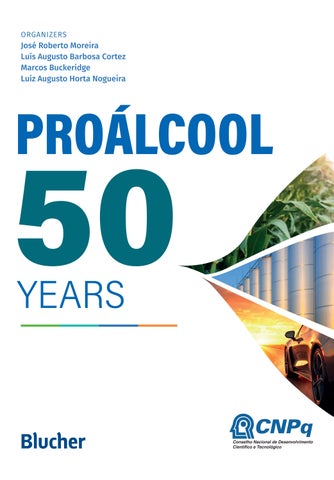
ORGANIZERS
José Roberto Moreira Luís Augusto Barbosa Cortez Marcos Buckeridge Luiz Augusto Horta Nogueira
Proálcool – 50 Years
Proálcool – 50 Years Organizers José Roberto Moreira Luís Augusto Barbosa Cortez Marcos Buckeridge Luiz Augusto Horta Nogueira
Proálcool – 5 0 Years © 2026 José Roberto Moreira, Luís Augusto Barbosa Cortez, Marcos Buckeridge and Luiz Augusto Horta Nogueira (organizers) Editora Edgard Blücher Ltda. Publisher Edgard Blücher Editor Eduardo Blücher Editorial C oordinator Rafael Fulanetti Production C oordinator Ana Cristina Garcia Editorial Producer Marcel Iha Design and layout Thiago Cordeiro Text Preparation Em ily de Moura C over Muiraquitã Editoração G ráfica C over im age Magnific
Cataloging in Publication Data (CIP) Heytor Diniz Teixeira, CRB-8/10570
Rua Pedroso Alvarenga, 1245, 4o andar 04531-934 – São Paulo – SP – Brasil Tel.: 55 11 3078-5366 contato@blucher.com.br www.blucher.com.br
Total or partial reproduction by any means is forbidden without the written permission of the publisher.
All rights reserved by Editora Edgard Blücher Ltda.
Proálcool – 50 Years / edited by José Roberto Moreira [et al.]. – São Paulo : Blucher, 2026. 160 p. : il. Includes bibliographical references ISBN 978-85-212-3157-8 (Print) ISBN 978-85-212-3158-5 (Electronic – Epub) ISBN 978-85-212-3154-7 (Electronic – PDF) 1. Biofuels. 2. Alcohol as fuel. 3. Ethanol. 4. Renewable energy sources. 5. Sugarcane. I. Moreira, José Roberto.
UDC 662.756
Index for the systematic catalog: 1. Biofuels UDC 662.756
Acknowledgements
The organization and publication of the Proceedings of the 50 Years of Proálcool event, held at the Institute of Energy and Environment (IEE) of the University of São Paulo on November 6, 2025, was only possible thanks to the financial support received from the following institutions: • National Council for Scientific and Technological Development (CNPq)
(http://portal-adm.cnpq.br/)
through
the
process
number
440066/2025-5 within Line 3: Non-Traditional National or International Events. •
Society of Chemical Industry (SCI) (https://www.soci.org/).
•
We also thank Mr. Paulo Roberto Katuni, systems analyst at IEE, for recording the event. The recordings are available on Fapesp’s Center for Ethanol Science and Development (CCD Etanol) site (https:// www.ccdetanol.feq.unicamp.br). The Organizers
Table of contents
Preface.................................................................................................................... 9 Introduction to the event Proálcool – 50 Years........................................... 13 Opening ceremony............................................................................................. 17 Session 1: Proálcool historical background................................................. 23 Session 2: Contributions from Proálcool...................................................... 49 Session 3: Present and future of Proálcool............................................................. 75 Session 4: Engines, challenges with electric vehicles............................ 105 Closing ceremony............................................................................................ 153
Preface
On November 6, 2025, the Energy and Environment Institute of the University of São Paulo (IEE-USP) held an event commemorating the 50th anniversary of Proálcool, highlighting the achievements for Brazil’s energy security and the challenges faced during its implementation. Professors José Roberto Moreira (IEE-USP), Luís Cortez (Interdisciplinary Center of Energy Planning – NIPE-Unicamp), Marcos Buckeridge (Institute for Advanced Studies – IEA-USP), and Luiz Augusto Horta Nogueira (Federal University of Itajubá-Unifei) organized and coordinated the meetings, which were attended by leaders from the sugar and ethanol sector and the most prominent experts in energy and environment. The 50th anniversary of Proálcool was also recognized at the United Nations Framework Convention on Climate Change (COP30) in Belém, Pará, as a major contribution from Brazil to mitigating the harmful consequences of greenhouse gas emissions. Thanks to renewable energies such as ethanol, biodiesel, hydroelectricity, biomethane, solar and wind power etc., cleaner sources now account for almost 50% of Brazil’s energy matrix, compared to a global average of only 15%.
In short, Brazil boasts the least polluting energy matrix in the world. Given this reality, further progress in this energy transition requires caution and great prudence to avoid increasing domestic energy costs. The higher cost of energy contributed to the premature deindustrialization of our country. The seminar discussed the present and future of Proálcool. It is a matter of utmost importance to the national economy. Fortunately, ethanol has become a commodity, given that more than 60 countries have already adopted the blending of anhydrous alcohol as an additive in gasoline. In Brazil, in my humble opinion, we should adopt a more flexible mandatory blending schedule tailored to different regions of the country. In regions that do not produce sufficient quantities of ethanol, such as the South, North and Northeast, the mandatory blending should be set at 5% to 10%. And in the producing states, it could reach up to 15%. This policy would significantly lower the final price of gasoline. In addition to this measure, the tax burden on hydrated1 ethanol should be lower than that of gasoline, keeping its price to the consumer consistently below 70% of the final price of gasoline. With the predominance of flex-fuel vehicles, there will be an incentive to expand the hydrated ethanol market while providing significant foreign exchange gains from gasoline exports. Through Proálcool, Brazil regained a prominent position in the global sugar market and need to seek more export revenues for hydrated or anhydrous ethanol through long-term supply contracts, seeking savings in logistics. We cannot forget that logistics is the second most important factor in final price formation. The national ethanol production from corn, growing at a much faster rate than sugarcane, will allow Brazil to reclaim its leading position in production. And thus, we can dream of becoming a net creditor nation, like some others, leaving a positive legacy for future generations, rather than remaining a debt-burdened country shamefully paying the world’s second highest real interest rates. Is this wishful thinking? I don’t think so. 1
Note by the Organizers: In Brazil, fuel ethanol is sold at gas stations in two forms: a) blended with gasoline (the blend as of September 2026 is E32, consisting of 68% of gasoline and 32% of anhydrous ethanol); and b) E100, which is 100% hydrated or hydrous ethanol (95-96% ethanol and 4-5% water).
10
Proálcool – 50 years
Introduction to the event Proálcool – 50 Years
Brazil is a bioenergy powerhouse and an example to the world, especially considering it is a developing nation where investment capital is scarce. The Proálcool program, in particular, demonstrates the nation’s long-term commitment, showcasing it as a state policy. Thus, after 50 years since its creation, it is opportune to remember its successes and the difficulties faced and resolved, to examine the current state of ethanol production and use in the country and the world, and to project future scenarios. To this end, we will hold an event on November 6th, 2025, to commemorate the 50th Anniversary of Proálcool and discuss scientific, technical, economic, and political aspects related to biofuels, particularly ethanol. Looking back shows how learning a technology can be important based on new facts. Since the 1930s, we have mixed ethanol with gasoline to balance sugarcane farming with the market demand for sugar. But, unexpectedly, serious economic reasons for the nation showed that the technology became of interest to the wider society and not just to a large, but restricted, agricultural group.
Exploring this economic interest, we improved the technology for producing ethanol and its co-products simultaneously with creating demand for them. To our surprise at the time, this economic interest gained new value as global concerns about global warming spread. This new fact, coupled with an already demonstrated economic alternative to fossil fuels, sparked the interest of the United States, which, possessing infinite capital, did in 10 years what Brazil did in 50 years. Therefore, the combination of an economically competitive product with its environmental qualities is the current driving force behind the success of the Proálcool program, created 50 years ago. As the environmental problem grows in importance, other solutions that compete with ethanol are emerging. All of them, so far, do not compete economically, but the abundance of capital and the power emanating from it causes society, enslaved by marketing and wealthy in only a few regions, to accept them, opening space for competition. Therefore, we have a lot of work to do, requiring capital, science, technology, and politics to be put into practice, guaranteeing another 50 years for ethanol. We intend to discuss and listen to the participants about what the future will be like after presenting our information about the past and ideas for the future. To look to the future, it is necessary to see how we achieved past success. Looking to the future, we need to discuss innovations, because, in today’s dynamic world, no static technology will succeed. We have competitors such as battery-electric vehicles, new fuels like hydrogen, and new technologies like fuel cells, which are challenging. We have examples from the past, such as the exploitation of latex and rubber production in the period before World War II, which gained importance with the war. It was a great success for several decades, and today it is summarized in the Rubber Museum in the Amazon. Abundant natural resources, favorable policies and incentives, and innovations in supply chains have propelled the country to become one of the largest producers and consumers of biomass for energy. However, the transportation sector, the largest consumer market for this biomass, is international.
14
Proálcool – 50 years
Opening ceremony Ildo Sauer, deputy director of IEE Organizers José Roberto Moreira, IEE-USP Luís Augusto Barbosa Cortez, NIPE-Unicamp Marcos Buckeridge, IEA-USP Luiz Augusto Horta Nogueira, Unifei
Professor Moreira opened the proceedings of the event celebrating the 50th Anniversary of Proálcool, recalling that we had an event in London, England, and that we will publish a book about the Past, Present, and Future of Proálcool: We must thank the National Council for Scientific and Technological Development – CNPq for supporting the event and the Society of Chemical Industries – SCI, which will publish an important book about the 50 years of Proálcool. The sessions will be presented in this sequence. We have about 70 registered participants for the event. I also thank the IEE for all the support and infrastructure given to our event. And passed the word to Professor Ildo Sauer: Thank you very much, Professor Moreira. The University of São Paulo, through this Institute of Energy and Environment, whose primary mission is to act in this broad interdisciplinary field and bring together the various contributions from the many areas that contribute to
Ildo Sauer
the complex and broad theme of energy and the environment, not only from USP, from our units, but also from outside, welcomes this initiative, which comes at an extraordinary time, the 50th anniversary of Proálcool, which was preceded, as we all know, by the initiatives of the Sugar and Alcohol Institute. And at a time when humanity is once again considering alternatives. Not everything that is debated today is entirely new. The old choices that are on the horizon and that are crystallizing are not necessarily defined. But I like to return to the beginning of the last century. We cannot forget that there was a great clash that has a technological basis that materializes what thermodynamics, the mother science, allows us to understand, but it also has a social and economic system that provides its answers and constructs trajectories, engaging in dialogue from the technological base, the base of natural resources, with the social and political system. Therefore, the trajectory of humanity is formed by this dialectic of confrontations between alternatives and the capacity of society to reorganize itself. Just remember, for example, that in 1910 there were many electric cars and steam cars, and we cannot forget that Henry Ford was a great advocate of alcohol. The first flex-fuel car was proposed by him, and he had been employed by Edison, who championed electric cars. Just to put it back in the past, when this new stage of the second phase of the industrial revolution materialized, we abandoned steam. We had the electric aspect, and we moved on to thermodynamics. Born there where our colleagues Clausius, Boltzmann, (I’m looking at [Prof. Horta] Helmholtz), all of them born in the vicinity of the University of Berlin, created the first example of a university created to build a new society. Germany, defeated by Napoleon, just like São Paulo in 1932, proclaimed: “We will win through science.” And the entire German industrial base emerged from a core of researchers. Let’s not forget that Zimedes did his doctorate there. He was later the first to leave the warmth of all our friends here and go into electromagnetism. And from there comes the industrial base that inspired the American industrial base and the reform of the English industrial base. So, energy is what allowed for increased productivity and the extraordinary increase in the world’s population. The industrial revolution that succeeded 12,000 years of agricultural revolution took us from 20 million to 700 million inhabitants. Steam power took our population from 700 to 1.7 billion in 1900. The era of electricity, internal combustion, and widespread flexible energy took us to 6.7-7 billion in 2000; now we are
18
Proálcool – 50 years
Session 1 Proálcool historical background :
José Roberto Moreira (moderator) Speakers Maurílio Biagi Filho Shigeaki Ueki José Goldemberg, IEE Roberto Rodrigues, FGV
Prof. Moreira: Let’s start with the past, and for that we invite the people who gladly accepted our invitation, who watched and participated. Let’s call on the people who participated. All of them who are here present have participated since the beginning of the program. So we will learn a lot from the past. Obviously, I think we must remember more than just what happened before. And we
José Roberto Moreira
must thank CNPq, which financially supported this project. We must thank the Society of Chemical Industry (SCI), which is funding and will publish the book I already mentioned. Speaking of books, we see that, fortunately, and with great joy, we had other competitors. I just received from Minister Ueki a work done here at USP by a professor in the History department of the USP History Institute, which also talks about Proálcool. It’s been 50 years of Proálcool. It’s very good to see that not only we, but many people remembered the fact. Let’s culminate here today by
learning something, looking at the past and then arriving at the future. Undoubtedly, we cannot say that the future is truly a continuation of the past, but it depends a lot on the past. So, for this first session, I would like to compose the table and I will then call Dr. Maurílio Biagi Filho to sit down. Then we have Professor José Goldemberg, Minister Shigeaki Ueki and Professor and former Minister Roberto Rodrigues. Let’s begin, then, by asking for the collaboration and participation of Dr. Maurílio Biagi Filho. As I said, like everyone here, he participated in the alcohol program from the beginning. And his activity in the area began in 1956 at the Santa Elisa Sugar Mill, where he ended up being its president. He also had a very intense participation in the industry that strengthened and allowed Proálcool to advance. He was the director of the very famous Zanini Industry and SERMATEC, both manufacturers of equipment for the sugar and ethanol sector. He was also president of the Agroenergy and Biofuels Committee of the Brazilian Rural Society and a major businessman in the sugar and ethanol sector. He received several awards, both national and international. Currently, still in public life, he participated as a member of the Economic and Social Development Council of the Presidency of the Republic, a member of the Brazilian Association of Basic Industries, and the American Chamber of Commerce, Amcham. And, obviously, as could not be otherwise, he was very active in UNICA. Very well. So, Dr. Maurílio, let’s start by asking for your opinion on the following: Did the Proálcool program begin with the government, or was it the business sector? Mr. Maurílio Biagi Filho has the floor: First of all, good morning, everyone. I wonder what I’m doing here with Professor Goldemberg, with Minister Ueki, with you, Roberto, with Ildo, with Cortez, and with Professor Moreira. These are people who have made an extraordinary contribution and have extraordinary merit, people who really made all this happen. For something I won’t mention, and then Ueki, Goldemberg, and Roberto will certainly be able to complement everything I say here.
24
Maurílio Biagi Filho
Proálcool – 50 years
Session 2 Contributions from Proálcool
:
Marcos Buckeridge, Instituto de Biociências and Vice-Director to Instituto de Estudos Avançados da USP (moderator) Speakers Lamartine Navarro Neto, Alcídia Mill Luiz Carlos Corrêa de Carvalho, Canaplan
Professor Buckeridge opened the proceedings of Session 2 of the 50th Anniversary Celebration of Proálcool: Ladies and gentlemen, let’s continue with our event. I am Marcos Buckeridge, a professor at the Institute of Biosciences and vice-director of the Institute for Advanced Studies-IEA at USP. Minister Shigeaki Ueki previously mentioned an institute for advanced studies, and indeed, we have one.
Marcos Buckeridge
You are invited to visit us. Our focus is precisely on the connection between science, public policy, and society, and we have ongoing programs dedicated to this interaction. It will be a pleasure to exchange our contact information later, as your experience in building a working group at the University of São Paulo would be extremely valuable.
Returning to the discussion: when we talk about ethanol, it’s impossible not to recognize that its trajectory in Brazil has been marked by cycles of advances and setbacks. In fact, this movement accompanies the very history of sugarcane since its introduction by the Portuguese: first as the basis of the sugar economy, then occupying a central role in the oil crisis. From the beginning, this crop has been subject to political, economic, and technological fluctuations. It is important to remember that the biochemical basis of the fermentation process we use today derives from the pioneering work of a German professor, Eduard Büchner, a Nobel laureate in 1907, considered one of the founders of modern biochemistry. He was the first to systematically study fermentation, using yeast to transform sugars into ethanol and to describe the chemical reactions involved. All our fermentation technology derives from this knowledge developed in the late 19th and early 20th centuries. And here in Brazil, we had some decisive figures. Professor Amorim, whose son, Henrique Amorim, is here today, played an absolutely essential role in the development of yeast strains adapted to our industrial reality. Amorim Sr., a graduate of ESALQ, founded his own company— Fermentec—which remains a benchmark to this day. Thanks to his work, we now have yeasts capable of surviving increasingly higher levels of ethanol, which has significantly increased the efficiency of large-scale industrial processes. In the previous session, we discussed the emergence of Proálcool. I recently wrote an international article on the institutional history of Brazilian ethanol1 — deliberately avoiding personalization to highlight how institutions in Brazil emerge, disappear, and re-emerge. This institutional 1
Grandis, A.; Fortirer, J.S.; Pagliuso, D.; Buckeridge, M.S. (2024) Scientific research on ethanol in Brazil: History and prospects for sustainable biofuel. S ustainability, 16, 4167. https://doi.org/10.3390/su16104167
50
Proálcool – 50 years
Session 3 Present and future of Proálcool :
Luís Augusto Barbosa Cortez, Unicamp (moderator) Speakers Henrique Amorim, Fermentec Guilherme Nolasco, UNEM Plínio Nastari, Datagro
Professor Cortez has the floor: Let’s begin Session 3 of the 50th Anniversary celebrations of Proálcool. This morning, we had the first session on history and the second session on the contributions of ethanol and Proálcool to Brazil, and then, the last session of the day will be about engines, about the issue of engines. This Session 3, to talk about the Present and Future of Proálcool, is not by chance the reason we chose three references: 1.
Luís Augusto Barbosa Cortez
Guilherme Nolasco is the president of the National Union of Corn Ethanol-UNEM,
2.
Plínio Nastari probably owns one of the largest market research consulting firms in the sugar and ethanol sector in the world, and
3.
Henrique Amorim is the owner and president of Fermentec. Fermentec is probably one of the most successful companies in the sugar and ethanol sector in Brazil.
I’m including this photo to show Mr. Maurílio Biagi, father of Maurílio Biagi Filho, who was here this morning speaking at the first session. Mr. Lamartine Navarro Júnior, father of Lamartine Navarro Neto, and President Ernesto Geisel. This photo is emblematic, as Lamartine mentioned today. Businessmen prepared the report “Photosynthesis as an Energy Source” and personally delivered it to President Geisel. This is considered the starting point of the National Alcohol Program. After you see the Proálcool decree, you’ll say: “My God, but how much the report resembles the decree,” it’s very interesting. Then, the so-called “learning curve” that Professor Goldemberg already mentioned—this is something I think is very important to say here, Nigro. It’s important to say that bioenergy, and ethanol in particular, depends on three efficiencies: •
76
agriculture,
Proálcool – 50 years
Session 4 Engines, challenges with electric vehicles :
Luiz Augusto Horta Nogueira, Unifei (moderator) Speakers Henry Joseph Junior, Anfavea Francisco Nigro, Poli-USP Waldyr Luiz Ribeiro Gallo, Unicamp Ricardo Simões de Abreu, UNICA
Opening Remarks Prof. Horta: Good afternoon! Those who have been here since this morning know that we have rarely had such dense discussions with people so capable and experienced with the Proálcool program. Now, in this last round table, we will continue in the same vein, focusing now on the use of ethanol. The alcohol program in Brazil has always been the subject of many studies, and, possibly, there is no energy program in Brazil as thoroughly evaluated as Proálcool. There are volumes and volumes of documents, and today we had a “revival” of all of that here. It was very timely, very enriching. Now we will conclude by calling the next speakers, whom I ask to be strict about the time, as I have been instructed to be strict about this. I will call them in the order in which we will have the presentations here. The first speaker will be Professor Nigro, who needs no introduction. He is an active member of IPT, a professor at the Polytechnic School, and a long-time respected researcher in combustion engines. Professor Waldyr Gallo was my right and left hand at ANP for many years. He is a professor at Unicamp, in the Mechanical Engineering and Energy Planning Programs.
Next, we will have Ricardo Abreu, who was a professor at Mauá, worked in companies in the automotive sector, and is currently a researcher and consultant with extensive experience in engines. And to conclude the presentations of our round table, we will have Henry Joseph Júnior, who worked for a long time at Volkswagen, including as Technological Director, and is now the Director of Sustainability and Energy Transition at ANFAVEA. Truly a team of engine experts who have closely followed the evolution of Proálcool. To begin our assessment and contextualize the issues we will explore, it is interesting to recall the chain of three energy conversion processes with which Professor Cortez aptly summarized the energy systems of the modern world: •
capturing energy available in nature,
•
obtaining an energy vector, and
•
converting that energy vector into useful energy.
In the case of ethanol used for transportation, this chain of processes begins with the fascinating process of photosynthesis, which, using solar radiation, water, and CO2, produces biomass, a raw material
that stores energy. The second process, involving reactions such as fermentation, uses biomass to produce ethanol, which finally, through combustion engines, allows vehicles to move, transporting people and goods. It is this third phase of this process that we will discuss now. Indeed, we are at an interesting moment in the global energy landscape, where we can see a clear and relevant energy transition in the
106
Proálcool – 50 years
Closing ceremony Organizers José Roberto Moreira, IEE-USP Luís Augusto Barbosa Cortez, NIPE-Unicamp Marcos Buckeridge, IEA-USP Luiz Augusto Horta Nogueira, Unifei
Professor Moreira has the floor: Well, really, from what I heard here at this roundtable, I wanted to first thank Ricardo Abreu, who suggested an excellent master’s thesis to me. Thank you very much. I’m really going to talk to him. I already have a student, so I’m leaving here, and I’m going to talk to him to do the calculations for the temporal accumulation of emissions. Imagine China with 650 g of CO2, its elec-
José Roberto Moreira
tricity emissions. And the government doesn’t, but it doesn’t matter. Right now, I’m cleaning up the city, and then I’ll reduce emissions from the sources, right? We’re going to make electricity sustainable, and then everything will improve. But we can do a calculation to see what this is costing the world. So, thank you very much. The other question I had with
the king, this sustainable fuel, is this hydrogen that is not organic, does it go through green hydrogen, is there no other way out. Background conversation: There are the synthetics, those synthetics from the war. Professor Moreira says: That’s right, hydrogen. What is the cost of a ton of CO2 avoided from a fuel? US$1000 per ton. A
cheaper option is US$ 500 per ton. We do it here for US$ 65… But the discourse changes, doesn’t it? Because at the G20, André Corrêa do Lago, our ambassador, fought hard. The Germans wanted hydrogen to remove bio, to keep what is bio without putting bio in front. It all became sustainable fuel. It’s implicit there, like SAF. People didn’t want SAF to be called aeronautical biofuel, so it became SAF. It’s the same thing. Well, then, I thank the audience for being here, and I am very grateful to the speakers who were here, right? In fact, in the first session I felt extremely honored. I think USP felt honored by the presence of three ministers here. I’m biased because of like the colleagues here who worked to put together this seminar, right? But my impression is that we had positive results, okay? I learned a lot, we were able to communicate a lot, and I’m very satisfied with the whole organization, aren’t we? I want to personally thank the Institute of Energy and Environment, to which I belong, for the service they provided here, not only in the coffee and snack part, but also in the preparation, the invitations that were sent, and everything. I’m very grateful to the colleagues who collaborated here to put this seminar into operation, especially my friend Cortez, whose knowledge of the community is impressive. I put 20 names on the guest list; he must have put 120. So, thank you very much. Professor Horta has the floor: Well, thank you all. I imagine someone else wants to speak. To be honest, you know that when you’re moving and taking a piano, for example, there’s a group that does the hard work, and another group that stays behind, helping out. I was in that last group, because the three of you here worked much harder 154
Proálcool – 50 years
PROÁLCOOL 50 YEARS PROÁLCOOL ■ ETHANOL ■ ALCOHOL ■ BIOFUELS ■ BIOMASS
This book offers a synthesis of the event celebrating the 50th anniversary of Proálcool, a landmark federal initiative launched in response to the 1970s oil crises. The first session features presentations by Maurílio Biagi Filho, sugarcane sector entrepreneur; Shigeaki Ueki, former Minister of Mines and Energy; and Roberto Rodrigues, former Minister of Agriculture. The second session covers contributions from Luiz Carlos de Carvalho (Abag) and Lamartine Navarro Neto. The third session presents insights from Plínio Nastari (Datagro), Henrique Amorim Neto (Fermentec), and Guilherme Nolasco (Unem). The fourth and final session includes perspectives from Henry Joseph Jr. (former Anfavea representative), Ricardo Abreu (Unica), Waldyr Gallo (Unicamp), and Francisco Nigro (Poli-USP).
What you will find in this book: • History of the National Alcohol Program (Proálcool). • Insights from key figures involved in the program’s creation. • Involvement of industry entrepreneurs and the automotive sector. • Overview of the program’s evolution to the present day. • Current status, opportunities, and future challenges. • Key impacts on the Brazilian economy.
Explore our catalogue at:
. com.br
On November 6, 2025, the Energy and Environment Institute of the University of São Paulo (IEE-USP) held an event commemorating the 50th anniversary of Proálcool, highlighting its achievements for Brazil’s energy security and the challenges faced during its implementation. The seminar discussed the present and future of Proálcool. The sessions brought together leaders from the sugar and ethanol sectors and the most prominent experts in energy and environment. Shigeaki Ueki Minister of Mines and Energy (1974–1979) and president of Petrobras (1979–1984)