DESERT HERITAGEMagazine
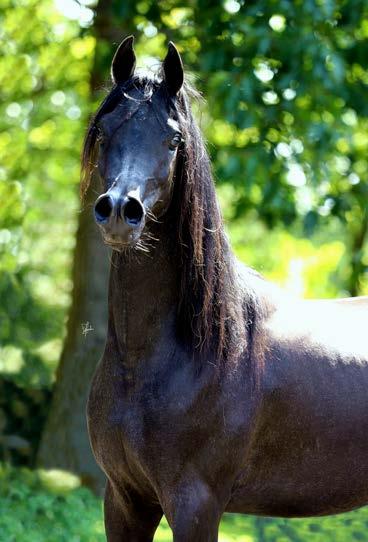

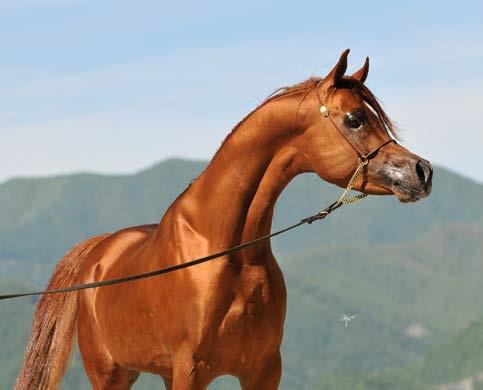
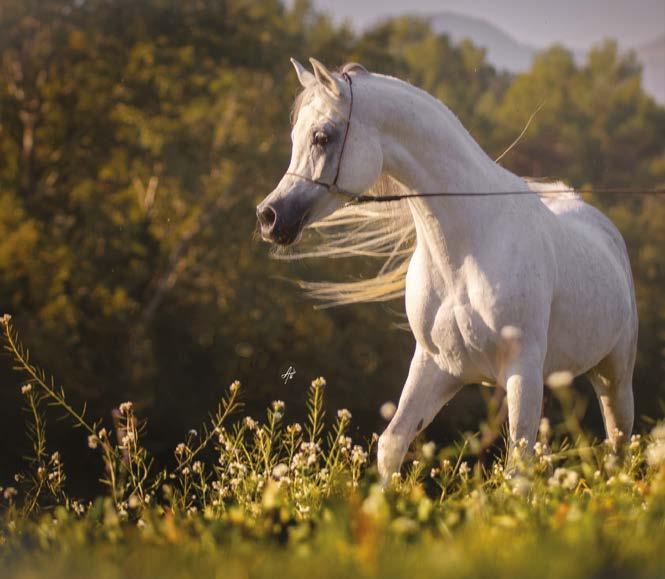
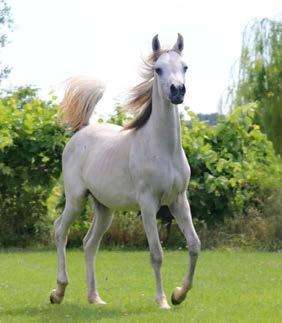
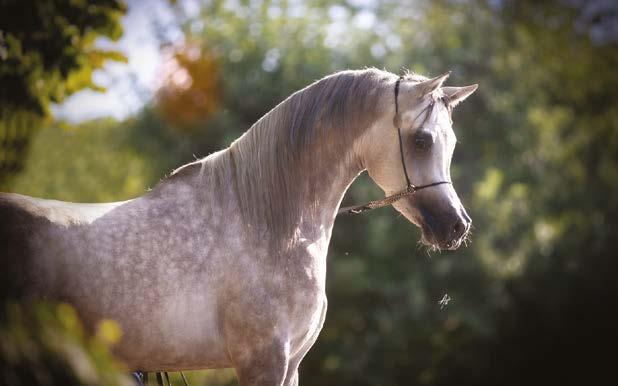
photo by Gregor Aymar
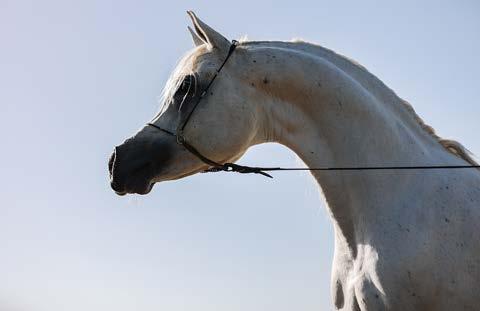
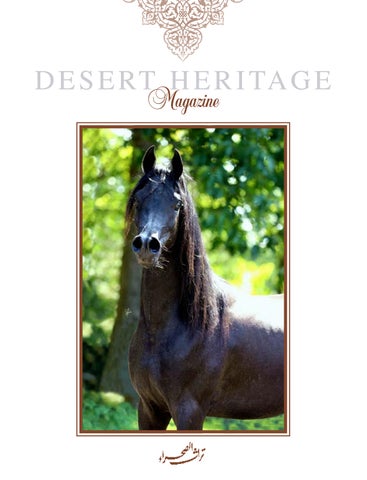
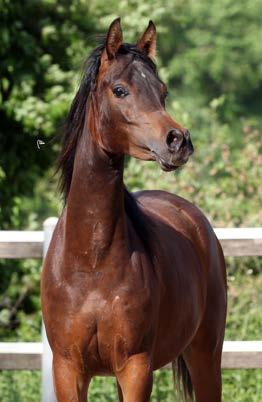
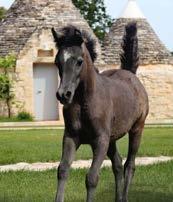
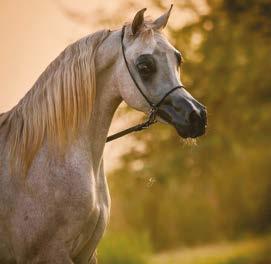
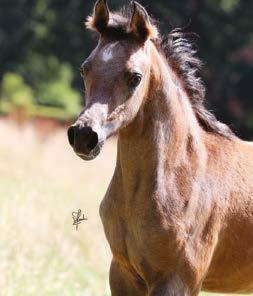
Frasera Mashar x Frasera Bint Nefisa
2012 Hadban Enzahi

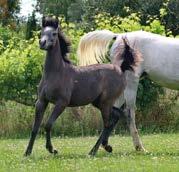
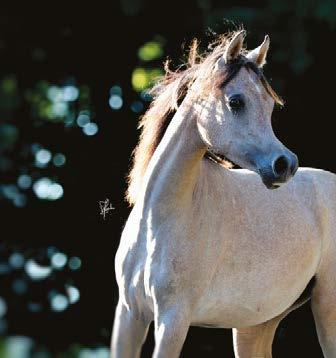
Nabeel al Rayyan x Frasera Mashalla
2017 Kohailan Radban
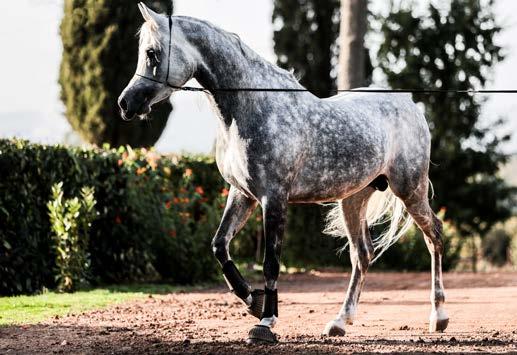
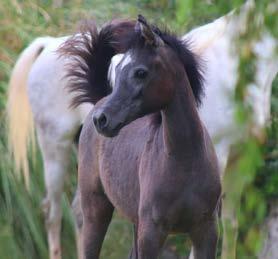
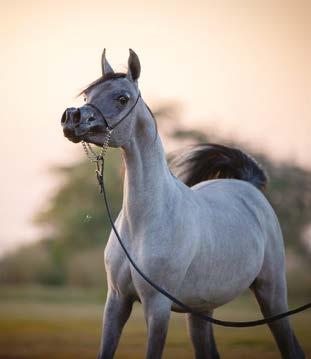
Pharros x Frasera Mashara
2008 Kohailan Radban

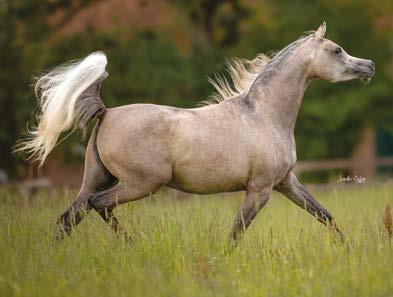
Al Ayal AA x Frasera Madalla
2020 Kohailan Radban
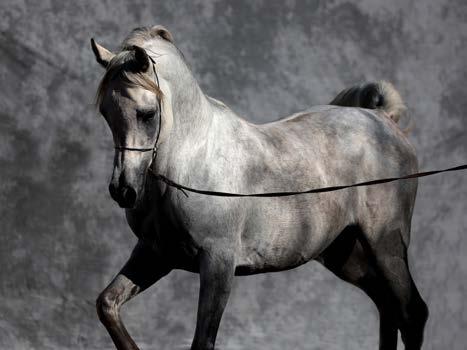
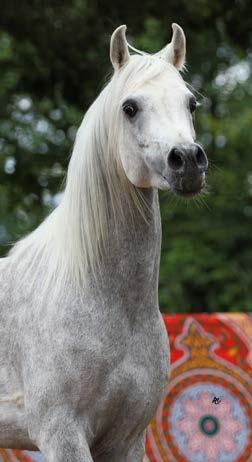
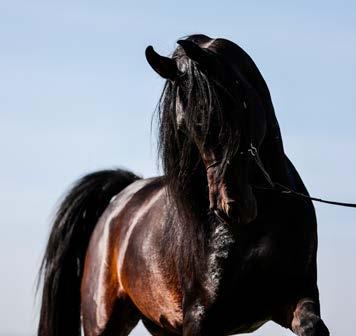
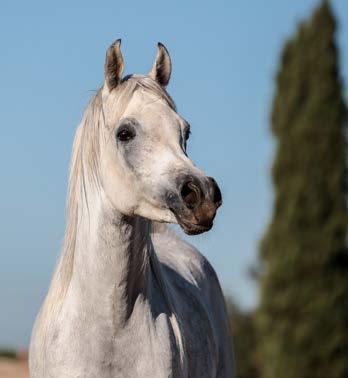




Frasera Mashar x Frasera Carina
2020 Dhama Shawan
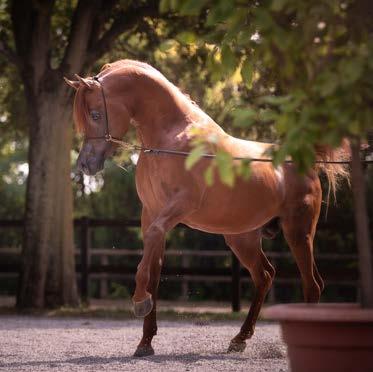
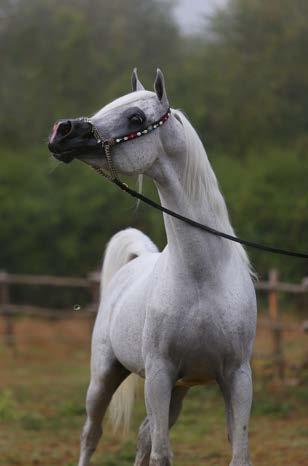
Frasera Ramses Shah x Fasera Wasima 2008 Hadban Enzahi
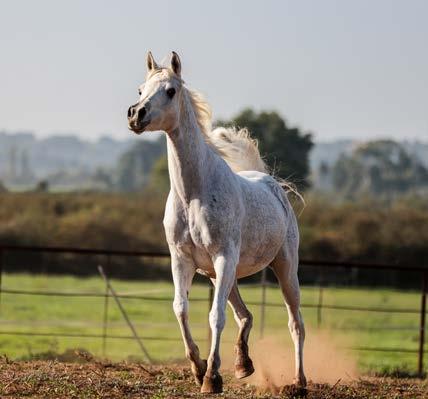
LA FRASERA
Straight Egyptian Horses



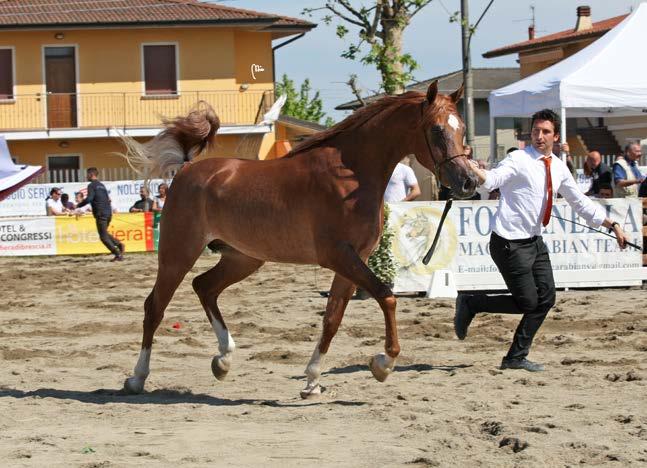
Frasera Mashar x Frasera Bint Nefisa 2013 Hadban Enzahi
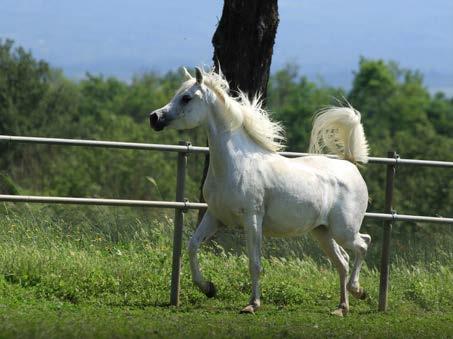
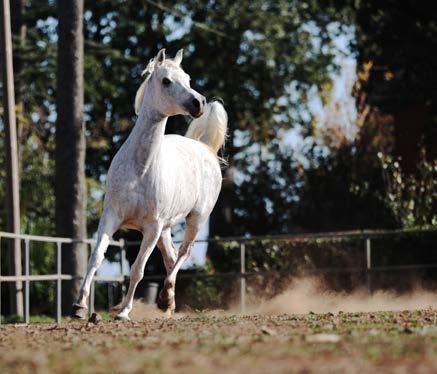
Frasera Mashall x Frasera Madara 2013 Kohailan Radban
Frasera Mashar x Frasera Futura
2013 Dahamah Shawan
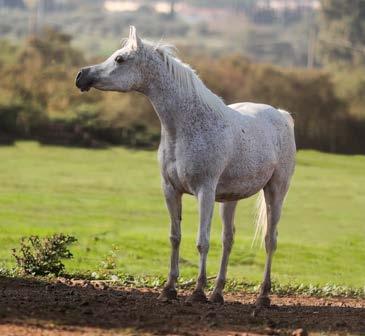
Frasera Mashall x Frasera Magica
2012 Dahamah Shawan


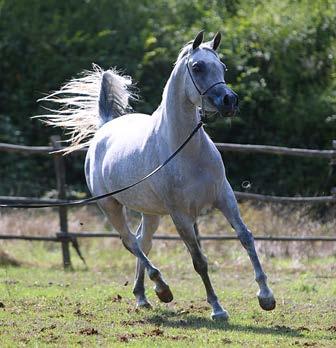
Shahil x Imperial Beveerah
2013 Saqlawi Jedram Ibn Sudan
2017 Kohailan Radban
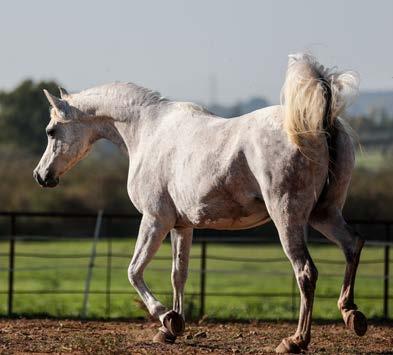




Fa Medu Neter | Egyptian Asinah
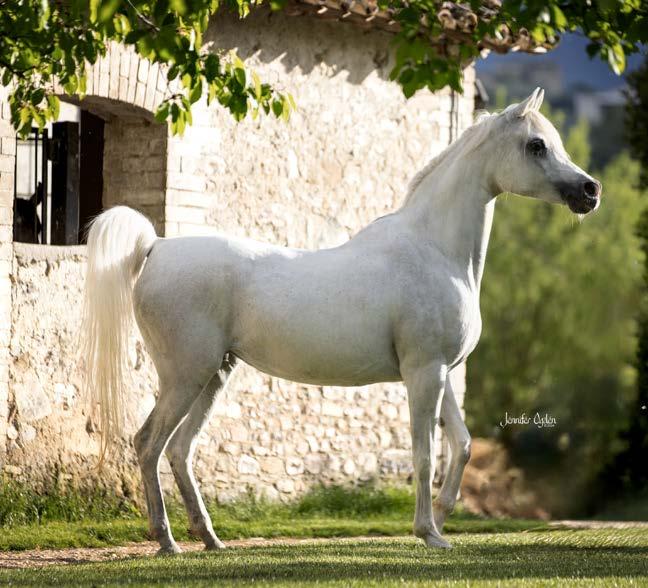
Straight Egyptian Mare
Siglawy Jedran Family





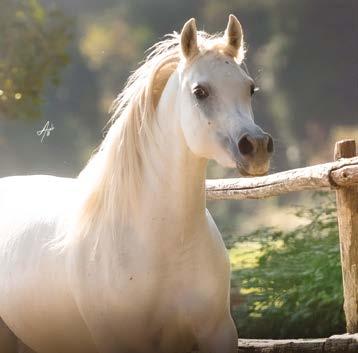
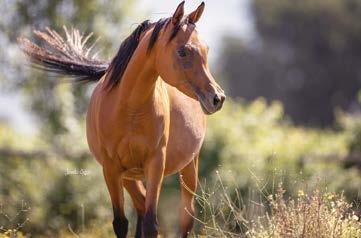
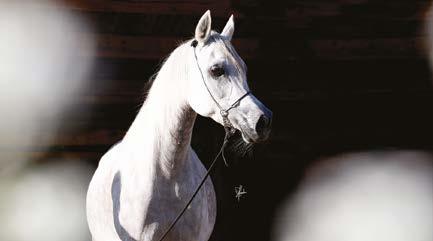
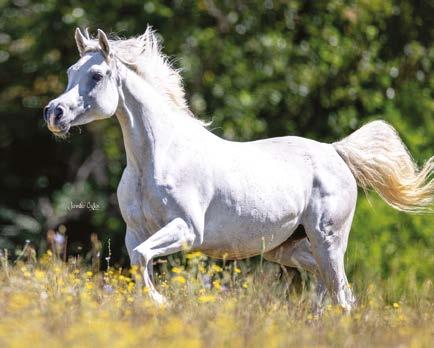
insha safrahna *2015 MiaD al ShaqaB x SiMEON SaricE
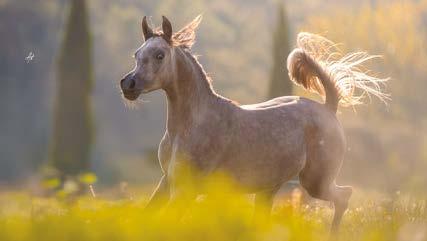
a mira al m ura D *2024
Ma NSO ur a l Mura D x r a Dali Daa
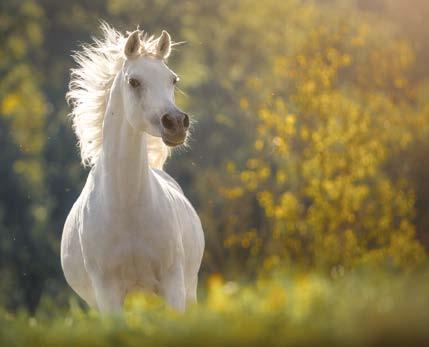
mayfouza al mura D *2016 El Thay Mahf O uz x MaySO u N a h ali Ma
Nader Halim x El Thay Konouz
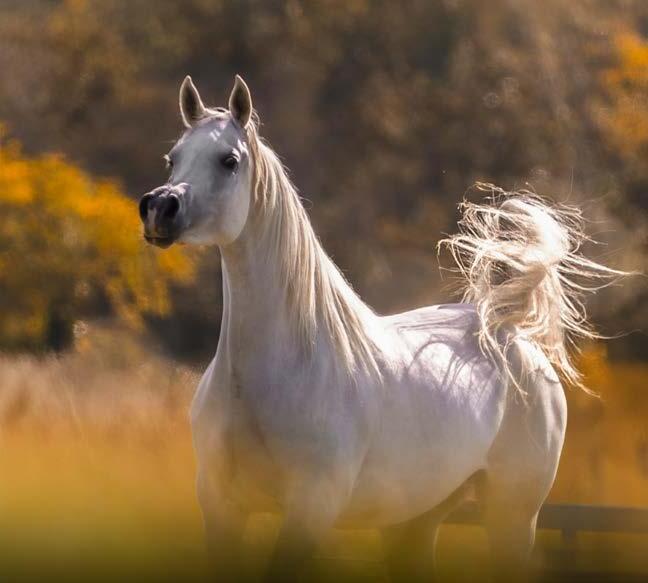
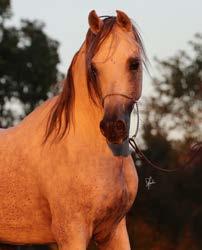
2015 Straight Egyptian Grey Stallion - CA/Scid free
“Protect
2026 Breeding Season
your future, don’t forget the ancestors”

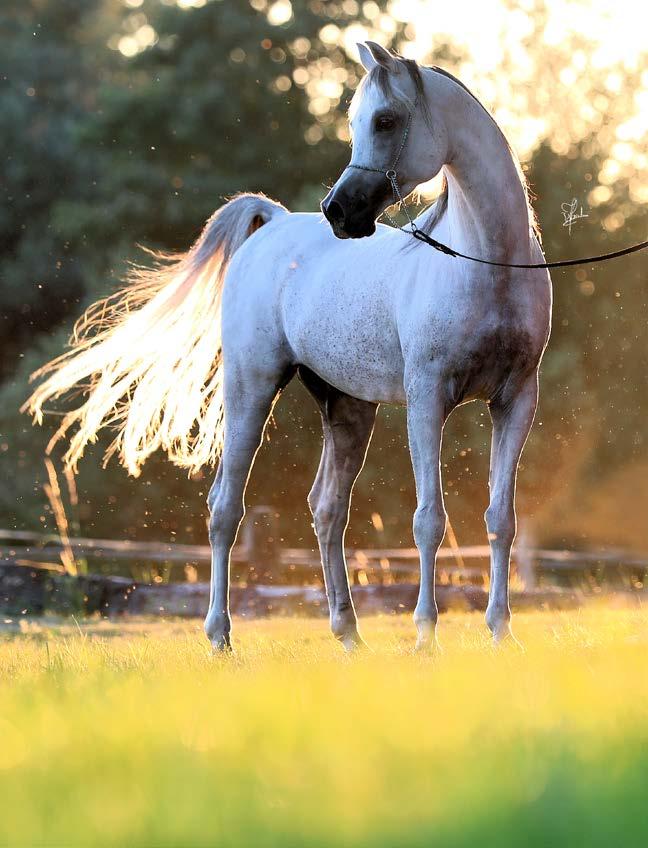


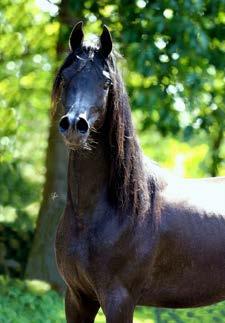
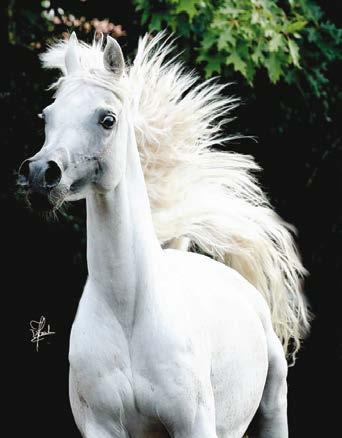
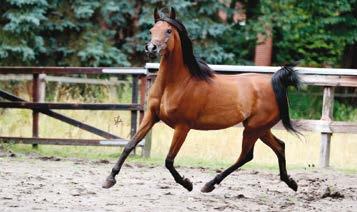
This young stallion, NK Lam el Dine, two and a half years old of the Siklawi family, will start his breeding career in our closed studbook in March 2027.
He has been chosen to further strengthen the solid leg and body conformation and to guarantee that the lightness and elegance of the NK Arabians is transmitted to following generations.
Hans J.Nagel
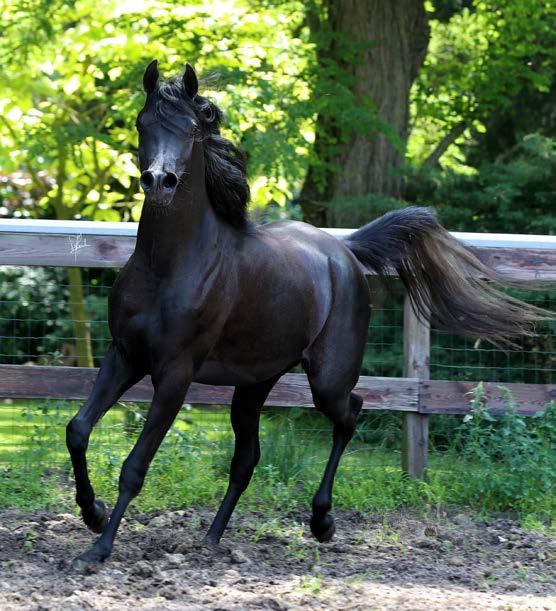


NK Katharinenhof - Dr. Hans J. Nagel
Am Graeberfeld 15 - 26197 Grossenkneten - Germany
ph.: +49 4433 15 35 - office@nk-arabians.de




Desert Heritage Magazine n.73
iscr. trib. di Milano n. 466 del 20/09/02 Expedition in A.P. 70% Milano
Alim Editrice s.n.c. via Ressi, 22 - 20125 Milano (Italy)
e-mail: info@tuttoarabi.it www.desertheritagemagazine.com instagram: @desertheritagemagazine
Publisher Simone Leo mobile: +39 348 5640190 leo.simon@tiscali.it
Editor Alim Editrice snc
Customer Service Fabio Brianzoni fabiobrianzoni56@gmail.com
Account Office/Subscription Office Barbara Belloni amministrazione@alimeditrice.it
Writers Alicia Midgett Hans J. Nagel Monika Savier
Gudrun Waiditschka Judith Wenning
Editing Susan Carden
Digital Artwork Viviana Castiglioni
Printed by AGF Printing Solutions Srl San Giuliano Milanese Milano (Italy)
Advertising
Alim Editrice s.n.c. via Ressi, 22 - 20125 Milano (Italy) tel. +39 02 36762850 e-mail: info@tuttoarabi.it
©
www.desertheritagemagazine.com

Pag. 34 Louis Damoiseau & Jules de Portes
Pag. 48 Nagel’s breeding aims and its historical roots. A guide in turbulent times
Pag. 72 Will the Arabian Horse become a product of the laboratory, or will it remain a masterpiece of nature and tradition?
Pag. 76 Wadi Al Nasmat.
Breeding Straight Egyptian Arabians in the USA
Pag. 90 Are we still breeding or are we just multiplying?
Inerview with Andreas Perner
Pag. 114 An obituary for Peter Smith

Majd Al Qusar is a stallion with ‘star quality’. This is evident in his nobility, charisma and gentle nature, and in his beautiful offspring.
This stallion is no genetic fluke; he is the product of a successful breeding programme developed over the last 30 years by his breeder, Robert Schlereth, at Al Qusar Stud. Fresh semen available.
ld al Faisal

alqusar@aol.com - robert-schlreth@web.de



tre balzane stud | Home of e gyptian a rabian Horses
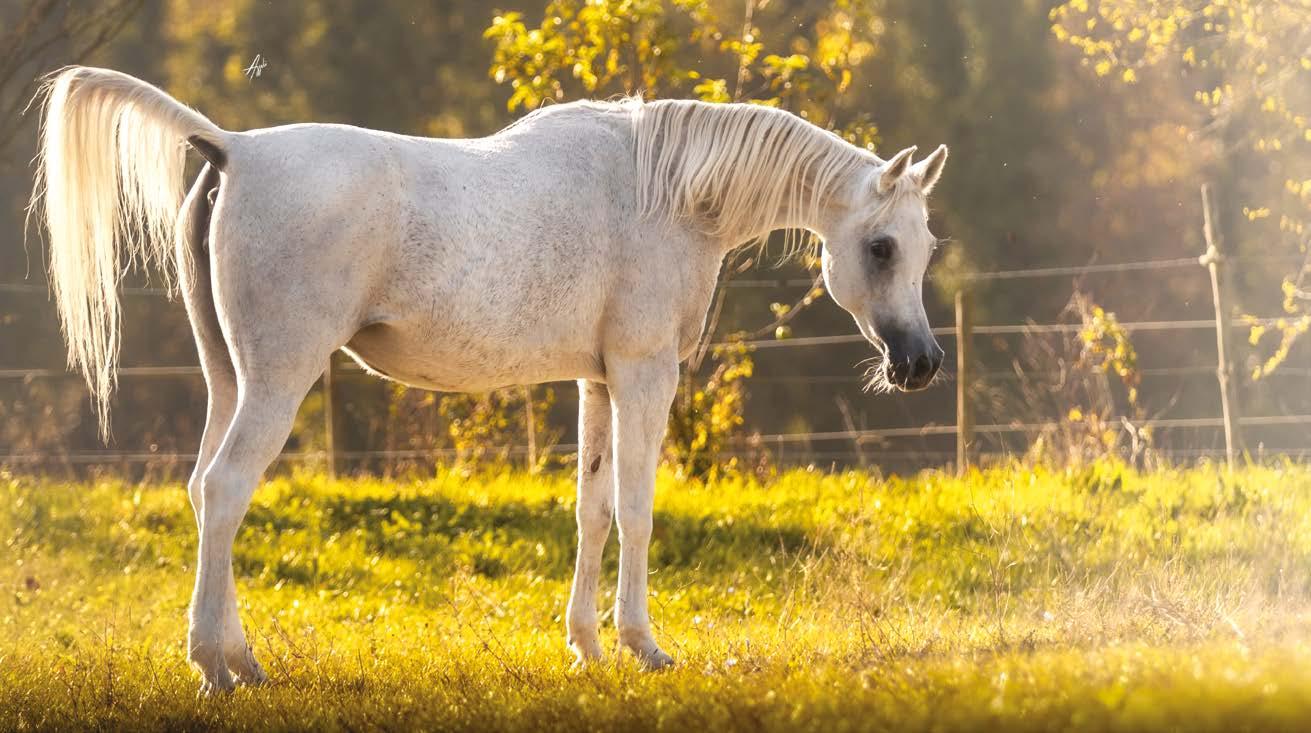
TB Helwa by Ibn El Nil is undoubtedly the most internationally successful of the three beautiful sisters from the Obayan line at the Tre Balzane stud. Like TB Heba and TB Hejaziya, she is a daughter of TB Hasna, who traces back via Sulifah to the Obayan mare Marah. Marah was imported to Germany by Dr Nagel from El Zahraa and founded her own successful dam line. Ibn El Nil was sucessfull in racing and showing. We imported him from Cairo to Italy in 2006.
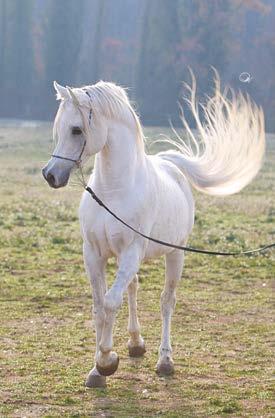
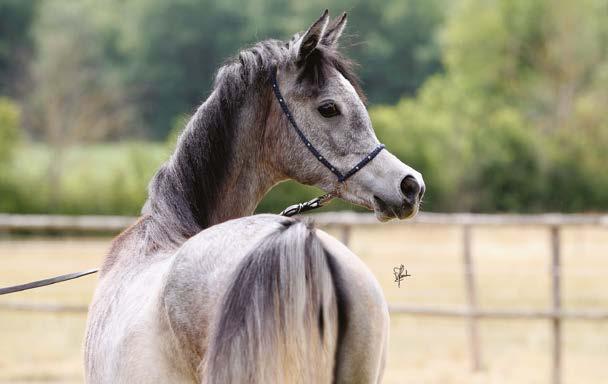
For a long time, TB Faysa by Jamil Al Rayyan was TB Helwa’s most famous daughter. Faysa had it all: charm, conformation and gaits and she won shows. At the age of three, she was purchased by a member of the Al Thani Royal Family in Doha, Qatar. Two years later, her full sister, TB Haya, was born; once again, the mating with Jamil Al Rayyan had worked
perfectly. She, too, was sold to the Al Thani royal family and moved into her stall at Doha Stud. She enjoyed success at shows and is a fine broodmare.
The elegant and typey bay mare Hayat Al Salem by Naseem Al Rashediah is her last daughter to date. She is owned by Al Salem Stud from Israel, which moved to Jordan this year.
TB Helwa has not only produced outstanding fillies, but also very handsome colts. In 2018, the magnificent TB Farouk by Jamil Al Rayyan was born. He is now a successful stallion at LG Arabian Stud in Albania. Three years later, the outstanding TB Hadir by Naseem Al Rashediah was born. He is owned by the Palestinian-Italian breeder Mr Usama Al Gaith and has won various championship titles at shows. He is standing at Costa Arabians in northern Italy.
The following year, TB Haydar by Jamil Al Rayyan was born. He closely resembles his two full sisters, TB Fayza and TB Haya, and is now owned by the Jordanian Mr Abed S Burqan of El Salim Stud. He, too, has won various championship titles at shows.
This year, TB Helwa is in foal to Hilal Al Waab (Sinan Al Rayyan x Sharubi HP). With this cross, our wonderful mare will give us another excellent foal.
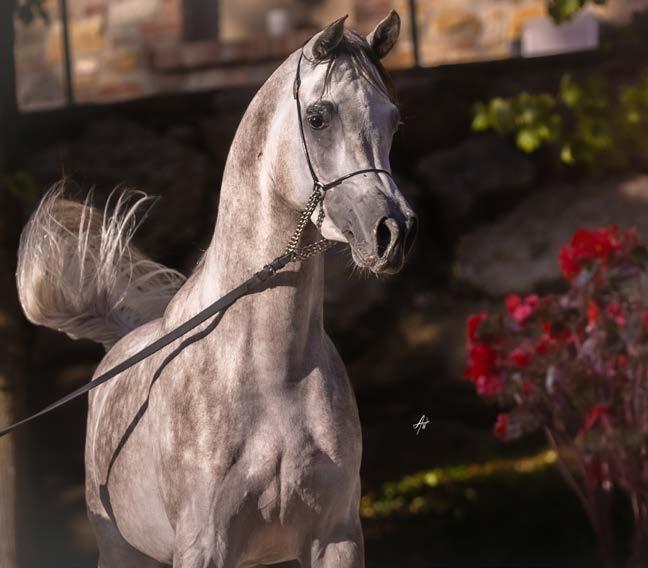
HayDaR
MONIKA SAVIER

06044 Castel Ritaldi, Umbria - ITALY e-mail: savier@arabi-egiziani.it - Phone: +39 335 5235135 www.straightegyptians.it
Bronze
Gold
Bronze




2019
Gold Champion Seniore Stallions
4th Qatar Nat. Arabian Peninsula Horse Show
Bronze Champion Senior Stallions
9th Qatar Int. Arabian Peninsula Horse Show
2017
Silver Champion Jr Colts - Egyptian Event Europe
Gold Champion Jr Colts - SE World Championship
2016
Gold Champion Jr Colts - Qatar Int. SE Horse Show
Gold Champion Yearling Colts - Egyptian Event Europe
BREEDING SEASON 2026
Sinan Al Rayyan | Sharuby HB
2015 Straight Egyptian Stallion
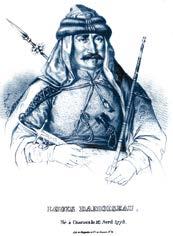
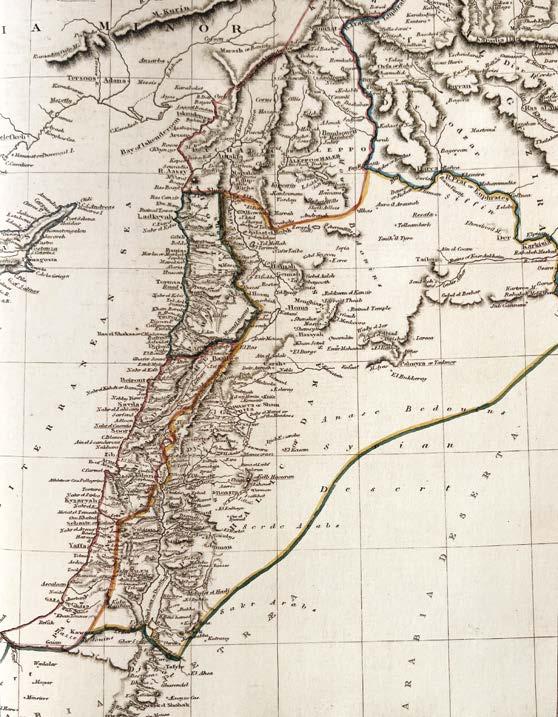
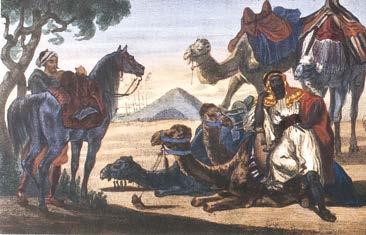
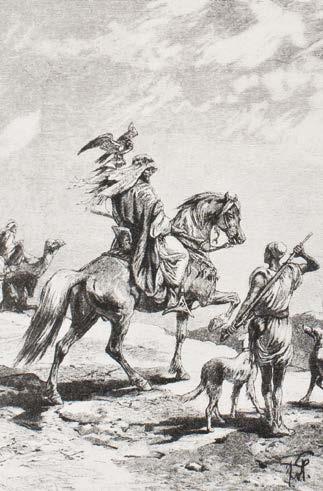
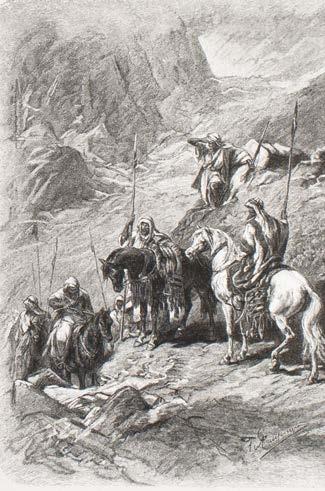
One of the first major purchases for France was made by Jules de Portes and his vet, Louis Damoiseau, in 1819–1820. They returned with around 36 stallions and one mare, including the stallion Massoud and the mare Nichab. Damoiseau described the adventures they experienced whilst purchasing these horses in his book “Voyage en Syrie et dans le Désert”.
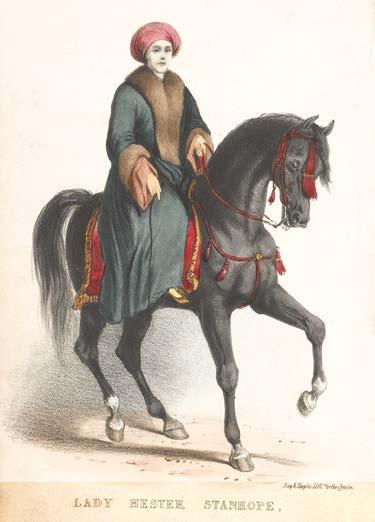
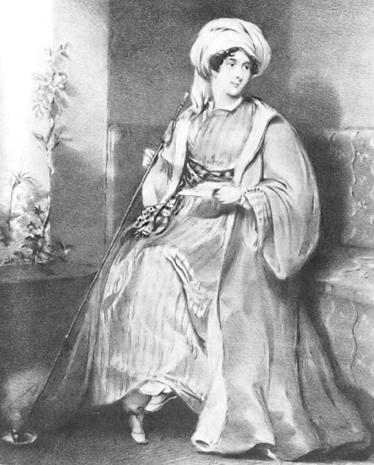
Strictly speaking, Nichab’s illustrious history began even before Messrs de Portes and Damoiseau set out on their purchasing mission, as she was born in Lady Hester Stanhope’s stables in Lebanon. Lady Hester was an Englishwoman of noble birth who had found her way to Lebanon. She lived there from 1810 onwards in the abandoned mountain monastery of Abra until her death, and was known as the ‘Queen of the Desert’ and the ‘Mystery Lady of the Orient’.
Louis Damoiseau described his first encounter with Lady Stanhope in his work *Voyage en Syrie et dans le Désert* (1833) as follows: ‘At last I reached the monastery where the Queen of Palmyra lived. She was sitting in a pavilion and had recognised me from a distance as a European, despite my Turkish attire. Lady Stanhope approached me, dressed like a Bedouin sheikh, but in a far more magnificent costume than was customary for these
desert princes. After exchanging pleasantries, she led me into a small room furnished only with cushions, where we took our seats. Pipes were brought; Milady took one, offered me another, and whilst we smoked, we began to converse. We were then served an Arabic meal; I ate it with the appetite the journey had given me. Milady, who did not drink alcohol herself, had Cypriot wine and Goldberg wine served to me. Both seemed excellent. Finally, after further lengthy conversations on various topics, and as it was
already late, I retired to the room that had been prepared for me. The next day I rose early; Milady was not yet to be seen. Whilst I waited for her, I checked on her horses. At about ten o’clock in the morning, she emerged from her tent, which stood on the terrace of the building, and came to me to enquire after the condition of her favourite horse, which was lame. It was a horse of consummate beauty. The ailment from which it suffered could be cured quickly. I assured her of this and explained the necessary steps, which seemed to give its mistress great pleasure. She had received this horse from a sheikh named Nasser, who belonged to several tribes encamped near Damascus and Palmyra. Following this examination, Milady showed me several mares, including a magnificent foal that was being particularly well looked after and of which several Turkish ladies claimed it could only be ridden by the greatest warrior in the world. They had recognised the foal’s destiny by certain characteristics.
Milady believed them and resolved to present such a gift to Napoleon. However, the birth of a foal destined to become even more beautiful prompted her to change her plans. The latter was favoured, and the former was handed over to Monsieur de Portes when we were ready to return to France.
Upon our arrival in Paris, it was purchased by the Duchess of Angoulême and is today, under the name Nichab, one of the treasures of the Haras du Pin stud farm. I also noticed another foal, about two years old, at Lady Stanhope’s, whose back was as hollow as a Turkish saddle and whose loins were arched downwards. In Milady’s eyes, these faults seemed to be a mark of perfection; she told me that this mare came from a family whose lineage could be traced back to the horses of Solomon’s studs; that this breed was exceedingly rare and precious; finally, she concluded that such a horse could only be worthy of one of the greatest rulers on earth.
‘That is why,’ she continued, ‘I intend to send it to the King of Rome [Napoleon’s son]. Like Nichab, this horse possesses qualities that foreshadow the honour I intend to bestow upon him.’ I also saw many horses, some of which caught my attention to a greater or lesser extent. Among them was a small dark-brown mare whom I
By Gudrun Waiditschka
later recognised in Paris: she was a gift from Milady to Mr Houay, an English Protestant minister. I spent the whole day at Lady Stanhope’s palace, whose peculiar manner
offered my observations the most astonishing mixture of grandeur and superstition that it had to offer.” We find the rest of Nichab’s story in Eugène Gayot’s treatise *La France
chevaline* (1850): “The story of Nichab caused quite a stir in Paris. Both the court and the city showed equal interest. The Duchess of Angoulême saw the newly arrived mare; she took a liking to her and purchased her. For a sum of 6,000 francs, Nichab passed from the hands of M. de Portes into the stables of Her Royal Highness. Her nobility and gentleness, her grace and beauty soon made Nichab a favourite. Everyone vied to provide her with care and attention. The stablemaster of Madame la Dauphine stepped forward and courted her favour.
The prediction comes true Everything went wonderfully, as long as it did not involve getting into the saddle. All the preparations
seemed to disprove the prediction; the preliminary work had been endured with the utmost good grace. Everything was going splendidly, and people were already laughing amongst themselves at the precautions that had been taken and the wise patience that had been deemed necessary so as not to offend the habits of freedom that had begun on the day of her birth. Nichab’s docility was unparalleled; it seemed as though the intelligent mare were literally inviting the rider to mount her, so effortlessly did she wear the gleaming bridle that had been fitted to her. But when the stablemaster, having adjusted the reins, tried to place his foot in the stirrup, Nichab made a movement that no one knew or had ever seen before, and promptly and completely
threw the daring rider off. He tried again, but in vain; his patience bore no fruit, his perseverance led nowhere, and his stubbornness met its punishment. Others came to try their luck, and were just as unsuccessful; these attempts continued for two years. Finally, weary of the struggle, it was decided to part with Nichab. She was offered to the stud farm management, who bought her back for the same sum that had originally been offered to M. de Portes. Nichab set off for the beautiful pastures of Normandy and took her place at the magnificent Le Pin stud farm. She remained there until 1833. She was then sent to the Pompadour stud farm, that other royal estate, where she remained until the end of her life, surrounded
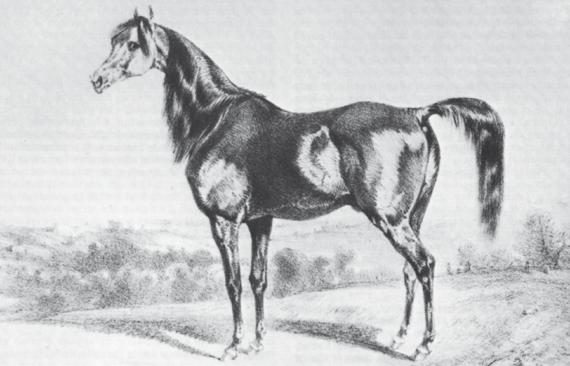
by the finest care and admired by both the common people and the most discerning connoisseurs. In this new situation, Nichab’s life was divided into two very distinct periods, corresponding to her years at Le Pin and at Pompadour: ten years in Normandy, thirteen in the Limousin.
In Normandy, the Arabian broodmare was mated with an English stallion; in the Limousin, she was returned to the exclusive breeding of her own breed. Given the contrasting results, one might think that the different tasks assigned to the management in these various regions were favoured by a secret design. Indeed, among Nichab’s seven offspring at Le Pin, there were six colts and only one filly. At Pompadour, the aim was different: the few remaining examples of the
Arabian breed in the country were gathered with the firm intention of increasing their numbers – and lo and behold, Nichab gave the stud seven fillies of Arabian blood out of her eight offspring. Chance, in its whims, is sometimes so fortunate that its effects should be carefully recorded. Nichab, born in 1818, did not arrive at Le Pin until 1824, in her sixth year. She gave birth to fifteen foals over a period of twenty-one years, which means that during this long career as a broodmare she had only six years’ rest. She was enjoying a life of leisure – a very rare privilege in state stud farms –when, in 1845, she was struck by such a severe skin disease that it became necessary to put her down. Her body was nothing but a single open wound; the unfortunate mare was gnawing at her own flesh with her teeth.
No external treatment, no medication could quell or alleviate the unbearable itching that consumed her. Thus Nichab met her end from a condition hitherto unknown. She was in her twenty-eighth year. Another mare would have been reduced to ruin; Nichab was merely old; nobility and strength had, in a sense, triumphed over time. Like an admirable monument from another age, she was still beautiful, undoubtedly very emaciated, but steady on her feet and full of vigour in the pasture. In all honesty, we must say that Nichab had been suffering from dropsy for several years and that this condition had been exacerbated by the age-related weakening of her organs. We also observed this illness towards the end of the lives of several of her offspring.
Nichab’s unique character
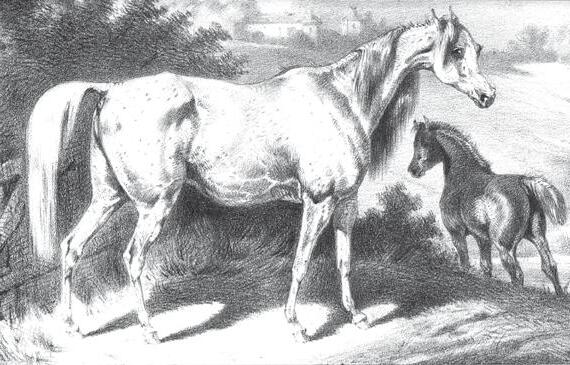
Nichab had a beautiful grey coat, a very light apple-grey interspersed in an original way with brown speckles (trout grey). This alone gave her a distinctive character, which was further emphasised by her fine, silky long hair. Her tuft, sitting in a peculiar way on her forehead, and her concave nasal line gave her an air of strange coquetry. Her eyes looked benevolent and noble; they were beautiful, perfectly placed and stood out slightly from her head. Her expression was lively and full of intelligence; the shape of her head was enchanting: every feature was beautiful and full of character. When one approached her, she would lively lay her ears back; at the same time, by pursing her lips in a way that was unique to her, she would pull a face unlike any other mare has ever done, baring her two rows of incisors wide. One might have taken it for a threat; it certainly looked the part, but it was not. She never once touched a human being with her hoof or her teeth; likewise, she was a very good-natured neighbour to her companions, from whom she likewise never suffered the slightest aggression. When she approached a visitor, Nichab would beg in the manner of an elephant, always expecting a treat from the goodwill of those who disturbed her. She loved and accepted everything with the same light-heartedness and the same appetite: she cracked sugar with ease, happily licked salt from a hand, ate bread with pleasure and devoured carrots with delight. When food was scarce, she would nibble at the bouquet of flowers people carried in their hands, on their lapels
or on their hats; she played with the flowers and sought the caresses she always craved with equal parts greed and delight. Nichab stood 1.48 m tall; she was, moreover, well-built and perfectly proportioned in every respect. Only her loins, somewhat long and weak at the joint, threatened in the long run to prevent the topline from remaining sufficiently taut. Consequently, her back began to sag prematurely and, with each passing year, displayed more clearly the defect known as a swayback. Nichab was therefore very ‘saddled’; it must be said, however, that this imperfection is considered one of the Arab horse’s virtues and is not combated there through the targeted selection of breeding stock with a different build. Strictly speaking, one could criticise Nichab for the fact that her chest was not as broad and deep as a good, solid build requires; as a result, she had a rounded and somewhat short shoulder. But is this not how the majority of horses that come to us from Arabia appear? Out of twenty, nineteen are built in this way. The most striking difference that perhaps exists between the English Thoroughbred and the Arabian Thoroughbred lies in the proportional dimensions of the chest and, consequently, in the length and inclination of the shoulder blade, which are much greater in the former. If one were to press the criticism further, one might have wished for more strength beneath the front knee. The cannon bones and the associated tendons were somewhat thin; otherwise, however, these parts were welldefined and compact. Had the various sections of the limbs been
longer and contributed to the horse’s height, they would undoubtedly have appeared gracile, inadequate or deficient; yet each section was short, and this lack of strength was noticed only by the most discerning observers.
Apart from this criticism, there was nothing but praise—and plenty of it—for Nichab, who possessed to the highest degree the brilliance, elegance, gentleness, energy and powerful spirit of the noble Arabian horse.
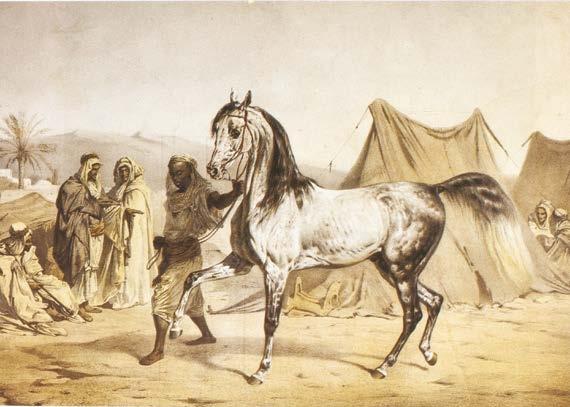
Let us read on to see what Damoiseau reports about the purchase of Massoud: ‘During the short journey I had undertaken to Aleppo, M. de Portes had haggled several times over a four-yearold bay, which, however, always seemed to vanish just when the deal appeared to be done. This horse was called Massoud (Happiness). M. de Portes had already given up hope of seeing it again when, one day, he spotted it once more in the stable. He immediately summoned me to examine it and give him my opinion.
I believed I could recognise great qualities in this animal, and added that I was convinced it would be perfectly suited to Normandy, should we be fortunate enough to acquire it. Massoud served as a stud horse within the tribe; his acquisition therefore proved to be very difficult. However, M. de Portes, having overcome his weariness with the fruitless negotiations—which had been resumed several times only to be broken off each time—turned to Saïd Hassan. He instructed him to leave no stone unturned in persuading the Bedouin who owned
the horse to part with it in our favour. Saïd set to work immediately and wasted no time in bringing all the parties involved together.
“Make me an offer,” said the Bedouin to M. de Portes. The latter named his price. “Offer more,” replied the Bedouin. “Just a moment,” I said straight away to the latter, “I’d like to assess Massoud’s gaits; could you ride him for a few minutes?” “All the Bedouins know how he runs,” replied the Arab coolly; “so I won’t do as you ask … if you absolutely must see him under a rider, ride him
yourself.”
At that moment, Massoud was without a saddle or bridle; moreover, his spine protruded exceptionally due to his extreme thinness. Mounting him in such a state was certainly cause for pause. Nevertheless, I took the risk. No sooner had I mounted than he bolted off at full gallop, which was by no means a painless experience … The ride I’d just completed had allowed me to get to know Massoud’s gallop; now I wanted to test his trot. This gait was, in a sense,
unfamiliar to him, and so I had the hardest time in the world getting him to do it. Eventually, however, I succeeded, and I was able to see for myself that he possessed excellent shoulder freedom.”
M. de Portes then raised his bids slightly and eventually reached the price the Arab was asking. But when the time came to hand over Massoud, the damned Bedouin seemed once again to be backing out; he declared that he wanted M. de Portes’s trousers as a baksheesh. This new demand was difficult to meet, as the garment in question was the only one of its kind he owned. A refusal followed, then a heated argument.
A compromise was eventually reached: the trousers were valued, and the unyielding Arab was paid their worth in cash …
However, it was not enough simply to have bought the stallion; we now had to find a way to rescue him from the incredible greed of our Arab friends. M. de Portes managed to accomplish this successfully, until the departure of the Turkmen who had accompanied us into the desert finally gave us the opportunity to take him to Aleppo.”
Eugène Gayot, who quotes M. de Portes’ notes, also reports that Massoud “stood at stud among the Fedaan Bedouins, who, I believe, possess the finest horses of all the tribes I have seen in the Syrian desert”.
Thirty years later, Gayot wrote: “Massoud is undeniably one of the finest Arabian stallions ever used in European breeding.” He added: “He was a magnificent horse, endowed with great athletic power, of brilliant conformation, albeit
of small stature; he displayed great spirit and pedigree and immediately took his place at the very top. He was extremely thin when he was purchased. This circumstance only served to highlight the beauty of his skeleton and the strength of his muscular and tendinous system even more clearly.”
Gayot had only become acquainted with Massoud towards the end of his life, but he had had sufficient time to assess his progeny: “He imparted to them all his type, an undeniable superiority; he was a strong sire and left his mark on them.”
Massoud initially spent thirteen years at Le Pin, where he covered 291 mares, though this resulted in only 132
offspring. yet although his offspring were of considerable quality, Massoud was only truly appreciated after his death: “He endowed them with a striking head, strong, clear, broad limbs – particularly powerful at the hock – beautiful gaits and a magnificent conformation. This would certainly have satisfied even the most demanding of judges; yet the regulations stipulated that premiums could only be awarded for tall broodmares, and there was always a fear that the daughters of Massoud – who was so small amidst the Norman population – would not reach the required height. However, when Massoud happened to be mated with one of those unassuming, sturdy mares that constitute the
wealth and reputation of a horsebreeding region, he sired powerful carriage horses and stallions of the highest order, of which Marmot was to be the most brilliant example.” Massoud covered the stud’s own mares at Le Pin and became the pillar upon which the foundations of the future Anglo-Arabian breed were to rest. He also covered mares in Tarbes, where he stood for just two years and sired 49 offspring (though not all of them were purebred), and finally in Pompadour, where, after 1835, attempts were made to perfect the ‘purebred French Arab’. There he was reunited with his travelling companion Nichab and died shortly after the arrival of Eugène Gayot.
THe IMporTS of M. De porTeS aND DaMoISeau for THe freNcH GoVerNMeNT 1819/1820 according to the french Studbook, Vol. 1 (1838)
aBufar Grey, born 1813. Imported from Syria by M. de Portes.
At the stallion depot of Rodez from 1821 to 1825; at the stallion depot of Pau from 1826 to 1829.
Died in 1829, after the breeding season.
aBou-arKouB Bay, born 1814. Originating from Syria; purchased in Marseille by M. de Portes.
At the stallion depot of Blois from 1822 to 1824; at the stallion depot of Pau from 1825 to 1835; at the stallion depot of Tarbes until his death, from 1835 to 1836.
aBJar Black, born 1814. Purchased in Aleppo by M. de Portes in 1820.
At the stallion depot of Braisne in 1821; at the stallion depot of Angers from 1822 to 1825.
Died in 1825. He covered 7 mares.
aBouSeIf Grey, born 1812. Imported from Syria in 1820 by M. de Portes.
At the stallion depot of Cluny from 1821 to 1827; at the stallion depot of Arles in the years 1828 and 1829. Sold in 1829, after the breeding season, to M. Bourdic.
acHMeT Bey Bay, born 1813. Imported from Syria by M. de Portes in 1820.
At the stallion depot of Arles from 1821 to 1830. Sold in 1830, after the breeding season.
aDDaL Chestnut, born 1817. Imported from Syria by M. de Portes in 1820.
At the stallion depot of Aurillac from 1822 to 1829. Sold in 1829, after the breeding sea son, to M. Bonnet.
BeDouIN Grey, born 1813. Imported from Syria by M. de Portes.
At the Royal Stud of Rosières from 1821 to 1828; at the stallion depot of Lamballe and Langonnet from 1829 to 1836; at the Royal Stud of Pompadour in the year 1837.
BercK Bay, born 1815. Purchased in Aleppo by M. de Portes.
At the stallion depot of Cluny from 1822 to 1828; at the stallion depot of Pau from 1829 to 1834.
Sold in 1834, after the breeding season, to M. Mirande.
cHeLeBy Grey, born 1816. Imported from Syria by M. de Portes.
At the stallion depot of Saint-Jean-d’Angély from 1821 to 1829; at the stallion depot of Pau from 1830 to 1834.
Died in 1834, after the breeding season.
DaHer Grey, born 1811. Imported from Syria by M. de Portes.
At the stallion depot of Pau from 1821 to 1829. Died in 1830, before the breeding season.
DIVaN effeNDI Grey, born 1815. Imported from Syria by M. de Portes.
At the stallion depot of Corbigny from 1821 to 1823. Sold in the year 1823, after the breeding season, to M. Mailly.
Drey Bay, born 1817. Imported from Syria by M. de Portes.
At the stallion depot of Perpignan from 1822 to 1824. He did not cover. Sold in 1825, before the breeding season, to M. Muther.
DouHey Chestnut, born 1817. Imported from Syria by M. de Portes.
At the Royal Stud of Pompadour from 1822 to 1825; at the stallion depot of SaintMaixent from 1826 to 1829.
Sold in 1829, after the breeding season, to M. Jaidy.
DurZy Grey, born 1815. Imported from Syria by M. de Portes.
At the stallion depot of Angers from 1821 to 1833. Sold in 1833, after the breeding sea son, to M. Roux.
frIGIaN Grey, born 1818. Imported from Syria by M. de Portes.
At the stallion depot of Libourne in the years 1823 and 1824; at the stallion depot of Saint-Maixent from 1825 to 1830; at the stallion depot of Pau from 1831 to 1837.
Part 2 (from AP 4-25 Damoiseau2.jpg)
GaZaL Grey, born 1816. Imported from Syria by M. de Portes.
At the stallion depot of Corbigny from 1821 to 1827. Died in 1827, after the breeding season.
HaDDeIDI Grey, born 1817. Imported from Syria by M. de Portes.
At the stallion depot of Tarbes from 1822 to 1828. Died in 1828, after the breeding season.
HaDJy Grey, born 1815. Imported from Syria by M. de Portes.
At the stallion depot of Saint-Maixent from 1821 to 1833. Sold in 1833, after the breeding season, to M. de Blois.
HaLeBy Grey, born 1813. Imported from Syria by M. de Portes.
At the Royal Stud of Pompadour from 1821 to 1826; at the stallion depot of Pau from 1827 to 1837.
HoNTIef Bay, born 1817. Imported from Syria by M. de Portes.
At the stallion depot of Pau from 1822 to 1832. Sold in 1832, after the breeding season, to M. Touzel.
KeBecHe Grey, born 1813. Imported from Syria by M. de Portes.
At the stallion depot of Angers from 1821 to 1831. Sold in 1831, after the breeding season, to M. Devarennes.
KeLLy Chestnut, born 1817. Imported from Syria by M. de Portes.
At the stallion depot of Pau from 1822 to 1831. Sold in 1831, after the breeding season, to M. Couder.
MaHaMa Bay, born 1816. Imported from Syria by M. de Portes.
At the stallion depot of Saint-Jean-d’Angély from 1822 to 1832. Sold in 1832, after the breeding season, to M. Faure.
MaHrucK Bay Persian stallion, born 1815. Imported from Syria by M. de Portes.
At the stallion depot of Braisne in the year 1821 (six mares); at the stallion depot of Libourne from 1822 to 1826.
Died in 1826; he covered 8 mares in total.
MaSSouD Bay, born 1815. Imported from Syria by M. de Portes.
At the Royal Stud of Le Pin from 1821 to 1833; at the stallion depot of Tarbes in the years 1834 and 1835; at the Royal Stud of Pompadour in the years 1836 and 1837.
MIKHaWI Grey, born 1814. Imported from Syria by M. de Portes.
At the stallion depot of Langonnet in the years 1821 and 1822; at the stallion depot of Angers from 1823 to 1827; at the stallion depot of Lamballe in the year 1828. Sold in 1828; he covered three mares.
MeDaNI Grey, born 1815. Imported from Syria by M. de Portes.
At the stallion depot of Saint-Lô from 1821 to 1826; at the stallion depot of Lamballe from 1827 to 1834. Died in 1834, after the breeding season.
MeLHeaN Grey, born 1817. Imported from Syria by M. de Portes.
At the stallion depot of Rodez from 1822 to 1837.
MoNKy Bay, born 1817. Imported from Syria by M. de Portes.
At the stallion depot of Aurillac from 1822 to 1832. Sold in 1832, after the breeding season, to M. Gaudin.
NaSSer Bay, born 1817. Imported from Syria by M. de Portes.
At the Royal Stud of Pompadour from 1822 to 1824; at the stallion depot of Libourne from 1825 to 1829; at the stallion depot of Pau from 1830 to 1837.
orKaN Bay, purchased in Syria by M. de Portes.
At the stallion depot of Libourne from 1821 to 1827. – Discarded/culled in 1828, before the breeding season.
rIcHaN Grey, born 1816. Imported from Syria by M. de Portes.
At the stallion depot of Aurillac from 1821 to 1830; at the stallion depot of Aurillac from 1831 to 1833; at the stallion depot of Arles from 1834 to 1837. (Note: The original text repeats Aurillac with separate date brackets).
SaKaL Chestnut, born 1795. Imported from Syria by M. de Portes.
At the stallion depot of Arles in the year 1820; at the stallion depot of Cluny from 1821 to 1825. Sold in 1826, before the breeding season, to M. Lelong.
Saraf Grey, born 1813. Imported from Syria by M. de Portes.
At the stallion depot of Langonnet from 1821 to 1827. Sold in the year 1827 to M. Longs, after the breeding season.
SHcouD Bay, born 1817. Imported from Syria by M. de Portes.
At the stallion depot of Arles from 1822 to 1824. Died in 1825, before the breeding season.
SHouaIMaNI Grey, born 1813. Imported from Syria by M. de Portes.
NIcHaB Grey mare, born 1818. Purchased by M. de Portes in Syria. NaMe DeScrIpTIoN & HISTory
At the stallion depot of Tarbes in the years 1821 and 1822. Died in 1822, after the breeding season.
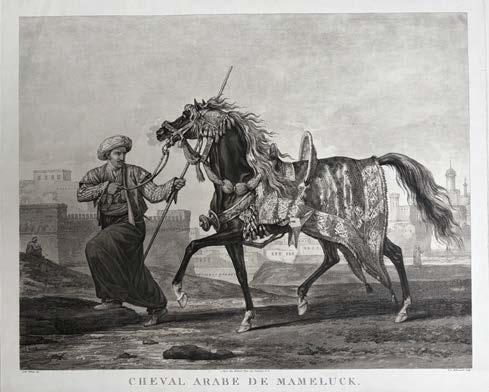
July 1st – September 30th, 2026 Munich, Germany
Specialized in the Horse in Art Worldwide shipping available
For more information please contact: Judith Wenning WhatsApp: +49 172 4700325 or judithwenning@hotmail.com www.gallery-atelier.com
Atelier - Fine Arts & Antiques is the only art gallery worldwide specializing in antique Arabian horse art. It is owned by Judith Wenning (born Judith Wich) and located just outside Munich, Germany.
Judith Wenning is an established name in the world of Arabian horses since many years. She breeds purebred Egyptian Arabians at her stud farm Orienta Arabians, has published countless articles in international magazines and authored the book “Jewels of the Desert - The Magic of Egyptian Arabians”.
Judith Wenning has always been interested in the Arabian horse in art. In the past years, one of the major subjects of her writings were Arabian horse painters and sculptors - antique and contemporary. In 2022, Judith Wenning founded the gallery “Atelier - Fine Arts & Antiques”. Today “Atelier - Fine Arts & Antiques” is specialised in buying, selling and researching equine art. The main emphasis is clearly on Arabian horse art, mostly from the 19th century with a few contemporary. In the gallery you will find works by well-known artists of the 19th century, such as Victor Adam, Carle Vernet, Horace Vernet, Alfred de Dreux, Alexandre-Gabriel Decamps, Albrecht Adam, Baron Gros, Georges Washington, Henry Alken, Hippolyte Lalaisse, Noel D. Finart, Theodore Gericault, Eugene Fromentin, Adolf Schreyer, Pierre-Jules Mene, Alfred Barye, etc. Visitors and interested people can expect to find a unique choice of carefully selected works.

In the summer of 2026, the gallery hosts a captivating exhibition on the Mamelucks, their Arabian horses, history and legacy. The Mamelucks were renowned for their discipline, courage, and refined horsemanship. Their majestic Arabian horses symbolized strength, endurance, and elegance, playing a vital role in both battle and ceremony. Together, the Mamelucks and their Arabians became a lasting symbol of loyalty, skill, and noble tradition in Middle Eastern history.
The exhibition features a collection of rare 19th century lithographs, original art works, and sculptures illustrating the Mamelucks’ charisma.
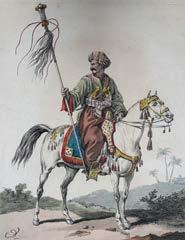
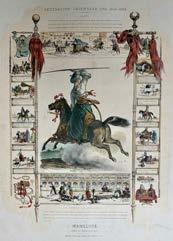
Visitors are always very welcome by appointment. Please call or send a WhatsApp to +49 1724700325.
A free catalogue of “The Mamelucks” Exhibition can be obtained in electronic form via email or WhatsApp.
To mark his 96th birthday in August 2026, Dr Nagel wrote a retrospective for the new DESERT HERITAGE MAGAZINE on his life with Arabian horses, his great passion, which has been a driving force for more than 60 years. Over time, horse breeding changed; selection methods increasingly focused on a new phenotype, whilst the horses’ genotype became significantly less influential. Geopolitical and economic aspects exerted an evergreater influence on global breeding. Nagel was fascinated by the Orient and, throughout his life, sought to answer the question of how an historic, thousands of years old horse breed could be preserved for the future in its finest form. His closed studbook of pure Egyptian Arabians is both a successful experiment with a scientific basis and a worldrenowned project for the conservation of historic mare lines and their noble offspring, which remain available to interested breeders as a gene pool.
Monika Savier
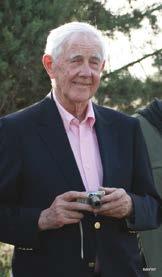
Dr HANS J. NAGEL, born in Germany in 1930 has been travelling and working in the Arabian world as a businessman and horse breeder for 60 years. He was president of the German Arabian Breeding Association (VZAP) for 20 years, is an ECAHO judge and was for many years President of WAHO (the World Arabian Horse Organisation). Founding the Katharinenhof, he realized his livelong passion. His famous breeding experiment to maintain the “Original Arabian Horse” of the “Southern Type” in a closed studbook intended to keep alive this historical treasure, which has had such a profound effect on the whole equine world.
Arabian horses, my great passion accompanied me intensely throughout my life. But to explain today’s horse breeding, I must look back at the geopolitics of history.
I set myself two tasks:
• By gaining precise knowledge of the history of this breed, from its origins to the present day, based on historical literature, current scientific findings and records in studbooks, as well as contemporary art as represented in painting, with the intention of understanding this breed as comprehensively as possible.
• By searching for existing breeding stock that comes as close as possible to the original, and whose continued breeding has been pursued consistently up to the present day.
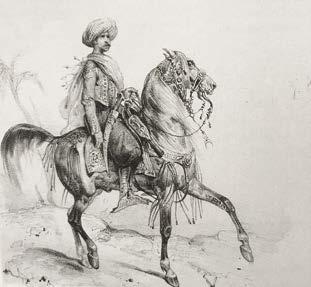
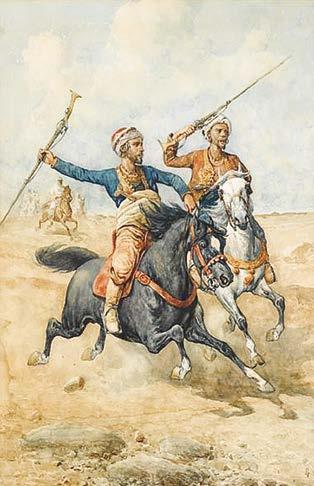
The Arabian horse was originally the warhorse of the nomads who roamed the Arabian Peninsula, the so-called Bedouins. Around 2,000 years ago, the ancestors of these horses came from the north into the hands of these people. They were the first horses to find their home on this peninsula. Until then, only camels and donkeys had been used as riding animals or beasts of burden.
“The Arabian horse is, in its originality, a unique part of the world’s cultural heritage, formed by its constant struggle with the forces of nature; yet today, throughout the world, it is shaped by the wishes and demands of a largely well settled breeding community, looking for entertainment and commerce”.
(H.J. Nagel)
These horses, previously kept in the lush environment of the northern Orient, had to adapt over the centuries to a completely different environment, namely that of the Arabian Peninsula. From the larger and heavier horses of the north, a light, undemanding, hardy and people-oriented breed of horse eventually developed. Like all domestic and wild animals living there, they were equally marked by the consequences of this merciless environment. Climate, vegetation and scarce water supplies imposed strict limits. Their life on the peninsula also meant that they had almost no contact with other horse breeds; this condition can be described as a closed population.
The first mention of these horses is found in the Koran in the 7th century. After that, further documentation remained sparse. It was not until the 19th century that the local population opened itself fully to the Western world. Adventurers and courageous merchants discovered these horses on their travels and were astonished and deeply impressed by the beauty and uniqueness of the small herds of Bedouin-bred horses. They reported on this breed, previously unknown in Europe, and before long numerous expeditions set out from Europe
and purchased hundreds of horses for their studs. Almost all of these purchasing commissions travelled to northern Arabia, to Syria, Iraq and Palestine; they did not dare venture to the southern peninsula. For foreigners, living and travelling there was very dangerous.
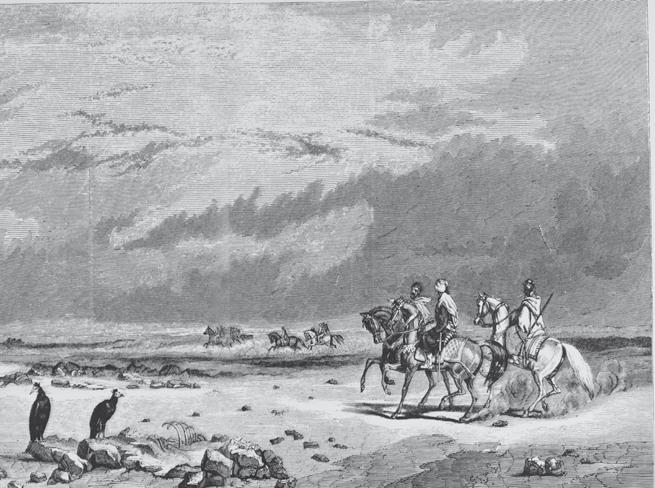
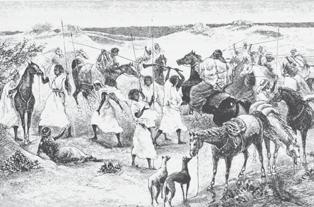
Over the centuries, this southern Arabian breed had spread throughout the Arab region through the great migrations from south to north. Large herds of hundreds of horses were kept by the Bedouin tribes there, and extensive grazing areas and abundant grain harvests provided a rich source of food. These many horses were a necessity: thousands of them were used in the great wars of that period between powerful Bedouin tribes, in which political control over the fertile territories of northern Arabia was contested.
The southern horse populations were limited and always remained a minority within the wider Arab region. Of these horses, from the many small breeding populations of the time that were noted for their beauty and nobility, only a few reached the Western world. In most cases, the best horses remained in the Orient and were bought by the wealthy upper classes in great cities such as Damascus and Baghdad, or were retained by Bedouin sheikhs.
In the meantime, the world in the Orient had changed. After the First World War, new countries were created and old national borders redrawn, making the long seasonal migrations of the Bedouins impossible. The aim was to settle them permanently, and this was forcefully pursued by every means. In the end, the breeding of Arabian horses came to an end as a result. Their keeping was taken over by a small number of enthusiasts and landowners from the settled population, who regarded them as a respected and valuable legacy from
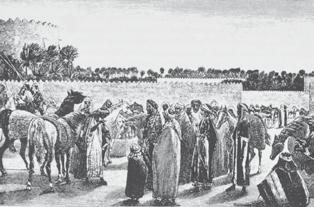
“Over the centuries, this southern Arabian breed had spread throughout the Arab regions. Large herds of hundreds of horses were kept by the Bedouin tribes.”
the past. No one from the West appeared any longer to buy horses from the abovementioned Arab countries.
Much later, in the 1990s, there was a great awakening, a kind of renaissance in the Orient. National studbooks for Arabian horses were established. The remaining horses were entered into these studbooks, as were the Arabian horses imported in large numbers from Western breeding programmes. High prices were paid for them, and so the best and most highly
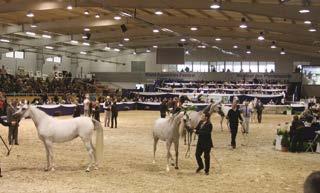
awarded mares and stallions from the West passed into the hands of the Arab upper classes and found a new home there. It was, in a sense, a return journey, now from West to East, and many studs in Europe and particularly in the USA benefited from this major wave of purchasing from the Orient. With these horses came, as it were, the entire Western industry surrounding the Arabian horse, and it was received with great enthusiasm in the Arab world. Today, the largest shows in the world take place in the Gulf states and in Saudi Arabia, with a new generation of Arabian horses. The old historical stocks have practically disappeared. The studbooks are packed with horses from the best breeding programmes all over the world.
As early as the 17th and 18th centuries, because of their proximity to Turkey, some landowners in south-eastern Europe had already purchased Arabian horses from the Orient. These noble horses later found much admiration, especially in Poland. New studs were added, with the result that Arabian horse breeding developed very successfully. The studs in Poland, Hungary, Russia and England became famous, going back to the great purchases of Arabian horses from Syria, Iraq and Palestine. From this
“The resulting racehorse breeding was seriously endangered by the tempting crossbreeding with English Thoroughbreds”
source, the Arabian breeding programmes established in Western Europe and the USA after the Second World War were able to acquire excellent breeding material. Under the very favourable economic conditions of the time, these populations grew very rapidly all over the world to an enormous size, with the foreseeable consequence of massive overproduction. A sudden collapse followed, hitting Western breeding hard. The heyday of the Arabian horse in the Western world was therefore only brief: just thirty years, from 1970 to around 2000, and then it was over.
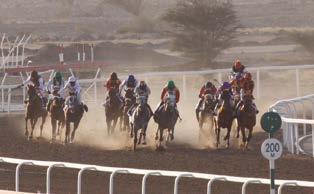
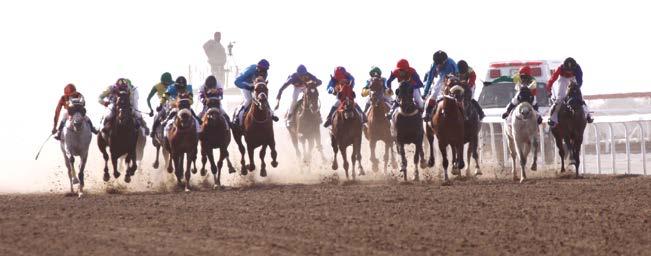
During this heyday of Arabian breeding, especially in the USA with its far larger studs and farms, a trend towards specialisation began. Arabian horses were bred for racing, for endurance riding, for leisure riding, but above all for the presentation of these Arabian horses at spectacular show events. This was something quite different, a much larger undertaking than the breeding shows customary in old Europe. Such shows soon became the favourite playground of breeders and lovers of Arabian horses. Everything else became secondary. The resulting racehorse breeding was seriously endangered by the tempting crossbreeding with English Thoroughbreds,
which were far superior to the Arabian horse in speed, with the result that today there are almost no purebred racing Arabians left. More than 90% of all these horses are crossbred products.
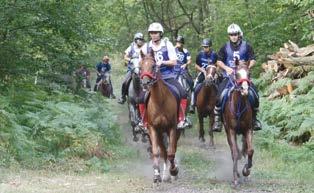
By contrast, the Arabian endurance horse has retained its leading position in this discipline on long distances of up to 120 km. In this discipline, the Arabian horse cannot be surpassed. However, the long training period, over many years, is a major handicap for the sport.
It is therefore not surprising that no more than 1-2% of all Arabian horses worldwide are kept for these two disciplines, and that both sports have remained popular mainly in the Arab countries.
The total population of Arabian horses worldwide is estimated at around 150,000200,000 horses. The horses participating in shows amount to roughly 10-15% of this population. A large proportion of the remaining horses are kept for breeding show horses; this is evidently proof that breeding is no easy matter and that only a few qualify to take part in major shows. The remaining portion stands in the stables of enthusiasts of the breed, used as leisure horses or kept out of pure passion. Where, in the development of such a
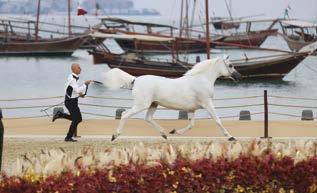
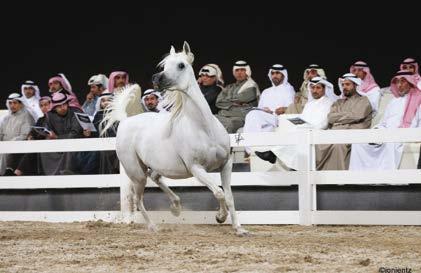
significant world population, has the historical Arabian horse remained? In the Orient, breeding was neglected or altered by crossing with imported horses. It was left behind by the pace of development. And the movement towards change continued and still continues, affecting all breeding directions worldwide, including the famous studs in Eastern and Western Europe that, over many years, had developed their own generally highly valued and recognisable type. The shows forced them all to rethink. Today, these shows dominate public attention and, to a significant extent, the entire course of events in Arabian breeding. Shows with thousands of participating horses are no longer rare. They are extremely well organised, strictly regulated and conducted according to fixed rules to which the show organisers have committed themselves. The Arabians presented there originally go back to the great European breeding, such as the Polish, Russian and Spanish, or to show Arabians bred in the USA, as well as to Arabians from Egyptian breeding.
For the uniform conduct of these shows, and especially with regard to a uniform judging system, a ‘show-horse standard’ was eventually developed. Every breeder,
“...judges at shows have been trained on courses, and they are able to apply such a scoring system ...”
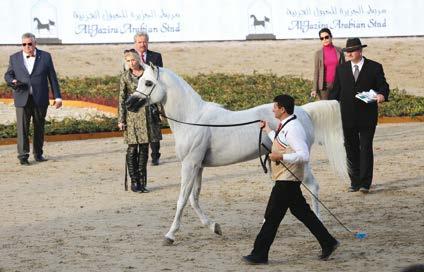
whether previously committed to Polish, Russian or American Arabians, now tried, through selection or through crossbreeding with horses from other foreign stocks, to achieve this standard. In this respect, even the globally known studs gave up their own national identity. The aim was and remains to achieve the highest score of 100 points across five categories. This is possible if the horse is awarded 20 points in each of the categories: type, head and neck, topline, limbs and movement. These requirements were ultimately bound to lead to the breeding of an Arabian that combines what is typical of the Arabian horse with Western ideas of correctness and performance. The Arabian horse, characterised by the five categories above, has indeed become a ‘show Arabian’, a newly created type that has evidently gained full international recognition. The typical Polish Arabians still exist, as do the Russian Arabians and the Crabbet Park horses in England. But there are only a few left, and from a breeding point of view they have slipped
into the background; something else has now become the focus.
In line with these ideas, judges at such shows are trained in courses and as assistant judges, and are able to apply such a scoring system correctly. The great exception to this development remains the breeding of Arabian horses that goes back to the Egyptian State Stud El Zahraa. In the 1920s, those Arabians whose ancestors had come from the Arabian Peninsula to Egypt were brought together in Egypt. At that time, in the second half of the 19th century, there was lively trade between the Egyptian upper classes and the Bedouins of the Arabian Peninsula. In particular, the viceroy Abbas Pasha was enthusiastic about these horses and collected the best examples in his palaces. In addition, many such noble horses had been brought to Egypt as spoils of war from the Wahhabi wars, which were fought in the north of the Arabian Peninsula. From these early days, only a few mares and stallions ultimately remained. Of these, around 16 of the best breeding mares and
a few stallions were purchased during the 1920s by the RAS (Royal Agricultural Society), and thus formed the foundation stock of the Egyptian State Stud, today’s El Zahraaa Stud, located on the edge of the capital, Cairo. The breeding objective was heritage breeding and the use of suitable stallions to improve the national horse breeding population. Later, a few additional stallions were purchased with the intention of using the offspring of such horses on the racetracks in Egypt. Unfortunately, the boundaries between these two intentions were soon blurred, and today it therefore requires a high level of expertise to manage such a stud successfully.
These so-called ‘Straight Egyptians’ have found a fairly constant international following. The following concerns itself exclusively with horses that trace back to the El Zahraa Stud in Cairo. Associations and interest groups were founded that devoted themselves to the breeding and dissemination of these horses. It would be surprising if the popular show
“...it is still possible today to find an astonishingly large number of breeders of Egyptian horses worldwide who have their own ideas of an ‘Egyptian Arabian’“.
business had not spread into this breeding direction as well. Shows for Egyptian horses became popular everywhere and were conducted according to the same rules as today’s major shows for typical show Arabians. The consequences for many Egyptian Arabians are easy to foresee: standardisation towards the typical show Arabian. Apart from such developments, it is still possible today to find an astonishingly large number of breeders of Egyptian horses worldwide who have their own ideas of an ‘Egyptian Arabian’. Especially in Egypt, there are many private breeders who concern themselves exclusively with these ‘Purebred Egyptian Arabians’. In quantity and quality, they have apparently overtaken the venerable old El Zahraa, which has suffered greatly under a misguided breeding and sales policy. There, unfortunately, the actual main goal - historically valuable heritage breeding - has long since been lost from view.
If one lets the development described above of a breed that once existed for thousands
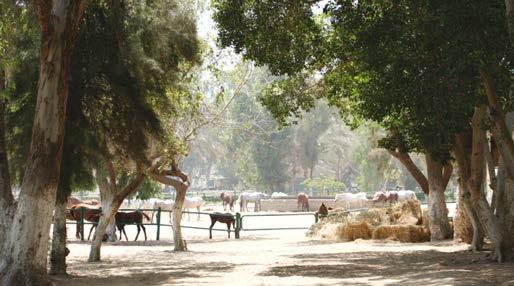
of years in the midst of the Arabian deserts pass before one’s eyes, one recognises how far today’s Arabian horses have moved away from their origin. One must therefore search for the few remaining horses, if any such horses still exist at all. Unfortunately, the strong pull of the show world, dominated by a standard type, has affected all breeding directions. Working with show horses promises good opportunities for profit, such as prize money and better sales prospects. Yet in these large show populations in the USA or the Middle East, one looks in vain for the historical Arabian type. It is no longer to be found there. An attractive descendant shaped by Western ideas has taken over the field.
Even all the relatively few remaining Arabian horses of different types, from the most varied studs and breeding programmes, especially those that arose after the First World War, also clearly bore the marks of selection according to European standards. Almost the entire hippological community in Western and Eastern Europe pursued other
“A precise study and assessment of today’s population of Egyptian Arabians shows, fortunately, that there are still considerable signs that the historical Arabian horse has not been lost”.
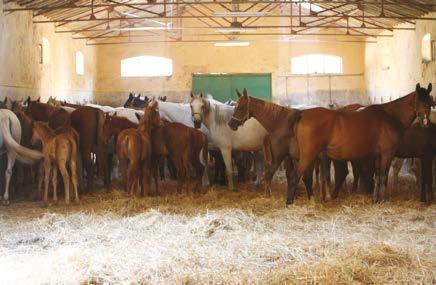
breeding goals, oriented towards its own national horse breeding. Heritage breeding was not in demand. Through selection within their own populations, and through lively exchange and purchases from friendly studs across national borders, all possible types of Arabian horses arose in the course of history. Many of these horses were used as improvers, or adapted to European conditions in so-called pure breeding. Pure breeding versus crossbreeding, homogeneity versus heterogeneity: this is a subject that has lost none of its vitality to this day, especially as the terms pure breeding and purity of the breed were used very arbitrarily and unprofessionally. The Egyptian population is different and has remained a phenomenon within this development.
• The Arabian horses brought to Egypt remained in an Oriental environment. Processes of adaptation were not essential. The Arabian Peninsula and Egypt are geographical neighbours; climatically, geographically and
culturally they are not identical, but they are very, very similar.
• There was no exchange with other studs. The original foundation stock remained unchanged; it grew and expanded from within itself. The approximately 16 initial mare strains founded their own families, yet in the end fewer than ten managed to become firm pillars of the entire Egyptian population up to the present day.
• On paper, such mare strains and dam lines are easy to recognise. But could a particular dam line also preserve the typical characteristics for which it was once selected, or has everything mixed with everything else so that differentiations are no longer recognisable? For the majority, this unfortunately has to be answered in the affirmative. However, that does not diminish the above observation. For a long time, internationally speaking, the El Zahraa stock lay in a fairy-tale sleep. From its beginnings in 1922 until 1960, for
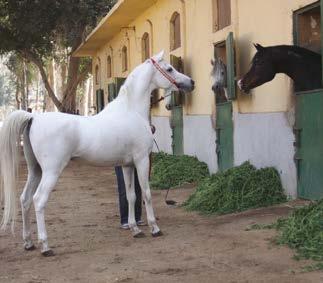
about forty years, it remained the national pride of Egypt’s great horse lovers in the upper levels of society. From a breeding point of view, four to six generations had grown up at El Zahraa during that period. Since then, a further sixty years have passed in which Egyptian Arabians have been bred internationally, in many studs in Egypt itself, in the USA, in Europe and in the Middle East. This adds another six to seven generations of breeding history. In each of these ten to twelve generations in total, changes have occurred. New things have been added and old things have disappeared, intentionally or unintentionally, with considerable or only minimal consequences.
A precise study and assessment of today’s population of Egyptian Arabians shows, fortunately, that there are still considerable signs that the historical Arabian horse has not been lost.
In order to recognise it, it will be useful to present this historical type in a precise definition, while not losing sight of its hundred-year development history. A
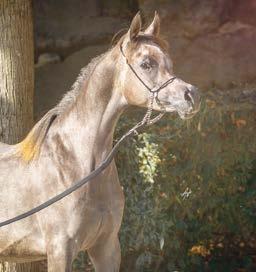
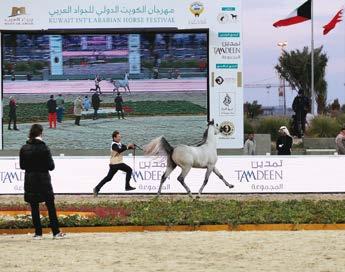
comparison with today’s so popular show horses will make the existing differences very clear.
Both the show horse and the historical Arabian horse are still closely related, but they are no longer brothers and sisters.
Today’s show horse has without question remained a noble Arabian, but it is clearly shaped by perfect management and by breeding selection aligned with the standard type.
What reminds people of the Arabian horse, and what is sought and demanded, is surprisingly the head typical of the Arabian horse. It has become a fetish. There has always been agreement that it is the concave frontal line of the head by which one recognises a good Arabian horse; no other horse breed has such a feature. Today, this head shape appears in the most varied forms, from extremely concave to only a slight indication. Whether one likes these heads that tend towards the extreme or not, within the standard type they have risen to become the most highly valued feature. The type
score stands or falls with the evaluation of the head.
Head and neck have been combined. A neck is preferred if it is set on high, somewhat too long and somewhat too fine; under no circumstances may it be too short, too thick or too heavy. Show horses have a finer mouth than was previously customary; the head as a whole is somewhat longer and narrower, the ears are usually somewhat too long, and the eyes are a problem.
The so-called topline is also desired; alongside the head, it is another decisive feature for a good score. This means, from the withers to the tail set, a firm back and a long, straight croup that flows into a high tail set.
Unfortunately, the high tail carriage so typical of an Arabian horse is not taken into account. This is a regrettable mistake.
A third element is movement, presented through the trot action. It must be spectacular; the horse must be in a state of the highest excitement and inspire the audience. It is a weighty element in the overall assessment.
But is it a typical Arabian feature? It is not. Rather, it is the gallop that gave the Arabian horse its highest value. At shows, there is no room for it.
These three highlights - features that are very easy for the audience to recognise and understand in relation to the scoring, namely the strongly developed head shape, the topline and the trot action - are now decisive characteristics of a successful show horse. This horse matures early, grows quickly, is stronger in bone structure and, as regards size, a height at the withers of 160 cm is no rarity.
For such a concept to be feasible at all, it must be as easy to understand as possible in all areas.
For those who breed and provide the show object, and who have a clear guideline in the required standard. This refers to the horse, which has become part of an overall concept and indeed one of its most important parts,
although the actual aim is the show result through the optimisation of all areas.
• For the audience, which must be kept in suspense by a constant change of presentations in the show arena in order to increase the entertainment value and which, in the end, expresses its full approval through applause. The fact that corrections are made from time to time to the manner and concept of judging shows an obvious need for optimisation, which is intended to be achieved through possible objectification of the matter. Every subjective influence must be prevented as far as possible. Such an approach is naturally supported if the definition of the show object is also as clear, unambiguous and understandable as possible. That is why agreement was reached on only five categories, while also taking into account the time factor for assessment.
Now to the historical Arabian. What makes it so unique, and why has it found so many admirers? It was its lightness, its dryness and its noble appearance that clearly distinguished it from the heavier native breeds common in Europe at the time. In detail, it was also the head so typical of the Arabian, then a novelty; however, extreme heads such as those seen today never existed. Elegant and lightly concave forms were valued, but even these were rather rare in the past. At all times, the northern type tended to have straighter heads; only the southern Peninsular Arabian was the source of this typical Arabian feature. For many, a fine, dry head was sufficient, but under no circumstances could it be convex. Only when heritage breeding was established at the El Zahraa Stud was greater attention paid to this characteristic, thereby significantly increasing its frequency in the population.
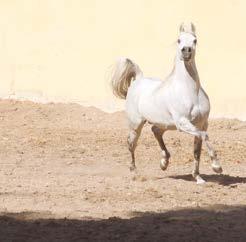
Its second extraordinarily important characteristic was its high tail carriage: when standing, carried like an elegant arch; in the trot, particularly high; and upright in the gallop, like a flag in the wind, with a silky fall of hair. Without this tail carriage, every Arabian horse in the Orient was disqualified as not Arabian, for example when Arabian
“Its extraordinarily important characteristic was its high tail carriage: when standing, carried like an elegant arch; in the trot, particularly high; and upright in the gallop, like a flag in the wind”.
being the small g ene pool and the sce pticism towards s breeding. W hich is why in some studs, a pedig ree is m and judging the horse himself. W hich, in tur n, raises t upg rades the pedig ree?
racehorses were admitted to the racetrack in Cairo. This tail carriage is a must for every Arabian.
Making too much of pureness or even super pureness clever business. If there is a lack of labels or log os o nobodies. Labels such as Asil, Al Khamza, or Blue Lis blue in itself is sug g estive of pureness, a blue sk y, blu assumedly clean and noble products, such as the pres clean Blue Efficiency technolog y with diesel cars. Jus “Red List Catalogue”! W ho wo uld still buy them?
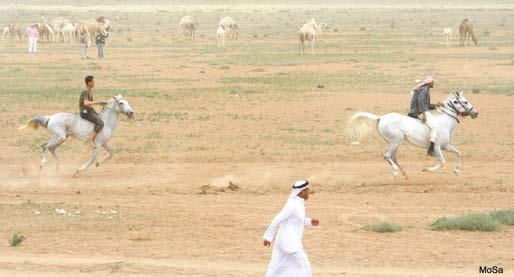
The gallop is regarded as the third important element. It was the most valuable quality of a horse in Bedouin breeding. A fast gallop, followed by a long walk, were the two most sought-after gaits. A good walk was adapted to the purpose of the often days-long migrations from pasture to pasture. The fast gallop was required on Bedouin raids, which were carried out as surprise attacks by day.
At night, one approached the desired target at the walk or trot. The trot had to be so light and springy that the hoofbeat of a trotting horse could not be heard. Everyone sought such horses, and the owners of such a horse were never safe from theft. In this respect, customs were harsh.
Young breeders, however, often take that kind of lab horses are Straight Eg yptians (just look at the offspri and Blue Star), and most of the Straight Eg yptians are still the cradle of the Straight Eg yptians, but only 25% W hich is understandable, as the Ott famly put up thei preser vation and increased production of the type of of the Bedouin tribes of Arabia...” (introduction to th it was not just about, among others, Straight Eg yptians of origin, as Eg ypt was a countr y impor ting Arabian liking for the horses from the Nejd area, the highlan become a hype for the new breeders on the Gulf.
Famous r oot stock fr om El Zahraa State s
The clearest expression of adaptation to its environment in the Arabian horse was its black skin. For this reason, in earlier times in the Orient all Arabians were called ‘Kohailan’, corresponding to the Arabic word ‘kohl’ meaning black. Every sun-hungry tourist now knows that sunburn can naturally only be prevented by good skin pigmentation. The same applies to these horses when they are exposed to the hot rays of the sun, as is usual in desert regions. Pink patches of skin beneath the silky coat burn, and light markings on the legs and body are also highly vulnerable. This necessary black skin is found in all colour varieties: greys, chestnuts and bays. Only minimal markings on the head were tolerated, and black hooves were the norm. To survive in a difficult environment, adaptation had to be as perfect as possible. In northern Arabia, people were not so strict. There were shady places for people and animals; the climate was somewhat milder and there was no shortage of water.
The historical Arabian was rather a rectangular horse with a slightly long back, a longer and slightly curved croup and predominantly somewhat shorter legs. Horses with longer legs were certainly valued, but they were in the minority. A longer back allowed tension and power to
T he Straight Eg yptian Nazeer (Mansour x Bint Samiha) emerg ed as the “stallion of the centur y ” in the state stud of El Zahraa. He inf luenced Arabian breeding all over the World
some of the foundation horses of Eg yptian original ore impor tant in breeding selecti on than looking at the question if it’s not actually the g ood horse who
be released in the gallop, as well as long strides and thus a speed that was often the salvation of horse and rider. For a Bedouin, the fast horse had the highest value.
s, without reg arding beauty and functionality, is just or famous prefixes added, g ood horses will just be st appear to refer to a kind of quality seal. T he ter m ue sea – with adver tising likely to use this color for sumedly blue blood of nobility, or the supposedly st imagine “Blue List” horses being presented in a
beling at face value. W hat is more, not all Blue List ing of Turfa, a foundation mare of both Blue List e not Blue List members – take El Zahraa in Cairo, % of the horse s tock there are Blue List.
r Blue List Catalogue in order to “ encourag e the f Arabian horse originally found in the possession e Blue Arabian Horse Catalog by Mrs Jane Ott). So s, but also about Syria and Saudi Arabia as countries horses, too. T he Eg yptian pashas had a par ticular nds of Saudi Arabia, whose offspring have today
In old stud documents and old studbooks, one finds records of the size of the horses once imported from the Orient. Heights at the withers of 145-155 cm are entered there. The great studs in the East also used these measurements for their selection in the past. Up until the 1960s, horses that were smaller or larger were excluded from breeding. Then these limits were abandoned; customers and breeders from the USA preferred the larger horse, a regrettable development that opened the door wide to unlimited growth in size. An original Arabian grew slowly and was a dry horse with fine skin and coat and light bone structure; every extra kilogram was a burden. Its body weight was estimated at 300-350 kg. Heat and weight do not go together. Scarce food and long marches made it an ascetic, a hardy and undemanding horse.
tud, Pyramid Society and Asil Club
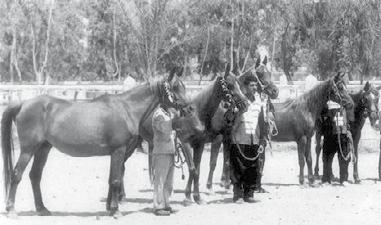
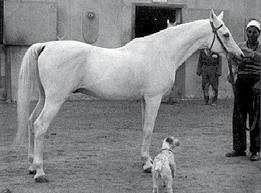
Arabian horses in southern Arabia lived under the open sky, neither in tents nor in stables, sometimes tethered or bound at the forelegs. They lived beside or near the tents and were treated as family horses. Without human care and protection, they would have been lost. They thanked their protectors with attachment
Inspecting things mor e closely, it’s appar ent tha necessarily aim to improve horses by selection. In s being the small g ene pool and the scepticism towa breeding. W hich is why in some studs, a pedig ree and judging the horse himself. W hich, in tur n, rai upg rades the pedig ree?
oriented and had to be. Their sense and feeling for human behaviour were strongly developed, and their reactions to good or less good treatment were clear and immediate. This behaviour has naturally been preserved in many of these horses. The Arabian horse was fully integrated into the life and daily struggle for survival of human society and therefore possessed the same range of means for successful adaptation that had been found for overcoming such hardships. Nomadism, in its history of many thousands of years, was the original way of life of many tribal peoples. The Bedouins on the Arabian Peninsula lived this way of life for thousands of years, and during these 2,000 years their horses occupied a firm place in their rhythm of life. This Bedouin life no longer exists in its uniqueness, and neither do their horses. The great upheaval came about 100 years ago. These last hundred years are only a short time compared with the long, long prehistory of these horses, a breed that arose on a peninsula and was kept there as an almost closed population. It was genetically established probably like no other, and most undesirable recessively inherited traits were selected out by nature. All these circumstances and conditions strengthen the assumption that such horses can still be found, carrying within them the great heritage of their past. From a breeding point of view, the habits of the Bedouins and modern breeding
Making too much of pureness or even super pure clever business. If there is a lack of labels or log nobodies. Labels such as Asil, Al Khamza, or Blue blue in itself is sug g estive of pureness, a blue sk y assumedly clean and noble products, such as the clean Blue Efficiency technolog y with diesel cars
“Red List Catalogue”! W ho wo uld still buy them?
Young breeders, however, often take that kind of horses are Straight Eg yptians (just look at the off and Blue Star), and most of the Straight Eg yptian still the cradle of the Straight Eg yptians, but only W hich is understandable, as the Ott famly put up preser vation and increased production of the typ of the Bedouin tribes of Arabia...” (introduction t it was not just about, among others, Straight Eg yp of origin, as Eg ypt was a countr y impor ting Arab liking for the horses from the Nejd area, the hig become a hype for the new breeders on the Gulf.
Quite hard for young breeders to with their own breeding g oals fir come and g o. Still, org anizations for them, are much coveted. T hey ideological homes. T his ill-fated b result in better horses – as is easy nar rowed-down show horse line supposed to have an inf luence o across the social classes of the di the horses they all have.
Browsing Facebook or respectiv matter whether analog ous or dig communicate with peers; always After all, even humans are her d places.
Ag ain and ag ain, however, the c bashing” phenomenon. Using g horses in the past, breeders can valuating the horses of others. E
concepts have interesting similarities:
The Bedouins thought in terms of mare strains when they wished to classify their horses genealogically. This method is still used today. Studs are based on mare lines that bear the names of their foundation mares. Such mare lines are their greatest breeding value and, as a rule, can hardly be replaced.
The probably best-known and most important Arabian populations, those of the Polish state studs Janow Podlaski and Michalow, bred with 16 mare lines; the German Marbach stud with five; and the Egyptian El Zahraa with eight such lines. This system allows a tracing back to their historical beginnings, that is, to the foundation mares. The sequence of their respective ancestors is recorded in studbooks and can now be checked for accuracy using DNA methods. On the mare side, therefore, there is a secure foundation.
The paternal side remains, as far as the past is concerned, a great question mark. The Bedouins simply ignored it, although in reality they did attach great importance to stallions. There were only a few stallions in the existing populations; everyone knew them, and a strange animal would have been noticed immediately. People trusted only what they knew.
Crucial things were expected of stallions as improvements of speed and better
conformation in a broadest sense. Bedouins brought their mares to the best-known and best stallions, even if they had to travel hundreds of kilometres to do so.
The selection of stallions has always been of the greatest importance in breeding. It has enormous influence, not only on the improvement of the offspring, but also on whether a valuable mare line is preserved or changed in the long term. An old mating rule says: ‘breed like to like’. This points to preservation of value. In such a case, the foundation mares and all following generations must have retained a resemblance - certainly not identical, but as stated, similar in their overall expression.
A breeding programme might, for example, have five mare lines, and care is taken that each of the mare families contributes one or more traits that are desired and useful for the overall population. To capture everything positive in a single line would probably be utopian. But can it be possible, after five or ten generations, still to recognise these qualities of a mare line? Perhaps not in exactly the same form, but the basic direction should still be present. There are many examples showing that this is possible.
In the Egyptian breeding population at El Zahraa, considerably more stallions have been used over the last 50 to 60 years than
in the early years, including stallions from outside sources with great variation and other desired qualities. It takes no great experience to recognise which stallions have caused clear changes, especially when they were dominant transmitters. Female descendants of such stallions have lost the original type and have no longer been able to reproduce it. Something else has arisen here, and an old heritage has been lost.
A good expert on his own breeding programme, especially if it has been well studied from the beginning, will certainly have experienced that some mare families have very fixed forms that can hardly be changed. Even if, when mated with stallions intended to bring a positive change, such changes can be seen in the offspring, the earlier forms reappear in subsequent generations. It is therefore necessary to ensure already in the foundation mares that they bring with them the most important desired prerequisites. As the development clearly shows, stallions have gained considerably in importance in show-horse breeding, namely those that most reliably transmit the characteristics demanded of show horses. In this respect, mare families have lost their prominent place.
In summary of the above, much suggests that heritage breeding, with the aim of preserving a typical Arabian horse as it was bred in Bedouin breeding and maintained over hundreds of years, can still be promising today.
• The task is to discover mare families that resemble the original, and to have an idea that this horse could live in an environment into which it was once born. This is judged by the fact that, in its overall structure, it appears light, dry and ascetic (sporting), and has not yet adapted through keeping and management to another culture, the culture of abundance.
• Also to be considered is a generally friendly behaviour and a certain intelligence - a repeatedly observed important characteristic of the Arabian horse - knowing full well that character traits are inherited in the same way as all other traits.
• In the history and breeding of historical Arabian horses, performance was without doubt the number one breeding objective: speed and endurance. Both traits have relatively high heritability, and
from time to time each family should be tested for these qualities. A good Arabian horse should be able to cover a distance of 18 kilometres in one hour.
Breeding the historical Arabian does not know all the limitations and considerations that are necessary for the show world. Certainly, one may perhaps establish a ranking of which characteristics should be promoted and which are more or less important. But there is no satisfactory scheme that can be imposed upon an entire living culture. Anyone who chooses this horse chooses a living creature that must be cared for, and preserving it as its history dictates is the only aim. Painters and sculptors, lovers of culture and, at one time, entire social classes were devoted to
this horse. It is thanks to them that valuable information about this horse has been preserved over a long period. Perhaps the considerations above have encouraged some lovers and breeders of the Arabian horse to reflect on how regrettable it would be if one of the oldest and most beautiful creatures produced by the Orient were to lose its originality. In its originality, this Arabian horse is a unique world cultural treasure - shaped by constant confrontation with the forces of nature, formed by the wishes and demands of its breeders, and adapted to the limited possibilities available to a wandering, unsettled population that existed for thousands of years.
NK Arabian stands with its Arabian horse population as an example that the legacy of the historical Arabian could be maintained.
Due to the fact that the root mares of this stud were once chosen from the older and those families, which were considered to represent the base of the El Zahraa heritage breeding. In addition, NK Arabian’s (Dr. Nagel) decision to breed Arabians was highly inspired by the El Zahraa breeding policy at that time and he wanted to follow the same path. Therefore, from the beginning of his breeding work all the necessary steps were taken to create a breeding concept, which was orientated on the same aim in applying the following four principles.
- To choose and to breed suitable stallions matching his mares.
- To keep and to work with the best offspring of these stallions.
- To make sure that the overall look on each dam-family will not be lost.
- To introduce into the breeding concept traditional rules and habits, prevailing in the Bedouin community as close familiar relationships.
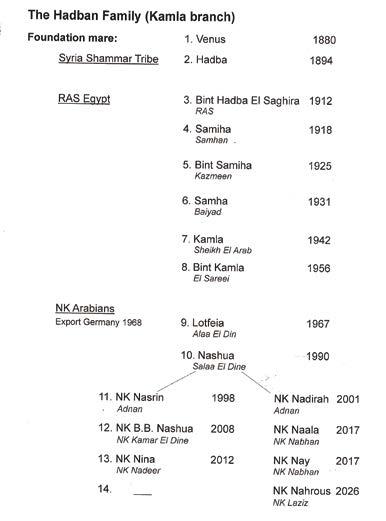
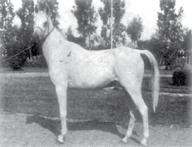
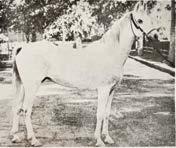
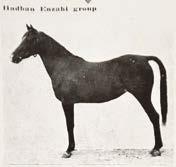
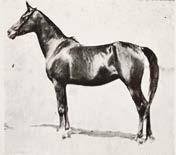
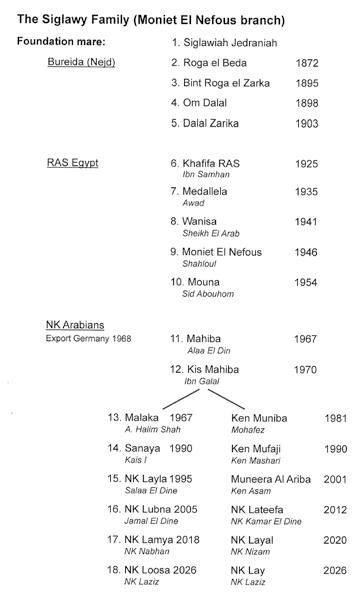
The Siglawy and the Hadban Family of the NK Arabian Stud have been bred, from generation to generation, according to these principles. From the earliest origin they have passed the test of time and their present status is the prove of their high heritage value. The first family is of the Siglawy strain; these horses present themselves as a more rectangular type, slightly longer in the back and with shorter legs, documented since the middle of the 19th century. Its origin is the Nejd region in the centre of the Arabian mainland, in today’s province of Bureida (Abbas Pasha Manuscript).
The second family is of the Hadban strain, a type of Arabian with longer legs, therefore higher in size, in total a square horse, tracing back to the mare Venus. The Shammar Bedouins claim this strain for themselves as the original breeders. These Shammar Bedouins used to live north of the Nejd region by the Shammar Mountains. During the great drought at the end of the 19th century, large parts of this tribe migrated to northern Syria with all their belongings including all their livestock. The mare Venus, belonging to the Hadban strain, was purchased in Syria at the end of the 19th century.
Appendices:
- The Hadban family (Kamla Branch)
- The Siglawy family (Moniet El Nefous Branch) - Syria with all their belongings including all their livestock.
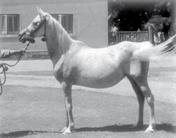
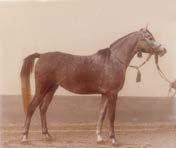
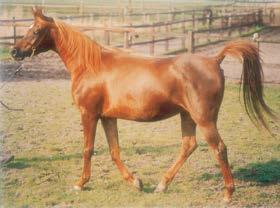
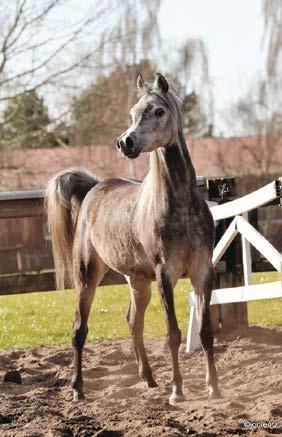
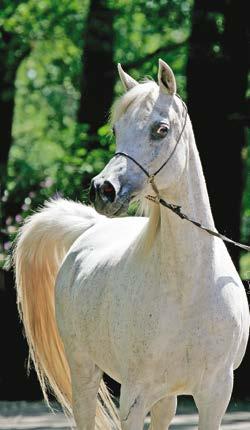
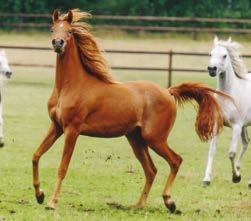
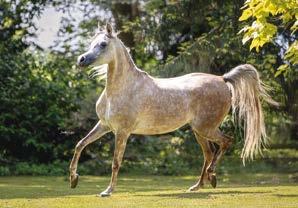
a product of the laboratory, or will it remain a masterpiece of nature and tradition?
by Monika Savier
Editing: Susan Carden - Graphic design: Mario Brunetti
The Arabian Horse stands as a testament to the power of centuries of selective breeding, shaped by nature and by the Bedouins’ unwavering dedication to traits like courage, resilience, functionality and loyalty. Its purity and refinement are unmatched, a living legacy of tradition. Yet, the last century has introduced frozen semen, assisted reproduction technologies (ART)—artificial insemination (AI), embryo transfer (ET), in the 21th century were added intracytoplasmic sperm injection (ICSI), in-vitro fertilisation (IVF), cloning and even CRISPR gene editing — these advances are reshaping the breed’s future and they offer unprecedented opportunities for the Big Pharma and Big Tech industries to capitalise on the horse industry, but for horse breeders and their horses around the world, they pose increasing existential risks. I want to emphasize that horse welfare always must weigh more heavily than purely commercial interests. We need a clear ethical compass instead of the technical assistance for speed breeding.

Intracytoplasmic sperm injection performed on an equine oocyte.
now an indispensable part of vets’ protocols for successful mating – have only been available since we replaced natural processes with reproductive technologies.
In Arabian horse breeding in the USA –which was still our opinion leader in the last century – the term ‘horse industry’ was used. This term sent a shiver down the spines of breeders in Europe, as it was reminiscent of animal production in the food industry, whose methods we Arabian breeders rejected outright. This was no problem for the pharmaceutical and biotech industries. Where there is no need, one is created and credibly propagated through a narrative suggesting that the modern Arabian breeder will only have a future through easier access to globalised markets and their technological innovations. However, the ‘industrialisation of broodmares’ meant that elite mares were often turned into ‘embryo factories’. Due to intensive hormone treatments and constant uterine flushing to produce several foals a year, many mares suffer from premature ‘reproductive burnout’.
Horse reproduction, mating, foaling and rearing are natural processes, not illnesses that need to be monitored and treated using highly technological veterinary medicine. Even ultrasound scans to determine a mare’s oestrus were, in the vast majority of cases, unnecessary in the last century. Anyone familiar with the behaviour of stallions and mares knew when a mare was ready to be covered. Healthy mares were covered in hand or inseminated with fresh semen. Mares that showed no signs of oestrus after 18 days were considered to be in foal. Anyone wishing to call a vet to be on the safe side paid just for a scan. Rarely we had a mare that failed to conceive during the entire breeding season. Hormonal treatments such as prostaglandins, HCG, Regumate and antibiotics – which are
Had it not been for the export boom of Arabian horses to Arab countries beginning 30 years ago, we would hardly have given in; yet demand from the East turned the small-scale Arabian breeding operations in rural areas of the US and Europe into a profitable enterprise. Horse breeding is an expensive undertaking, and the prospect of speeding up production through technological innovations – to bypass the slowness of natural reproduction – was tempting for many.
The first groundbreaking tool that decisively changed the lives of stallions and mares was the invention of frozen semen. Promoted as a transport alternative to enable the global
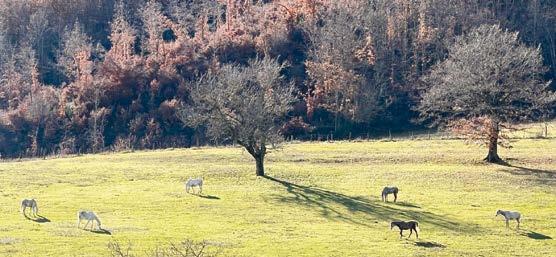
commercialisation of famous stallions via semen shipping, it enjoyed enormous success. Yes, it was now possible to order and dispatch semen from other continents. A new profession emerged: that of the equine gynaecologist – a vet with specialist skills and equipped with expensive technology, as the production of frozen semen is complex and costly.
The cryopreservation industry provided specialised containers for the shipment of frozen semen. Insemination of the mare no longer took place on the farm but, in accordance with the law, at an accredited veterinary clinic or a specially equipped breeding station. The use of ultrasound became indispensable for monitoring ovulation and ensuring insemination took place within the correct time window.
Scientists worldwide were working on ever-improving techniques to gain total control over reproduction and to shift this process away from the horses and into international biotech laboratories. Time and again, the scientific community announced a new ‘breakthrough’. Following ICSI (intracytoplasmic sperm injection) – which involves using a special microscope for oocyte retrieval which may pose certain risks to foals – the new method is an innovation designed to improve and simplify ‘in-vitro fertilisation’ (IVF), i.e. reproduction outside the uterus. Apparently, researchers have succeeded in encouraging stallions’ sperm to fertilise an oocyte – that is, an egg cell from the mare – in a Petri dish without manual intervention. This reduces the risks and costs associated with ICSI.
Research centres will claim that this method will ‘democratise’ speed breeding, as it is available to everyone. Whilst ICSI was extremely expensive, IVF could be a further step towards mass, less expensive speed breeding. As the ‘icing on the
cake’, there is also the possibility of determining the sex in advance. We will then have a glut of mares whose market value will crash just as the colts did before.
Apparently, there are already breeding stations in the Gulf States where hundreds of embryos – often full siblings –are floating in liquid nitrogen inside containers, awaiting sale at auction and implantation into a mare to carry the foal to term. Not many of the very few foals that survive this process turn out to be what the breeders expect. But with 20 full siblings, there’s bound to be a future champion among them, isn’t there? The other 19 end up on the leisure market, practically as a giveaway.
Although very few breeders in Europe use in-vitro reproduction, many foals from ‘intensive breeding’ programmes or embryo transfers are on the market here, ensuring that hardly any breeder dares to have their mares covered anymore. The costs of covering and rearing the foals probably exceed the income from their sale, as there are simply too many horses on the market. ART has set an inflationary mechanism in motion and, due to the globalisation of the market, no region in the world can feel safe from ET foals produced through invitro fertilisation.
I do not wish to romanticise the past of Arabian breeding in rural areas; there were problems too, particularly with marketing the offspring or transporting mares to the stallion, but today we are grappling with the side effects of ART and all its costly refinements. The problem is also that there are hardly any legal alternatives for freeing oneself from the industry’s grip.
The promised benefits – internationalisation, greater certainty for breeders regarding laboratory-based

WAHO'S InTeRnATIOnAlly ACCePTed mAndATORy RuleS, WHICH HAVe been RePeATedly PASSed by VOTe OF THe delegATeS TO THe geneRAl meeTIngS.
Rule 20: ClOnIng
1. It is a mandatory WAHO rule that any Arabian of any age produced by cloning must not be registered under any circumstances.
2. It is a mandatory WAHO rule that the foals of any Arabian which was produced by cloning cannot be registered.
Rule 21: eXTeRnAl FeRTIlISATIOn OF OOCyTeS FOR embRyO TRAnSFeR
Effective from 1st January 2013.
1. It is a mandatory WAHO rule that any Arabian of any age produced by the post-mortem collection of oocytes must not be registered under any circumstances.
2. It is a mandatory WAHO rule that any Arabian of any age produced by any method of In Vitro Fertilisation (IVF) must not be registered under any circumstances.
Rule 22: geneTIC mOdIFICATIOn InCludIng gene edITIng And gene dOPIng
Effective from 8 February 2019.
1. It is a mandatory WAHO rule that any Arabian horse of any age which has been subject to any form of genetic modification at the embryo stage or later must not be registered under any circumstances.
2. It is a mandatory WAHO rule that the progeny of any Arabian horse which was subject to any form of genetic modification at the embryo stage or later must not be registered under any circumstances.
3. It is a mandatory WAHO rule that any Arabian horse of any age which has been conceived using genetically modified gametes must not be registered under any circumstances.
4. It is a mandatory WAHO rule that the progeny of any Arabian horse which was conceived using genetically modified gametes must not be registered under any circumstances.
reproduction, and the health and welfare of the horses themselves – in fact relate to problems and risks that have only arisen because of the use of ART.
A few examples:
· It is said that biotechnology has saved many bloodlines from extinction through the long-term preservation of stallion semen and embryos.
On the contrary, thanks to these technologies, state studs should have invested in the genetic conservation of the older, less commercial bloodlines so that they could serve as a healthy source within the breed. Yet this possibility was not considered, and the decision on breeding was left to the market – that is, to private breeders – who, however, only invest where they expect to make a profit from their own selection breeding the best of the best. Even at the historic El Zahraa State Stud in Cairo, the cradle of authentic, pure Egyptian lines, genetic purity was abandoned in the last years in favour of using modern show stallions.
The result: ART has encouraged the ‘Popular Sire Syndrome’, thereby reducing the breed’s genetic diversity. The consequence is an increase in inbreeding and, consequently, the occurrence of hereditary diseases. One of the most common symptoms of inbreeding depression is a decline in fertility in stallions and mares.
· It is said that ART is ideal for sub-fertile stallions and mares, as in-vitro fertilisation bypasses nature whilst still enabling the production of offspring.
In this context, ART is actually counterproductive, as in natural breeding, the less fertile animals do not pass on their genes and these lines die out in favour of the healthy and stronger ones - ‘the winner mates’. We, however, artificially preserve these lines through ART and thereby produce foals carrying pathological genetic traits. Why, exactly? It’s all about money in the here and now. Famous horses of the past and their offspring are branded; it’s all about the names and the pedigrees, which will continue to play a role in the vanity market of the future.
After all, all ART methods make use of embryo transfer (ET) to transform the produced embryos into Arabian foals. There’s a catch, however, as the surrogate mare is not the biological mother. She usually comes from a gentle, fertile warmblood or even a coldblood mare of substantial build, as opposed to a delicate Arabian mare. A uterus that is too large, far too much milk, a lack of Arabian charm in her nature, and certainly the mother’s different gaits influence the embryo for 11 months and then the foal for a further 6 months until weaning.
This is where epigenetics comes into our breeding management. The term is a combination of the words genetics and epigenesis, i.e. the development of a living organism. Epigenetics is regarded as the link between environmental influences and genes. However, it is not limited to maternal socialisation: epigenetics also refers to heritable changes in gene function without any alteration to the DNA sequence. In horses, training, feeding, stress, husbandry and breeding methods are all factors that can influence epigenetic patterns. Many breeders therefore do not include ET foals in their breeding programmes. This already highlights a clash between tradition and breed purity on the one hand, and laboratory technology and market orientation on the other.
It is high noon for the traditionally run Arabian studs, which have formed the backbone of quality breeding throughout the world.
Yet we are not giving up hope. WAHO’s resolute stance on strictly prohibiting cloning, any form of in-vitro fertilisation, and genetic modification is our strongest line of defence. Whilst international commercial pressure from biotech firms is pushing for the unrestricted deregulation of these laboratory techniques, WAHO’s decision ensures that Arabian horses and their original genetics have a right to welfare and protection.
In the interests of the horses and the breeders, the Registries should communicate the relevant rules more effectively, as most breeders are unaware that foals produced through any method of in-vitro fertilisation (IVF), genetic modification or

cloning cannot be registered in their country’s stud book. It should be mentioned that WAHO Rules refer to the non-registration of the resulting foals, and their future offspring, not the procedures themselves. Obviously, it is very difficult to ‹police› these rules, and that WAHO Registering Authority Members do face difficulties in enforcing them, as they cannot easily verify the methods used to create the foals when registration is applied for.
To help their Member Registries to be more effective, WAHO has asked them all to ensure that any veterinary centres in their country offering these procedures are aware of the rules.
There is one lever that everyone can pull: drastically reducing the number of foals registered per mare per year. After all, the industrial-scale mass production of foals can only function if there is no limit on the registration of ET foals. Egypt has shown how things can be done better. From 2026, only one foal per mare per year may be registered there, regardless of whether it is produced via ET or naturally. Applause for this courageous decision. Poland, too, is already a good step ahead of most member countries: a maximum of one natural and one ET foal per mare may be registered each year. And in addition: The recipient mare must be an Arabian mare to combat the epigenetic effect. Czech Republic, France, Jordan and Sweden followed the Polish Idea of 1+1.
The welfare of the horses must take precedence over purely commercial interests. An ethical compass for the conservation of the Arabian horse breed will have a positive long-term impact for everyone. This is the only way we can prevent the majority of Arabian horses in the future from being the product of laboratory technology.
Monika Savier has been breeding Arabian horses in Italy for 35 years. Since 2015 her farm operates a certified European stallion station. She has an MA in Social and Educational Science and also works as an equestrian journalist for Desert Heritage and other Arabian horse magazines.
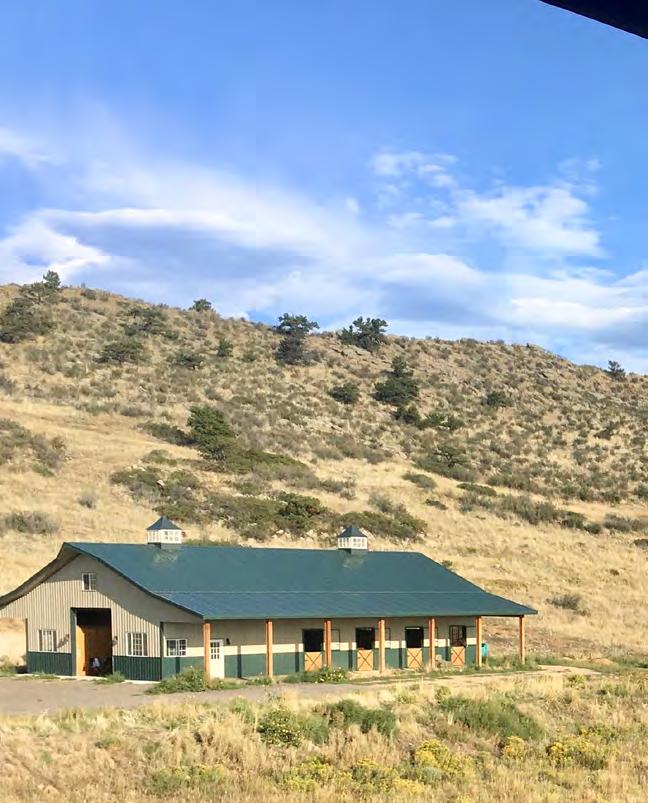
Alicia Midgett, founder and owner of Nasmat stud in Colorado, USA writes about the history and life nowadays with her 40 Straight Egyptians at Nasmat Stud. This farm is situated in the natural, unspoilt countryside where Arabian horses can enjoy their freedom whilst being raised in herds like just as in the days of their origins.
If I have to define my breeding program, I’ll answer honestly: it is a combination of carefully planned matings and a percentage of happy accidents.
Almost every year, one or more young colts that I’m still evaluating inevitably break out and breed mares. Because they are all bred within the philosophy of my program, I’m comfortable with those unexpected pairings. In many ways, I find them fascinating.
I’m curious about the mares’ choice of stallions, the decisions the horses make on their own, and what those unplanned breedings can teach me.
Sometimes, taking a small step outside my carefully laid plans reveals possibilities I might never have considered.
Alicia Midgett
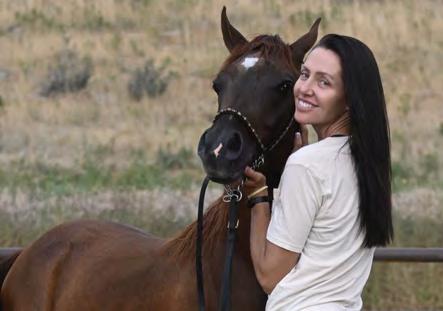
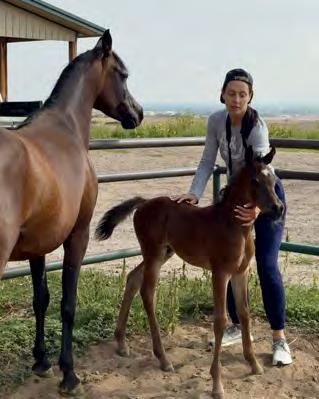
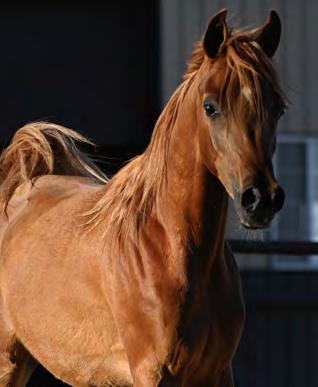
n by Alicia Midgett
It’s hard to believe we welcomed our 20th foal crop this year. 20 years has come and gone in the blink of an eye. This has been an amazing project, and I have learned so much. I am so grateful to have been able to experience this.
I’m not sure what possessed me to start this project. It just kind of happened. I had always loved horses, but I think my family hoped I would grow out of my desire to own a horse when I was grown.
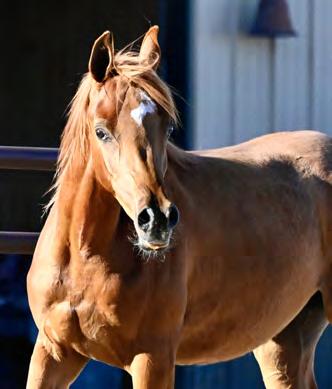
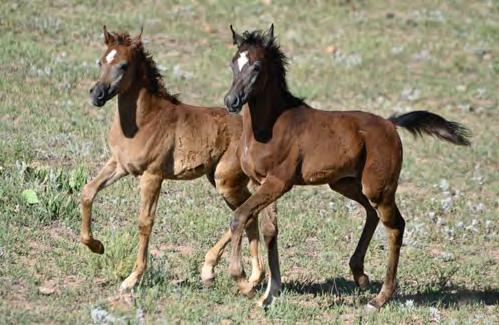
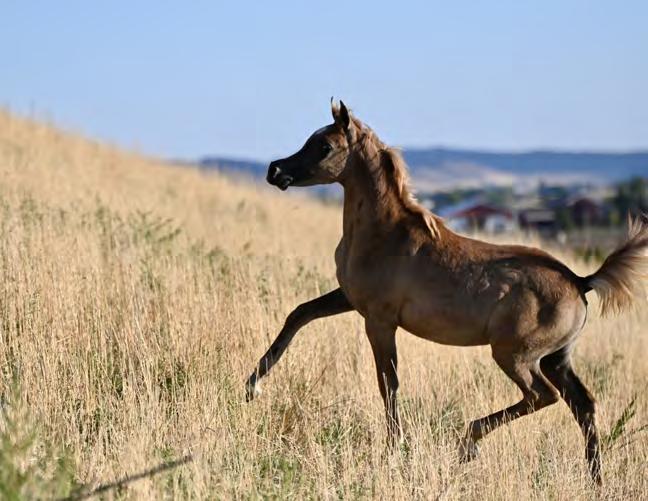
I got my first Arabian when I was 29. He was a pure Polish gelding. Shortly after that, I would fall in love with a straight Egyptian stallion named Rafiq. He was a son of El Hadiyyah by Ansata Ibn Halima. Somehow, I became obsessed with the Ansata program when I was little. My dad travelled a lot for business and found a brochure from Ansata Egyptian Stud at one of the hotels he was staying in Arkansas, and he thought I would like it because I was into horses. He was right, and I named all my Breyer horses with the prefix and names. So, I was drawn to Ansata from the get-go, I purchased that straight Egyptian Stallion, and began to learn all about bloodlines. I never intended to breed, it just happened. I fell upon a beautiful little mare named SDR Hostan Granat, she was a typey compact near perfect little mare and I bred her to Rafiq in 2006 for our first foal. She was by Cajun Man who was an Ansata Shah Zahir son. I was incredibly nervous about breeding these horses by myself. I had limited horse experience, but as people proved to be completely unreliable, I took on the project by myself.
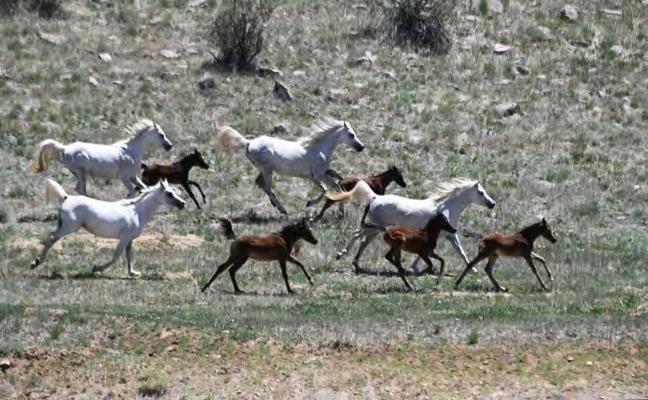
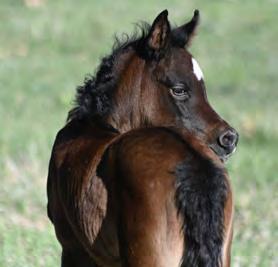
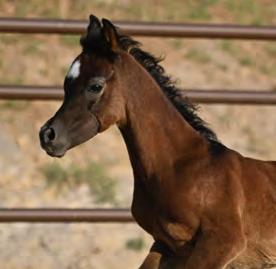
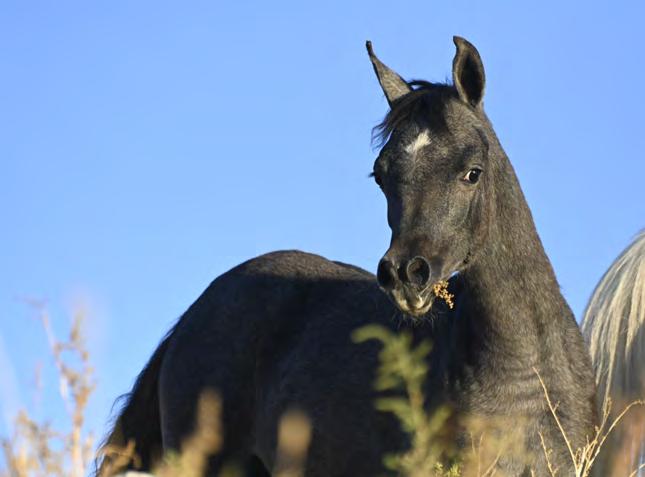
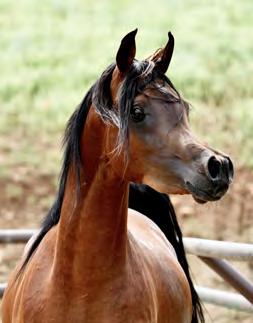
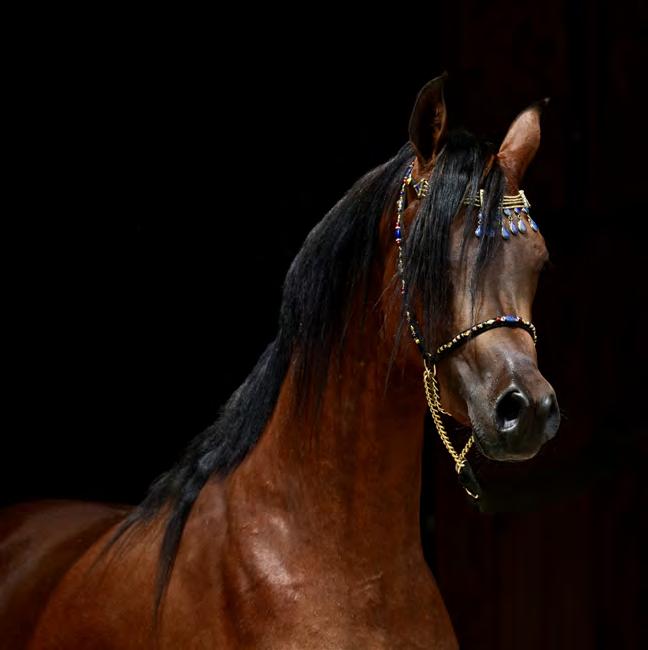
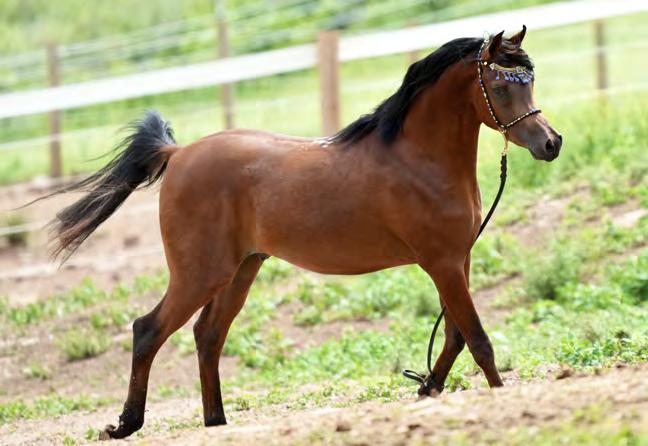
Since I thought Granat was a perfect little mare, I set out to find her sire and purchase him and buy any daughters I could find of his. The terms of the lease of Granat were that I would get a foal and send the mare back in foal. As luck would have the owner decided to sell buyer came for a pre-purchase exam and she failed a silly flexion test and I was able to purchase Granat myself. That year she had an incredible filly, Nasmat Aleftina. She was so special and one of the founding mares of our program for sure. She was a dark liver, chestnut, and we still see this colour in our herd of her daughters and granddaughters.
Aleftina ultimately suffered a pre-pubic tendon rupture that would take her life, but I was honoured to be with her when she took her last breath.
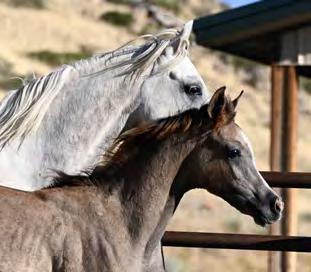
Over the years, we have focused on one Stallion at a time normally attempting 10 to 15 test breedings in a year and then evaluating the offspring. Over the past years we have landed on a very special Stallion, El Zilal Tamar, whom we imported from Gregor Pintar in Slovenia as a nine-monthold. His blood now saturates our herd, and we have many important daughters from him. Our stallion Jamal Al Rashediah, imported from the Netherlands, has also been an important piece in building a broodmare band that we want to take into the next generation.
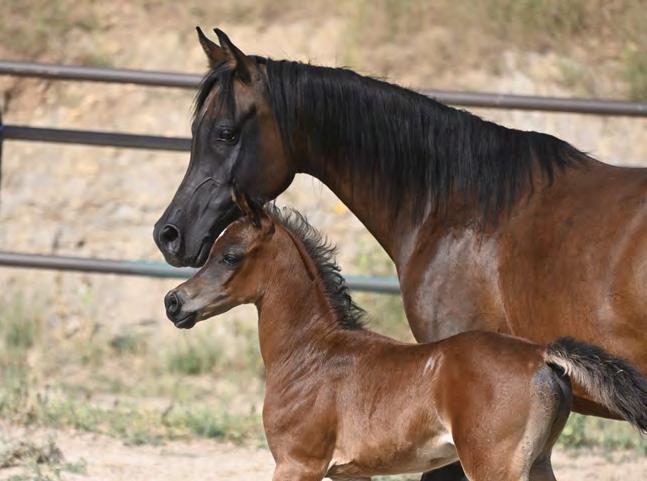
For the past two years, we have exclusively been test breeding Nemty our son from NK Nabhan, whom we imported in utero from Germany after breeding our mare Al Ilha Taghira to NK Nabhan. We are very happy with his production so far, he excels in both temperament and type and consistently passes his marvellous qualities onto his offspring. Nemty has successfully crossed with all our bloodlines here.
I wanted to take this opportunity while celebrating Dr. Nagels 96th birthday this year and the success of his program to highlight Nemty and his role at our stud. Here we are presenting Nemty himself and some examples of his first two years of production. Hope you enjoy. We have some of his offspring available please feel free to contact me. q
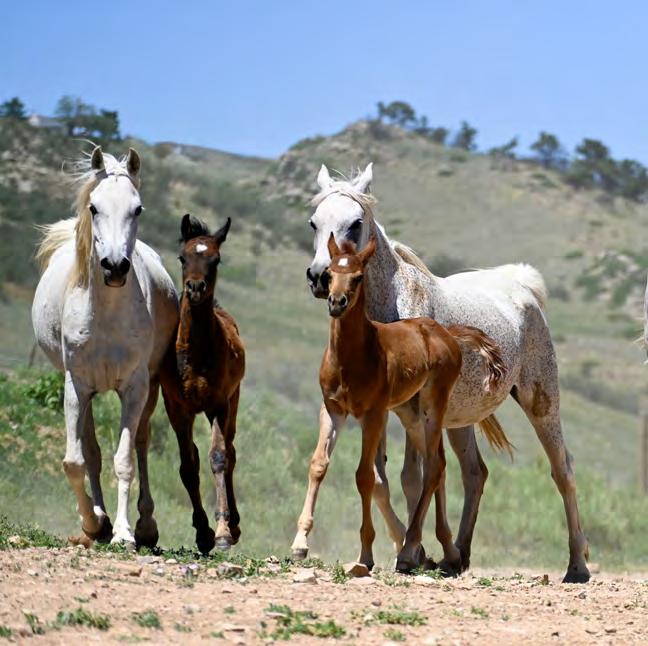

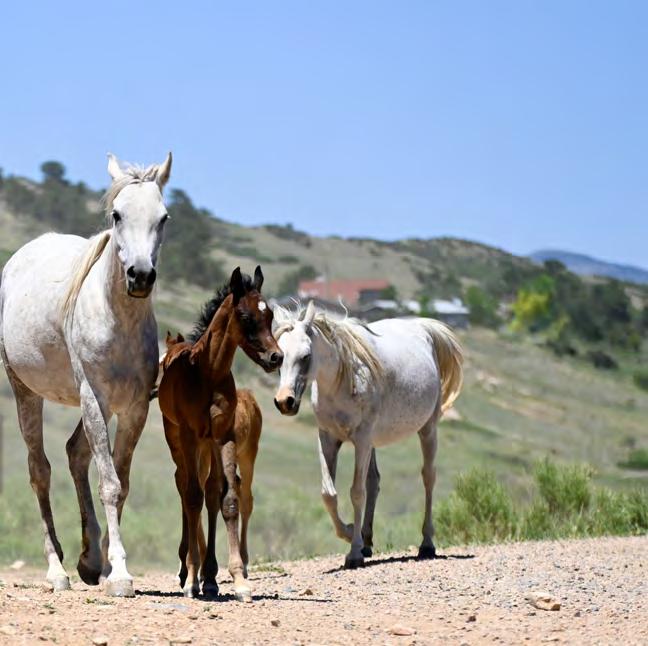
Arabian Horses IN THE FOCUS, online & print the high-quality magazine in German language published four times a year featuring:
The Arabian horse as a leisure and sports companion
Legendary breeding lines
Arabian studs at home and abroad
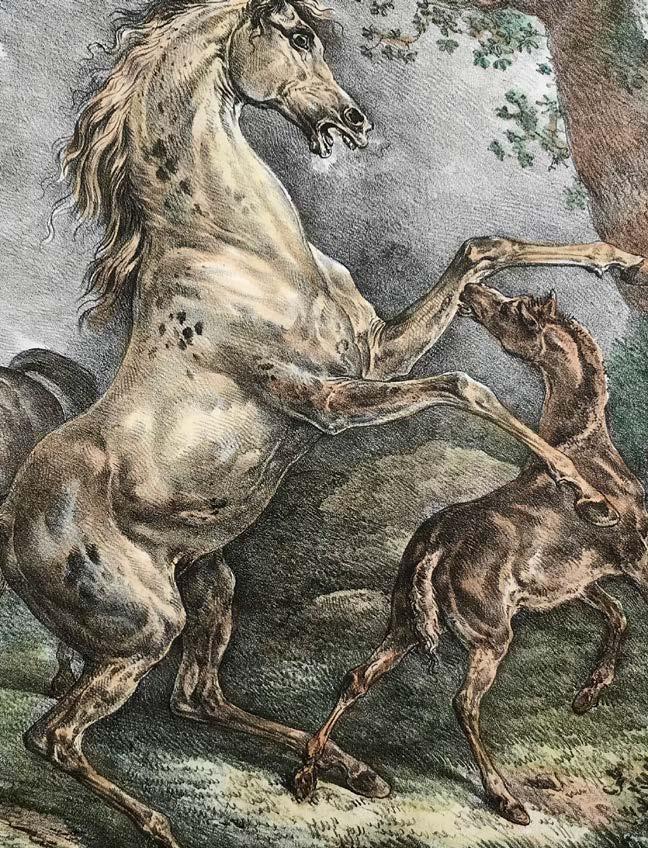
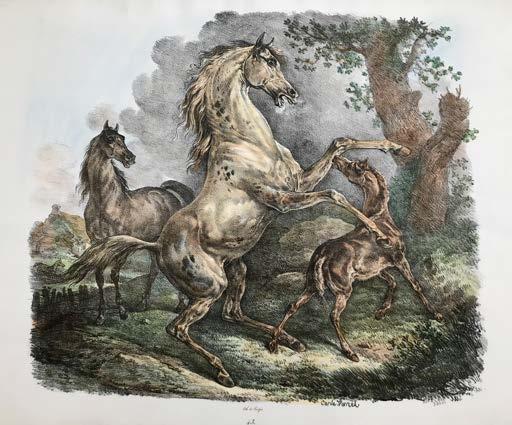
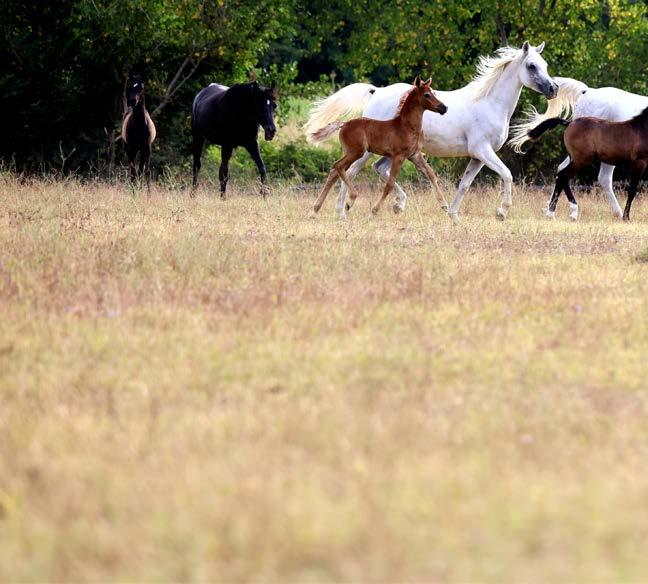
Are we still breeding or are we just multiplying?
Arabian horses are something special – their rich history, their beauty, their nobility and charisma, their movements, but also their gentle nature, their intelligence and their reliability; these qualities have made the Arabian horse an international breed, registered with the WAHO in more than 80 countries. Good horse breeding is firmly rooted in its rural environment and continues to draw its essence from agricultural and farming traditions, from a great deal of manual labour and maximum degree of freedom for the horses, which forms the basis for their mental and physical health. Is this still true today? Or are these lines merely a romanticised description of the past? To what extent have the industrialisation and digitalisation of our time not only changed the breed, but also our specific perspective and the (commercial) interest in horse breeding?
The famous desert horses of the past have now been reduced, through selection, to three highly specialised groups: Arabian horses on the racecourse, where racing performance is what counts, regardless of the phenotype. The situation is similar with endurance Arabians. For show Arabians, the beauty factor is the be-all and end-all, particularly with regard to the head and
neck. For healthy ‘all-rounders’, there is now only the market of enthusiasts in the leisure sector. Yet even there, changes in the Arabian horse breed have become widespread. Particularly regarding the ‘interieur’ – that means, inner qualities such as character and breed-typical traits, fertility and morphological aspects in show Arabians – it is becoming increasingly clear that most breeders today no longer feel responsible for the long-term consequences of their selection practices within this breed.
The following interview, conducted by Gudrun Waiditschka – former Secretary General of ECAHO, biologist and editor of the magazine Arabische Pferde IN THE FOCUS – (www.in-thefocus.com) – with Andreas Perner, is based on his presentation at the annual general meeting of the VZAP (Arabian Horse Association in Germany). It addresses the disclosure of problematic developments in Arabian breeding, which have arisen primarily through specialisation and selection for individual traits. Perner also highlights interesting, scientifically grounded parallels from cattle breeding – insights that are helpful for modern horse breeding.
by Monika Savier
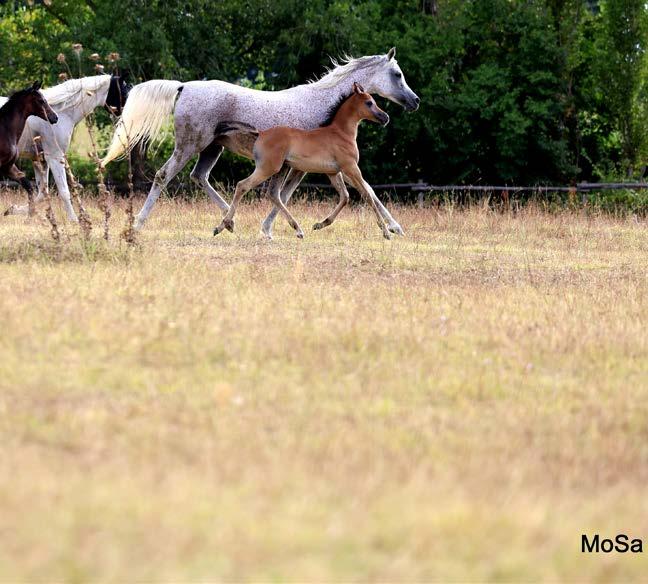
“Horse breeding is a rather conservative area of animal breeding, so perhaps we shouldn’t follow every fashion, but rather the experiences of the last centuries”
Gudrun Waiditschka
I cavalli arabi sono delle creature speciali: la loro considerevole storia, la loro bellezza, la loro nobiltà e il loro carisma con movimenti impressionanti, ma anche la loro intelligenza e la loro affidabilità hanno reso i cavalli arabi una razza di interesse internazionale, registrata presso la WAHO in più di 80 Paesi del mondo. Un buon allevamento equino è saldamente radicato nel suo ambiente rurale e trae ancora oggi la sua essenza dalle tradizioni contadine, da un intenso lavoro manuale e dalla massima libertà per i cavalli, che costituisce la base della loro salute mentale e fisica. È ancora vero oggi? O queste righe sono solo una descrizione romantica del passato? In che misura l’industrializzazione e la digitalizzazione dei nostri tempi hanno cambiato la razza, e il nostro specifico punto di vista - oltre all’interesse (commerciale) ad esso collegato - per l’allevamento dei cavalli?
I famosi cavalli del deserto del passato si possono oggi ricondurre per effetto della selezione, a tre gruppi altamente specializzati: i cavalli arabi sulle piste da corsa, dove ciò che conta è la prestazione in gara, indipendentemente dal fenotipo. Gli arabi da endurance, per cui vale lo stesso principio. E gli arabi da show, per i quali il fattore bellezza è il non plus ultra, specialmente per quanto riguarda la testa e il collo. Per i soggetti sani “tuttofare” esiste ormai solo il mercato degli appassionati
nel settore del tempo libero. Ma anche lì i cambiamenti nella razza araba dovuti alle modalità di selezione e riproduzione di cui tratterà questa intervista si sono diffusi.
Per quanto riguarda soprattutto l’interiorità, ovvero valori come il carattere, il carisma e le caratteristiche tipiche della razza, ma anche la fertilità e in particolare gli aspetti morfologici nei cavalli arabi da show, si nota sempre più che la maggior parte degli allevatori di oggi non si sente più responsabile dei risultati a lungo termine delle modalità con cui opera la propria selezione di questa razza.
La seguente intervista con Andreas Perner, condotta da Gudrun Waiditschka, ex segretaria generale dell’ECAHO, biologa ed editrice della rivista Arabische Pferde IN THE FOCUS – (www. in-the-focus.com), si basa sulla relazione di Perner all’Assemblea Generale annuale della VZAP (Associazione dei Cavalli Arabi in Germania) nella quale denuncia gli sviluppi problematici nell’allevamento arabo, causati soprattutto dalla specializzazione e dalla selezione. Perner mostra anche interessanti parallelismi scientificamente fondati con l’allevamento bovino, condividendo nel contempo conoscenze utili per l’allevamento equino odierno.
by Monika Savier
Andreas Perner studied in Vienna, specialising in animal breeding and population genetics. He heads the Research Institute for Ecological Animal Breeding and Land Use (FIT), the successor organisation to the Institute for Domestic Animal Genetics at the University of Veterinary Medicine in Munich, founded by Prof. Dr Frederik Bakels and his assistant Dr Richard Storhas. Research, education and public relations work for organic farming, particularly in the field of organic animal breeding, are the institute’s main areas of focus. In addition to their main work, Andreas Perner and his wife run an organic farm with dairy cows and Arabian horse breeding.
Andreas Perner ha studiato a Vienna e si è specializzato in zootecnia e genetica delle popolazioni. Dirige l’Istituto di ricerca per l’allevamento ecologico e l’uso del territorio (FIT), l’organizzazione che ha preso il posto dell’Istituto di genetica degli animali domestici presso l’Università di Medicina Veterinaria di Monaco, fondato dal Prof. Dr. Frederik Bakels e dal suo assistente Dr. Richard Storhas. Ricerca, formazione e attività di sensibilizzazione per l’agricoltura biologica, in particolare nel campo della zootecnia ecologica, sono i principali compiti dell’istituto. Come attività secondaria, Andreas Perner e sua moglie gestiscono un’azienda biologica con vacche da latte e allevamento di cavalli arabi.
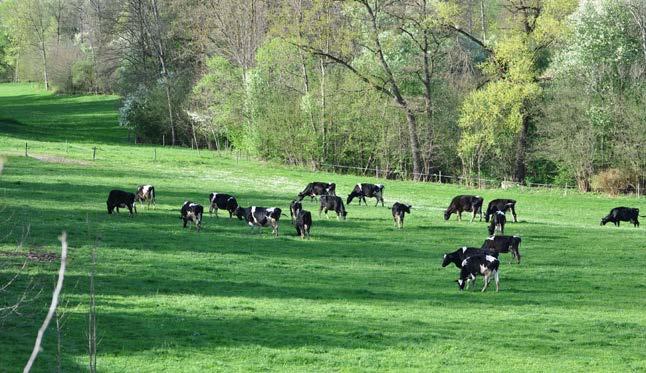
by Gudrun Waiditschka
Mr. Perner, in your presentation at the VZAP general meeting you pointed out some parallels that exist between cattle and horse breeding. Why should we concern ourselves with cattle when we are actually interested in horses?
Perner: Because there are numerous parallels. The primitive cattle were characterized by an enormous chest cavity with plenty of space for the organs, relatively fine legs and a pelvic shape with a high sacrum so that birth could proceed quickly. Through breeding selection, a major change in this appearance has taken place over the last 100 years, including extreme specialization in beef and dairy cattle. Since cows as farm animals have long been the focus of science, one also has easy access to data, e.g. milk yield, slaughter weight, but also bone measurements, etc., which can also be used to document such changes.
In animal breeding, a distinction is made between two constitution types: the asthenic and the athletic. The representatives of the Holstein cattle, a highly specialized breed of dairy cattle, today almost exclusively belong to the asthenic constitutional type: large, tall and narrow, i.e. less space in the chest for the organs, rather poor feed conversion, etc. Male calves of this breed are so weak in the muscle development that they no longer have any economic (slaughter) value. Before this extreme specialization in milk production, this breed corresponded to dual-purpose cattle (milk and meat) and thus more of the athletic constitution type, which has become very rare today. One can definitely draw parallels here with Arabian breeding, where the Arabian show horse was bred through specialization – and became also an asthenic, tall, long-legged, with little depth to the trunk. And among Arabians, too, the athlete, the medium-sized, broad, deep-rumped Arabian of the “old type” who is
Signor Perner, nella sua relazione in occasione dell’assemblea annuale 2025 dei soci della VZAP (Stud book Cavalli arabi in Germania), ha evidenziato alcuni parallelismi tra l’allevamento dei bovini e quello dei cavalli. Perché dovremmo occuparci proprio dei bovini, se in realtà ci interessano i cavalli?
Perner: Perché ci sono numerosi parallelismi. Il bovino originario era caratterizzato da un torace enorme con molto spazio per gli organi, gambe relativamente sottili e una forma del bacino con osso sacro prominente, in modo che il parto potesse avvenire agevolmente. A causa della selezione allevatoriale, negli ultimi 100 anni si è verificato un forte cambiamento di questo aspetto, fino ad arrivare ad una specializzazione estrema in bovini da carne e da latte. Poiché le vacche, in quanto animali da reddito, sono da molto tempo al centro dell’attenzione della scienza, è facile accedere ai dati disponibili, ad esempio la produzione di latte, il peso alla macellazione, ma anche le misure delle ossa, ecc., che consentono di dimostrare tali cambiamenti. Nell’allevamento degli animali si distinguono due tipi di costituzione: l’astenico e l’atletico. I capi della razza Holstein, una razza bovina da latte altamente specializzata, appartengono oggi quasi esclusivamente al tipo di costituzione astenico: grandi, alti e snelli, cioè con meno spazio nel torace per gli organi, piuttosto scarsa conversione alimentare, ecc. I vitelli maschi di questa razza hanno così poca muscolatura da non avere più alcun valore economico (per la macellazione). Prima di questa estrema specializzazione nella produzione di latte, questa razza corrispondeva a un bovino da latte e da carne quindi ad un bovino a duplice attitudine con un tipo di costituzione atletica, oggi diventata molto rara. Si possono tracciare parallelismi con l’allevamento di cavalli arabi dove la specializzazione ha portato alla selezione del cavallo arabo da show, anch’esso astenico, alto, con zampe lunghe e torace poco profondo. E anche tra gli
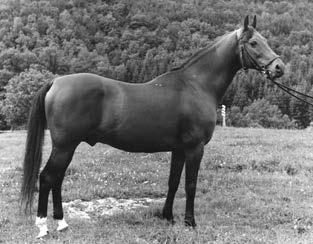
Halef (Enwer Bey / Kasztelanka), who was born in Poland in 1937, embodied the athletic build characterised by medium height, broad shoulders and a deep chest – a physique that has become very rare today.
also a good feed converter, is becoming increasingly rare. From a population genetic point of view, this is a major catastrophe and countermeasures must be taken.
If we ignore the outside appearance, i.e. the conformation – are there any other changes that have occurred as a result of this specialization?
Perner: In the last 30-40 years, dairy cattle have increasingly been bred for maximum performance (milk production) in the young animals, i.e. there has been conscious selection for early maturity. This has resulted in serious changes in the animals: through selection for early maturity, the useful life has been extremely shortened due to high susceptibility to disease and fertility problems - the latter is the main cause of loss in cattle breeding. This can also be proven with figures: In Germany today a cow has an average of 2.4 calves, but biologically it can have 14-15 calves. The “useful life” of cows is now at an all-time low. The selection for early maturity also has an impact on the quality of the claws: the early maturing animals need claw care three times a year, because the claws are soft and grow very quickly. In contrast, slow, long-lasting growth - i.e. late maturity - ensures healthy development of the entire organism and a long lifespan. Late-maturing cattle only need hoof care once a year, sometimes only every two years, because they have extremely good, strong hoof horn.
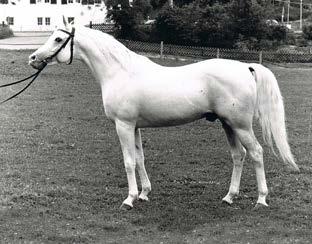
Saher (Ghazal / Sahmet) *1967, champion at the first international Arabian horse show in Germany, Verden 1973.
arabi, l’atleta, l’ arabo di taglia media, largo e dal torace profondo, il tipo “classico”, che è anche un buon consumatore di foraggio, sta diventando sempre più raro. Dal punto di vista della genetica delle popolazioni, questo presenta un vero disastro e bisognerebbe intervenire per contrastarlo.
Se tralasciamo l’“aspetto esteriore”, ci sono altri cambiamenti causati da questa specializzazione?
Perner: Negli ultimi 30-40 anni i bovini da latte sono stati allevati sempre più per ottenere il massimo rendimento già nei giovani animali, cioè si è selezionata consapevolmente la precocità. Ciò ha portato a gravi cambiamenti negli animali: la selezione per la precocità ha ridotto notevolmente la durata di utilizzo a causa dell’elevata suscettibilità alle malattie e dei problemi di fertilità, che rappresentano la principale causa di abbattimento nell’allevamento bovino. Ciò può essere dimostrato anche con i numeri: in Germania oggi una vacca partorisce in media 2,4 vitelli, ma dal punto di vista biologico potrebbe partorirne 14-15. La “durata di utilizzo” è oggi ai minimi storici. La selezione per la precocità ha anche un impatto sulla qualità degli zoccoli: gli animali precoci hanno bisogno di tre trattamenti all’anno, gli zoccoli sono morbidi e crescono molto rapidamente. Al contrario, una crescita lenta e prolungata, con una maturità tardiva, garantisce uno sviluppo sano dell’intero organismo e una lunga durata di vita.
All this can also be transferred to the horse, because the horse’s hoof horn is also of better quality in latematuring animals. This all depends on the high quality of the connective tissue. If you breed late-maturing animals, they often look underdeveloped when they are young and breeders often do not recognize their true quality. It is also a feature of breeding for longevity that it produces healthier animals, which statistically incur significantly less veterinary costs (i.e. only a quarter of the costs) in cattle breeding. Here, too, the parallels to horse breeding seem clear to me: the late-maturing types have no chance at shows in the junior classes, which is why show horse breeding promotes the early-maturing type. Late maturing horses often look like “ugly ducklings”, but often they only become “beautiful swans” when they are 6 years old or older. Egyptian breeding has had this problem for a long time, which is why you see fewer and fewer Egyptians at international shows or they have their own shows where they are not in competition with the early-maturing “show horses”.
When you say that a late-maturing horse is characterized by long-term growth, which then ensures healthy development of the entire organism and a long lifespan, the Russians come to mind. But it is precisely these that are tested on the racetrack very early, as early as two-year-olds. Isn’t that a contradiction?
Perner: As far as I know, the two-year-old horses are prepared very carefully for the racetrack and the trainers make sure that they are not overstrained. The horses also have time to develop further - they are encouraged to exercise without being overstrained. As
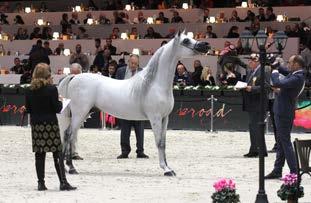
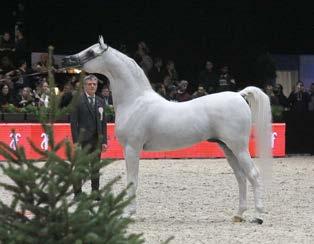
I bovini tardivi necessitano di cure agli zoccoli solo una volta all’anno, a volte anche solo ogni due anni, perché hanno zoccoli estremamente buoni e resistenti, cosa che si può trasferire anche al cavallo, poiché anche lo zoccolo del cavallo è di migliore qualità negli animali tardivi, legato all’alta qualità del tessuto connettivo. Quando si allevano animali a maturazione tardiva, questi spesso sembrano meno sviluppati in giovane età e gli allevatori spesso non riconoscono la loro vera qualità. È anche una caratteristica dell’allevamento orientato alla longevità che produce animali più sani, che nell’allevamento bovino, dal punto di vista statistico comporta costi veterinari significativamente inferiori di quasi un quarto. Anche in questo caso mi sembrano evidenti i parallelismi con l’allevamento dei cavalli: i soggetti a maturazione tardiva non hanno alcuna possibilità nelle classi junior degli show, motivo per cui l’allevamento di cavalli di questo tipo promuove gli animali precoci. Spesso i cavalli a maturazione tardiva sembrano “brutti anatroccoli”, ma in molti casi diventano “bei cigni” solo dall’età di 6 anni in poi. Questo problema affligge da tempo l’allevamento di arabi puri egiziani, motivo per cui se ne vedono sempre meno agli show internazionali o hanno le loro gare riservate, dove non sono in concorrenza con i “cavalli misti”.
A modern show horse type and a slender build: ES Sarab (Marajj (by Marwan Al Shaqab) / Mahjesty (by WH Justice) *2012 – tall, long-legged, with little depth of chest.
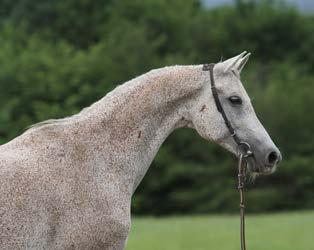
In Russia, importance is still attached to sexual dimorphism; a mare is immediately recognisable as such...
a result, they develop better, become wider in the chest, more muscular overall, the entire organism becomes stronger, etc.
But ultimately what matters is: How old do the horses get in good health - and therefore without major veterinary costs? And in the case of breeding animals there is also the question: How good is their fertility? There are Russian stallions with racetrack careers who are still mating naturally at the age of 28, mares who still have foals at well over 20 years of age, and the Arabian mare Nefta in Pompadour, France, had one foal every year between 1975 and 1995, i.e. 21 foals in
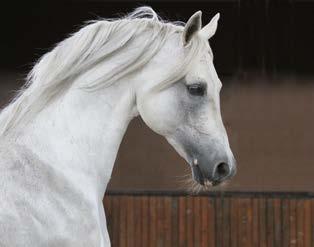
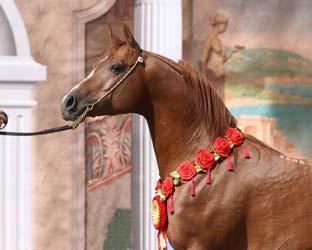
... and a stallion is a “gentleman”, because “the more masculine the male animals appear, the more feminine their female offspring are”.
Quando lei dice che un cavallo a maturazione tardiva è caratterizzato da una crescita prolungata, che garantisce uno sviluppo sano dell’intero organismo e una lunga durata di vita, mi vengono in mente i cavalli arabi di linea russa. Ma proprio questi vengono testati molto presto, già a due anni, in pista. Non è una contraddizione?
Perner: Per quanto ne so, i cavalli di due anni vengono preparati con molta attenzione all’ippodromo e gli allenatori fanno attenzione a non sovraccaricarli. I cavalli hanno anche il tempo di svilupparsi ulteriormente: vengono stimolati dal punto di vista sportivo senza essere sovraccaricati. In questo modo si sviluppano meglio, diventano più larghi di petto, complessivamente più muscolosi e l’intero organismo si rafforza, ecc. Ma alla fine ciò che conta è: quanti anni vivono i cavalli in buona salute, senza grandi spese veterinarie? E nel caso degli animali da riproduzione si aggiunge anche: quanto sono fertili? Ci sono “stalloni russi” che hanno corso, che a 28 anni continuano a coprire in naturale, fattrici che a oltre 20 anni hanno ancora puledri ad esempio la fattrice araba purosangue Nefta a Pompadour, in Francia, ha avuto un puledro ogni anno tra il 1975 e il 1995, per un totale di 21 puledri! Nell’allevamento di cavalli da esposizione non mi vengono in mente esempi simili che non abbiano fatto uso dell’embryo transfer (ma sono pronto a ricredermi!). Nell’allevamento di cavalli a sangue caldo si vede l’effetto della selezione sulla precocità, in particolare nei cavalli da salto, che spesso già a 8-9 anni subiscono una nevrectomia
Straight profile of the Russian stallion Teddi (Drug / Travinka) *1996, a former race horse with large black eyes.
total! I don’t know of any such examples from show horse breeding without the use of embryo transfer (but I’m happy to be informed!).
In warmblood breeding you can see what selection for early-maturity does, especially with show jumping horses, the horses often have a nerve cut at 8 to 9 years of age, then you have two more years of use, so to speak, and then they go to the slaughterhouse. Or think of the hypermobility of dressage horses, which have weak connective tissue and the resulting weakness of the joints, capsules and ligaments as well as the tendons and muscles. That cannot be the breeding goal.
To what extent have modern selection methods influenced the development of specialization?
Perner: Specialization in cattle has been driven forward in the last 10 years by genomic breeding value estimation, which has now also found its way into horse breeding. For this method, the entire genome had to be sequenced and all performance parameters were then assigned to specific gene loci. Then, using complicated calculations, one could get an estimate of what performance the animal in question will perform in the future. In this way, it was possible for a young cow to achieve a milk production of over 40 kg per day, but the animals are no longer physiologically able to absorb enough nutrients to be able to achieve this output at all! As a result, over 90% of young cows end up with severe organ damage in the slaughterhouse. This means that the animals can endure it for a certain amount of time, mobilize all their body reserves but at some point, their metabolism switches off and liver damage occurs, which ultimately leads to death.
Part of the problem is that selection according to the wrong parameters took place. Instead of taking “longevity” and “health” into account, they only selected for “milk production”. A lot of breeding knowledge is also lost due to the convenient catalogue selection. The people who are in charge of cattle breeding today only use the preliminary breeding value or the genomic value for planning the matings.
We are not quite there yet in horse breeding and especially not in Arabian horse breeding. But here too, a lot of breeding knowledge has been lost in recent years!
How can you avoid such a development in horse breeding as you have outlined for cattle breeding?
Perner: In our association “European Association for Natural Cattle Breeding” we have selected cow
chirurgica, dopo di che si hanno, per così dire, ancora due anni di utilizzo e poi vanno al macello. Oppure pensate all’ ipermobilità dei cavalli da dressage, che hanno un tessuto connettivo lasso e una conseguente debolezza delle articolazioni, delle capsule e dei legamenti, nonché dei tendini e dei muscoli. Questo non può essere l’obiettivo dell’allevamento.
In che misura i moderni metodi di selezione hanno influenzato lo sviluppo della specializzazione?
Perner: Negli ultimi 10 anni, la specializzazione nel settore bovino è stata promossa dalla valutazione genomica, che nel frattempo ha fatto il suo ingresso anche nell’allevamento dei cavalli. Per questo metodo è stato necessario sequenziare l’intero genoma e quindi assegnare tutti i parametri di prestazione a determinati locus genetici. Successivamente, con l’aiuto di complessi calcoli, è stato possibile ottenere una stima delle prestazioni che l’animale in questione avrebbe fornito in futuro. In questo modo si è ottenuto che una giovane vacca raggiungesse una produzione di latte superiore a 40 kg al giorno, ma gli animali non sono più fisiologicamente in grado di assorbire così tante sostanze nutritive da poter realizzare tale prestazione! Di conseguenza, oltre il 90% delle giovani vacche finisce al macello con gravi danni agli organi. Ciò significa che gli animali resistono per un certo periodo di tempo, mobilitando tutte le riserve del corpo, ma a un certo punto il metabolismo subisce un crollo e si verificano danni al fegato che alla fine portano alla morte. Parte del problema è che la selezione è stata effettuata in base a parametri sbagliati. Invece di includere “longevità” e “salute”, si è selezionato esclusivamente in base alla “produzione di latte”. Inoltre, la “comoda” selezione da catalogo comporta una perdita di molte conoscenze zootecniche. Le persone che oggi hanno il controllo nell’allevamento bovino utilizzano solo il valore genetico provvisorio o il valore genomico per pianificare l’accoppiamento. Nell’allevamento dei cavalli, e in particolare nell’allevamento dei cavalli arabi, non siamo ancora arrivati a questo punto. Ma anche qui negli ultimi anni si è perso molto del sapere degli allevatori!
Come si può evitare un simile sviluppo, come quello che lei ha descritto per l’allevamento dei bovini, nell’allevamento dei cavalli?
Perner: Nella nostra associazione “Associazione europea per l’allevamento naturale dei bovini” abbiamo selezionato famiglie di vacche che, da un lato, si sono dimostrate longeve per diverse generazioni e, dall’altro, nelle ultime 3-4 generazioni hanno prodotto oltre 100.000 litri di
families that have proven to be long-lived over several generations and in which the animals have produced over 100,000 litres of milk in the last 3 to 4 generations. We buy bulls from these cows. We have also inseminated such cows with semen from bulls that lived 30 or 40 years ago, and we now have the first 200 daughters of this F1 generation of the appropriate age. What’s exciting is that the animals produce almost as much milk as their “high-performance relatives”, but are significantly healthier! The question now is: How to continue breeding with the F1 generation – this requires a lot of breeding experience and knowledge. But this is exactly what young farmers are missing.
In horse breeding we have the same problem, where the most diverse bloodlines are crossed together and due to Mendel’s rules, the appearance then splits in all directions in the F2 generation, and top horses that cost a lot of money produce maximum average offspring, as can be seen from the example of the gelding Agnat (pedigree see AP 2-22). That’s why we offer information in our association on the topic: How do you have to breed in order to achieve a high level of heredity reliability? To do this you have to use the old breeding methods, i.e. line breeding, occasional inbreeding, always working with blood connection. Then I don’t have the problem of anything splitting.
Let’s stay with Arabian breeding: What are the breedtypical characteristics that you should select for?
Perner: Breeding means selecting. That doesn’t mean that the horses that are not suitable for breeding go to the slaughterhouse. But you have to decide which horses go into breeding based on which characteristics and which don’t. Those that do not go into breeding should still have enough quality that they can survive in their respective market segment (riding horses, show horses, racing horses).
Characteristics typical of Arabians that need to be maintained are a hard constitution, suitability for longterm performance, high age, high fertility, good feed conversion, lively but benign temperament, sociability and people-oriented nature. The suitability for long-term performance is due, among other things, to the fact that the Arabian has the most haemoglobin per litre of blood (compared to warm-blooded and cold-blooded horses). Haemoglobin is responsible for supplying oxygen to the muscles, and it is therefore important that the Arabian can also mobilize the haemoglobin reserves in the body most efficiently at the same time. In this context there is also a high regenerative capacity. All of
latte. Acquistiamo i tori che nascono da queste vacche. Abbiamo inseminato queste vacche anche con lo sperma di tori vissuti 30 o 40 anni fa e ora abbiamo le prime 200 figlie della generazione F1 nell’età produttiva. È interessante notare che questi animali producono quasi la stessa quantità di latte dei loro “parenti ad alto rendimento”, ma sono molto più sani! Continuare l’allevamento con la generazione F1 richiede molta esperienza e conoscenza di genetica. Ma proprio questo manca ai giovani allevatori. Nell’allevamento dei cavalli abbiamo lo stesso problema, dove vengono incrociate le linee di sangue più disparate e, in base alle leggi di Mendel, l’aspetto fisico si diversifica in tutte le direzioni nella generazione F2 e dai cavalli di punta, che sono costati molto, si ottengono al massimo discendenti nella media, come si può vedere dall’ esempio del castrone Agnat. Per questo motivo, nella nostra associazione offriamo informazioni sul questo tema: come si deve allevare per ottenere un’elevata sicurezza ereditaria? A tal fine è necessario applicare i vecchi metodi di allevamento, ovvero allevamento di linea, occasionale consanguineità, lavorare sempre con legami di sangue. In questo modo non ho il problema che i caratteri si perdano.
Rimaniamo nell’allevamento dei cavalli arabi: quali sono le caratteristiche tipiche della razza su cui si dovrebbe selezionare?
Perner: Allevare significa selezionare. Questo non vuol dire che i cavalli non adatti all’ allevamento debbano essere mandati al macello. Ma bisogna decidere quali cavalli, in base a certe caratteristiche, possono essere utilizzati per l’allevamento e quali no. Quelli che non vengono utilizzati per la riproduzione dovrebbero comunque avere una qualità sufficiente da poter essere utilizzati nel loro rispettivo segmento di mercato (cavallo da sella, cavallo da show, cavallo da corsa). Le caratteristiche tipiche dell’arabo che devono essere preservate sono la costituzione robusta, l’idoneità alla prestazione prolungata, l’elevata longevità, l’alta fertilità, l’ottimo metabolismo, un temperamento vivace ma docile, la socievolezza e la fedeltà all’uomo. L’idoneità alla prestazione prolungata deriva, tra l’altro, dal fatto che l’arabo ha il maggior livello di emoglobina per litro di sangue (rispetto ai cavalli a mezzo sangue e a sangue freddo). L’emoglobina è responsabile dell’apporto di ossigeno alla muscolatura, ed è quindi importante che l’arabo sia anche in grado di mobilitare in modo efficiente le riserve di emoglobina nel corpo. A questo si aggiunge anche un’elevata capacità di rigenerazione. Tutto ciò è profondamente radicato a livello genetico, ma se non si presta attenzione a queste caratteristiche e non si seleziona in base ad esse, allora queste proprietà vanno perse. Nell’allevamento degli animali si parla di interazione
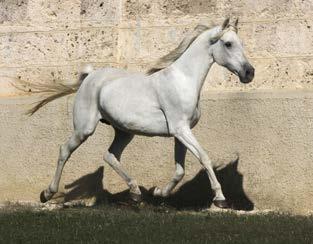
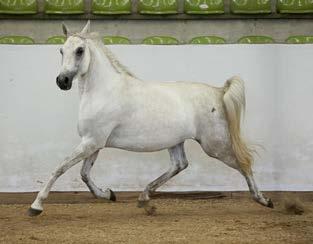
this is deeply anchored genetically, but if you don’t pay attention to these characteristics, i.e. if you don’t select for them, then these characteristics are lost within few generations. In animal breeding we speak of genotypeenvironment interaction, i.e. if I decrease the selection for certain characteristics, then these are gradually (and unnoticed) lost.
The lifespan of Arabians is often 25 years, and horses over 30 are not uncommon. Regarding fertility, there
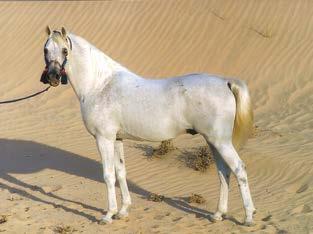
genotipo-ambiente, ovvero se si allenta la selezione di determinate caratteristiche, queste vanno gradualmente (e inavvertitamente) perse. La durata della vita degli arabi facilmente raggiunge i 25 anni, e non sono rari i cavalli che superano i 30 anni. Per quanto riguarda la fertilità, ci sono esempi provenienti dagli allevamenti statali, dove le giumente hanno avuto da 15 a 20 puledri e hanno mostrato un’elevata fertilità fino alla vecchiaia. A ciò si aggiunge il fatto che gli arabi hanno la più alta produzione di latte (in grammi) per kg di peso vivo, il che è anche un segno di buon utilizzo dell’alimentazione ed efficienza. A Tersk la produzione di latte è considerata un criterio di selezione, perché non si vogliono madri che producono troppo poco latte.
Quali altri risultati della ricerca sulla costituzione dei bovini possono essere trasferiti al cavallo o al cavallo arabo?
Perner: Mi vengono in mente tutta una serie di punti: i tipi di costituzione e la precocità/ tardività li abbiamo già in parte trattati, a cui si aggiungerebbe il dimorfismo sessuale, ovvero la differenza tra animali maschi e femmine, le regole di allevamento, i relativi metodi , l’importanza delle famiglie di fattrici, la selezione in base alla taglia e gli effetti dell’allevamento da show, che esiste anche nei bovini! Il dimorfismo sessuale è un vero e proprio carattere sessuale secondario, causato da diverse
Before specialization took place: Drug (Prizrak / Karinka) *1985, not only “European Race horse of the Year”, but also European Champion in the show ring, Lier, 1990.
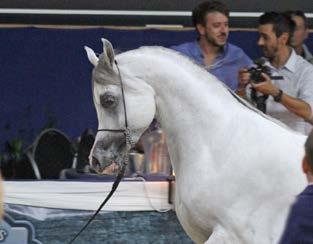
are examples from the state stud farms where mares had 15 to 20 foals and demonstrated high fertility into old age. In addition, the Arabian horse has the highest milk yield (in grams) per kg live weight, which is also a sign of good feed conversion and efficiency. In Tersk Stud, milk production is used as a selection criterion because they don’t want mothers who don’t produce enough milk.
Which other results from constitutional research on cattle can be transferred to horses or the Arabian horse?
Perner: A whole series of points come to mind: we have already covered some of the constitutional types and early maturity/late maturity, plus there is sexual dimorphism, i.e. the difference between male and female animals, breeding rules, breeding methods, the importance of mare families, the selection for size and the effects of show breeding, which also occurs with cattle!
Sexual dimorphism is a true secondary sexual characteristic caused by different hormone constellations between the sexes. These sex hormones are produced in the adrenal cortex of stallions and mares. In addition, testosterone is produced in the testicles of stallions and oestrogens are produced in the ovaries of mares. One such secondary sexual characteristic is, for example,
costellazioni ormonali dei sessi. Questi ormoni sessuali vengono prodotti negli stalloni e nelle giumente nella corteccia surrenale, inoltre il testosterone viene prodotto negli stalloni nei testicoli e gli estrogeni nelle giumente nelle ovaie. Un tale caratteristica sessuale secondaria è, ad esempio, il “collo dello stallone”. Se ora alleviamo cavalli in cui stalloni e giumente hanno lo stesso aspetto, senza alcuna differenza visibile tra i sessi, cosa succede a livello ormonale? Si sposta il naturale equilibrio ormonale, il testosterone diminuisce, il collo da stallone scompare. A lungo termine, però, selezioniamo contro la fertilità, ovvero la fertilità peggiorerà! Questo è anche ciò che si sente dire sempre più spesso, a voce bassa: gli stalloni hanno una scarsa qualità dello sperma e le giumente una diminuita fertilità – spesso è necessario ricorrere a tutti i mezzi della moderna tecnologia di riproduzione per riuscire a far rimanere le giumente gravide. A proposito, esiste un’antica legge dell’allevamento animale che recita: “Più gli animali maschi sono mascolini nel loro aspetto, più femminili saranno le loro discendenti femmine”.
L’allevamento è una questione molto complessa, come si può vedere. Quali principi di allevamento può dare a un “giovane allevatore”?
Perner: Cosa abbiamo imparato per l’allevamento da tutte queste ricerche?
1. Non selezionare mai in modo massivo in base a singole caratteristiche se non si comprende il quadro complessivo. Si rischia di fallire. Vorrei citare uno degli esperimenti più significativi nella storia dell’allevamento: negli anni ‘50, il biologo russo Dimitri Beljajew e i suoi collaboratori hanno iniziato a catturare volpi argentate selvatiche e a selezionarle in base alla docilità, accoppiando ripetutamente tra loro gli animali scelti in base a questo criterio. L’obiettivo era quello di ricreare la domesticazione (trasformazione in animale domestico) in un esperimento. Cosa è successo? Già dopo la terza generazione si sono verificati gravi cambiamenti nel fenotipo (aspetto esteriore): cambiamento del colore del pelo, orecchie pendenti, code ad anelli, accorciamento delle estremità, accorciamento della mascella superiore e inferiore, cambiamento della consistenza del pelo, cambiamento della lunghezza del tronco, ecc. Esistono diverse ipotesi per spiegare questo fenomeno, ma la loro elencazione qui sarebbe troppo lunga. È importante sapere che solo una piccola parte dell’intero genoma è attivata, il resto sono i cosiddetti “geni dormienti”. Gli influssi ambientali o la pressione selettiva esterna (= allevamento) non modificano il patrimonio genetico stesso, ma cambia l’intensità con cui alcune sue sezioni vengono lette e convertite in molecole
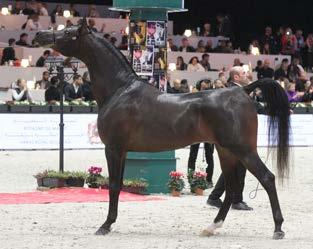
Sultan GK (WW Stivallea / Al Magna) *2015 at the World-Championships 2018, 3. place Junior Colts: light in the chest, absolutely straight topline, non-functional croup and hindquarters.
the “stallion neck or crest”. If we now breed horses where stallions and mares look the same, where there is no longer any visible difference between the sexes - what happens on the hormonal level? The natural hormonal balance shifts, testosterone decreases, and the stallion’s neck disappear. In the long term, however, we are selecting against fertility, i.e. fertility will deteriorate! That’s also what you hear more and more often - behind closed doors: stallions have poor semen quality and mares are becoming increasingly difficult to conceive - you often have to use all the tricks of modern reproductive technology to get the animals pregnant at all. By the way, there is an old animal breeding law that says: “The more masculine the male animals are in their appearance, the more feminine their female offspring are.”
Breeding is a very complex matter, as we can see. What breeding principles can you give to a “young breeder”?
Perner: Yes, what have we learned for breeding from all this research?
1. Never massively select for individual traits if you don’t understand the whole thing. This is going to shit. I would like to cite one of the most significant experiments in the history of animal breeding here: In
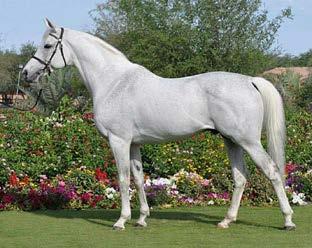
Dostatok (Status / Dupona) *2007, winner of 17 out of 33 races, including the All-Russian Derby: deep chest, muscular hindquarters, functional croup.
come ad esempio gli ormoni. La conclusione per l’allevatore rimane: la selezione di un carattere modifica in ultima analisi interi complessi di caratteri!!!
2. Qualsiasi selezione che non sia orientata anche alla forma fisica e alla longevità o alla prestazione continua comporta automaticamente un peggioramento di queste caratteristiche. Come già accennato all’inizio, la base fisiologica per la longevità e le prestazioni durature è una crescita lenta e prolungata (= maturità tardiva). All’opposto si trova il complesso di caratteristiche della “maturità precoce”, ovvero crescita rapida e breve, prestazioni elevate e intense in giovane età e, di conseguenza, rapido invecchiamento. La ricerca sui bovini ha dimostrato che la selezione intensiva per una produzione lattiera precoce ed elevata degli animali riduce drasticamente la loro durata di utilizzo. Prima ancora che gli animali raggiungano la maturità (con 4 vitelli), una percentuale molto elevata di vacche da latte deve lasciare la stalla a causa di malattie. Questi animali precoci non sono fisiologicamente in grado di sopportare tali prestazioni. Al contrario, gli animali a maturazione tardiva iniziano con prestazioni medie, si sviluppano lentamente e raggiungono prestazioni elevate e massime solo in età adulta. L’organismo, con tutti i suoi processi metabolici, è quindi “allenato” al meglio, il tessuto connettivo, la cartilagine, le articolazioni, i tendini, i legamenti e gli zoccoli sono di alta qualità (perché cresciuti
the 1950s, the Russian biologist Dimitri Belyayev and his colleagues began to capture wild silver foxes, select them for tameness and repeatedly breed the animals selected according to this criterion with each other. The aim was to recreate domestication (becoming pets) in an experiment. So, what happened? Already after the 3rd generation, serious changes occurred in the phenotype (external appearance): change in fur color, lop-eared ears, curly tails, shortening of the extremities, shortening of the upper and lower jaw, change in the texture of the fur, change in torso length, etc. There are a number of hypotheses to explain this phenomenon, but explaining them here would go too far. It is important to know that only a small part of the entire genome is activated; the rest are so-called “sleeping genes”. Environmental influences or selection pressure from outside (= breeding) do not change the genetic material itself, but rather the intensity with which certain parts of it are read and converted into molecules such as hormones. The conclusion for the breeder remains: selection for one characteristic ultimately changes entire complexes of characteristics!!!
2. Any selection that is not also aimed at fitness and longevity or long-term performance automatically
lentamente) e gli animali producono senza alcun problema di salute fino a tarda età. Tutto ciò che è stato appena detto vale anche per l’allevamento dei cavalli. Il rapido successo, spinge l’allevamento verso la precocità con conseguenze devastanti per i cavalli e, in ultima analisi, anche per gli allevatori.
3. La funzione determina la forma. Devo riflettere su quale sia il mio obiettivo di allevamento? Se voglio allevare un cavallo da sella, questo deve avere determinate caratteristiche e deve essere cavalcato affinché queste possano essere verificate. Se voglio allevare un cavallo da corsa, deve essere veloce: è questa funzione (velocità) a determinare la forma. Se invece voglio allevare un cavallo da show, questo deve corrispondere a un modello di esteriorità sviluppato da alcune persone (giudici). In questo caso è quindi la forma a venire prima e il cavallo viene adattato a questa forma attraverso l’allevamento, il che è fondamentalmente sbagliato.
Per raggiungere il proprio obiettivo di allevamento esistono diversi metodi di allevamento. Potrebbe spiegarci brevemente quali sono?
Perner: In realtà provengo da una generazione precedente alla genetica delle popolazioni. Mio nonno non
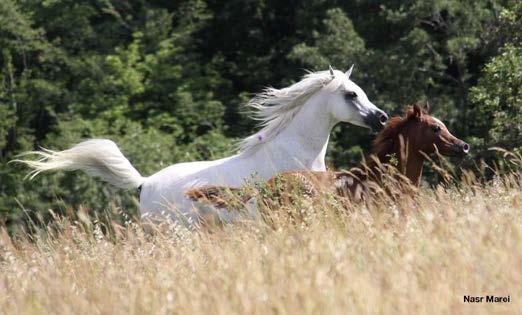
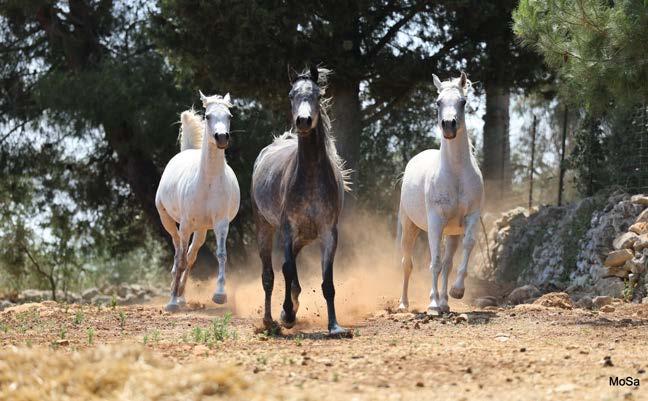
causes these characteristics to deteriorate. As already mentioned at the beginning,the physiological basis for longevity and long-term performance is slow, long-lasting growth (=late maturity). Opposite to this is the complex of characteristics of “early maturity”, i.e. fast, short growth, high and intensive performance at a young age and the associated rapid aging. Research on cattle has shown that intensive selection for early and high milk production of the animals dramatically reduces their useful life. Before the animals are even fully grown (with 4 calves), a very high percentage of dairy cows have to leave the stable due to illness. These early-mature animals are physiologically incapable of maintaining this performance. On the other hand, latematuring animals begin with medium performance, develop slowly and only achieve high and highest performance when they are fully grown. The organism with all its metabolic processes is then well “trained”, connective tissue, cartilage, joints, tendons, ligaments and claws are of high quality (because they have grown slowly) and the animals produce well into old age without any health problems. Everything that has just been said also applies in
aveva nulla a che fare con queste considerazioni teoriche. Ma queste persone hanno comunque sviluppato diversi metodi di allevamento sulla base della loro esperienza, che sono validi ancora oggi. I metodi di allevamento comunemente utilizzati per il cavallo arabo sono:
1. Allevamento in linea: ciò significa che troviamo una (lieve) parentela sia dal lato paterno che da quello materno, quindi, per così dire, uniamo geni affini, logicamente di animali da allevamento che corrispondono ai nostri obiettivi di allevamento e che sono stati selezionati nel miglior modo possibile. Grazie alla parentela minima ho un alto grado di sicurezza che la prossima generazione sarà altrettanto buona o migliore della generazione dei genitori.
2. Si parla di inbreeding quando si dispone di animali da riproduzione eccellenti e si desidera consolidare o potenziare il pool genetico attraverso l’allevamento tra parenti stretti. La consanguineità è ovviamente possibile solo se l’animale è privo di qualsiasi difetto genetico. La consanguineità non solo consolida gli aspetti positivi, ma anche i difetti genetici o i tratti indesiderati, facendoli
reverse to horse breeding. The rapid success pushes breeding towards early maturity with devastating consequences for the horses and ultimately for the horse owner.
3. Function determines form. I have to think about what breeding goal do I have? If I want to breed a riding horse, it needs certain riding horse points and it has to be ridden so that these can be checked. If I want to breed a racehorse, it has to be fast - it is this function (speed) that dictates the form. But if I want to breed a show horse, it has to fit into a conformation template that was developed by some people (judges). So here the form comes first, and the horse is bred to adapt to this form, which is fundamentally wrong.
There are different breeding methods to achieve your breeding goal. Could you briefly explain to us what these are?
Perner: I actually come from a generation before population genetics. My grandfather had nothing to do with these theoretical considerations. But these people still developed different breeding methods based on
emergere. Due geni recessivi possono diventare omozigoti, cioè dominanti, attraverso l’incrocio tra consanguinei. Se il gene contiene un difetto genetico, questo difetto genetico sarà presente in forma dominante e si manifesterà (ad esempio CA, SCID). Quanto deve essere stretto l’incrocio è oggetto di discussione. In linea di principio, una generazione sfalsata è sempre positiva. Prima che fosse possibile effettuare test genetici per individuare difetti genetici, si effettuavano accoppiamenti padre-figlia: se il padre era portatore occulto (recessivo) di un difetto genetico, questo veniva alla luce. Con i test genetici odierni si evitano eventualmente puledri morti o malformati. In ogni caso, però, l’uso dell’incrocio consanguineo deve essere integrato in un piano di allevamento e deve essere effettuata una rigorosa selezione!
3. Accoppiamento casuale – si tratta in realtà di un “accoppiamento non pianificato”, perché in questo caso viene utilizzato il simpatico stallone dietro l’angolo o il super campione da esposizione, senza riflettere troppo su quanto sia adatto alla giumenta e quali effetti ciò possa avere. Prendiamo ancora una volta l’esempio di Agnat: suo padre Empire è stato medaglia di bronzo junior ai campionati europei e nella top ten ai campionati mondiali.
their experience – and these are still valid today. The breeding methods commonly used for the Arabian horse are:
1. Line breeding - this means that we find a (minor) relationship on both the father’s and mother’s side, so we bring together related genes, so to speak, from breeding animals that correspond to our breeding goals and are selected as best as possible. Because of the slight relationship, I have a high degree of certainty that the next generation will be as good as or better than the parent generation.
2. We talk about inbreeding when you have outstanding breeding animals and you want to consolidate or increase this gene pool through breeding close relatives. Of course, inbreeding is only possible if the animal is free of any genetic defects. Inbreeding not only solidifies the good sides, but also the hereditary defects or undesirable traits and brings them forward. Two recessive genes can appear homozygous, i.e. monozygotic, through inbreeding. If the genetic makeup, then contains a genetic defect, this genetic defect is present in a monozygotic form and it comes into play (e.g. CA, SCID). How close the inbreeding can be is a matter of debate. Basically, a generation postponement is always good. Before it was possible to test for hereditary defects using genetic tests, fatherdaughter matings were made - if the father was a hidden (recessive) carrier of a hereditary defect, this would come to light. Today’s genetic tests can save you from having dead or deformed foals. In any case, the use of inbreeding must be embedded in a breeding plan and strict selection must take place!
3. “Unplanned mating” - here the nice stallion around the corner or the super show crack is used without much consideration as to how well he suits the mare and what effects this has. Let’s take Agnat’s example again: His sire Empire was bronze champion at the European Championships as a junior and in the top ten at the World Championships. Grandfather Enzo was US National Champion, his grandmother Emira was All Nations Cup Champion, his other grandfather QR Marc was World Champion, and Kwestura was also World Champion and the most expensive horse at a Polish auction. His pedigree really shows the “Who’s Who” of show horse breeding and yet the combination of all these illustrious names resulted in a completely ordinary horse. So, what happened there? It’s simple: In this pedigree everything is mixed together and then Mendel’s splitting rule kicks in and it splits in
Il nonno Enzo è stato campione nazionale degli Stati Uniti, sua nonna Emira è stata campionessa dell’All Nations Cup, l’altro nonno QR Marc era campione del mondo e anche Kwestura era campionessa del mondo e il cavallo più costoso in un’asta polacca. Il suo pedigree mostra davvero il “Who is Who” dell’allevamento da esposizione, eppure dalla combinazione di tutti questi nomi altisonanti è uscito un cavallo del tutto normale. Cosa è quindi successo? Molto semplice: in questo pedigree tutto è mescolato insieme e poi entra in gioco la legge di Mendel sulla segregazione genetica e nella seconda generazione (F2) si divide in tutte le direzioni. Di conseguenza, i grandi allevatori di cavalli da show passano al embryo transfer, producono embrioni di diversi padri, ad esempio 10 puledri, 9 dei puledri risultanti non soddisfano i requisiti e vengono venduti a basso prezzo, mentre quello che soddisfa le aspettative va in show. Ma il fatto che 9 puledri non soddisfino lo standard di allevamento viene taciuto. Si tratta di “prova ed errore” e non ha nulla a che vedere con l’“allevamento”. Per questo motivo sono assolutamente contrario a questi metodi.
4. Out-cross – come funziona correttamente un out-cross dal punto di vista dell’allevamento è, di norma, noto a pochissimi. Ecco quindi un esempio: lo stallone Kurier, allevato nella scuderia Chrenovoje, una scuderia nota per il suo allevamento estremamente performante. La linea materna è russa, l’out-cross proviene dallo stallone Egis dalla Polonia, vincitore di un derby, dal quale i russi si aspettavano da un lato un rinnovamento del sangue, ma anche massime prestazioni. Dal punto di vista dell’allevamento, ora funziona così: lo stallone Egis viene accoppiato con le 5 migliori giumente dell’intero allevamento e i suoi due o tre figli migliori vengono poi destinati all’ allevamento. Solo questi figli vengono poi ampiamente utilizzati nella mandria di fattrici. Allevare significa pensare in termini di generazioni!
5. Allevamento di sostituzione – in questo caso, in termini generali, alcune caratteristiche vengono sostituite da altre. Nell’allevamento degli animali, ciò avviene di solito attraverso l’incrocio con altre razze. Nell’allevamento dei cavalli arabi ciò avviene attraverso un altro tipo all’interno della razza. Attualmente lo si può vedere nelle scuderie statali polacche, dove a volte già nella terza generazione vengono utilizzati indiscriminatamente stalloni da show con fattrici polacche pure, in modo che il sangue polacco venga sempre più soppiantato. Quello che sta accadendo lì attualmente è un incrocio di sostituzione con cavalli da show. In questo modo, entro 20 anni, verrà compromesso tutto ciò che è stato costruito e consolidato in 150 anni di lavoro di allevamento.
all directions in the F2 generation. As a consequence, the major show horse breeders then switch to embryo transfer, producing embryos from different sires, e.g. B. 10 foals, 9 of the resulting foals do not meet the requirements of a show horse and are sold cheaply, and the one that meets expectations goes into the show. But the fact that 9 foals do not meet the breeding standard is kept quiet. This is “trial and error” and has nothing to do with “breeding”. That’s why I am an absolute opponent of these methods.
4. Outcross – how an outcross works properly in terms of breeding is generally not known to many. So here’s an example: the stallion Kurier, bred at the Khrenovoje stud farm, a stud farm that was known for its extreme racing performance breeding. The dam line is Russian, the outcross comes through the stallion Egis from Poland, a Derby winner of which the Russians have hoped to get not only a blood refreshment, but also the highest performance. In terms of breeding, the way it works now is that the stallion Egis gets the 5 best mares from the entire mare population to cover and his two or three best sons then go into breeding. Only these sons are then widely used in the broodmare band. Breeding means thinking in generations!
5. Displacement breeding – generally speaking, this involves replacing certain traits with others. In animal breeding, this is usually done by crossing with other breeds. In Arabian breeding this happens through a different type of horse within the breed. This can currently be seen in the Polish state stud farms, where show horse stallions, sometimes in the third generation, are being used indiscriminately on the thoroughly bred Polish mare base, so that Polish blood is being increasingly suppressed. What is currently happening there is a displacement crossing with show horses. In doing so, within 20 years they are ruining everything that has been built and consolidated over 150 years of breeding work.
6. Selection – in the large stud farms you could actually still select. Every year you have 50 or more foals and you select the 3 to 4 best ones; the rest become riding horses and are therefore taken from the breeding gene pool. But if, as a small private breeder, I only breed one foal in 10 years, the selection becomes difficult. The golden rule in animal breeding is: always double the good! Then you have a high degree of security in inheritance.
Mare families traditionally play a major role in horse
6. Selezione – nei grandi allevamenti era ancora possibile selezionare. Ogni anno si hanno 50 o più puledri e si selezionano i 3 o 4 migliori, gli altri vanno domati, quindi diventano cavalli da sella e vengono eliminato dal pool genetico dell’allevamento. Ma se come piccolo allevatore privato allevo solo un puledro in 10 anni, la selezione diventa difficile.
La regola d’oro nell’allevamento degli animali è: sempre raddoppiare il buono! In questo modo si ha un alto grado di sicurezza nella trasmissione ereditaria.
Tradizionalmente, nell’ allevamento dei cavalli – e in particolare nell’allevamento dei cavalli arabi – le famiglie di fattrici svolgono un ruolo importante. Perché?
Perner: Scientificamente, ciò può essere ricondotto alla cosiddetta eredità citoplasmatica. Durante la fecondazione, lo stallone contribuisce solo con lo sperma, e di questo solo il nucleo cellulare. La cavalla, invece, contribuisce con l’ovulo, con il nucleo cellulare e, all’esterno, con il citoplasma, con gli organelli cellulari e, in particolare, i mitocondri. I mitocondri sono anche portatori di materiale genetico e sono responsabili del metabolismo energetico delle cellule. Questi mitocondri vengono trasmessi dalla madre al puledro insieme all’ovulo. Nel caso di un puledro maschio, questo ne trae beneficio, ma non può trasmettere questo DNA mitocondriale (mtDNA) alla sua progenie. Solo una puledra può trasmetterlo alla successiva generazione. Pertanto, utilizzando il DNA mitocondriale è possibile risalire alla linea femminile del passato. Anche nell’ allevamento dei cavalli arabi sono note linee materne prestazionali, come quella di Sabellina in Polonia o di Sapine in Russia.
Che consiglio darebbe a un allevatore che desidera acquistare una cavalla da riproduzione?
Perner: Un allevatore dovrebbe esaminare la linea materna della cavalla in questione. Se possibile, si dovrebbe scegliere una cavalla proveniente da una linea materna che abbia superato prove di rendimento. Come stanno la madre, la nonna ecc. per quanto riguarda il numero di puledri? Questo permette di trarre conclusioni sulla fertilità. Se le ultime tre generazioni sono costituite da cavalle che soddisfano tutti i criteri, si può anche contare su una eredità sorprendente per la cavalla che si desidera acquistare o con cui si desidera allevare, ovvero su un alto grado di sicurezza ereditaria. Se si acquista una cavalla da riproduzione che ha già avuto puledri, è opportuno informarsi se questa cavalla ha partorito senza problemi. È rimasta incinta subito, il parto è stato senza problemi, ha accettato il puledro? Se selezioniamo
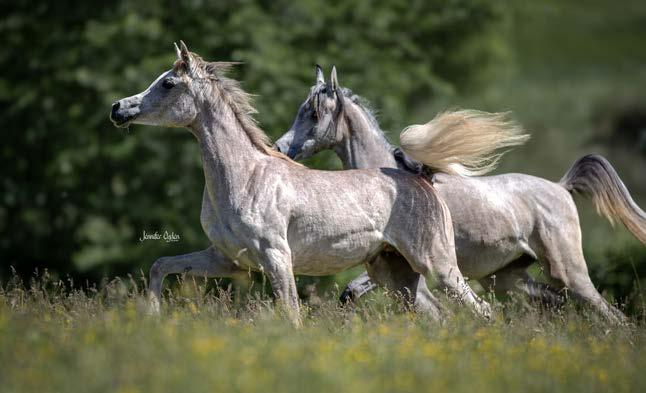
breeding – and in Arabian breeding in particular. Why is that?
Perner: Scientifically, this can be attributed to the socalled cytoplasmic inheritance. During fertilization, the stallion only contributes the sperm, and of that only the cell nucleus. The mare, however, contributes the egg cell with the cell nucleus and around it the cytoplasm with the cell organelles, and especially the mitochondria. The mitochondria are also carriers of genetic material and are responsible for the energy metabolism of the cells. These mitochondria are always passed on from mother to foal in the egg cell. A colt has the benefit of this, but cannot pass on this mitochondrial DNA (mtDNA) to its offspring. Only a filly can pass this on to the next generation. Therefore, the female line can be traced back into the past using mtDNA. Maternal performance lines such as Sabellina in Poland and Sapine in Russia are also known in Arabian horse breeding.
What advice would you give to a breeder who wants to buy a mare for breeding?
Perner: Breeder should look at the dam line of the
meglio in termini di fertilità, risparmieremo molte spese veterinarie inutili! Il problema oggi è che sta diventando sempre più difficile ottenere tali dati, perché anche i registri genealogici contengono per lo più solo i puledri nati sani e considerati “degni di essere registrati” dagli allevatori - il numero di coperture che portano alla gravidanza, il numero di riassorbimenti, aborti, nati morti, tutto questo purtroppo oggi non viene più registrato. Un altro problema è che la maggior parte delle fattrici si trova presso piccoli allevatori, dove non hanno alcuna possibilità di avere 10 o più puledri, perché vengono coperte solo una o due volte nella loro vita. Sulla base dei dati odierni dei registri genealogici non è possibile sapere se una fattrice che ha avuto solo due puledri in 10 anni sia stata fecondata più volte senza però partorire puledri vivi o se sia stata utilizzata solo due volte per la riproduzione. E una buona fattrice deve anche avere una buona produzione di latte! Nei grandi allevamenti statali in Polonia e Russia questo è stato registrato come criterio di selezione, perché anche questo è uno dei buoni requisiti di una madre.
Come si può rimediare alla “mancanza di dati” dato che proprio gli stati i membri delle associazioni hanno deciso di registrare solo i dati assolutamente necessari, ovvero
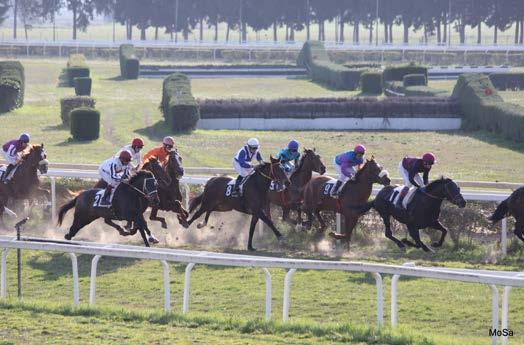
mare in question. If possible, you should choose a mare from a dam line that has undergone performance tests. Ask the breeder about the number of foals for the mother, grandmother, etc.? This gives an indication of fertility. If the last three generations consist of mares that meet all the criteria, you can also count on a resounding inheritance in the mare that you want to buy or with which you want to breed, i.e. a high degree of heredity security. If you buy a broodmare that has already had foals, you should ask whether this mare gave birth without any problems, did she become pregnant immediately, did she accept the foal? If we select better with regards to fertility, this will save a lot of unnecessary veterinary costs!
The problem today is that it is becoming increasingly difficult to obtain such data, because even studbooks usually only contain those foals that are born healthy and are considered “worthy of registration” by the breeder - the number of coverings that are used to become a mare pregnant, the number of resorptions, abortions, stillbirths, all of this is unfortunately no longer recorded today. Another problem is that most broodmares are kept by small breeders where they have
che i nati morti o gli aborti non vengono affatto segnalati al registro genealogico?
Perner: Sì, questo è un problema. Ma penso che siamo giunti a un punto in cui dobbiamo riflettere su dove vogliamo arrivare con l’allevamento nei prossimi 20 o 30 anni. Gli allevatori dovrebbero sollecitare le associazioni affinché i dati corrispondenti vengano raccolti e archiviati. Lo stesso vale per le prove di rendimento, che si tratti di equitazione, corse, distanze o show.
Passiamo dalle fattrici agli stalloni: gli stalloni hanno un’influenza numericamente molto maggiore sull’allevamento. Se penso, ad esempio, che un QR Marc ha generato oltre 850 discendenti negli ultimi 15 anni...
Perner: Cosa contraddistingue un buon stallone? Antenati con prestazioni comprovate, privi di difetti ereditari, prestazioni comprovate, miglior conformazione e, cosa molto importante, un carattere impeccabile. Se uno stallone è problematico, difficile da gestire, non ha nulla a che fare con l’allevamento. Veniamo alla domanda: come si alleva un buon stallone? Per me questa è la
no chance of having 10 or more foals because they are only bred once or twice in their lives. Based on today’s studbook data, it is not possible to determine whether a broodmare that only had two foals in 10 years was bred more often but did not produce a live foal, or was only used for breeding twice.
How can the “lack of data” be remedied, since it is the members of the associations who have decided that only the absolutely necessary data will be recorded, or that stillbirths or abortions will not be reported to the stud book at all?
Perner: Yes, that is a problem. But I think we’re at a point now where we have to think about where do we want to go with breeding Arabian horses in the next 20 or 30 years? The breeders should arrange for the associations to collect the relevant data. The same applies to proof of performance, regardless of whether it is equestrian sport, racing, endurance or show. Let’s move from mares to stallions: Stallions have a much greater influence on breeding in terms of numbers. For example, QR Marc has sired over 850 offspring in the last 15 years...
Perner: What makes a good stallion? For me he has to have performance-tested ancestors, he must be free of hereditary defects, proven performance, best conformation and - very important - an impeccable character. If a stallion is problematic and cannot be handled, he has no place in breeding. Let’s get to the question: How do I breed a good stallion? For me, this is the most exciting question of all! I currently see far too few good young stallions in Arabian horse breeding in order to have a few good stallions available for breeding in 5 or 10 years. How to address this problem? In breeding you can say: behind every good stallion there is a good stallion mother. The mare from which you want to breed a future sire is extremely important. Good mares in particular should remain in breeding and planned, targeted matings should be encouraged.
What dangers do you see for breeding in show horse breeding?
Perner: My job here as a population geneticist is to point out developmental trends. One must be aware of the dangers of where the path leads if we continue in this direction for a long time. I want to come back to the cattle here to show what effects show breeding has, because it really runs in parallel:
domanda più interessante in assoluto! Attualmente vedo nell’allevamento di cavalli arabi troppo pochi giovani stalloni di qualità per poter disporre tra 5 o 10 anni di alcuni buoni stalloni da riproduzione! Come si può affrontare questo problema? Nell’allevamento si può dire che dietro ogni buon stallone c’è una buona fattrice. La giumenta da cui si vuole ottenere un futuro riproduttore è estremamente importante. Proprio le giumente di qualità dovrebbero rimanere nell’allevamento e dovrebbero essere promossi accoppiamenti pianificati e mirati.
Quali pericoli per la riproduzione vede nella selezione allevatoriale da show?
Perner: Il mio compito qui come genetista delle popolazioni è quello di segnalare le tendenze di sviluppo. Bisogna essere consapevoli dei pericoli e di dove ci porterà questa strada, se continuiamo a percorrerla ancora a lungo in questa direzione. Vorrei tornare ancora una volta al bestiame per mostrare quali effetti ha l’allevamento da esposizione, perché è davvero molto simile:
1. Proprio come nell’allevamento dei cavalli arabi, nell’allevamento bovino si cerca di ottenere una linea dorsale diritta o “topline”. La topline deve essere perfettamente diritta, in conformità con lo standard da esposizione. Ma cosa succede in questo caso? A causa della selezione per ottenere questa linea dorsale, l’osso sacro si abbassa nel bacino e ostacola la funzionalità dell’animale durante il parto. Le vie del parto diventano più piccole (strette) perché, come desiderato dagli allevatori, il sacro si abbassa.
2. Muscolatura poco sviluppata nella parte posteriore –ricordiamo ancora una volta i vitelli maschi menzionati all’inizio, che sono poveri di muscoli. Ciò è dovuto al fatto al fatto che le apofisi spinose del sacro si sono accorciate di 2-3 cm a causa di una selezione errata. In questo modo si perde superficie di attacco per la muscolatura e si creano bacini con pochi muscoli. Ed è proprio questa tendenza che vedo anche nei cavalli da esposizione.
3. Nell’allevamento bovino, un’indagine ha rivelato che oltre il 90% dei bovini Holstein appartiene alla categoria degli astenici, ovvero agli animali alti e magri, mentre meno del 10% appartiene alla categoria degli atleti, ovvero al tipo di corporatura media con torace ampio, che potrebbe compensare questo difetto. Ora si vorrebbe in realtà allevare un animale il più possibile ben bilanciato, ma per farlo sarebbe necessario che per la grande maggioranza degli animali fosse disponibile uno stallone/toro di corporatura media e larga. Questi però rappresentano solo
1. Just like in Arabian breeding, in cattle breeders try to achieve a straight topline. The topline must be completely straight, only then it corresponds to the show standard. But what happens when this has been achieved? By selecting for the straight topline, the sacrum descends into the pelvis and makes birth more difficult. The birth ducts become smaller (narrower) because - as desired by breeders - the sacrum lowers.
2. Poorly developed muscles in the hindquarters - let’s remember again the male calves mentioned at the beginning, which have poor muscles. This is due to the fact that the spinous processes of the sacrum have shortened by 2-3 cm due to incorrect selection. This means that the attachment area for the muscles is lost and this creates these muscle-poor pelvises. And I see exactly this tendency with the show horses.
3. In cattle breeding, a survey has shown that over 90% of Holstein cattle are asthenics, i.e. tall, narrow animals, while less than 10% are athletics, i.e. the medium-framed type with the broad chest, which could compensate for this in the population. Now you actually want to breed an animal that is as well balanced as possible, but to do this you would have to have a medium-framed, broad stallion/bull available for the vast majority of animals. However, these only make up less than 10% of the population. And this is exactly the direction horse breeding is going in!
4. The position of the hip joint, in cattle this is called the inverter, meaning the point at which the thigh attaches to the pelvis. The selection for the straight topline tends to shift the hip joint backwards, which means that the animal has to put the hind legs behind the body, which in turn has a negative impact on movement, creates kidney pressure and significantly worsens the resilience of the back.
5. The extreme “typey” head with dish is, in my opinion, a deformation. Anyone who demands a minimum level of performance from their horse will recognize that a horse with an extreme dish will have trouble breathing. This would require research to understand the exact connections. But we know from dogs and cats that the shortening of the nose does not reduce the amount of mucous membrane material in the nasopharynx. However, this is no longer tight, but rather “wrinkled”, which leads to the familiar wheezing breathing noises. The lower jaw and the ridge are no longer straight, but are curved, which leads to dental problems. Teeth change very slowly in evolutionary terms. The desert
meno del 10 % della popolazione. Ed è proprio in questa direzione che si sta andando anche nell’allevamento dei cavalli!
4. La posizione dell’articolazione dell’anca, detta articolazione coxofemorale, si riferisce al punto di attacco della coscia al bacino. Tendenzialmente, la selezione per la linea superiore diritta sposta l’articolazione dell’anca all’indietro, il che significa che l’animale deve spingere le zampe posteriori dietro il corpo, il che a sua volta ha effetti negativi sul movimento, crea una pressione sui reni e peggiora significativamente la resistenza della schiena.
5. La testa estremamente fina con Dish estremo è a mio avviso una deformazione. Chiunque richieda al proprio cavallo un minimo di prestazione si renderà conto che un cavallo con un Dish molto estremo respira male, perché un cavallo non può respirare tramite la bocca. A tal fine sarebbe necessaria una ricerca per comprendere le esatte correlazioni.
Ma dai cani e dai gatti si sa che con l’accorciamento del naso non fa diminuire la quantità di mucosa nello spazio naso-faringeo. Questa non è più tesa, ma “rugosa”, il che porta ai noti rumori respiratori gorgoglianti. Anche la mascella inferiore e la dentatura non sono più dritte, ma hanno una forma arcuata, il che porta a problemi dentali. I denti cambiano molto lentamente dal punto di vista evolutivo. Per le teste delicate di oggi, i denti dei cavalli arabi del deserto sono troppo grandi e quindi hanno problemi di spazio nella mascella.
6. L’affinamento in particolare della testa, ma anche dell’intero cavallo e, di conseguenza, una mancanza di tipicità sessuale negli stalloni. Ciò ha ripercussioni, ad esempio, sull’ipofisi (ghiandola pituitaria). L’ipofisi controlla l’intero processo ormonale nell’organismo. Si riduce di dimensioni e si interviene direttamente sull’equilibrio ormonale dell’animale, selezionando in ultima analisi contro la fertilità. Anche in questo caso un esempio dall’allevamento bovino: sempre più spesso riceviamo dalla pratica feedback sulla debolezza delle contrazioni durante il parto. Cosa è successo in questo caso: l’ormone ossitocina è responsabile della ritenzione idrica nei tessuti prima del parto e durante il parto per l’innesco delle contrazioni. Tutte queste regolazioni naturali sono notevolmente indebolite dalla modifica dell’ipofisi e il livello ormonale è troppo basso. Di conseguenza, a causa delle contrazioni durante il parto, il sangue residuo non viene spinto a sufficienza dalla placenta attraverso il cordone ombelicale nel feto. Un vitello normale ha circa 7 litri di sangue nell’organismo poco dopo la nascita. In caso di contrazioni deboli, i vitelli vengono solitamente estratti
Arabians’ teeth are too large for today’s delicate heads and therefore have space problems in their jaws.
6. The refinement of the head in particular, but also of the entire horse, and the associated lack of gender type in the stallions. This has, for example, effects on the pituitary gland. The pituitary gland controls the entire hormonal process in the organism. It shrinks and you intervene directly in the animal’s hormonal balance and ultimately select against fertility. Here is also an example from cattle breeding: we are increasingly receiving feedback from farmers about weak contractions during birth. What happened here: the hormone oxytocin is responsible for water retention in the tissues before birth and during birth for triggering contractions. All of these natural regulators are significantly weakened by the change in the pituitary gland; the hormone levels are too low. As a result, the contractions during birth mean that the remaining blood is not sufficiently pressed from the placenta via the umbilical cord into the foetus. A normal calf has around 7 litres of blood in its system shortly after birth. If contractions are weak, the calves are usually taken out using mechanical pulling aid and the calves often only have around 3.5 litres of blood in their system and are therefore clearly weak and have to be brought with great effort through the first three weeks of life or even die.
7. Insufficient depth of the thorax means that the animal has no space for the organs, especially for the heart and lungs. Such animals lack endurance and performance, and the performance of the lymphatic system is significantly reduced.
8. The middle section is too long – although a feature of the Arabian horse is its short back! Nevertheless, long backs are selected here, which means that the animals have backs that are far too soft and the backs are no longer stable. The long back causes the loins to sink and the animals can no longer walk without pain.
9. Significant weaknesses in the connective tissue. Selection for early maturity and the associated rapid growth led to a significant weakening of the connective tissue. We examined this in cattle over long periods of time based on the suspension of the uterus in the abdomen/pelvis and the back formation of the uterus after birth. Swollen legs and swollen hocks are a sign of this weakness in the connective tissue in horsesand these animals are ultimately completely useless as riding horses.
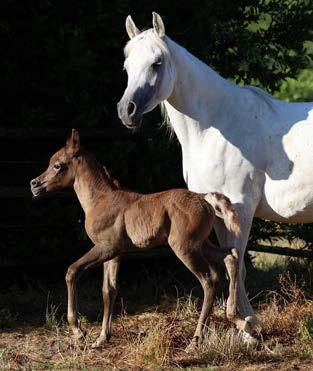
con l’ausilio di un dispositivo meccanico e spesso hanno solo circa 3,5 litri di sangue nell’organismo, il che li rende chiaramente deboli e richiede un grande sforzo perché superino le prime tre settimane di vita o addirittura li porta alla morte.
7. Lo sviluppo insufficiente del torace significa che l’animale non ha spazio per gli organi, in particolare per il cuore e i polmoni; tali animali mancano di resistenza e prestazioni, e le prestazioni del sistema linfatico sono notevolmente ridotte.
8. Un dorso troppo lungo, quando invece una caratteristica del cavallo arabo è proprio la schiena corta! Ciononostante, si selezionano dorsi lunghi, con il risultato che gli animali hanno il dorso troppo delicato e non sono più stabili. Il dorso lungo provoca un abbassamento della zona lombare e gli animali non riescono più a camminare senza dolore.
9. Evidenti debolezze nel tessuto connettivo. La selezione basata sulla precocità e sulla conseguente crescita rapida porta a un evidente indebolimento del tessuto connettivo. Abbiamo studiato questo fenomeno nei bovini per lunghi periodi di tempo sulla base del posizionamento dell’utero nella cavità addominale/pelvica e sulla base della regressione dell’utero dopo il parto. Le zampe e le
An important aspect today is size. The Arabian horse, which was imported to Europe 200 years ago, was often smaller than 1.50 m, but today customers demand a horse that should be 10 cm taller. What “dangers” can we expect when our “cultural Arabs” become bigger and bigger?
Perner: In cattle, we examined what happens when the animals get bigger and heavier and what effects this has. On average, a cow weighs around 600 kg. If we now have 100 kg more body weight, this inevitably means an enormous increase in resources just to maintain the body.
I agree with H. V. Musgrave Clark, an English Arabian breeder who valued small horses around 1.45 m and did not use any animal for breeding that was over 1.53 m. He lived in America for several years and worked there as a post rider and his insight was that medium-sized horses always had the greatest endurance. For us, this means that selection for excessive size, i.e. for animals that are over 1.60 - 1.65 m, is not effective. The size must fluctuate freely, which means there may well be animals that are larger, but you shouldn’t select especially for this.
Perner: The state stud farms are dissolving, unfortunately one has to say that. In Russia, Khrenovoye was privatized and Arabian breeding was abandoned. Tersk is also privatized and today has three different breeding programs, racehorses, show horses and “Classic Russian”, although this last group is becoming smaller and smaller. In Poland we have seen that displacement breeding with show horses is taking place. If this goes on for another 10 years, there will be nothing left of the original Polish Arab.
But there are also small glimmers of hope. A very interesting project was launched in Spain back in 2003. A breeding value for performance tests was developed; there are different selection levels, including young horse selection, tested sires and elite sires. Finally, I would like to introduce a project that we have launched here in cattle breeding. We have decided to maintain long-term performance breeding because this type of cattle has no chance at all due to genomic selection and breeding value estimation as currently carried out. We therefore founded an association and then looked for cow families that met our criteria for long-term performance breeding. Then we bought bulls from them, i.e. we now have almost 40 bulls in the insemination station, we have our own semen depot, and we use it to supply farmers who are interested in this type of breeding. Something similar could also be
articolazioni gonfie sono un segno di questo problema nei cavalli e questi animali sono alla fine completamente inutilizzabili come cavalli da sella.
Un aspetto importante oggi è anche la taglia. Il cavallo arabo, importato in Europa 200 anni fa, era spesso più piccolo di 1,50 m, mentre oggi i clienti richiedono un cavallo che sia 10 cm più alto. Quali “pericoli” comporta l’aumento di taglia del cavallo arabo?
Perner: Nel caso dei bovini è stato studiato cosa succede quando gli animali diventano sempre più grandi e pesanti e quali effetti ciò comporta. Una mucca pesa in media circa 600 kg. Se ora abbiamo 100 kg in più di peso corporeo, ciò significa inevitabilmente anche un enorme aumento del fabbisogno di mantenimento. Sono d’accordo con H. V. Musgrave Clark, un allevatore inglese di cavalli arabi, che apprezzava i cavalli di circa 1,45 m e non utilizzava per la riproduzione nessun animale che superasse 1,53 m. Ha vissuto diversi anni in America, dove ha lavorato come corriere postale, e ha capito che i cavalli di taglia media avevano sempre maggiore resistenza. Ciò significa per noi che la selezione basata su una statura eccessiva, su animali che superano 1,60 - 1,65 m, non è efficace. La statura deve oscillare liberamente, ovvero possono esserci animali più alti, ma non si dovrebbe selezionare in modo rigoroso in base a questo criterio.
Come potrebbe evolversi la situazione?
Perner: I grandi allevamenti statali stanno scomparendo, purtroppo bisogna dirlo. In Russia Chrenovoje è stato privatizzato e ha abbandonato l’allevamento di cavalli arabi. Anche Tersk è stato privatizzato e oggi ha tre diversi programmi di allevamento: cavalli da corsa, cavalli da show e “Classic Russian”, anche se quest’ultimo gruppo sta diventando sempre più piccolo. In Polonia abbiamo visto che si sta verificando un allevamento competitivo con cavalli da show. Se la situazione continuerà così per altri 10 anni, non rimarrà più nulla dell’originale arabo polacco. Ma c’è anche un piccolo barlume di speranza. In Spagna, già nel 2003 è stato avviato un progetto molto interessante. In questo contesto è stato sviluppato un valore genetico per le prove di rendimento, ci sono diversi livelli di selezione, tra cui una selezione di cavalli giovani, riproduttori testati e riproduttori d’élite. Infine, vorrei presentare un progetto che abbiamo avviato qui nell’allevamento bovino. Ci siamo prefissati di preservare l’allevamento di bestiame da lavoro orientato alle prestazioni a lungo termine perché questo bovino, a causa della selezione genomica e della valutazione del valore genetico, come viene attualmente effettuata, non ha più alcuna possibilità. Abbiamo quindi fondato un’associazione e
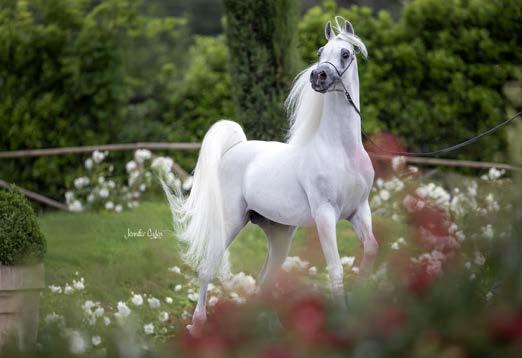
Hilal Al Waab is a striking, masculine stallion who, like many others, has to demonstrate his breeding potential not in the natural environment but on the catwalk at Arabian horse shows.
applied to the Arabian horse. You would need a Europewide breeding platform, and of course you have to think about how you could finance something like that. Then you need much better data collection, research work would have to be done, you would have to network the individual initiatives (like in Spain, see above), record stallion and mare lines to see which ones are at risk, start a survey to find out which frozen semen from older stallions still exist and – and this is very important to me – there needs to be a transfer of knowledge. It would be necessary to offer breeding advice for the next, younger generation of breeders, because otherwise the old hippological knowledge would be completely lost.
Thank you very much for your clear words and your commitment to preserving the old values in our breed. q
Andreas Perner - email: andreas.perner@outlook.at
abbiamo cercato famiglie di vacche che corrispondessero ai nostri criteri per l’allevamento a rendimento costante. Poi abbiamo acquistato dei tori, ovvero ora abbiamo quasi 40 tori nella stazione di inseminazione, abbiamo un nostro deposito di sperma e riforniamo gli agricoltori interessati a questo tipo di allevamento. Qualcosa di simile potrebbe essere applicato anche al cavallo arabo. Servirebbe una piattaforma di allevamento a livello europeo, naturalmente bisogna riflettere su come finanziare un progetto del genere. Poi occorre una raccolta dati molto migliore, bisognerebbe fare ricerca, bisognerebbe mettere in rete le singole iniziative (come in Spagna, vedi sopra), registrare le linee di stalloni e fattrici per vedere quali sono a rischio, avviare un sondaggio per sapere quale sperma congelato di stalloni più anziani è ancora disponibile e – e questo per me è molto importante – sarebbe necessario un trasferimento di conoscenze. Sarebbe necessario offrire una consulenza sull’allevamento alla prossima generazione di allevatori più giovani, altrimenti le antiche conoscenze equestri andrebbero completamente perdute.
Grazie mille per la sua chiarezza e per il suo impegno a favore della conservazione dei valori antichi dell’allevamento del cavallo arabo. q
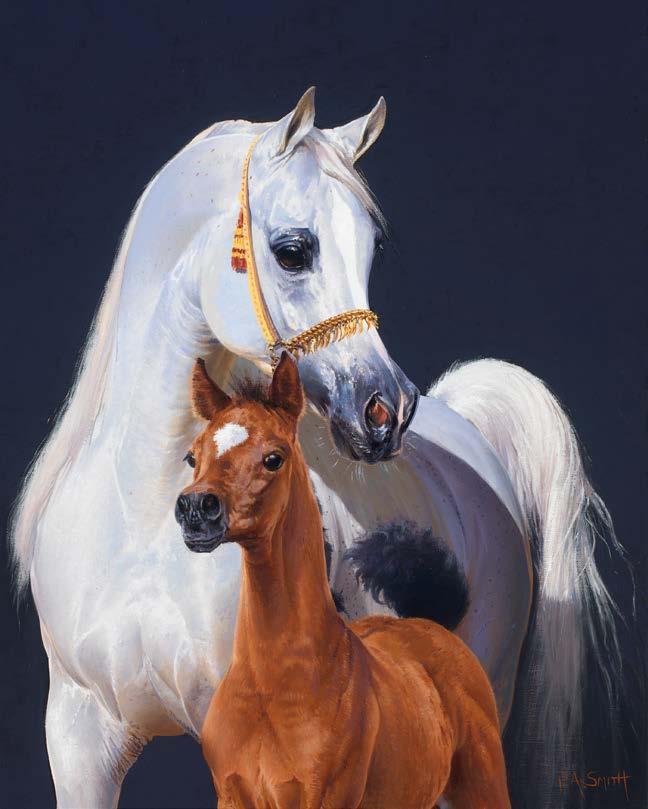
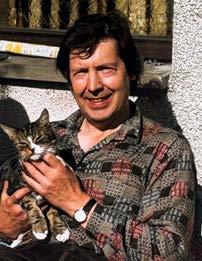
Peter Smith, the distinguished Scottish equestrian and sporting artist celebrated for his powerful depictions of Arabian horses and horse racing, passed away in 2025 in Scotland, the country where he was born, lived, and devoted his life to his art. He was 75 years old.
n by Judith Wenning
Born in Lanarkshire in 1949 to an English mother and Scottish father, Smith developed an early passion for both art and horses. He often credited his artistic talent to his grandfather, a Portugueseborn painter who painted throughout his life. Smith’s first drawings as a child were of horses, and from an early age he aspired to become an equestrian artist.
He studied at Carlisle Art School and later at Glasgow School of Art, where he refined the draughtsmanship and technical understanding that would define his career. Influenced by artists such as Edgar Degas and Sir Alfred Munnings, Smith developed a style distinguished by expressive brushwork, strong composition, and an instinctive command of light, colour, and movement.
Working primarily in oils, Smith became widely recognised for his energetic depictions of racehorses, jockeys, and equestrian scenes. Living near Ayr Racecourse, he found constant inspiration in the surrounding racing community and landscape. His subjects included horses from local racing stables, which he painted on the gallops, in paddocks, on racecourses, and along the vast sandy beaches where trainers exercised their thoroughbreds. Although he sketched at major racecourses including Aintree and Newmarket, much of his work remained rooted in Ayr and Hamilton Park.
His paintings captured not only the physical power of the horse but also the atmosphere, tension, and drama of racing itself, particularly the intensity of the closing stages of a race. Over the course of his career, he painted many celebrated racehorses and earned commissions from royal families and prominent collectors around the world.
“The Master’s Tent”, oil on canvas
Later in his career, Smith became especially admired for his paintings of Arabian horses, a subject through which he achieved significant international recognition. Peter Smith’s Arabian horse works demonstrate exceptional technical precision while conveying the refinement, intelligence, and spirit for which the breed is renowned. Through luminous colour, elegant line, and a deep understanding of equine form and movement, he created paintings that resonated deeply with owners, breeders, and collectors.
These works became highly sought after by royalty and distinguished private collectors throughout the Middle East and beyond. Alongside his original paintings, his limited-edition prints attracted an international audience and are now held in private collections worldwide.
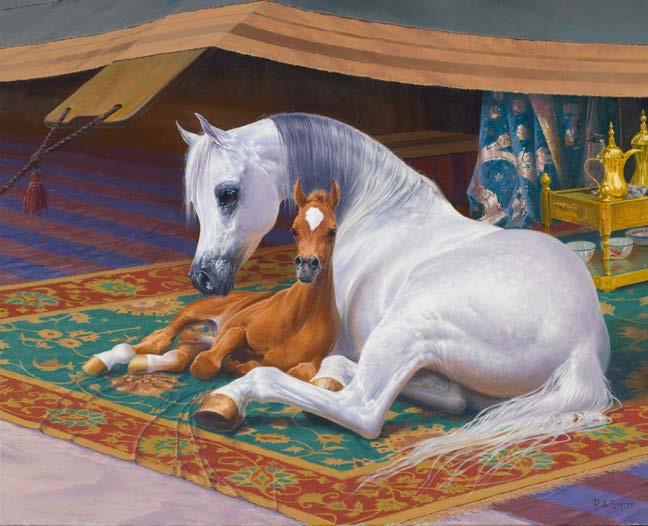
Though he worked quietly from Scotland, Peter Smith’s art earned widespread admiration for its vitality, atmosphere, and emotional depth. His body of work stands as a lasting testament to a lifetime devoted to artistic excellence and to the enduring beauty of the horse, particularly the Arabian horse that he portrayed with such distinction.
Beyond his artistic accomplishments, he will be remembered as a kind and thoughtful man, a valued friend, and someone whose quiet dedication and passion left a lasting impression on all who knew him.
Peter Smith is survived by his son, Alan, and by Diane, who was like a daughter to him. q
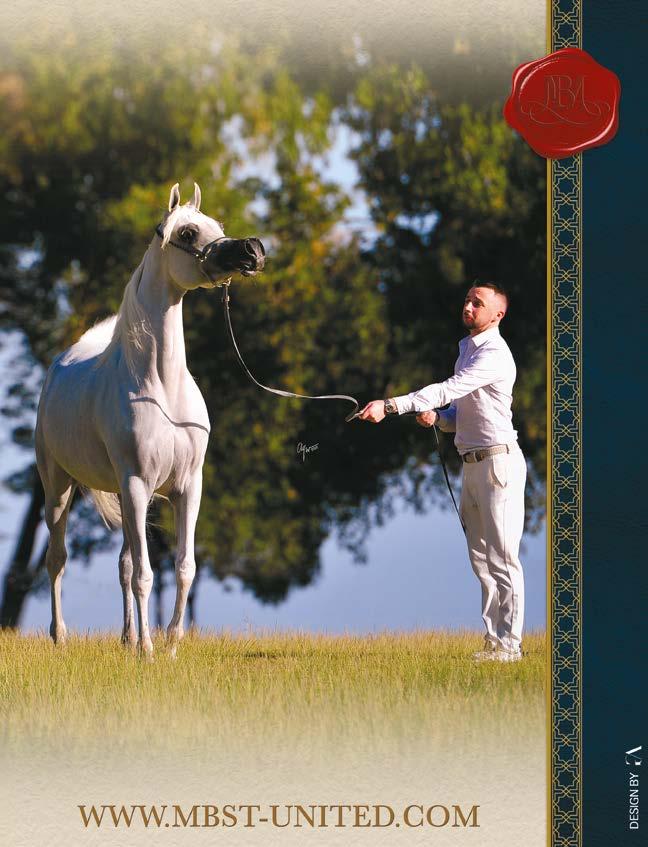
MANSOUR AL MURAD
* 2017, Italy
ANSATA NILE ECHO x MAYSOUNA HALIMA by MAYSOUN
MANSOUR AL MURAD has made the most of his opportunity, standing at Tre Balzane Stud, to become an internationally renowned breeding stallion. His outstanding pedigree, asil and blue-listed, reflects the crème de la crème of straight Egyptian history.