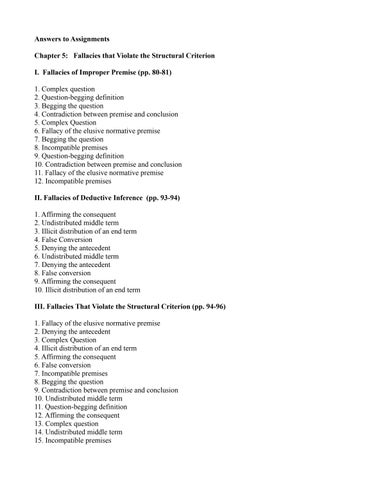
Answers to Assignments Chapter 5: Fallacies that Violate the Structural Criterion I. Fallacies of Improper Premise (pp. 80-81) 1. Complex question 2. Question-begging definition 3. Begging the question 4. Contradiction between premise and conclusion 5. Complex Question 6. Fallacy of the elusive normative premise 7. Begging the question 8. Incompatible premises 9. Question-begging definition 10. Contradiction between premise and conclusion 11. Fallacy of the elusive normative premise 12. Incompatible premises II. Fallacies of Deductive Inference (pp. 93-94) 1. Affirming the consequent 2. Undistributed middle term 3. Illicit distribution of an end term 4. False Conversion 5. Denying the antecedent 6. Undistributed middle term 7. Denying the antecedent 8. False conversion 9. Affirming the consequent 10. Illicit distribution of an end term III. Fallacies That Violate the Structural Criterion (pp. 94-96) 1. Fallacy of the elusive normative premise 2. Denying the antecedent 3. Complex Question 4. Illicit distribution of an end term 5. Affirming the consequent 6. False conversion 7. Incompatible premises 8. Begging the question 9. Contradiction between premise and conclusion 10. Undistributed middle term 11. Question-begging definition 12. Affirming the consequent 13. Complex question 14. Undistributed middle term 15. Incompatible premises
16. False conversion 17. Fallacy of the elusive normative premise 18. Denying the antecedent 19. Begging the question 20. Illicit distribution of an end term 21. Contradiction between premise and conclusion 22. Question-begging definition VI. Dad's First Email to Jim (pp. 96-97) 1. Incompatible premises 2. Question-begging definition 3. Begging the question 4. Illicit Distribution of an end term 5. Undistributed middle term 6. Affirming the consequent 7. Denying the antecedent 8. False conversion 9. Contradiction between premise and conclusion 10. Fallacy of the elusive normative premise 11. Complex question Chapter 6: Fallacies that Violate the Relevance Criterion I. Fallacies of Irrelevant Premise (p. 108) 1. Using the wrong reasons 2. Genetic fallacy 3. Rationalization 4. Rationalization 5. Drawing the wrong conclusion 6. Using the wrong reasons 7. Genetic fallacy 8. Drawing the wrong conclusion II. Fallacies of Irrelevant Appeal (pp. 123-124) 1. Appeal to tradition 2. Appeal to force or threat 3. Appeal to self-interest 4. Manipulation of emotions 5. Appeal to irrelevant authority 6. Appeal to tradition 7. Appeal to common opinion 8. Appeal to self-interest 9. Appeal to force or threat 10. Manipulation of emotions 11. Appeal to common opinion 12. Appeal to irrelevant authority
III. Fallacies that Violate the Relevance Criterion (pp. 124-126) 1. Appeal to tradition 2. Appeal to force or threat 3. Appeal to self-interest 4. Appeal to irrelevant authority 5. Genetic fallacy 6. Appeal to common opinion 7. Rationalization 8. Drawing the wrong conclusion 9. Using the wrong reasons 10. Manipulation of emotions 11. Using the wrong reasons 12. Rationalization 13. Appeal to self-interest 14. Appeal to irrelevant authority 15. Genetic Fallacy 16. Appeal to common opinion 17. Appeal to force or threat 18. Drawing the wrong conclusion 19. Appeal to tradition 20. Manipulation of emotions VI. Dad's Second Email to Jim (pp. 126-127) 1. Appeal to force or threat 2. Appeal to self-interest 3. Appeal to tradition 4. Genetic fallacy 5. Appeal to common opinion 6. Appeal to irrelevant authority 7. Using the wrong reasons 8. Rationalization 9. Drawing the wrong conclusion 10. Manipulation of emotions Chapter 7: Fallacies that Violate the Acceptability Criterion I. Fallacies of Linguistic Confusion (p. 144) 1. Misuse of a vague expression 2. Equivocation 3. Ambiguity 4. Distinction without a difference 5. Illicit contrast 6. Misuse of a vague expression 7. Ambiguity 8. Misleading accent
9. Equivocation 10. Misleading accent 11. Distinction without a difference 12. Illicit contrast II. Unwarranted Assumption Fallacies (pp. 164-166) 1. Faulty analogy 2. Misuse of a principle 3. Wishful thinking 4. Fallacy of composition 5. Fallacy of the continuum 6. Fallacy of division 7. False alternatives 8. Is-ought fallacy 9. Wishful thinking 10. Fallacy of the mean 11. Fallacy of novelty 12. Fallacy of the mean 13. Fallacy of division 14. Faulty analogy 15. Fallacy of novelty 16. Misuse of a principle 17. False alternatives 18. Is-ought fallacy 19. Fallacy of composition 20. Fallacy of the continuum III. Fallacies that Violate the Acceptability Criterion (pp. 166-168) 1. Fallacy of novelty 2. Is-ought fallacy 3. Equivocation 4. Wishful thinking 5. Distinction without a difference 6. False alternatives 7. Misuse of a vague expression 8. Misuse of a principle 9. Ambiguity 10. Fallacy of division 11. Misleading accent 12. Fallacy of the mean 13. Fallacy of the continuum 14. Fallacy of composition 15. Faulty analogy 16. Illicit contrast 17. Misleading accent 18. Is-ought fallacy 19. Illicit contrast
20. False alternatives 21. Equivocation 22. Wishful thinking 23. Distinction without a difference 24. Fallacy of division 25. Misuse of a vague expression 26. Misuse of a principle 27. Ambiguity 28. Fallacy of the mean 29. Fallacy of novelty 30. Fallacy of composition 31. Faulty analogy 32. Fallacy of the continuum VI. Dad's Third Email to Jim (pp. 168-170) 1. Illicit contrast 2. Fallacy of division 3. Is-ought fallacy 4. Faulty analogy 5. False alternatives 6. Fallacy of the mean 7. Equivocation 8. Fallacy of the continuum 9. Misuse of a principle 10. Fallacy of composition 11. Misleading accent 12. Distinction without a difference 13. Misuse of a vague expression 14. Wishful thinking 15. Fallacy of novelty 16. Ambiguity Chapter 8: Fallacies that Violate the Sufficiency Criterion I. Fallacies of Missing Evidence (pp. 186-187) 1. Special pleading 2. Insufficient sample 3. Unrepresentative data 4. Fallacy of popular wisdom 5. Omission of key evidence 6. Contrary-to-fact hypothesis 7. Special pleading 8. Arguing from ignorance 9. Insufficient sample 10. Omission of key evidence 11. Arguing from ignorance 12. Contrary-to-fact hypothesis