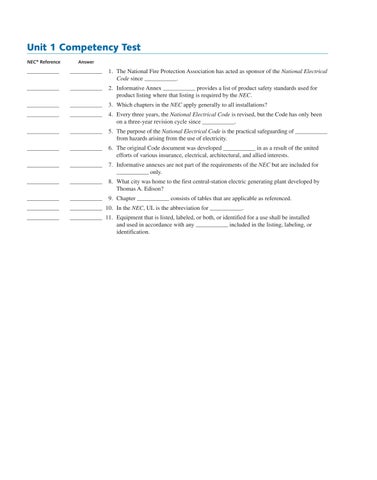
Unit 1 Competency Test NEC ® Reference
Answer
1. The National Fire Protection Association has acted as sponsor of the National Electrical Code since . 2. Informative Annex provides a list of product safety standards used for product listing where that listing is required by the NEC. 3. Which chapters in the NEC apply generally to all installations? 4. Every three years, the National Electrical Code is revised, but the Code has only been on a three-year revision cycle since . 5. The purpose of the National Electrical Code is the practical safeguarding of from hazards arising from the use of electricity. 6. The original Code document was developed in as a result of the united efforts of various insurance, electrical, architectural, and allied interests. 7. Informative annexes are not part of the requirements of the NEC but are included for only. 8. What city was home to the first central-station electric generating plant developed by Thomas A. Edison? 9. Chapter
consists of tables that are applicable as referenced.
10. In the NEC, UL is the abbreviation for
.
11. Equipment that is listed, labeled, or both, or identified for a use shall be installed and used in accordance with any included in the listing, labeling, or identification.
Unit 2 Competency Test NEC ® Reference
Answer
1. A(n) branch circuit supplies two or more receptacles or outlets for lighting and appliances. 2.
is the largest amount of current capable of being delivered at a point on the electrical system during a short-circuit condition.
3. A(n) branch circuit consists of two or more ungrounded conductors having a potential difference between them, and a grounded conductor having equal potential difference between it and each ungrounded conductor of the circuit and that is connected to the neutral or grounded conductor of the system. 4. An intermittent operation in which load conditions are regularly recurrent is the definition of . 5. The is the connection between the grounded-circuit conductor and the equipment grounding conductor at the service. 6. A(n) is used to connect the system grounded conductor or the equipment to a grounding electrode or to a point on the grounding electrode system. 7. Rainproof, raintight, or watertight equipment can fulfill the requirements for where varying weather conditions other than wetness, such as snow, ice, dust, or temperature extremes, are not a factor. 8. A(n) is an intentionally constructed, low-impedance electrically conductive path designed and intended to carry current during ground-fault events from the point of a ground fault on a wiring system to the electrical supply source and that facilitates the operation of the overcurrent protective device or ground-fault detectors. 9. A(n) is a manual, nonautomatic, or automatic operated device used in conjunction with a transfer switch to provide a means of directly connecting load conductors to a power source and of disconnecting the transfer switch. 10. A surface, flush, or freestanding assemblage with a raceway, fittings, or other enclosure provided with one or more receptacles, for the purpose of supplying power to utilization equipment is called a(n) . 11. A raceway encased in 4 in. (102 mm) of concrete on the ground floor (in direct contact with the earth) shall be considered a(n) location. 12. A(n) may consist of one or more sensing elements integral with the motor-compressor and an external control device. 13. An enclosure designed for either surface or flush mounting and provided with a frame, mat, or trim in which a swinging door or doors are or can be hung is called a(n) . 14. A(n) is a shaftway, hatchway, well hole, or other vertical opening of space in which an elevator or dumbwaiter is designed to operate. 15. A multiwire branch circuit can supply: I. 20/240 volts to only one piece of utilization equipment II. 120/240 volts where all ungrounded conductors are opened simultaneously a) I only b) II only c) both I and II d) neither I nor II 16. An overcurrent protective device with a circuit opening fusible part that is heated and severed by the passage of overcurrent through it is the definition of a(n) .
NEC ® Reference
Answer
17.
is a string of outdoor lights suspended between two points.
18. Name two items that must be present when defining an area as a bathroom. 19. A continuous load is where the hours or more.
current is expected to continue for three
a) 80% b) average c) maximum d) 125% 20. Solidly grounded is defined as connected to ground without inserting any or impedance device. 21. A(n) is a point on the wiring system at which current is taken to supply utilization equipment. 22. A(n) is defined as the circuit conductors between the final overcurrent device protecting the circuit and the outlet(s). 23.
enclosures are constructed or protected so that exposure to a beating rain will not result in the entrance of water under specified test conditions.
24. Continuous duty is an operation at a substantially constant load for
.
a) 1 hour or more b) 1½ hours or more c) 3 hours or more d) an indefinitely long time 25. Ampacity is defined as the maximum current, in amperes, that a conductor can carry continuously under the conditions of use without exceeding . 26. When a disconnecting means must be located within sight from a motor, the disconnect must be visible and not more than ft from the motor. 27. A building containing three dwelling units is called a(n) 28. Ground is defined as ___________
.
.
29. At the neutral point of the system, the of the nominal voltages from all other phases within the system that utilize the neutral, with respect to the neutral point, is zero potential. 30. Four panelboards are in an electrical room behind locked doors. Only authorized personnel have keys to this electrical room. In accordance with 240.24, overcurrent devices shall be readily accessible. Since a key must be used to gain entry into the electrical room, are the overcurrent devices in these panelboards considered readily accessible? 31. A(n) is defined as an electrical power supply output, other than a service, having no direct connection(s) to circuit conductors of any other electrical source other than those established by grounding and bonding connections. 32. A feeder is defined as all circuit conductors between the service equipment, the source of a separately derived system, or other power supply source and the final overcurrent device. 33. A(n) is defined as utilization equipment, generally other than industrial, that is fastened in place, stationary, or portable; is normally built in a standardized size or type; and is installed or connected as a unit to perform one or more functions such as clothes washing, air-conditioning, food mixing, deep frying, and so forth. 34. A motor branch circuit includes the circuit conductors as well as the equipment between the motor branch-circuit short-circuit and ground-fault protective device and a(n) motor.
Unit 3 Competency Test NEC ® Reference
Answer
1. In pull boxes or junction boxes having any dimension over tors shall be cabled or racked up in an approved manner.
in., all conduc-
a) 6 b) 12 c) 36 d) 72 2. Boxes and conduit bodies in buildings shall be installed so the contained wiring and devices are . 3. What are the minimum dimensions for “X” and “Y” in the drawing below if the conductors within the 3-in. conduit are pulled straight through the 3-in. conduit on the opposite wall and the conductors in the 2-in. conduit are pulled through the 2-in. conduit on the adjacent wall? All conductors are 4 AWG and larger.
3"
“Y”
2"
3"
“X” 2"
4. Outlet boxes that do not enclose devices or utilization equipment shall have a minimum internal depth of in. 5. A 4411⁄16-in. square box that is 21⁄8 in. deep already contains two receptacles, two internal cable clamps, four 12 AWG THHN copper conductors (two black and two white), two grounding conductors, three wire nuts, two pigtails, and one equipment bonding jumper. (A flat plaster ring was used to secure the receptacles to the box.) How many more 12 AWG THHN copper conductors can be added to this box? 6. In damp or wet locations, surface-type enclosures (within the scope of Article 312) shall be so placed or equipped as to prevent moisture or water from entering and accumulating within the cabinet or cutout box and shall be mounted so there is at least in. airspace between the enclosure and the wall or other supporting surface. 7. The minimum thickness in inches for a steel box measuring 6 in. 3 4 in. 3 3½ in. is in. 8. Covers of outlet boxes and conduit bodies having holes through which flexible cord pendants may pass shall be provided with approved or shall have smooth, well-rounded surfaces on which the cord may bear. 9. A weatherproof metal junction box measuring 4 in. 3 4 in. 3 6 in. has been installed to support a luminaire. Two rigid metal conduits have been threaded wrenchtight into the threaded entries of the enclosure. The box has not yet been secured to the brick wall, but both conduits have been strapped to the wall 16 in. from the box. What additional support (from the following list) is required for this box? I. Two metal screws with plastic anchors II. Two toggle bolts III. Two drive pins a) none b) I or II only c) I or III only d) I, II, or III
NEC ® Reference
Answer
___________
___________ 10. Where permanent barriers are installed in a junction box, each section shall be considered as a(n) .
___________
___________ 11. What is the maximum number of 12 AWG THW conductors permitted in a 4-in. octagon box that is 1½ in. deep? (The box contains a fixture stud and a hickey.)
___________
___________ 12. A means must be provided in each metal box for the connection of a(n)
___________
___________ 13. Installations within or behind a surface of concrete, tile, gypsum, plaster, or other noncombustible material, including boxes employing a flush-type cover or faceplate, shall be made so that the front edge of the box, plaster ring, extension ring, or listed extender will not be set back of the finished surface more than in.
___________
___________ 14. Nonmetallic boxes shall be suitable for the lowest
___________
___________ 15. An electrician needs to install a surface-mounted, nonmetallic, weatherproof cabinet on the outside of a concrete block building. Since the cabinet must be mounted in a wet location, it must be mounted so there is at least in. of airspace between the cabinet and the wall.
___________
___________ 16. How many 14 AWG THW conductors are permitted in a 3 in. 3 2 in. 3 2½ in. device box?
___________
___________ 17. Nonmetallic surface extensions must be secured in place by approved means at intervals not exceeding in.
___________
___________ 18. A 2½-in. rigid metal conduit enters the back of a pull box with a removable cover on the opposite side. The raceway encloses four 4/0 AWG THHN copper conductors and one 4 AWG equipment grounding conductor. The minimum depth (distance from the entry wall to the cover) for this pull box is in.
___________
___________ 19. Where nonmetallic boxes are used with open wiring or concealed knob-and-tube wiring, the conductors must enter the box through .
___________
___________ 20. Luminaires weighing no more than pounds can be supported by boxes (such as device boxes) not specifically designed to support luminaires, provided the luminaire, or its supporting yoke, is secured to the box with at least two No. 6 or larger screws.
___________
___________ 21. For straight pulls, the length of the box shall not be less than the outside diameter, over sheath, of the largest shielded conductor entering the box if the system voltage is over 1000 volts, nominal.
___________
___________ 22. Approved drainage openings not smaller than and not larger than in diameter shall be permitted to be installed in the field in boxes or conduit bodies listed for use in damp or wet locations.
___________
___________ 23. Unused openings, other than those intended for the operation of equipment, those intended for mounting purposes, or those permitted as part of the design for listed equipment, shall be closed to afford protection to the wall of the equipment.
___________
___________ 24. At least in. of free conductor (measured from the point in the conduit body where it emerges from its raceway or cable sheath) shall be left at each outlet, junction, and switch point.
___________
___________ 25. A switch rated for 20 amps will be installed in a device box adjacent to a switch rated for 15 amps. Two 12 AWG THHN copper conductors will be terminated onto the switch rated 20 amps and two 14 AWG THHN copper conductors will be terminated onto the switch rated 15 amps. The required volume allowance for the switch rate 20 amps is in.3 and the required volume allowance for the switch rate 15 amps is in.3
.
conductor entering the box.