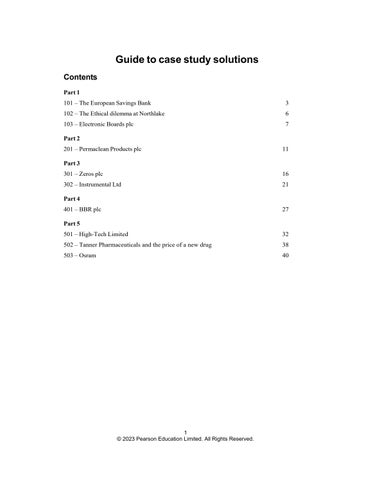
Guide to case study solutions Contents Part 1 101 – The European Savings Bank
3
102 – The Ethical dilemma at Northlake
6
103 – Electronic Boards plc
7
Part 2 201 – Permaclean Products plc
11
Part 3 301 – Zeros plc
16
302 – Instrumental Ltd
21
Part 4 401 – BBR plc
27
Part 5 501 – High-Tech Limited
32
502 – Tanner Pharmaceuticals and the price of a new drug
38
503 – Osram
40
1 © 2023 Pearson Education Limited. All Rights Reserved.
PART I
Management and cost accounting fundamentals
2 © 2023 Pearson Education Limited. All Rights Reserved.
CASE 101
The European Savings Bank This case provides a unique vehicle for covering the legal issues and raising the ethical awareness of students with regard to software piracy. The case allows students to apply ethical reasoning in a legal framework with which students may not be completely familiar, but of which they are aware. This is especially appropriate with today’s increased copyright awareness, with cases such as Napster taking over the news headlines. The software case can also be used to discuss other ethical issues, such as unethical behaviour. The motivations include a compulsion to win, a fear about economic uncertainty and/or the future and self-esteem. If an act is legal, does that make it ethical? Conversely, if an act is ethical, should it be legal? Since software piracy behaviour is so prevalent despite its illegality, it is particularly suited to this issue. The various issues related to copying software provide robust discussions in the classroom. Before presenting the case, it is helpful to present an overview of the legal issues related to software piracy. This will allow students to have an adequate background for the case discussion and will also highlight the variation in the rights granted to the licensees of different software packages. A comparison of the laws and the licensing agreements points out how difficult it is always to adhere to legal constraints and introduces areas where ethical judgement enters the process.
Software piracy Legal issues The laws regarding copying software were not clear for many years. This changed when the US copyright protection for computer software altered. Software became a literary work subject to copyright protection. Software is typically licensed rather than sold in an effort to control software piracy. Under the typical licensing agreement, the software is shrink wrapped with the agreement on the front – by opening the shrink-wrap, the end user automatically agrees to the details of the copyright agreement. Ethical aspects Ethical behaviour considers the impact of our actions on others and society as a whole. Software piracy differs from other ethical issues because it is so widespread and prevalent in today’s society. The question, ‘If everyone does it, then surely it’s OK?’ arises and this is further exacerbated by the muddle with technology: copyright regarding printed matter is fairly easy – only one person can read a book at any one time; with software, the issue becomes muddled – one person can use the same software on different computers in exactly the same way and if that person uses it on only one computer at a time, is it piracy?
3 © 2023 Pearson Education Limited. All Rights Reserved.
Bhimani et al., Management and Cost Accounting, 8e, Instructor’s Manual
Discussion of roles To facilitate the use of the case, each role is discussed separately. Tareq Hassan The major reason for including Tareq in the case is to force the students to identify the creation of software with a particular individual (i.e. to personalise the issue). By attaching the issue to a person, rather than just considering the large software vendor, students recognise that an individual has invested considerable time and money in the creation of the software. Tareq’s fundamental concern or issue in the case is the fact that the software he has created is being stolen. One topic that can be discussed is what, if anything, he can do about his software being pirated. His actions may be limited because he has agreed to have Data Sources, SA, market his software. Anna Rodrigues Anna, as the representative of the software vendor, is mainly concerned with what to do about the software piracy. Some people have argued that companies should encourage software piracy because anyone who uses it will subsequently want to purchase the package – this is a typical ploy of freeware companies. Some options are reinstating copy protection, registration, encouraging whistle-blowing through incentives, hardware or software key and embedded user name and these are a useful starting point for discussion. Joe Fordham Joe is the individual in this case who faces the largest dilemma: what decision is he going to make regarding the software? He believes that the bank would benefit from a wider use of Loan Net, but he is unsure how to proceed. One of the grey areas often identified in the issue of software piracy occurs with work on multiple machines. As discussed before, would the use of multiple copies be a breach of the agreement? Sometimes it is the case that the agreement is unclear thereby adding to the confusion. The discussion of Joe’s dilemma should also include other possible courses of action. One alternative is for Joe to talk to Mia Huber and support his case for purchasing more copies of the software. In addition, Joe should read the actual licensing agreement and talk to the software company to determine what right he has to make extra copies. Mia Huber Many companies will spend large amounts of money to collect data, but put that same data at risk by using pirated software that is undocumented, unsupported and typically lacking in access to updates. One suggestion usually made by one of the students is that the bank examines the possibility of a site licence. A site licence gives the purchaser the right to use the software on various computers located within a specific area. This is very typical of academic institutions, where IT-purchasing departments obtain licences to cover the whole organisation. Another important part of this discussion is Mia’s role as a representative of 4 © 2023 Pearson Education Limited. All Rights Reserved.
Bhimani et al., Management and Cost Accounting, 8e, Instructor’s Manual
the company. The group can discuss the costs and merits of establishing a clear policy regarding the copying of software. Dave Saunders Software piracy has become so prevalent that some argue it has almost become socially acceptable, despite the fact that it is illegal behaviour. Dave, as CEO of the bank, should recognise the potential costs that software piracy can cause his company. The other serious issue facing Dave is the ethical tone established by top management. One area that Dave should have responsibility for is maintaining a policy on ethical behaviour, including software piracy. How should managers respond when they become aware of unethical or illegal behaviour? This issue can give rise to discussions relating to the actions of those in top management as well as their proposed policies. Society Some people argue that unauthorised copying of software has a cost to society while others, following the ‘hacker ethic’, would argue that piracy results in the free sharing of information. Those who adhere to the hacker ethic argue that all software should be in the public domain, since this encourages the free flow of information. They argue that this will result in a greater benefit to society as a whole since more learning and growth will occur. Software is copyrighted to protect the intellectual rights of the developers. The underlying rationale for copyrights is that they will foster the sharing and growth of knowledge. If copyrights are not observed, the potential developer may well choose to work in another area.
5 © 2023 Pearson Education Limited. All Rights Reserved.