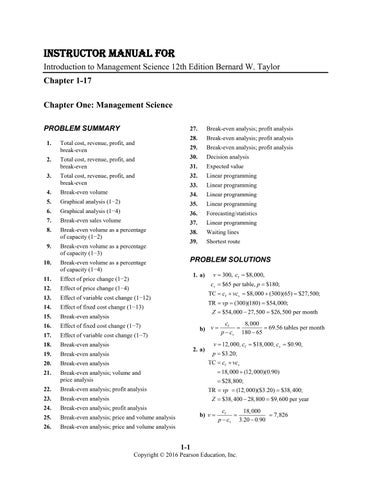
Instructor Manual for Introduction to Management Science 12th Edition Bernard W. Taylor Chapter 1-17 Chapter One: Management Science PROBLEM SUMMARY
27.
Break-even analysis; profit analysis
28.
Break-even analysis; profit analysis
29.
Break-even analysis; profit analysis
1.
Total cost, revenue, profit, and break-even
2.
Total cost, revenue, profit, and break-even
30.
Decision analysis
31.
Expected value
3.
Total cost, revenue, profit, and break-even
32.
Linear programming
33.
Linear programming
4.
Break-even volume
34.
Linear programming
5.
Graphical analysis (1−2)
35.
Linear programming
6.
Graphical analysis (1−4)
36.
Forecasting/statistics
7.
Break-even sales volume
37.
Linear programming
8.
Break-even volume as a percentage of capacity (1−2)
38.
Waiting lines
9.
Break-even volume as a percentage of capacity (1−3)
39.
Shortest route
10.
Break-even volume as a percentage of capacity (1−4)
11.
Effect of price change (1−2)
12.
Effect of price change (1−4)
13.
Effect of variable cost change (1−12)
14.
Effect of fixed cost change (1−13)
15.
Break-even analysis
16.
Effect of fixed cost change (1−7)
17.
Effect of variable cost change (1−7)
18.
Break-even analysis
19.
Break-even analysis
20.
Break-even analysis
21.
Break-even analysis; volume and price analysis
PROBLEM SOLUTIONS 1. a)
v 300, cf $8,000, cv $65 per table, p $180; TC cf vcv $8,000 (300)(65) $27,500; TR vp (300)(180) $54,000; Z $54,000 27,500 $26,500 per month
b) v
2. a)
cf 8,000 69.56 tables per month p cv 180 65
v 12, 000, cf $18, 000, cv $0.90, p $3.20; TC cf vcv 18, 000 (12, 000)(0.90) $28,800;
22.
Break-even analysis; profit analysis
TR vp (12, 000)($3.20) $38, 400;
23.
Break-even analysis
Z $38, 400 28,800 $9, 600 per year
24.
Break-even analysis; profit analysis
25.
Break-even analysis; price and volume analysis
26.
Break-even analysis; price and volume analysis
b) v
cf 18, 000 7,826 p cv 3.20 0.90
1-1 Copyright © 2016 Pearson Education, Inc.
v 18,000, cf $21,000, cv $.45,
3. a)
p $1.30; TC cf vcv $21,000 (18,000)(.45) $29,100;
cf 18, 000 9, 729.7 cupcakes p cv 2.75 0.90
It increases the break-even
TR vp (18,000)(1.30) $23, 400;
volume from 7,826 to 9, 729.7
Z $23, 400 29,100 $5,700 (loss)
per year.
b) v 4.
v
11.
cf 21,000 24,705.88 yd per month p cv 1.30 .45
v
12.
per month; it reduces the break-even
cf $25,000, p $.40, cv $.15, v
cf 25,000 55,555.55 lb p cv .60 .15
volume from 100,000 lb per month
cf 25,000 100,000 lb per month p cv .40 .15
to 55,555.55 lb. v
13.
5.
cf 25,000 65,789.47 lb p cv .60 .22
per month; it increases the break-even volume from 55,555.55 lb per month to 65,789.47 lb per month. v
14.
cf 39,000 102,613.57 lb p cv .60 .22
per month; it increases the break-even volume from 65,789.47 lb per month
6.
to 102,631.57 lb per month. Initial profit: Z vp cf vcv (9,000)(.75)
15.
4,000 (9,000)(.21) 6,750 4,000 1,890 $860 per month; increase in price: Z vp cf vcv (5,700)(.95) 4,000 (5,700)(.21) 5, 415 4,000 1,197 $218 per month; the dairy should not raise its price. cf
v=
8.
Break-even volume as percentage of capacity
9.
v=
16.
v 7,826 .652 65.2% k 12, 000 17.
Original break-even point (from problem 7) = 1,250 New break-even point:
v 24,750.88 .988 98.8% k 25,000
Break-even volume as percentage of v 100,000 capacity .833 83.3% k 120,000
cf 35,000 = = 1,750 p cv 30–10
The increase in fixed cost from $25,000 to $35,000 will increase the break-even point from 1,250 to 1,750 or 500 dolls; thus, he should not spend the extra $10,000 for advertising.
Break-even volume as percentage of capacity
10.
p cv
=
$25,000 = 1,250 dolls 30 10
7.
v
cf 17,000 1,062.5 p cv 30 14
Reduces BE point by 187.5 dolls. 18. a) v b)
cf $27,000 5,192.30 pizzas p cv 8.95 3.75
5,192.3 259.6 days 20
1-2 Copyright © 2016 Pearson Education, Inc.
c) Revenue for the first 30 days = 30(pv − vcv)
63v = 6,700
= 30[(8.95)(20) − (20)(3.75)]
v = 106.3 pupils c) Z = vp − cf − vcv
= $3,120
$5,000 = 60p − $1,700 − 60(12)
$27,000 − 3,120 = $23,880, portion of fixed cost not recouped after 30 days.
60p = 7,420 p = $123.67
cf $23,880 New v 5,685.7 pizzas p cv 7.95 3.75
22. a) cf = $350,000 cv = $12,000
Total break-even volume = 600 + 5,685.7 = 6,285.7 pizzas
p = $18,000 v
5,685.7 20 314.3 days
Total time to break-even 30
19. a) Cost of Regular plan = $55 + (.33)(260 minutes)
b) Z = (75)(18,000) − 350,000 − (75)(12,000) = $100,000
Cost of Executive plan = $100 + (.25)(60 minutes) = $115
c) Z = (35)(25,000) − 350,000 − (35)(12,000) = 105,000
Select Executive plan. b) 55 + (x − 1,000)(.33) = 100 + (x − 1,200)(.25)
This is approximately the same as the profit for 75 students and a lower tuition in part (b).
− 275 + .33x = .25x − 200 x = 937.50 minutes per month or 15.63 hrs.
23.
p = $400 cf = $8,000
7,500 p .35
cv = $75 Z = $60,000
p = $0.89 to break even b) If the team did not perform as well as expected the crowds could be smaller; bad weather could reduce crowds and/or affect what fans eat at the game; the price she charges could affect demand. c) This will be a subjective answer, but $1.25 seems to be a reasonable price.
v
Z cf p cv
v
60,000 8,000 400 75
v = 209.23 teams 24.
Z = vp − cf − vcv
Fixed cost (cf) = 875,000 Variable cost (cv) = $200
Z = (14,000)(1.25) − 7,500 − (14,000)(0.35)
Price (p) = (225)(12) = $2,700 v = cf/(p – cv) = 875,000/(2,700 – 200) = 350
= 17,500 − 12,400 = $5,100 21. a) cf = $1,700
With volume doubled to 700:
cv = $12 per pupil p = $75
v
350,000 18,000 12,000
= 58.33 or 59 students
= $140.80
20. a) 14,000
cf p cv
1,700 75 12
25.
= 26.98 or 27 pupils
Profit (Z) = (2,700)(700) – 875,000 – (700)(200) = $875,000 cf = $26,000 cv = $0.67 p = $3.75
b) Z = vp − cf − vcv
v=
$5,000 = v(75) − $1,700 − v(12)
26, 000 3.75 0.67
1-3 Copyright © 2016 Pearson Education, Inc.
b) (8 weeks)(6 days/week)(3 lawns/day) = 144 lawns
= 8,442 slices Forecasted annual demand = (540)(52) = 28,080
Z = (144)(30) − 500 − (144)(14) Z = $1,804
Z = $105,300 – 44,813.6 = $60,486.40 26.
Fixed cost (cf) = 100,000 Variable cost (cv) = $(.50)(.35) + (.35)(.50) + (.15)(2.30) = $0.695 Price (p) = $6 Profit (Z) = (6)(45,000) – 100,000 – (45,000)(0.695) = $138,725
c) (8 weeks)(6 days/week)(4 lawns/day) = 192 lawns Z = (192)(25) − 500 − (192)(14) Z = $1,612 No, she would make less money than (b) 29. a) v
This is not the financial profit goal of $150,000.
cf 700 p cv 35 3
v = 21.88 jobs
The price to achieve the goal of $150,000 is, p = (Z + cf + vcv)/v = (150,000 + 100,000 + (45,000)(.695))/45,000 = $6.25
b) (6 snows)(2 days/snow)(10 jobs/day) = 120 jobs Z = (120)(35) − 700 − (120)(3) Z = $3,140
The volume to achieve the goal of $150,000 is, v = (Z + cf)/(p − cv) = (150,000 + 100,000)/(6 − .695) = 47,125
c) (6 snows)(2 days/snow)(4 jobs/day) = 48 jobs Z = (48)(150) − 1800 − (48)(28) Z = $4,056 Yes, better than (b)
27. a) Monthly fixed cost (cf) = cost of van/60 months + labor (driver)/month = (21,500/60) + (30.42 days/month)($8/hr) (5 hr/day) = 358.33 + 1,216.80 = $1,575.13
d) Z = (120)(35) − 700 − (120)(18) Z = $1,340 Yes, still a profit with one more person 30.
This is a decision analysis problem – the subject of Chapter 12. The payoff table is: Weather Conditions
Variable cost (cv) = $1.35 + 15.00 = $16.35 Price (p) = $34 v = cf/(p − vc) = (1,575.13)/(34 16.35) v = 89.24 orders/month
Decision Alternatives
Good
Bad
$3.25
$12,800
$8,450
$4.00
$14,400
$5,275
The student’s decision depends on the degree of risk they are willing to assume.
b) 89.24/30.42 = 2.93 orders/day − Monday through Thursday
Chapter 12 includes decision criteria for this problem. 31.
Double for weekend = 5.86 orders/day − Friday through Sunday
This problem uses expected value for the decision alternatives in problem 30. Expected value ($3.25) = ($12,800)(0.60) + ($8,450)(0.40) = $11,060
Orders per month = approximately (18 days) (2.93 orders) + (12.4 days)(5.86 orders)
Expected value ($4.00) = ($14,400)(0.60) + ($5,275)(0.40) = $10,750
= 125.4 delivery orders per month Profit = total revenue − total cost = vp – (cf + vcv) = (125.4)(34) − 1,575.13 – (125.4)(16.35) = 638.18 cf 500 28. a) v p cv 30 14
Although the decision to sell hotdogs for $3.25 results in the greatest expected value, the results are so close, Annie would likely be indifferent. 32.
There are two possible answers, or solution points: x = 25, y = 0 or x = 0, y = 50 Substituting these values in the objective function: Z = 15(25) + 10(0) = 375 Z = 15(0) + 10(50) = 500
v = 31.25 jobs
1-4 Copyright © 2016 Pearson Education, Inc.
Thus, the solution is x = 0 and y = 50
33.
This is a simple linear programming model, the subject of the next several chapters. The student should recognize that there are only two possible solutions, which are the corner points of the feasible solution space, only one of which is optimal.
The solution is computed by solving simultaneous equations, x = 30, y = 10, Z = $1,400 It is the only, i.e., ―optimal‖ solution because there is only one set of values for x and y that satisfy both constraints simultaneously.
34. Labor usage
Clay usage
Profit
Possible
# mugs
12x + 15y < = 60
9x+5y < = 30
300x + 250y
solution?
0
1
15
5
250
yes
1
0
12
9
300
yes
1
1
27
14
550
yes
0
2
30
10
500
yes
2
0
24
18
600
yes
1
2
42
19
800
yes
2
1
39
23
850
yes
2
2
54
28
1100
yes, best solution
0
3
45
15
750
yes
3
0
36
27
900
yes
1
3
57
24
1050
yes
3
1
51
32
1150
no
2
3
69
33
1350
no
3
2
66
37
1400
no
3
3
81
42
1650
no
4
0
48
36
1200
no
0
4
60
20
1000
yes
1
4
72
29
1300
no
4
1
63
41
1450
no
2
4
84
38
1600
no
4
2
78
46
1700
no
# bowls
1-5 Copyright © 2016 Pearson Education, Inc.