Davis and Davis, Managerial Accounting 4th ed. Instructor’s Manual
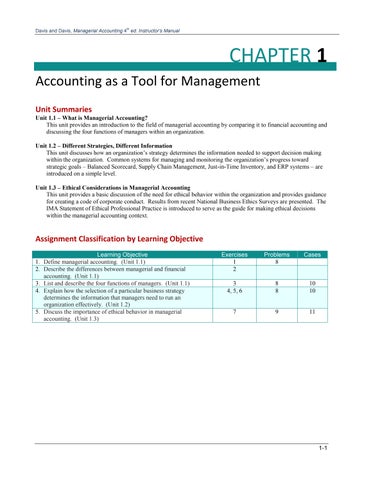
CHAPTER 1 Accounting as a Tool for Management Unit Summaries Unit 1.1 – What is Managerial Accounting? This unit provides an introduction to the field of managerial accounting by comparing it to financial accounting and discussing the four functions of managers within an organization. Unit 1.2 – Different Strategies, Different Information This unit discusses how an organization‟s strategy determines the information needed to support decision making within the organization. Common systems for managing and monitoring the organization‟s progress toward strategic goals – Balanced Scorecard, Supply Chain Management, Just-in-Time Inventory, and ERP systems – are introduced on a simple level. Unit 1.3 – Ethical Considerations in Managerial Accounting This unit provides a basic discussion of the need for ethical behavior within the organization and provides guidance for creating a code of corporate conduct. Results from recent National Business Ethics Surveys are presented. The IMA Statement of Ethical Professional Practice is introduced to serve as the guide for making ethical decisions within the managerial accounting context.
Assignment Classification by Learning Objective Learning Objective 1. Define managerial accounting. (Unit 1.1) 2. Describe the differences between managerial and financial accounting. (Unit 1.1) 3. List and describe the four functions of managers. (Unit 1.1) 4. Explain how the selection of a particular business strategy determines the information that managers need to run an organization effectively. (Unit 1.2) 5. Discuss the importance of ethical behavior in managerial accounting. (Unit 1.3)
Exercises 1 2
Problems 8
Cases
3 4, 5, 6
8 8
10 10
7
9
11
1-1
Davis and Davis, Managerial Accounting 4th ed. Instructor’s Manual
Assignment Characteristics + n * Revised problem in 4th edition Lightboard video solution available New problem Difficulty: E = Easy, M = Moderate, D = Difficult Bloom’s: K = Knowledge, C = Comprehension, AP = Application, AN = Analysis, S = Synthesis, E = Evaluation IMA: S = Strategy, planning & performance, R = Reporting and control, T = Technology and analytics, B = Business acumen & operations, L = Leadership, E = Professional ethics & values AICPA ACC: RA = Risk assessment, M = Measurement, R = Reporting, RS = Research, S = System/process management, T = Technology AICPA BUS: S = Strategic, G = Global, P = Process management, GV = Governance, C = Customer AICPA PRO: E = Ethics, P = Professional behavior, D = Decision making, CO = Collaboration, L = Leadership, C = Communication, PM = Project Management
Item
Description
L. O.
Difficulty Level
Minutes to Complete
Bloom’s Taxonomy
IMA
AICPA ACC
AICPA BUS
AICPA PRO
Ethics Coverage
1 2
M D
12 10-15
AP AP
B, S R, S
S R
S, P S, GV
D C
3 4 4 4 5
D M D M D
10-12 12 15-20 10-15 20
C AP S, AN C AP, AN
S B, S B B, S E
R M S R RS
S, P S, P GV, P S, P GV
C D D C C, E
1, 3, 4 5
M M
15-20 15-20
AP, AN C, AN
S E
S R
S GV
D C, E
3 5
M D
15-20 15-20
S, AN AN, E
S, B E
M RS
S, P GV
D C, E
EXERCISES 1.1 1.2* 1.3 1.4 1.5 1.6 1.7
Use managerial accounting information Discriminate between managerial and financial accounting Classify managerial functions Identify managers‟ need for information Identify supply chain links Identify balanced scorecard perspectives Apply the IMA Statement of Professional Practice
PROBLEMS 1.8 1.9
Use managerial accounting information Evaluate corporate codes of conduct
CASES 1.10 1.11
Identify supply chain trading partners Apply a corporate code of conduct to make ethical decisions
1-2
Chapter 2 – Cost Behavior and Cost Estimation
Learning Objective Summary by Unit Unit 1.1 LO 1
Define managerial accounting. There are several formal definitions of managerial accounting. A simple one is “the generation of relevant information to support management’s decision-making activities.”
LO 2
Describe the differences between managerial and financial accounting. Managerial accounting‟s primary users are managers and decision makers within an organization, whereas financial accounting is aimed primarily at external users. Unlike GAAP that guides financial accounting, there are no mandated rules in managerial accounting. Managerial accounting reports focus on operating segments, while financial accounting statements report results for the organization as a whole. Managerial accounting is concerned more with projecting future results than reporting past results. Managerial accounting information is prepared to allow managers to take advantage of an opportunity, even if some accuracy must be sacrificed. Financial accounting information is balanced to the penny and is delivered after the end of the accounting period.
LO 3
List and describe the four functions of managers. Planning means setting a direction for the organization. Long-term, or strategic planning provides direction for a five- to ten-year period. Short-term, or operational planning provides more detailed guidance for the coming year; it translates the company‟s strategy into action steps. Controlling is the monitoring of day-today operations to identify any problems that require corrective action. Evaluating is the process of comparing a particular period‟s actual results to planned results for the purpose of assessing managerial performance. Decision making means choosing between alternative courses of action.
Unit 1.2 LO 4
Explain how the selection of a particular business strategy determines the information that managers need to run an organization effectively. To run a business effectively, managers need information that shows how well operations are meeting the organization‟s strategic goals. For instance, if the organization‟s strategy is to be a low-cost producer, information about product costs and cost variances will be more useful to managers than information about research and development.
Unit 1.3 LO 5
Discuss the importance of ethical behavior in managerial accounting. Ethical behavior means knowing right from wrong and then doing the right thing. Many companies and most professional organizations have codes of conduct to guide employees‟ actions. Acting unethically can lead to illegal activity and ultimately to the destruction of the firm. Furthermore, research has shown that a public commitment to ethical behavior can lead to superior financial performance.
2-3
Davis and Davis, Managerial Accounting Instructor’s Manual, 4th ed.
Related Reading Kristine Brands and Mark Holtzblatt. “Business Analytics: Transforming the Role of Management Accountants,” Management Accounting Quarterly, Spring 2015, vol. 16, no. 3. This article discusses how management accountants can apply business analytics in several settings. IMA members may download a pdf version from the IMA web site at www.imanet.org. Peter Brewer, “Redefining Management Accounting,” Strategic Finance, March 2008, 27-34. Brewer presents a new framework for management accounting based on four pillars of leadership, strategic management, operational alignment, and continuous learning and improvement. Tables 1, 2, 3, and 4 provide questions that you may want to consider as you develop your course. IMA members may download a pdf version from the IMA web site at www.imanet.org. B. Douglas Clinton and Larry R. White. “The Roles of the Management Accountant: 2003 – 2012,” Management Accounting Quarterly, Fall 2012, 40 – 74. This study reports results from a survey of IMA members and compares those results to a 2003 survey to determine how management accounting has changed over the decade. IMA members may download a pdf version from the IMA web site at www.imanet.org. James W. Damitio and Raymond S. Schmidgall, “What Accounting Skills Do Managers Value?,” Strategic Finance, October 2007, 52-53. This short article will be helpful in motivating non-accounting students to understand that the concepts covered in this course are important to managers in all areas of business. IMA members may download a pdf version from the IMA web site at www.imanet.org. Delwyn D. DeVries and Tanya Lee, “Making Information Work for You,” Strategic Finance, February 2012, 37-41. Management accountants play an important role in providing information to support managers‟ decision making. This survey of manufacturing firm managers provides insights into how to improve decision making results through acquiring the appropriate information. IMA members may download a pdf version from the IMA web site at www.imanet.org. “Doing the Right Thing: IMA Updates Ethics Guidance,” Strategic Finance, July 1, 2017, https://sfmagazine.com/post-entry/july-2017-doing-the-right-thing-ima-updates-ethics-guidance/. This article provides a timeline of IMA‟s ethics guidance for the profession and discusses the 2017 revision. Phred Dvorak, “Clarity is Missing Link in Supply Chain,” The Wall Street Journal,” May 18, 2009, A1. This article provides an interesting look at the supply chain for chips used in consumer electronics. Of particular interest is the discussion of how just-in-time inventory affects different links in the supply chain. A supply chain diagram is included that shows the international nature of this particular supply chain. The article can be the basis of discussing how the actions of one supply chain trading partner can have potentially disastrous consequences for other supply chain trading partners. The discussion of the lead times for Best Buy‟s purchase of DVD players and the DVD manufacturer‟s time required to produce the DVDs also shows potential timing issues within the supply chain. Ethics Resource Center, http://www.ethics.org/. This web site has a number of excellent resources on ethics. You can obtain results of the latest Global Business Ethics Survey here - https://www.ethics.org/knowledge-center/2018-gbes-2/. Also of note is the set of ethics tools provided at https://www.ethics.org/resources/free-toolkit/. Amy Fredin, “The Unexpected Cost of Staying Silent,” Strategic Finance, April 2012, 53-59. It‟s easier to not blow the whistle when you observe unethical behavior, yet there is a price to pay when you choose to remain silent. IMA members may download a pdf version from the IMA web site at www.imanet.org.
2-4
Chapter 2 – Cost Behavior and Cost Estimation
Lea Hart, “Tips for Teaching Accounting Ethics,” Extra Credit: The Newsletter for Accounting Educators, August 14, 2018, https://www.journalofaccountancy.com/newsletters/extra-credit/teaching-accountingethics.html. This article provides several simple tips to help teach ethics in accounting courses. Kasthuri Henry, “Leading with Your Soul,” Strategic Finance, February 2009, 44-51. Henry presents The Corporate Ethical Leadership Model ™ and discusses six ethical leadership traits. IMA members may download a pdf version from the IMA web site at www.imanet.org. David Hurtt, Michael Robinson, and Marty Stuebs, “The Gatekeepers‟ Tools,” Strategic Finance, January 2010, 37-43. This article examines the management accountant‟s role as information gatekeepers, with a particular emphasis on the need for professional and personal ethics. IMA members may download a pdf version from the IMA web site at www.imanet.org. Raef Lawson, “New Competencies for Management Accountants,” Strategic Finance, March 2019, 40-47. This article explains the newly updated IMA Management Accounting Competency Framework. The framework identifies and categorizes the skills needed to be successful in today‟s business environment. (All end of chapter materials have been coded based on this framework.) You may download a pdf version from the IMA web site at https://sfmagazine.com/post-entry/march-2019-new-competencies-for-managementaccountants/. Pietra Rivoli, The Travels of a T-shirt in the Global Economy, Hoboken, NJ: John Wiley & Sons, 2005. This book recounts how a $6 t-shirt begins in the cotton fields of West Texas, makes it way to a Chinese factory, and eventually ends up in a used clothing market in Africa. It also provides some insight into the apparel industry, which is used in the C&C Sports running case throughout the textbook. A video of the author discussing the book is available at http://www.youtube.com/watch?v=9yYQqKxz8Tg. Manuel Velasquez, Claire Andre, Thomas Shanks, S.J., and Michael J. Meyer, “Thinking Ethically: A Framework for Moral Decision Making”. This web site provides a short description of various ethical decision making approaches. Available online at http://www.scu.edu/ethics/practicing/decision/thinking.html. Curtis C. Verschoor, “New Survey of Workplace Ethics Shows Surprising Results,” Strategic Finance, April 2012, 12-15. Results of the 2011 National Business Ethics Survey are discussed. Anne M. Wilkins, Robert Colvard, and John Lipinski, “Does Your Company Have This Document?,” Strategic Finance, July 2014, 35-39. This article discusses the need for having a corporate code of conduct and identifies seven steps to follow in creating a code of conduct. IMA members may download a pdf version from the IMA web site at www.imanet.org. Susan Wolcott, “Using an Ethical Reasoning Model to Teach Ethics,” IMA Faculty Friday Webinar, November 30, 2018. Susan Wolcott presents how she teaches ethics in accounting courses using her ethical reasoning model. https://www.youtube.com/watch?v=NRIunBh2dQI&feature=youtu.be
2-5