RESEARCH AND SECURITY POLICIES Q&A QUIZ 8 - SUMMER 2020
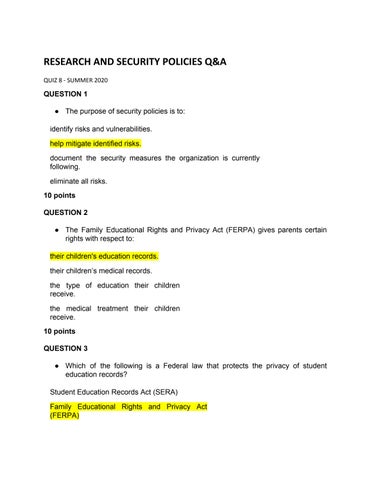
QUESTION 1 ● The purpose of security policies is to: identify risks and vulnerabilities. help mitigate identified risks. document the security measures the organization is currently following. eliminate all risks. 10 points QUESTION 2 ● The Family Educational Rights and Privacy Act (FERPA) gives parents certain rights with respect to: their children's education records. their children’s medical records. the type of education their children receive. the medical treatment their children receive. 10 points QUESTION 3 ● Which of the following is a Federal law that protects the privacy of student education records? Student Education Records Act (SERA) Family Educational Rights and Privacy Act (FERPA)
Intellectual Property Act (IPA) Gramm-Leach-Bliley Act (GLBA) 10 points QUESTION 4 ● The task of identifying your IT assets begins with recognizing that your IT infrastructure and supporting resources can be divided into: categories value.
based
on
departments. work groups. the seven IT domains. 10 points QUESTION 5 ● Under the Family Educational Rights and Privacy Act (FERPA), which of the following has the right to inspect and review the student’s education records maintained by the school? Other schools The parents
student’s
Other parents Everyone 10 points QUESTION 6 ● Under the Family Educational Rights and Privacy Act (FERPA), schools may disclose, without consent, __________ such as a student’s name, address, telephone number, date and place of birth, honors and awards, and dates of attendance.
Personally Identifiable Information (PII) directory information educational information academic information 10 points QUESTION 7 ● Which of the following statements is true regarding environments? The environment has no bearing on risk. Any given risk has the same significance, regardless of environment. Some environments produce highly significant risks. Every environment carries the same set of risks. 10 points QUESTION 8 ● Which of the following statements is true regarding risks? Some risks environments.
are
unique
to
different
Every environment carries the same set of risks. The environment does not have any bearing on risks. Every risk is of equal importance. 10 points QUESTION 9 ● The Family Educational Rights and Privacy Act (FERPA) gives students certain rights with respect to their education records when they: enroll in high school.
graduate from high school. reach the age of 18 or attend a school beyond the high school level. reach the age of 21. 10 points QUESTION 10 ● The Family Educational Rights and Privacy Act (FERPA) applies to: all schools, regardless of level or funding source. all schools that receive funds under an applicable program of the U.S. Department of Education. only higher education institutions such as colleges and universities. only elementary, middle, and high schools. 10 points QUESTION 11 ● How do special environments, such as hospitals, schools, or financial institutions, know how to handle risks? Each one develops its own security policies independently. All hospitals, schools, and financial institutions have the same security policies. The government legislates precise security policies. The government legislates special acts to provide guidance and countermeasures. 10 points QUESTION 12 ● Under the Family Educational Rights and Privacy Act (FERPA), schools generally must have __________ from the parent or eligible student in order to release any information from a student’s education record. written permission
oral consent given in person only oral consent given either in person or over the telephone enrollment verification 10 points QUESTION 13 ● Security policies mitigate risks in: educational businesses.
institutions,
for-profit businesses, institutions.
but
but
not
not
for-profit
educational
a limited number of environments. a wide variety of environments. 10 points QUESTION 14 ● Which of the following statements is true regarding how the Family Educational Rights and Privacy Act (FERPA) differentiates between the three types information? FERPA considers each with different levels of protection. FERPA considers all three types of information with the same level of protection. FERPA is not concerned with disclosure in any of the types of information. FERPA is only concerned with the protection of Personally Identifiable Information (PII). 10 points QUESTION 15 ● Under the Family Educational Rights and Privacy Act (FERPA), parents or eligible students have the right to request that a school correct records which they believe to be: