Solution Manual for Accounting An Introduction 9th Edition by Peter Atrill ISBN9780655708421 Chapter 1-14
with AT + Capstone Case Study 1 + SAQs
Chapter 1 Introduction to finance and accounting Discussion questions—Easy 1.1
What is the purpose of producing accounting information?
Solution: The objective of providing accounting information is to enable users to make more informed decisions and judgements about the organisation concerned. LO1 Explain the nature and role of accounting
1.2
What type of accounting information is produced more frequently? Why?
Solution: Management accounting information is provided on an ‘as needed’ basis for managers. Financial accounting reports, on the other hand, are prepared at less frequent, scheduled dates (e.g. year-end, quarterly or monthly). LO3 Compare and contrast financial and management accounting
1.3
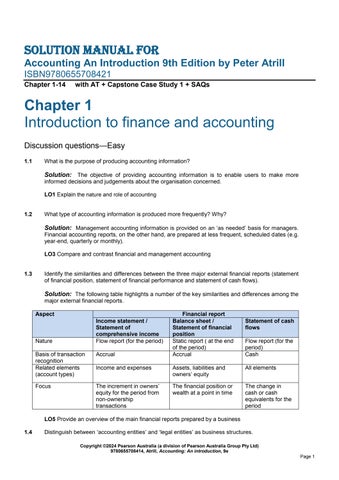
Identify the similarities and differences between the three major external financial reports (statement of financial position, statement of financial performance and statement of cash flows).
Solution: The following table highlights a number of the key similarities and differences among the major external financial reports. Aspect Income statement / Statement of comprehensive income Flow report (for the period)
Nature
Financial report Balance sheet / Statement of financial position Static report ( at the end of the period) Accrual
Statement of cash flows Flow report (for the period) Cash
Basis of transaction recognition Related elements (account types)
Accrual Income and expenses
Assets, liabilities and owners’ equity
All elements
Focus
The increment in owners’ equity for the period from non-ownership transactions
The financial position or wealth at a point in time
The change in cash or cash equivalents for the period
LO5 Provide an overview of the main financial reports prepared by a business 1.4
Distinguish between ‘accounting entities’ and ‘legal entities’ as business structures. Copyright ©2024 Pearson Australia (a division of Pearson Australia Group Pty Ltd) 9780655708414, Atrill, Accounting: An introduction, 9e Page 1
Solution: For accounting purposes it is assumed that the business is separate from the owner(s). The business may be in the form of a sole proprietorship, partnership, company or other operating structure. This assumption is essential to facilitate transaction recording and reporting in relation to the business or operating activities of that entity. From the perspective of the law, most entity structures other than the company do not represent separate legal entities. That is, from the perspective of the law, there is no distinction between the business and the owners of the business. However, with the company entity structure, the business is granted the status of a ‘legal person’ and the rights and responsibilities that go with that status. LO6 Outline the main types of business ownership, describe the way in which a business is typically organised and managed, and explain the importance of accounting in a business context 1.5
As business changes, accounting must change. Do you agree?
Solution: Given its goal of providing useful information it is crucial for accounting to change as business changes. Financial accounting will change more slowly than management accounting due to its regulated nature and the need for consistency and comparability. LO7 Identify ways in which business and accounting have been changing, together with some current issues confronting businesses and their associated reporting, including current thinking on ethics in business 1.6
‘Understandability’ is identified in the text as a key characteristic of accounting information. By whom should the financial reports be readily understood?
Solution: The Accounting Framework suggests the report users need to be both competent and diligent. Therefore, it is not assumed that financial reports will be readily read and understood by lay readers, but rather that the readers will be proficient in accounting and finance (aptitude and application). LO8 Explain why accounting information is generally considered to be useful, and why you need to know the basics of accounting 1.7
Distinguish between ‘planning’ and ‘control’.
Solution: Planning is concerned with providing direction for future activity. Control can be defined as compelling events to conform to the plan. LO3 Compare and contrast financial and management accounting LO4 Identify the main purpose of a business (while recognising a range of other influences), and explain the traditional risk–return relationship LO6 Outline the main types of business ownership, describe the way in which a business is typically organised and managed, and explain the importance of accounting in a business context 1.8
Within a business, how can accounting facilitate control?
Solution: One simple way that accounting can facilitate control is through a comparison of planned or budgeted outcomes with actual results. Where variances occur managers can take actions to get the business back on track. LO3 Compare and contrast financial and management accounting LO4 Identify the main purpose of a business (while recognising a range of other influences), and explain the traditional risk–return relationship LO6 Outline the main types of business ownership, describe the way in which a business is typically organised and managed, and explain the importance of accounting in a business context 1.9
How are annual budgets linked to the long-term plans of an organisation?
Solution: To achieve the long-term plans of an organisation, the management strategy would normally be to break down that plan into incremental targets or achievement hurdles. These Copyright ©2024 Pearson Australia (a division of Pearson Australia Group Pty Ltd) 9780655708414, Atrill, Accounting: An introduction, 9e Page 2
incremental targets will normally be aligned with, or be labelled as the annual budget. Budgets are normally expressed in quantitative terms, including monetary amounts (e.g. sales dollars) and nonmonetary measures (e.g. production efficiency percentage or the number of units produced). LO3 Compare and contrast financial and management accounting LO4 Identify the main purpose of a business (while recognising a range of other influences), and explain the traditional risk–return relationship LO6 Outline the main types of business ownership, describe the way in which a business is typically organised and managed, and explain the importance of accounting in a business context
Discussion questions—Intermediate 1.10
‘Relevance’ and ‘faithful representation’ are two key qualitative characteristics of accounting information. What do these two terms mean in an accounting context? Are they in conflict?
Solution: Relevance relates to the capacity of finanical information to influence decision making. Faithful representation relates to ‘faithfully representing’ what it purports to represent, implying that the information is complete, unbiased and free from material error. The possible conflict relates to obtaining the appropriate balance between the two, as relevance is often inversely related to the passage of time, while faithful representation is positively related to the passage of time. LO1 Explain the nature and role of accounting 1.11
As an owner of a small business, what are three key financial attributes of the business you would wish to assess when you review financial reports?
Solution: Liquidity, solvency and profitability. LO2 List the main groups that use the accounting reports of a business entity, and summarise the different uses that can be made of accounting information 1.12
Reconcile financial accounting with management accounting. Your textbook clearly distinguishes between them. What are the similarities?
Solution: The link between management and financial accounting is in the actual statement of financial performance and statement of financial position. For management accounting, the actuals are required to compare with budgets and standards as part of the control function. For financial accounting, the actuals are the substance of the financial reports. LO3 Compare and contrast financial and management accounting 1.13
What is meant by the ‘risk–return relationship’? Provide a non-accounting example of the trade-off between risk and return.
Solution: Projects or ventures that are less likely to succeed should provide higher returns. It is acceptable for safe (likely to succeed) ventures to earn lower returns. A long shot bet at the racetrack is unlikely to win but will pay off handsomely if you get lucky as compared with betting on the favourite that has a good chance of winning but won’t pay back a great deal. LO4 Identify the main purpose of a business (while recognising a range of other influences), and explain the traditional risk–return relationship 1.14
Describe two advantages for each type of business organisation.
Solution: Copyright ©2024 Pearson Australia (a division of Pearson Australia Group Pty Ltd) 9780655708414, Atrill, Accounting: An introduction, 9e Page 3
Sole trader Partnership Limited company
– easy and inexpensive to create – owner maintains control of the business – easy and inexpensive to create – greater access to financing and skills – limited liability – unlimited life.
LO6 Outline the main types of business ownership, describe the way in which a business is typically organised and managed, and explain the importance of accounting in a business context
1.15
In relation to recent corporate crashes, what have been the main lessons in relation to the accounting process (recording and reporting procedures)?
Solution:
A review of corporate crashes from the perspective of accounting recording and reporting processes invariably highlights a similar list of issues. Asset values are overstated. They should have been expensed in earlier years through depreciation, amortisation, impairment, bad debts or other write-downs. More recently, it has been the intangibles that have featured prominently in the overstated assets (e.g. goodwill, rights, licences, development costs, patents, franchises, copyrights). Liabilities understated. The use of off-balance sheet financing arrangements. Liabilities misclassified as equity or as non-current when in fact they are current (e.g. leases and preference shares). Expenses understated or deferred. This is closely aligned with overstated assets and understated liabilities. Revenues are overstated or recognised too early (brought forward). Subsequently, the revenues are not realised. A cash crisis. Businesses are undercapitalised with too little equity and too much short-term debt. They grow too quickly and the working capital management is at best ineffective. LO7 Identify ways in which business and accounting have been changing, together with some current issues confronting businesses and their associated reporting, including current thinking on ethics in business
1.16
Accounting is said to perform a ‘decision-usefulness role’ as well as an ‘accountability (stewardship) role’. Distinguish between these two roles and provide an example of each.
Solution:
Stewardship or accountability is traditionally identified with objectively tracking transactions and events to ensure that they have been fully and appropriately accounted for. It would include the use of historic cost and objectivity as underlying rationale, and focuses on asset security and past transactions and events. Decision-usefulness identifies the decision-making process and the relevance of financial information to the decision. It would therefore tolerate greater use of estimates and future projections. LO5 Provide an overview of the main financial reports prepared by a business LO6 Outline the main types of business ownership, describe the way in which a business is typically organised and managed, and explain the importance of accounting in a business context
Copyright ©2024 Pearson Australia (a division of Pearson Australia Group Pty Ltd) 9780655708414, Atrill, Accounting: An introduction, 9e Page 4
1.17
Control in accounting is linked to timely comparison between actual and budget figures. What are the implications of this relationship for: (a) the budgeting process, and (b) the financial reporting process?
Solution: The implications of ‘control in accounting being linked to timely comparison between actual and budget figures’: (a) For the budget process: It is important to link control with responsibility. Someone in the organisation should be held responsible for cost overruns and commended for cost reductions. Responsibility without authority leads only to frustration and underperformance. Also, the budget should be regularly updated to ensure that it is based on current data related to production methods, cost structures and regulatory requirements. (b) for financial reporting: Similarly, the financial reporting magnitude for comparison should only include those items over which respective management has control. The report should be prepared as soon as possible after the end of that period. The reporting periods should be frequent. The comparison should be made promptly and action seen to be taken immediately. LO6 Outline the main types of business ownership, describe the way in which a business is typically organised and managed, and explain the importance of accounting in a business context
Discussion questions—Challenging 1.18
Financial accounting statements tend to reflect past events. In view of this, how can they help a user make a decision when decisions, by their very nature, can only be made about future actions?
Solution: Since we can never be sure what is going to happen in the future, the best that we can do is to make judgements on the basis of past experience. Thus, information concerning flows of cash and wealth in the recent past is likely to be a useful source on which to base judgements about possible future outcomes. LO1 Explain the nature and role of accounting 1.19
However a business is organised, it must meet the needs or demands of various stakeholders. • What are the different types of business structure? • What is meant by the term ‘stakeholder’? • Who are the stakeholders for each type of business? • What are their needs or demands, and why should they be met? • Will stakeholder demands affect the choice of business structure?
Solution: •
What are the different types of business structure? Proprietorship, partnership, company
•
What is meant by the term ‘stakeholder’? The stakeholders of an organisation represent those individuals or groups that are affected by the decisions of the organisation, or can have an influence on those decisions.
•
Who are the stakeholders for each type of business? The stakeholders involve a diverse group including owners, employees, suppliers, customers, lenders, regulators, environmental activists, social welfare groups and other community groups. Copyright ©2024 Pearson Australia (a division of Pearson Australia Group Pty Ltd) 9780655708414, Atrill, Accounting: An introduction, 9e Page 5