Weygandt, Kieso, Kimmel, Trenholm, Warren, Novak
Accounting Principles, Seventh Canadian Edition
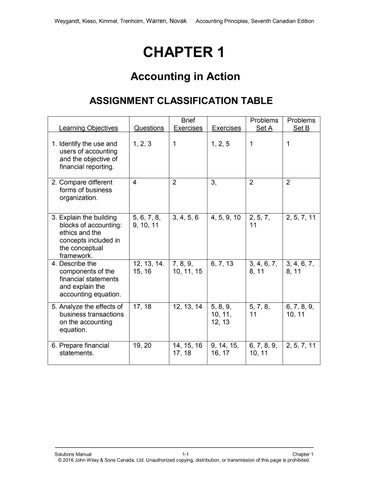
CHAPTER 1 Accounting in Action ASSIGNMENT CLASSIFICATION TABLE Questions
Brief Exercises
Exercises
Problems Set A
Problems Set B
1. Identify the use and users of accounting and the objective of financial reporting.
1, 2, 3
1
1, 2, 5
1
1
2. Compare different forms of business organization.
4
2
3,
2
2
3. Explain the building blocks of accounting: ethics and the concepts included in the conceptual framework. 4. Describe the components of the financial statements and explain the accounting equation.
5, 6, 7, 8, 9, 10, 11
3, 4, 5, 6
4, 5, 9, 10
2, 5, 7, 11
2, 5, 7, 11
12, 13, 14. 15, 16
7, 8, 9, 10, 11, 15
6, 7, 13
3, 4, 6, 7, 8, 11
3, 4, 6, 7, 8, 11
5. Analyze the effects of business transactions on the accounting equation.
17, 18
12, 13, 14
5, 8, 9, 10, 11, 12, 13
5, 7, 8, 11
6, 7, 8, 9, 10, 11
6. Prepare financial statements.
19, 20
14, 15, 16 17, 18
9, 14, 15, 16, 17
6, 7, 8, 9, 10, 11
2, 5, 7, 11
Learning Objectives
Solutions Manual 1-1 Chapter 1 © 2016 John Wiley & Sons Canada, Ltd. Unauthorized copying, distribution, or transmission of this page is prohibited.
Weygandt, Kieso, Kimmel, Trenholm, Warren, Novak
Accounting Principles, Seventh Canadian Edition
ASSIGNMENT CHARACTERISTICS TABLE Problem Number
Description
Difficulty Level
Time Allotted (min.)
1A
Identify users and use of accounting information.
Simple
15-20
2A
Determine forms of business organization and types of accounting standards. Determine missing items.
Simple
15-20
Moderate
20-25
Simple
20-30
5A
Classify accounts and prepare accounting equation. Assess accounting treatment.
Moderate
20-25
6A
Analyze transactions and calculate owner’s equity.
Simple
35-45
7A
Analyze transactions and prepare balance sheet.
Simple
40-50
8A
Moderate
40-50
9A
Analyze transactions and prepare financial statements. Prepare financial statements.
Simple
35-45
10A
Determine missing amounts, and comment.
Moderate
35-45
11A
Discuss errors and prepare corrected balance sheet.
Moderate
45-55
1B
Identify users and use of accounting information.
Simple
15-20
2B
Determine forms of business organization and types of accounting standards. Determine missing items.
Simple
15-20
Moderate
20-25
Simple
20-30
5B
Classify accounts and prepare accounting equation. Assess accounting treatment.
Moderate
20-25
6B
Analyze transactions and calculate owner’s equity.
Simple
35-45
7B
Analyze transactions and prepare balance sheet.
Simple
40-50
8B
Moderate
40-50
9B
Analyze transactions and prepare financial statements. Prepare financial statements.
Simple
35-45
10B
Determine missing amounts, and comment.
Moderate
35-45
11B
Discuss errors and prepare corrected balance sheet.
Moderate
45-55
3A 4A
3B 4B
Solutions Manual 1-2 Chapter 1 © 2016 John Wiley & Sons Canada, Ltd. Unauthorized copying, distribution, or transmission of this page is prohibited.
Weygandt, Kieso, Kimmel, Trenholm, Warren, Novak
Accounting Principles, Seventh Canadian Edition
BLOOM’S TAXONOMY TABLE Correlation Chart between Bloom’s Taxonomy, Learning Objectives and End-ofChapter Material
Learning Objective 1. Identify the use and users of accounting and the objective of financial reporting.
Knowledge Q1-3 BE1-1 E1-5
2. Compare different forms of business organization .
Comprehension Q1-1 Q1-2 E1-1 E1-2
Application
Q1-4 BE1-2 BE1-4 BE1-10 E1-3 E1-7
P1-2A P1-2B P1-11B
3. Explain the building blocks of accounting: ethics and the concepts included in the conceptual framework.
Q1-6 Q1-7 E1-5
Q1-5 Q1-8 Q1-9 Q1-10 Q1-11 BE1-4 BE1-5 BE1-6 E1-4 E1-9 E1-10 P1-5A P1-5B
P1-2A P1-2B P1-3A P1-3B P1-7A P1-7B P1-11A P1-11B
4. Describe the components of the financial statements and explain the accounting equation.
Q1-12 Q1-13 Q1-14 Q1-16 BE1-11
BE1-7
BE1-8 BE1-9 BE1-10 BE1-14 BE1-15 E1-6 E1-7 E1-13 P1-4A P1-4B P1-6A P1-6B P1-7A P1-7B P1-8A P1-8B P1-11A P1-11B
Analysis
Synthesis P1-1A P1-1B
Evaluat ion
BE1-3
Solutions Manual 1-3 Chapter 1 © 2016 John Wiley & Sons Canada, Ltd. Unauthorized copying, distribution, or transmission of this page is prohibited.
Weygandt, Kieso, Kimmel, Trenholm, Warren, Novak
Accounting Principles, Seventh Canadian Edition
BLOOM‘S TAXONOMY TABLE (Continued) Learning Objective 5. Analyze the effects of business transactions on the accounting equation.
Knowledge Q1-19 E1-5
6. Prepare financial statements.
Broadening Your Perspective
Comprehension Q1-17 Q1-20 E1-8 E1-9 E1-10 E1-11 P1-5A P1-5B
Q1-19 Q1-20 E1-9
BYP1-1
Santé Saga BYP1- 6
Application Analysis Q1-18 BE1-12 BE1-13 BE1-14 E1-12 E1-13 P1-7A P1-7B P1-8A P1-8B P1-11A P1-11B BE1-15 BE1-16 BE1-17 BE1-18 E1-14 E1-15 E1-16 E1-17 P1-6A P1-6B P1-7A P1-7B P1-8A P1-8B P1-9A P1-9B P1-11A P1-11B BYP1-3
Synthesis
Evaluat ion
P1-10A P1-10B
BYP1-4
BYP1-2 BYP1-5
Solutions Manual 1-4 Chapter 1 © 2016 John Wiley & Sons Canada, Ltd. Unauthorized copying, distribution, or transmission of this page is prohibited.
Weygandt, Kieso, Kimmel, Trenholm, Warren, Novak
Accounting Principles, Seventh Canadian Edition
ANSWERS TO QUESTIONS
1.
Yes. Accounting is the financial information system that provides useful financial information to every person who owns and uses economic resources or otherwise engages in economic activity.
2.
Internal users are those who plan, organize, and run businesses and include managers, supervisors, directors, and company officers. External users work for other organizations but have reasons to be interested in the company’s financial position and performance, and include current or potential investors (owners), and creditors. Internal users may want answers to several types of questions. For example, the finance department wants to know if there is enough cash to pay the bills. The marketing department wants to know what price the business should use in selling its products to maximize profits. The human resources department wants to know how many people the business can afford to hire. The production department wants to know which product lines make the business the most profit. External users may want answers to several types of questions. For example, investors want to know if the company is earning enough to give them a return on their investment. Creditors want to know if the company is able to pay its debts as they come due. Labour unions want to know whether the owners can afford to pay increased wages and benefits. Customers are interested in whether a company will continue to honour its product warranties and support its product lines. Taxing authorities want to know whether the company respects the tax laws. Regulatory agencies want to know whether the company is respecting established rules.
3.
The main objective of financial reporting is to provide useful information to investors and creditors (external users) to make decisions about a business. Users may be potential investors who need to decide if they wish to invest in the business or they may be creditors deciding if they wish to lend money to the business. These users want to know if the business is running successfully and can generate cash and earn a profit.
Solutions Manual 1-5 Chapter 1 © 2016 John Wiley & Sons Canada, Ltd. Unauthorized copying, distribution, or transmission of this page is prohibited.