Instructor’s Manual / Solutions Manual Full Solution Manual for Accounting What The Numbers Mean 13th Edition David Marshall
CHAPTER
1
Accounting—Present and Past
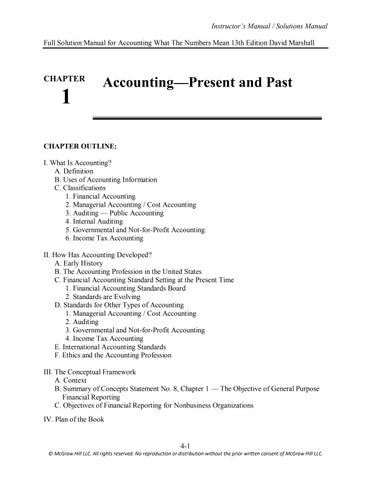
CHAPTER OUTLINE: I. What Is Accounting? A. Definition B. Uses of Accounting Information C. Classifications 1. Financial Accounting 2. Managerial Accounting / Cost Accounting 3. Auditing — Public Accounting 4. Internal Auditing 5. Governmental and Not-for-Profit Accounting 6. Income Tax Accounting II. How Has Accounting Developed? A. Early History B. The Accounting Profession in the United States C. Financial Accounting Standard Setting at the Present Time 1. Financial Accounting Standards Board 2. Standards are Evolving D. Standards for Other Types of Accounting 1. Managerial Accounting / Cost Accounting 2. Auditing 3. Governmental and Not-for-Profit Accounting 4. Income Tax Accounting E. International Accounting Standards F. Ethics and the Accounting Profession III. The Conceptual Framework A. Context B. Summary of Concepts Statement No. 8, Chapter 1 — The Objective of General Purpose Financial Reporting C. Objectives of Financial Reporting for Nonbusiness Organizations IV. Plan of the Book
4-1 © McGraw Hill LLC. All rights reserved. No reproduction or distribution without the prior written consent of McGraw Hill LLC.
Instructor’s Manual / Solutions Manual
TEACHING/LEARNING OBJECTIVES: Principal: 1. To present a definition of accounting. 2. To identify and describe different classifications of accounting. 3. To emphasize that financial accounting standards are not a ―fixed code of rules,‖ but are established in response to user needs and business developments. Accountants need to apply professional judgment in the application of accounting principles. 4. To emphasize the role and sources of ethics for the accounting profession. Supporting: 5. To summarize how accounting has evolved over time. 6. To identify sources of standards for other types of accounting and to contrast these with financial accounting standards. 7. To introduce the issues associated with the development of international accounting standards. 8. To describe the context of the FASB Conceptual Framework project. 9. To summarize Concepts Statement No. 8, Chapter 1 — The Objective of General Purpose Financial Reporting. 10. To relate the objectives of financial reporting for nonbusiness organizations to those of business enterprises. TEACHING OBSERVATIONS/ASSIGNMENT SUGGESTIONS: 1. Students should be put on notice about the jargon of accounting, the use of synonymous terms, the importance of the context within which a term is used, and the need for precision in the use of terminology. The first example of jargon is the term entity. 2. When discussing "Auditing — Public Accounting," have students find the auditors' opinion in the Campbell Soup Company 2020 Annual Report (see pages 87-88 of the Appendix). Emphasize that a "clean opinion" is not a "clean bill of health." 3. Discuss the Summary of Concepts Statement No. 8, Chapter 1 — The Objective of Financial Reporting, in detail.
4-2 © McGraw Hill LLC. All rights reserved. No reproduction or distribution without the prior written consent of McGraw Hill LLC.
Instructor’s Manual / Solutions Manual 4. Assign Exercise 1-1. Encourage students to experiment with websites that are of interest. In addition, or as an alternative to having students request their own annual reports, distribute reports that have been obtained by the instructor. 5. Use Exercise 1-5 to generate discussion about the importance of ethical standards in general and independence (in both appearance and fact) in particular. Follow up with a brief look at Exercise 1-7 concerning audit independence standards.
SOLUTIONS: E1.3.
This exercise provides an opportunity to gauge where the students are in terms of their prior background in accounting, be it practical or educational, and to clear up some of the common misconceptions (i.e., to explain that accounting goes beyond the ―how to‖ aspects of bookkeeping and involves the use of judgment).
E1.4.
This exercise provides an opportunity to align student and instructor expectations. For first-time instructors in this course, or for those having a diverse student group, you will get a glimpse at the common perceptions students have concerning the course content, level of difficulty, and methods of presentation, testing/evaluation, and grading.
E1.5.
The principal factors Jim Sandrolini must consider are his competence and independence. Is he competent to prepare financial statements for a company that operates in a different industry than the one in which he works? Accepting a contingent fee arrangement would normally cause an impairment of his independence because he would directly benefit if the loan were to be approved.
E1.6.
Suggested discussion strategy: Q: Why does a business have value? A: It provides the owners an opportunity to earn a profit, an opportunity for personal fulfillment from being in charge, and an opportunity to provide a product or service that is useful to others. Q: How can this value be measured? A: Financial information will have the most to do with evaluating the firm‘s profitability, and the financial statements include this information. Q: How is an asking price for the sale of a business established? A: The asking price should be a function of the profit, resources, and obligations related to the business as shown in the financial statements. Note: This exercise also provides an opportunity to point out some of the basic limitations of the data provided by the accounting process (e.g., historical cost information — how useful are past earnings results in predicting future earnings and cash flows?). Be careful not to get too carried away with details. Let the students lead this discussion. 4-3
© McGraw Hill LLC. All rights reserved. No reproduction or distribution without the prior written consent of McGraw Hill LLC.
Instructor’s Manual / Solutions Manual
E1.7.
Answers will vary depending on the search engines used by students to locate the requested information.
E1.8.
Answers will vary depending on the company selected. Note that requirement d provides an opportunity to discuss some of the financial statement terms that are introduced in Chapter 2, for those instructors wishing to get a head start.
CHAPTER
2
Financial Statements and Accounting Concepts/Principles
CHAPTER OUTLINE: I. Financial Statements A. From Transactions to Financial Statements B. Financial Statements Illustrated 1. Explanations and Definitions a. Balance Sheet b. Income Statement c. Statement of Changes in Stockholders' Equity d. Statement of Cash Flows 2. Comparative Statements in Subsequent Years 3. Illustration of Financial Statement Relationships II. Accounting Concepts and Principles A. Schematic Model of Concepts and Principles B. Concepts/Principles Related to the Entire Model C. Concepts/Principles Related to Transactions D. Concepts/Principles Related to Bookkeeping Procedures and the Accounting Process E. Concepts/Principles Related to Financial Statements F. Limitations of Financial Statements III. The Corporation‘s Annual Report
4-4 © McGraw Hill LLC. All rights reserved. No reproduction or distribution without the prior written consent of McGraw Hill LLC.
Instructor’s Manual / Solutions Manual TEACHING/LEARNING OBJECTIVES: Principal: 1. To illustrate the four principal financial statements and their basic form. 2. To introduce students to the terminology of financial statements. 3. To present the accounting equation. 4. To explain several of the concepts of financial accounting and financial statement presentation. Supporting: 5. To explain that financial statements are the product of financial accounting and that the statements represent a historical summary of transactions. 6. To explain some of the limitations of financial statements. 7. To illustrate that the financial statements are included in the corporation‘s annual report. 8. To introduce and explain several business procedures and their terminology.
TEACHING OBSERVATIONS: 1. This is the keystone chapter of the text, and the material presented here becomes a foundation for all subsequent financial accounting topics. The instructor must resist trying to teach the entire course from this one chapter! Instead, try to help students sort out the key ideas that must be learned now from those that they should be acquainted with, but that will really be learned when subsequent material is covered. Items to be learned now include: a. What a transaction is. b. The name of each financial statement and what it shows. c. The accounting equation. d. Financial statement relationships. e. Limitations of financial statements. 2. A significant amount of time should be spent illustrating and explaining the purpose and content—by account category (asset, liability, stockholders' equity, revenue, expense)—of each financial statement, and how the financial statements tie together. Some instructors may wish to discuss gains and losses at this point, but the key is to keep it as simple as possible!
4-5 © McGraw Hill LLC. All rights reserved. No reproduction or distribution without the prior written consent of McGraw Hill LLC.