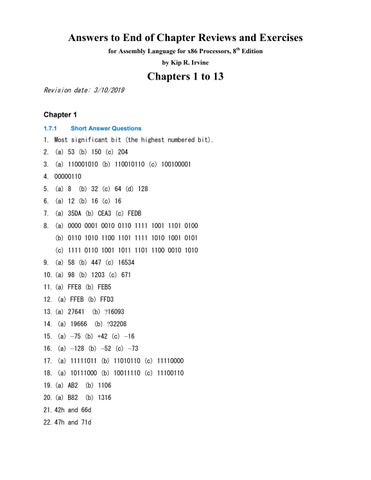
Answers to End of Chapter Reviews and Exercises for Assembly Language for x86 Processors, 8th Edition by Kip R. Irvine
Chapters 1 to 13 Revision date: 3/10/2019
Chapter 1 1.7.1
Short Answer Questions
1. Most significant bit (the highest numbered bit). 2. (a) 53 (b) 150 (c) 204 3. (a) 110001010 (b) 110010110 (c) 100100001 4. 00000110 5. (a) 8
(b) 32 (c) 64 (d) 128
6. (a) 12 (b) 16 (c) 16 7. (a) 35DA (b) CEA3 (c) FEDB 8. (a) 0000 0001 0010 0110 1111 1001 1101 0100 (b) 0110 1010 1100 1101 1111 1010 1001 0101 (c) 1111 0110 1001 1011 1101 1100 0010 1010 9. (a) 58 (b) 447 (c) 16534 10. (a) 98 (b) 1203 (c) 671 11. (a) FFE8 (b) FEB5 12. (a) FFEB (b) FFD3 13. (a) 27641 (b) ?16093 14. (a) 19666 (b) ?32208 15. (a) −75 (b) +42 (c) −16 16. (a) −128 (b) −52 (c) −73 17. (a) 11111011 (b) 11010110 (c) 11110000 18. (a) 10111000 (b) 10011110 (c) 11100110 19. (a) AB2 (b) 1106 20. (a) B82 (b) 1316 21. 42h and 66d 22. 47h and 71d
23. 229 − 1, or 6.8056473384187692692674921486353 X 1038 24. 286 − 1, or 77371252455336267181195263 25. Truth table:
26. Truth table: (last column is the same as #25)
27. It requires 24 (16) rows. 28. 2 bits, producing the following values: 00, 01, 10, 11
1.7.2 Algorithm Workbench
1. Code example (C++) int toInt32(string s) { int num = 0; for(int i = 0; s[i] >= '0' && s[i] <= '1'; i++) { num = num * 2 + s[i]-'0'; } return num; }
2. Code example (C++) int hexStrToInt32(string s) { int num = 0; for(int i = 0; ; i++) { if( s[i] >= '0' && s[i] <= '9' ) num = num * 16 + s[i]-'0'; else if( s[i] >= 'A' && s[i] <= 'F' ) num = num * 16 + (s[i]-'A'+10); else break; } return num; }
3. Code example (C++) string intToBinStr( int n ) vector<int> stack;
{
do { int quotient = n / 2; int remainder = n % 2; stack.push_back(remainder); n = quotient; } while( n > 0 ); string s; while( stack.size() > 0 ) { s += (stack.back() + '0'); stack.pop_back(); } return s; }
4. Code example (C++) string intToHexStr( int n ) vector<int> stack;
{
do { int quotient = n / 16; int remainder = n % 16; stack.push_back(remainder); n = quotient; } while( n > 0 ); string s; while( stack.size() > 0 ) { int d = stack.back(); if( d >= 0 && d <= 9 ) s += (stack.back() + '0'); else // probably a hex digit s += (stack.back() - 10 + 'A'); stack.pop_back(); } return s; }
5. Code example (C++) string addDigitStrings( string s1, string s2, int base ) { string sumStr; int carry = 0; for(int i = s1.size() - 1; i >= 0; i--) { int dval = (s1[i] - '0') + (s2[i] - '0') + carry; carry = 0; if( dval > (base - 1) ) { carry = 1; dval = dval % base; } sumStr.insert(sumStr.begin(), (dval + '0')); } if( carry == 1 ) sumStr.insert( sumStr.begin(), 1 + '0'); return sumStr; }
Chapter 2 2.8.1 Short Answer Questions
1. EBP 2. Choose 4 from: Carry, Zero, Sign, Direction, Aux Carry, Overflow, Parity. 3. Carry flag 4. Overflow flag 5. True 6. Sign flag 7. Floating-point unit 8. 80 bits 9. True 10. False 11. True 12. False 13. True 14. False 14. False 15. False 16. True 17. False 18. True 19. False 20. False 21. True 22. True 23. False 24. False 25. Hardware, BIOS, and OS 26. It gives them more precise control of hardware, and execution is faster.
Chapter 3 3.9.1 Short Answer Questions
1. ADD, SUB, MOV 2. A calling convention determines how parameters are passed to subroutines, and how the stack is restored after the subroutine call. 3. By subtracting a value from the stack pointer register. 4. Assembler means the program that translates your source code. A more correct term is "assembly language". 5. Little endian places the least significant bit in position 0, on the right side of the number. Big endian does the opposite. 6. An integer literal, such as 35, has no direct meaning to someone reading the program's source code. Instead, a symbolic constant such as MIN_CAPACITY can be assigned an integer value, and is self-documenting. 7. A source file is given as input to the assembler. A listing file has additional text that will not assemble. It is a file that iscreated by the assembler. 8. Data labels exist in the data segment as variable offsets. Code labels are in the code segment, and are offsets for transfer of control instructions. 9. True 10. False (this notation is used in C, but not in assembly language). 11. False 12. True 13. Label, mnemonic, operand(s), comment 14. True 15. True 16. Code example: COMMENT ! this is the first comment line this is the second comment line !
17. You do not use numeric addresses (offsets) for variables because the addresses would change if new variables were inserted before the existing ones.
3.9.2 Algorithm Workbench
1. Code example: one = 25 two = 11001b three = 31o four = 19h
2. Yes, it can have multiple code and data segments.