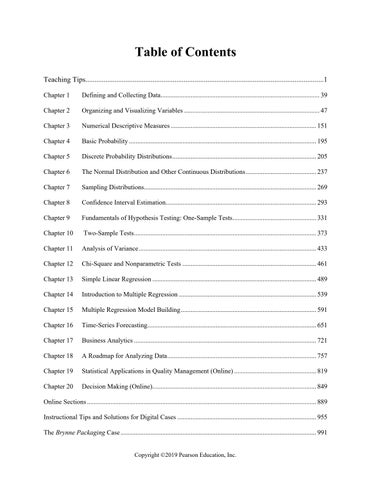
Table of Contents Teaching Tips...................................................................................................................................1 Chapter 1
Defining and Collecting Data............................................................................................... 39
Chapter 2
Organizing and Visualizing Variables ................................................................................. 47
Chapter 3
Numerical Descriptive Measures ....................................................................................... 151
Chapter 4
Basic Probability ................................................................................................................ 195
Chapter 5
Discrete Probability Distributions ...................................................................................... 205
Chapter 6
The Normal Distribution and Other Continuous Distributions .......................................... 237
Chapter 7
Sampling Distributions....................................................................................................... 269
Chapter 8
Confidence Interval Estimation.......................................................................................... 293
Chapter 9
Fundamentals of Hypothesis Testing: One-Sample Tests.................................................. 331
Chapter 10
Two-Sample Tests............................................................................................................. 373
Chapter 11
Analysis of Variance .......................................................................................................... 433
Chapter 12
Chi-Square and Nonparametric Tests ................................................................................ 461
Chapter 13
Simple Linear Regression .................................................................................................. 489
Chapter 14
Introduction to Multiple Regression .................................................................................. 539
Chapter 15
Multiple Regression Model Building ................................................................................. 591
Chapter 16
Time-Series Forecasting..................................................................................................... 651
Chapter 17
Business Analytics ............................................................................................................. 721
Chapter 18
A Roadmap for Analyzing Data ......................................................................................... 757
Chapter 19
Statistical Applications in Quality Management (Online) ................................................. 819
Chapter 20
Decision Making (Online).................................................................................................. 849
Online Sections ......................................................................................................................................... 889 Instructional Tips and Solutions for Digital Cases ................................................................................... 955 The Brynne Packaging Case ..................................................................................................................... 991 Copyright ©2019 Pearson Education, Inc.
The CardioGood Fitness Case .................................................................................................................. 993 The Choice Is Yours/More Descriptive Choices Follow-up Case .......................................................... 1105 The Clear Mountain State Student Surveys Case.................................................................................... 1201 The Craybill Instrumentation Company Case ........................................................................................ 1373 The Managing Ashland MultiComm Services Case ................................................................................ 1375 The Mountain States Potato Company Case........................................................................................... 1423 The Sure Value Convenience Stores Case .............................................................................................. 1431
Copyright ©2019 Pearson Education, Inc.
Teaching Tips Our Starting Point Of late, business statistics has been expanding and combining with other disciplines to form new fields of study such as business analytics. Because of these changes, business statistics has become an increasingly important part of business education. One must consistently reflect on which business statistics topics should get taught and how those topics should be taught. As authors, we seek ways to continuously improve the teaching of business statistics have always guided our efforts. We are members of the Decision Sciences Institute (DSI) and American Statistical Association (ASA) and attend their annual conferences. We are members of the DSI Data, Analytics and Statistics Instruction (DASI) Special Interest Group and are frequent presenters at DASI sessions held at annual and regional DSI meetings. We use the ASA’s Guidelines for Assessment and Instruction (GAISE) reports and combine them with our experiences teaching business statistics to a diverse student body at several large universities. What to teach and how to teach it are particularly significant questions to ask during a time of change. As an author team, we bring a unique collection of experiences that we believe helps us find the proper perspective in balancing the old and the new. Mark Berenson and David Levine were the first educators to create a business statistics textbook that discussed using statistical software and that used computer output as illustrations. They introduced many additional teaching and curricular innovations in their careers, and with David Stephan developed the first comprehensive introductory business statistics textbook that featured Microsoft Excel. Kathryn Szabat has provided statistical advice to various business and non-business communities. Her extensive background in statistics and operations research and her experiences interacting with professionals in practice guided her to develop and chair a new, interdisciplinary Business Systems and Analytics department, in response to the technology- and data-driven changes occurring in business today. David Stephan, an information system specialist, devised new courses and teaching methods for computer information systems, creating and teaching in one of the first personal computer classrooms in a large school of business. He became involved in early digital media efforts to improve education and lectured about the importance of data in a digital media, which led him to join Berenson’s and Levine’s efforts to improve statistics education and simplify interactions with statistical programs. Our work also benefits from teaching and research interests and the diversity of interests and generous contributions of our past co-author, Timothy Krehbiel.
Copyright ©2019 Pearson Education, Inc.
1
2
Teaching Tips
Five Guiding Principles When writing for introductory business statistics students, five principles guide us. 1. Help students see the relevance of statistics to their own careers by providing examples drawn from the functional areas in which they may be specializing. Students need a frame of reference when learning statistics, especially when statistics is not their major. That frame of reference for business students should be the functional areas of business, such as accounting, finance, information systems, management, and marketing. Each statistics topic needs to be presented in an applied context related to at least one of these functional areas. The focus in teaching each topic should be on its application in business, the interpretation of results, the evaluation of the assumptions, and the discussion of what should be done if the assumptions are violated. 2. Emphasize interpretation of statistical results over mathematical computation. Introductory business statistics courses should recognize the growing need to interpret statistical results that computerized processes create. This makes the interpretation of results more important than knowing how to execute the tedious hand calculations required to produce them. 3. Give students ample practice in understanding how to apply statistics to business. Both classroom examples and homework exercises should involve actual or realistic data as much as possible. Students should work with data sets, both small and large, and be encouraged to look beyond the statistical analysis of data to the interpretation of results in a managerial context. 4. Familiarize students with how to use statistical software to assist business decision-making. Introductory business statistics courses should recognize that programs with statistical functions are commonly found on a business decision maker’s desktop computer. Integrating statistical software into all aspects of an introductory statistics course enables the course to focus on interpretation of results instead of computations (see second point). 5. Provide clear instructions to students for using statistical applications. Books should explain clearly how to use programs such as Microsoft Excel, JMP, and Minitab with the study of statistics, without having those instructions dominate the book or distract from the learning of statistical concepts.
Copyright ©2019 Pearson Education, Inc.
Teaching Tips
3
First Things First Chapter In a time of change, you can never know exactly what knowledge and background students bring into an introductory business statistics classroom. Add that to the need to curb the fear factor about learning statistics that so many students begin with, and there’s a lot to cover even before you teach your first statistical concept. We created “First Things First” to meet this challenge. This unit sets the context for explaining what statistics is (not what students may think!) while ensuring that all students share an understanding of the forces that make learning business statistics critically important today. Especially designed for instructors teaching with course management tools, including those teaching hybrid or online courses, “First Things First” has been developed to be posted online or otherwise distributed before the first class meets. We would argue that the most important class is the first class. First impressions are critically important. You have the opportunity to set the tone to create a new impression that the course will be important to the business education of your students. Make the following points:
This course is not a math course.
State that you will be learning analytical skills for making business decisions.
Explain that the focus will be on how statistics can be used in the functional areas of business.
This book uses a systematic approach for meeting a business objective or solving a business problem. This approach goes across all the topics in the book and most importantly can be used as a framework in real world situations when students graduate. The approach has the acronym DCOVA, which stands for Define, Collect, Organize, Visualize, and Analyze.
Define the business objective or problem to be solved and then define the variables to be studied.
Collect the data from appropriate sources
Organize the data
Visualize the data by developing charts
Analyze the data by using statistical methods to reach conclusions.
You can begin by emphasizing the importance of defining your objective or problem. Then, discuss the importance of operational definitions of variables to be considered and define variable, data, and statistics. Just as computers are used not just in the computer course, students need to know that statistics is used not just in the statistics course. This leads you to a discussion of business analytics in which data is used to make decisions. Make the point that analytics should be part of the competitive strategy of every
Copyright ©2019 Pearson Education, Inc.