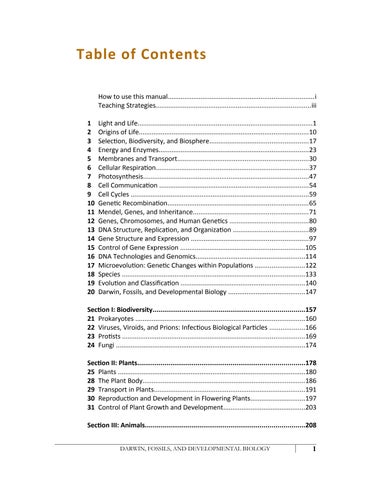
Table of Contents How to use this manual................................................................................i Teaching Strategies.....................................................................................iii 1 Light and Life................................................................................................1 2 Origins of Life.............................................................................................10 3 Selection, Biodiversity, and Biosphere......................................................17 4 Energy and Enzymes..................................................................................23 5 Membranes and Transport........................................................................30 6 Cellular Respiration....................................................................................37 7 Photosynthesis...........................................................................................47 8 Cell Communication ..................................................................................54 9 Cell Cycles ..................................................................................................59 10 Genetic Recombination.............................................................................65 11 Mendel, Genes, and Inheritance...............................................................71 12 Genes, Chromosomes, and Human Genetics ...........................................80 13 DNA Structure, Replication, and Organization .........................................89 14 Gene Structure and Expression ................................................................97 15 Control of Gene Expression ....................................................................105 16 DNA Technologies and Genomics............................................................114 17 Microevolution: Genetic Changes within Populations ...........................122 18 Species ....................................................................................................133 19 Evolution and Classification ....................................................................140 20 Darwin, Fossils, and Developmental Biology ..........................................147 Section I: Biodiversity..............................................................................157 21 Prokaryotes .............................................................................................160 22 Viruses, Viroids, and Prions: Infectious Biological Particles ...................166 23 Protists ....................................................................................................169 24 Fungi ........................................................................................................174 Section II: Plants......................................................................................178 25 Plants .......................................................................................................180 28 The Plant Body.........................................................................................186 29 Transport in Plants...................................................................................191 30 Reproduction and Development in Flowering Plants..............................197 31 Control of Plant Growth and Development.............................................203 Section III: Animals..................................................................................208 DARWIN, FOSSILS, AND DEVELOPMENTAL BIOLOGY
1
26 Protostomes ............................................................................................210 27 Deuterostomes: Vertebrates and Their Closest Relatives ......................216 32 Introduction to Animal Organization and Physiology .............................222 33 Information Flow: Nerves, Ganglia, and Brains ......................................226 34 Sensory Systems......................................................................................232 35 The Endocrine System .............................................................................237 36 Muscles, Skeletons, and Body Movements.............................................243 37 The Circulatory System............................................................................247 38 Animal Reproduction...............................................................................252 39 Animal Development...............................................................................257 40 Animal Behaviour ....................................................................................263 41 Plant and Animal Nutrition .....................................................................267 42 Gas Exchange: The Respiratory System..................................................274 ........................................................................................................................ 43 Regulation the Internal Environment......................................................279 44 Defences Against Disease .......................................................................288 45 Population Ecology..................................................................................294 46 Populations Interactions and Community Ecology..................................305 47 Ecosystems...............................................................................................316 48 Conservation of Biodiversity....................................................................322 49 Domestication..........................................................................................330
IF NOTHING ELSE, MY STUDENTS SHOULD LEARN… 1.
Light drives and/or affects many biological processes, directly or indirectly.
2.
Light serves as an important source of energy, but can also be used by organisms to gather information about their surroundings.
LEARNING OBJECTIVES
DARWIN, FOSSILS, AND DEVELOPMENTAL BIOLOGY
2
Students should be able to:
Define key terms (nature of light): light, photon, wavelength, electromagnetic spectrum, photosynthesis, chloroplast, pigment, chlorophyll, action spectrum, prokaryote, proton pump. [Knowledge]
Describe, in general terms, how the products of photosynthesis sustain most organisms on earth. [Comprehension]
Define key terms (light as information source): photoreceptor (rhodopsin, phytochromes as examples), opsin, retina, photoreceptor, eye, eyespot, compound eye, ommatidia, camera eye. [Knowledge]
Describe how organisms can sense light without image forming eyes. [Comprehension]
Describe, in general terms, the evolution of image forming eyes from early simple regions of photoreceptor cells. [Comprehension]
Define key terms (light damage): photosystem, ultraviolet radiation, thymine dimer, absorption spectrum, melanin, vitamin D. [Knowledge]
Provide an example of how light can damage biological molecules. [Comprehension]
Define key terms (light in ecology/behaviour): circadian rhythms, biological clock, melatonin, camouflage, pollination, phytoerythrin, light pollution, natural selection. [Knowledge]
DARWIN, FOSSILS, AND DEVELOPMENTAL BIOLOGY
3
Provide an example of how daylight (or length of day) can affect physiology or behaviour of plants/animals. [Comprehension]
Describe circadian rhythms and their uses, contrasting the systems in plants and humans. [Comprehension/Analysis]
Describe the usefulness of colour in nature (e.g., sex selection, mimicry, warning…) [Comprehension]
Describe different ways that colour influences animal behaviour, providing examples. [Comprehension]
Explain the effect of water on light, and how this can influence marine life. [Comprehension]
Define key terms (bioluminescence): bioluminescence/bioluminescent, ATP. [Knowledge]
In basic terms, explain how some organisms use bioluminescence. [Comprehension]
Explain why artificial light is problematic for many organisms and can be considered a form of pollution. [Comprehension]
WHY IS THIS CHAPTER IMPORTANT TO SCIENTISTS?
As light is so integral to photosynthesis, and involved in many biological phenomena (as described in this chapter), an understanding of the nature, properties and impact of light is vital to many areas of biological research.
Much of evolution has been shaped by selective forces relating to light (as energy source, information source, etc.).
Researchers are looking into ways of harnessing the energy of light, using biological (or biologicallyderived) molecules in biotechnology, nanotechnology and cancer treatment.
WHY SHOULD STUDENTS CARE?
Understanding the role of light in various biological phenomena will be helpful throughout the course. It provides a way to link many topics in biology that students might otherwise view as isolated, tying biochemical/biophysical properties and processes to organismal, physiological and behavioural aspects.
DARWIN, FOSSILS, AND DEVELOPMENTAL BIOLOGY
4
Understanding how sensing light, even in the most basic way, can be useful to an organism can help students to appreciate and understand the gradual nature of evolution of the eye.
Understanding how light can damage biological molecules can provide useful information in understanding how skin cancer arises.
WHAT ARE COMMON STUDENT MISCONCEPTIONS/ STUMBLING BLOCKS? 1.
The nature of light (wave and particle) can be confusing to students. Depending on the background preparation of your students, you may want to spend some time discussing this.
2.
It is often counterintuitive to students that colour is the result of those wavelengths of light that are NOT absorbed by a pigment. This is important in terms of the nature of pigments, and related to absorption spectra (which will be discussed in Chapter 7, Photosynthesis).
3.
There can be some confusion relating to the fact that light is key to photosynthesis and other vital biological processes, yet can damage biological molecules (even leading to development of cancers, in some cases). While this may initially be counterintuitive to students, this does provide an opportunity to discuss the properties of light that allow it to be so beneficial in many ways, yet cause damage to proteins and DNA.
4.
The information in this chapter includes a lot of details and terminology that students will not be familiar with, particularly if this is the first topic in an introductory course. Instructors are encouraged to use layman explanations for those terms they want students to understand, and to provide clear expectations regarding what students need to know vs. what is for interest at this stage.
5.
Many people have heard that the evolution of the camera eye is not possible, as an argument for intelligent design. This misconception may affect some student attitudes and we recommend that it be addressed (debunked) early, showing known examples of “intermediate” eyes. It can be used as an example of how science is done by looking at evidence, outside the commonly presented “scientific method”.
6.
Many students refer to the ‘use it or lose it’ issue and ask how long a structure can go unused before it gets ‘lost’.
7.
We have found that students are often confused by the levels of melanin and vitamin D production from photoconversion reactions in the body. Some students believe that vitamin D increases melanin production. A full understanding of how photons can be absorbed, transmitted or reflected may help prevent this confusion.
DARWIN, FOSSILS, AND DEVELOPMENTAL BIOLOGY
5