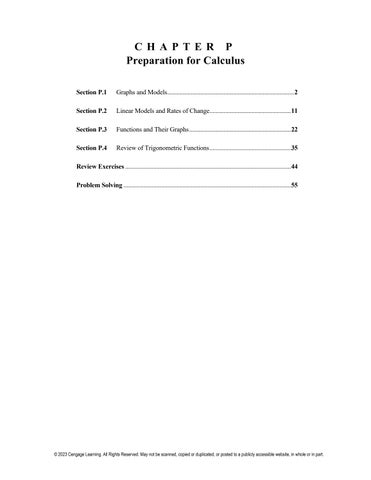
CHAPTER P Preparation for Calculus Section P.1
Graphs and Models................................................................................. 2
Section P.2
Linear Models and Rates of Change.................................................... 11
Section P.3
Functions and Their Graphs .................................................................22
Section P.4
Review of Trigonometric Functions ....................................................35
Review Exercises ..........................................................................................................44 Problem Solving ...........................................................................................................55
© 2023 Cengage Learning. All Rights Reserved. May not be scanned, copied or duplicated, or posted to a publicly accessible website, in whole or in part.
C H A P T E R P Preparation for Calculus Section P.1 Graphs and Models 1. To find the x-intercepts of the graph of an equation, let y be zero and solve the equation for x. To find the y-intercepts of the graph of an equation, let x be zero and solve the equation for y.
8. y = 5 − 2 x x
−1
0
1
2
5 2
3
4
y
7
5
3
1
0
−1
−3
2. Symmetry helps in sketching a graph because you need only half as many points to plot. Answers will vary. 3. y = − 32 x + 3 x-intercept: ( 2, 0) y-intercept: (0, 3) Matches graph (b). 9 − x2
4. y =
9. y = 4 − x 2
x-intercepts: ( −3, 0), (3, 0) y-intercept: (0, 3)
x
−3
−2
0
2
3
y
−5
0
4
0
−5
Matches graph (d). 5. y = 3 − x 2 x-intercepts:
( 3, 0), (− 3, 0)
y-intercept: (0, 3) Matches graph (a).
6. y = x3 − x x-intercepts: (0, 0), ( −1, 0), (1, 0) y-intercept: (0, 0) Matches graph (c).
7. y =
2
10. y = ( x − 3)
2
x
0
1
2
3
4
5
6
y
9
4
1
0
1
4
9
1 x + 2 2
x
−4
−2
0
2
4
y
0
1
2
3
4
© 2023 Cengage Learning. All Rights Reserved. May not be scanned, copied or duplicated, or posted to a publicly accessible website, in whole or in part.
Section P.1 11. y = x + 1
15. y =
x
−4
−3
−2
−1
0
1
2
y
3
2
1
0
1
2
3
Graphs and Models
3
3 x
x
−3
−2
−1
0
1
2
3
y
−1
− 32
−3
Undef.
3
3 2
1
12. y = x − 1 x
−3
−2
−1
0
1
2
3
y
2
1
0
−1
0
1
2
13. y =
16. y =
1 x + 2
x
−6
−4
−3
−2
−1
0
2
y
− 14
− 12
−1
Undef.
1
1 2
1 4
x −6
x
0
1
4
9
16
y
−6
−5
−4
−3
−2
17. y =
(a)
14. y =
5− x
(2, y ) = (2, 1.73) ( y =
5− 2 =
(3 =
5 − ( −4)
(b) ( x, 3) = ( −4, 3)
x + 2
x
−2
−1
0
2
7
14
y
0
1
2
2
3
4
)
18. y = x5 − 5 x
(a)
)
3 ≈ 1.73
(−0.5, y ) = (−0.5, 2.47)
(b) ( x, − 4) = ( −1.65, − 4) and ( x, − 4) = (1, − 4)
© 2023 Cengage Learning. All Rights Reserved. May not be scanned, copied or duplicated, or posted to a publicly accessible website, in whole or in part.
4
Chapter P
Preparation for Calculus
19. y = 2 x − 5 y-intercept: y = 2(0) − 5 = −5; (0, − 5) x-intercept: 0 = 2 x − 5 5 = 2x x = 52 ;
( 52 , 0)
25. y =
2− x 5x + 1
y -intercept: y =
2− 0 = 2; 5(0) + 1
x-intercept: 0 =
2− x 5x + 1
20. y = 4 x 2 + 3
0 = 2−
x
x = 4;
( 4, 0)
y-intercept: y = 4(0) + 3 = 3; (0, 3) 2
x-intercept: 0 = 4 x 2 + 3
−3 = 4 x 2 None. y cannot equal 0.
26. y =
x 2 + 3x
(3x + 1)
2
y-intercept: y =
21. y = x 2 + x − 2
0 = ( x + 2)( x − 1) x = −2, 1; ( −2, 0), (1, 0)
y = 0; (0, 0) x-intercepts: 0 = x 3 − 4 x 0 = x( x − 2)( x + 2)
2
x 2 + 3x
(3x + 1) x( x + 3) 0 = (3x + 1)2 x = 0, − 3; (0, 0), ( −3, 0)
x-intercepts: 0 = x + x − 2
y-intercept: y 2 = 03 − 4(0)
3(0) + 1
x-intercepts: 0 =
2
22. y 2 = x3 − 4 x
02 + 3(0)
y = 0; (0, 0)
y-intercept: y = 02 + 0 − 2 y = −2; (0, − 2)
2
27. x 2 y − x 2 + 4 y = 0
y-intercept: 02 ( y ) − 02 + 4 y = 0
y = 0; (0, 0) x-intercept: x 2 (0) − x 2 + 4(0) = 0
x = 0; (0, 0)
x = 0, ± 2; (0, 0), ( ± 2, 0)
y-intercept: y = 0 16 − 02 = 0; (0, 0) x-intercepts: 0 = x 16 − x 2
(4 − x)( 4 + x) x = 0, 4, − 4; (0, 0), ( 4, 0), ( − 4, 0)
0 = x
24. y = ( x − 1)
x2 + 1
28. y = 2 x −
23. y = x 16 − x 2
y-intercept: y = 2(0) −
02 + 1
y = −1; (0, −1)
x-intercept:
0 = 2x −
x2 + 1
x2 + 1
2x =
4x2 = x2 + 1 3x 2 = 1
x2 + 1
x2 =
y-intercept: y = (0 − 1) 02 + 1 y = −1; (0, −1)
x-intercept: 0 = ( x − 1)
(0, 2)
x = ±
3 3
x =
3 3 ; , 0 3 3
x2 + 1
x = 1; (1, 0)
Note: x = −
1 3
3 3 is an extraneous solution.
© 2023 Cengage Learning. All Rights Reserved. May not be scanned, copied or duplicated, or posted to a publicly accessible website, in whole or in part.
Section P.1
29. Symmetric with respect to the y-axis because
y = ( − x) − 6 = x − 6. 2
2
Graphs and Models
5
41. y = 2 − 3 x y = 2 − 3(0) = 2, y -intercept 0 = 2 − 3( x) 3x = 2 x = 23 , x-intercept
30. y = 9 x − x 2 No symmetry with respect to either axis or the origin.
31. Symmetric with respect to the x-axis because
Intercepts: (0, 2),
( 23 , 0)
Symmetry: none
(− y) = y 2 = x3 − 8 x. 2
32. Symmetric with respect to the origin because
( − y ) = ( − x) + ( − x) 3
− y = − x3 − x
42. y = 23 x + 1
y = x 3 + x.
33. Symmetric with respect to the origin because ( − x)(− y ) = xy = 4. 34. Symmetric with respect to the x-axis because
x( − y ) = xy 2 = −10. 2
35. y = 4 −
y = 23 (0) + 1 = 1, y -intercept 0 = 23 x + 1 − 23 x = 1 x = − 32 , x-intercept
(
Intercepts: (0, 1), − 32 , 0
)
Symmetry: none
x +3
No symmetry with respect to either axis or the origin.
36. Symmetric with respect to the origin because
(− x)(− y) −
4 − ( − x)
xy −
2
= 0
43. y = 9 − x 2
4 − x 2 = 0.
y = 9 − (0) = 9, y -intercept 2
37. Symmetric with respect to the origin because −y = y =
−x
0 = 9 − x 2 x 2 = 9 x = ± 3, x-intercepts Intercepts: (0, 9), (3, 0), ( −3, 0)
( − x) + 1 2
y = 9 − ( − x) = 9 − x 2 2
x . x2 + 1
Symmetry: y-axis
38. Symmetric with respect to the origin because −y =
( − x )5 2 4 − ( − x)
44. y = 2 x 2 + x = x( 2 x + 1)
− x5 −y = 4 − x2
y = 0( 2(0) + 1) = 0, y -intercept
x5 y = . 4 − x2
0 = x( 2 x + 1) x = 0, − 12 , x-intercepts
39. y = x3 + x is symmetric with respect to the y-axis
(
)
because y = ( − x) + ( − x) = − x3 + x = x3 + x . 3
40.
(
Intercepts: (0, 0), − 12 , 0
)
Symmetry: none
y − x = 3 is symmetric with respect to the x-axis
because
−y − x = 3 y − x = 3.
© 2023 Cengage Learning. All Rights Reserved. May not be scanned, copied or duplicated, or posted to a publicly accessible website, in whole or in part.