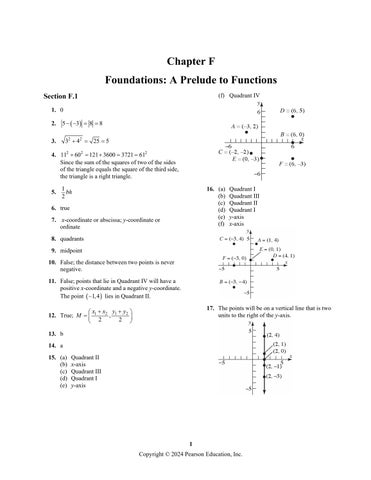
Chapter F Foundations: A Prelude to Functions (f) Quadrant IV
Section F.1 1. 0 2.
5 3 8 8
3.
32 42 25 5
4. 112 602 121 3600 3721 612 Since the sum of the squares of two of the sides of the triangle equals the square of the third side, the triangle is a right triangle. 5.
1 bh 2
16. (a) Quadrant I (b) Quadrant III (c) Quadrant II (d) Quadrant I (e) y-axis (f) x-axis
6. true 7. x-coordinate or abscissa; y-coordinate or ordinate 8. quadrants 9. midpoint 10. False; the distance between two points is never negative. 11. False; points that lie in Quadrant IV will have a positive x-coordinate and a negative y-coordinate. The point 1, 4 lies in Quadrant II.
17. The points will be on a vertical line that is two units to the right of the y-axis.
x x y y2 12. True; M 1 2 , 1 2 2 13. b 14. a 15. (a) Quadrant II (b) x-axis (c) Quadrant III (d) Quadrant I (e) y-axis
1 Copyright © 2024 Pearson Education, Inc.
Chapter F: Graphs 18. The points will be on a horizontal line that is three units above the x-axis.
28. d ( P1 , P2 )
6 ( 4) 2 2 (3) 2
102 52 100 25 125 5 5
29. d ( P1 , P2 )
2.3 (0.2) 2 1.1 (0.3) 2
2.52 0.82 6.25 0.64 6.89 2.62
30. d ( P1 , P2 )
(1.5) 2 (1.2) 2 2.25 1.44
19. d ( P1 , P2 ) (2 0) 2 (1 0) 2
3.69 1.92
22 12 4 1 5
31. d ( P1 , P2 ) (0 a) 2 (0 b) 2
20. d ( P1 , P2 ) (2 0) 2 (1 0) 2 (2) 2 12 4 1 5
(3) 2 12 9 1 10
22. d ( P1 , P2 )
2 (1) (2 1)
a 2 a 2 2a 2 a
23. d ( P1 , P2 ) (5 3) 2 4 4
d ( A, B )
2
24. d ( P1 , P2 )
2 1 4 0
3 4 9 16
25. d ( P1 , P2 )
4 (7) 2 (0 3)2
d ( B, C )
25 5
d ( A, C )
1 (2) 2 (0 5)2
12 (5) 2 1 25 26
112 ( 3) 2 121 9 130
4 2 2 2 (3) 2
22 52 4 25 29 27. d ( P1 , P2 ) (6 5) 2 1 (2)
1 12 (0 3)2
(2) 2 (3)2 4 9 13
2
2
1 (2) 2 (3 5)2
32 (2) 2 9 4 13
2
26. d ( P1 , P2 )
2
33. A (2,5), B (1,3), C (1, 0)
22 8 4 64 68 2 17
2
(a )2 (a )2
2
32 12 9 1 10
2
( a ) 2 ( b ) 2 a 2 b 2
32. d ( P1 , P2 ) (0 a ) 2 (0 a) 2
21. d ( P1 , P2 ) (2 1) 2 (2 1) 2
2
0.3 1.2 2 1.1 2.32
2
12 32 1 9 10
2 Copyright © 2024 Pearson Education, Inc.
Section F.1: The Distance and Midpoint Formulas
Verifying that ∆ ABC is a right triangle by the Pythagorean Theorem:
d ( A, B)2 d ( B, C )2 d ( A, C )2
13 13 26 2
2
1 bh . In this 2
12 (2) 2 (3 5)2
2
400 400 1 The area of a triangle is A bh . In this 2 problem, 1 A d ( A, B ) d ( B, C ) 2 1 10 2 10 2 2 1 100 2 100 square units 2
d ( A, B)
6 ( 5) 2 (0 3)2
112 ( 3) 2 121 9 130
142 (2) 2
d ( B, C )
196 4 200 10 2
5 6 2 (5 0)2
(1) 2 52 1 25
10 12 2 (11 3)2 2
(2) (14)
26
2
d ( A, C )
4 196 200
5 ( 5) 2 (5 3)2
102 22 100 4
10 2 d ( A, C )
2
35. A ( 5,3), B (6, 0), C (5,5)
34. A (2, 5), B (12, 3), C (10, 11)
d ( B, C )
2
200 200 400
problem, A 1 d ( A, B) d ( B, C ) 2 1 13 13 1 13 2 2 13 2 square units
d ( A, B )
10 2 10 2 20
2
13 13 26 26 26
The area of a triangle is A
d ( A, B)2 d ( B, C )2 d ( A, C )2
104
10 (2) (11 5) 2
2
2 26
122 (16) 2 144 256 400 20
Verifying that ∆ ABC is a right triangle by the Pythagorean Theorem:
Verifying that ∆ ABC is a right triangle by the Pythagorean Theorem: 3 Copyright © 2024 Pearson Education, Inc.
Chapter F: Graphs
d ( A, C )2 d ( B, C )2 d ( A, B)2
d ( A, C )2 d ( B, C )2 d ( A, B)2
104 26 130
29 2 29 145
2
2
2
104 26 130 130 130 1 The area of a triangle is A bh . In this 2 problem, 1 A d ( A, C ) d ( B, C ) 2 1 104 26 2 1 2 26 26 2 1 2 26 2 26 square units
36. A (6, 3), B (3, 5), C (1, 5) d ( A, B)
3 (6) (5 3) 2
2
92 (8) 2 81 64 145 d ( B, C )
1 32 (5 (5))2
(4) 2 102 16 100 116 2 29 d ( A, C )
2
2
29 4 29 145 29 116 145 145 145 1 The area of a triangle is A bh . In this 2 problem, 1 A d ( A, C ) d ( B, C ) 2 1 29 2 29 2 1 2 29 2 29 square units
37. A (4, 3), B (0, 3), C (4, 2) d ( A, B ) (0 4) 2 3 (3)
2
( 4)2 02 16 0 16 4 d ( B, C )
4 0 2 2 (3) 2
42 52 16 25 41
1 ( 6) (5 3) 2
2
2
52 22 25 4
d ( A, C ) (4 4) 2 2 (3)
2
02 52 0 25
29
25 5
Verifying that ∆ ABC is a right triangle by the Pythagorean Theorem:
Verifying that ∆ ABC is a right triangle by the Pythagorean Theorem:
4 Copyright © 2024 Pearson Education, Inc.
Section F.1: The Distance and Midpoint Formulas
d ( A, B)2 d ( A, C )2 d ( B, C )2 4 2 52
41
d ( A, B)2 d ( B, C )2 d ( A, C )2
2
42 22 2 5
1 bh . In this 2
problem, 1 A d ( A, B) d ( A, C ) 2 1 45 2 10 square units
d ( A, B ) (4 4) 2 1 (3)
1 bh . In this problem, 2
1 d ( A, B) d ( B, C ) 2 1 42 2 4 square units
2
02 42 0 16 16 4
39. The coordinates of the midpoint are: x x y y ( x, y ) 1 2 , 1 2 2 2 35 4 4 , 2 2 8 0 , 2 2 (4, 0) 40. The coordinates of the midpoint are: x x y y2 ( x, y ) 1 2 , 1 2 2
2 4 2 1 12
(2) 2 02 4 0 4 2 d ( A, C ) (2 4) 2 1 (3)
The area of a triangle is A A
38. A (4, 3), B (4, 1), C (2, 1)
d ( B, C )
2
16 4 20 20 20
16 25 41 41 41
The area of a triangle is A
2
(2) 2 42 4 16 20
2 2 0 4 , 2 2 0 4 , 2 2 0, 2
41. The coordinates of the midpoint are: x x y y ( x, y ) 1 2 , 1 2 2 2 1 8 4 0 , 2 2 7 4 , 2 2 7 , 2 2
2 5
Verifying that ∆ ABC is a right triangle by the Pythagorean Theorem:
5 Copyright © 2024 Pearson Education, Inc.