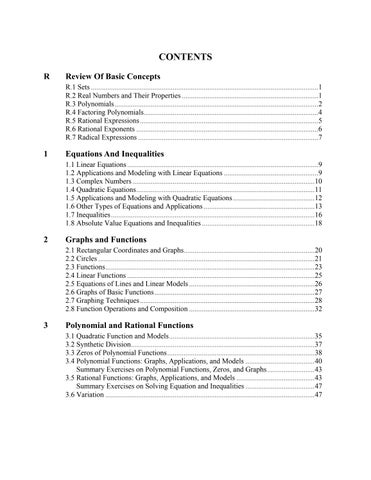
CONTENTS R
Review Of Basic Concepts R.1 Sets ............................................................................................................................. 1 R.2 Real Numbers and Their Properties ........................................................................... 1 R.3 Polynomials ................................................................................................................ 2 R.4 Factoring Polynomials................................................................................................ 4 R.5 Rational Expressions .................................................................................................. 5 R.6 Rational Exponents ....................................................................................................6 R.7 Radical Expressions ...................................................................................................7
1
Equations And Inequalities 1.1 Linear Equations .........................................................................................................9 1.2 Applications and Modeling with Linear Equations ....................................................9 1.3 Complex Numbers .................................................................................................... 10 1.4 Quadratic Equations .................................................................................................. 11 1.5 Applications and Modeling with Quadratic Equations .............................................12 1.6 Other Types of Equations and Applications ............................................................. 13 1.7 Inequalities ................................................................................................................ 16 1.8 Absolute Value Equations and Inequalities ..............................................................18
2
Graphs and Functions 2.1 Rectangular Coordinates and Graphs........................................................................ 20 2.2 Circles ....................................................................................................................... 21 2.3 Functions ................................................................................................................... 23 2.4 Linear Functions ....................................................................................................... 25 2.5 Equations of Lines and Linear Models ..................................................................... 26 2.6 Graphs of Basic Functions ........................................................................................ 27 2.7 Graphing Techniques ................................................................................................ 28 2.8 Function Operations and Composition .....................................................................32
3
Polynomial and Rational Functions 3.1 Quadratic Function and Models ................................................................................ 35 3.2 Synthetic Division..................................................................................................... 37 3.3 Zeros of Polynomial Functions ................................................................................. 38 3.4 Polynomial Functions: Graphs, Applications, and Models ......................................40 Summary Exercises on Polynomial Functions, Zeros, and Graphs .......................... 43 3.5 Rational Functions: Graphs, Applications, and Models ...........................................43 Summary Exercises on Solving Equation and Inequalities ...................................... 47 3.6 Variation ................................................................................................................... 47
4
Inverse, Exponential, and Logarithmic Functions 4.1 Inverse Functions ......................................................................................................49 4.2 Exponential Functions .............................................................................................. 51 4.3 Logarithmic Functions .............................................................................................. 53 4.4 Evaluating Logarithms and the Change-of-Base Theorem ....................................... 55 4.5 Exponential and Logarithmic Equations ................................................................... 56 4.6 Applications and Models of Exponential Growth and Decay .................................. 57
5
Trigonometric Functions 5.1 Angles ....................................................................................................................... 59 5.2 Trigonometric Functions ........................................................................................... 59 5.3 Trigonometric Function Values and Angle Measures .............................................. 61 5.4 Solutions and Applications of Right Triangles .........................................................63
6
The Circular Functions and Their Graphs 6.1 Radian Measure ........................................................................................................66 6.2 The Unit Circle and Circular Functions .................................................................... 67 6.3 Graphs of the Sine and Cosine Functions ................................................................. 68 6.4 Translations of the Graphs of the Sine and Cosine Functions ..................................70 6.5 Graphs of the Tangent and Cotangent Functions ...................................................... 72 6.6: Graphs of the Secant and Cosecant Functions ......................................................... 74 6.7 Harmonic Motion ...................................................................................................... 76
7
Trigonometric Identities 7.1 Fundamental Identities ..............................................................................................77 7.2 Verifying Trigonometric Identities ........................................................................... 77 7.3 Sum and Difference Identities ................................................................................. 78 7.4 Double-Angle and Half-Angle Identities .................................................................. 80 7.5 Inverse Circular Functions ........................................................................................ 82 7.6 Trigonometric Equations .......................................................................................... 84 7.7 Equations Involving Inverse Trigonometric Functions ............................................ 87
8
Applications of Trigonometry 8.1 The Law of Sines ...................................................................................................... 88 8.2 The Law of Cosines .................................................................................................. 90 8.3 Geometrically Defined Vectors and Applications ....................................................91 8.4 Algebraically Defined Vectors and the Dot Product ................................................ 93 8.5 Trigonometric (Polar) Form of Complex Numbers; Products and Quotients...........93 8.6 DeMoivre’s Theorem; Powers and Roots of Complex Numbers ............................. 95 8.7 Polar Equations and Graphs ......................................................................................96 8.8 Parametric Equations, Graphs, and Applications ..................................................... 99
9
Systems and Matrices 9.1 Systems of Linear Equations .................................................................................. 101 9.2 Matrix Solution of Linear Systems ......................................................................... 103 9.3 Determinant Solution of Linear Systems ................................................................ 104 9.4 Partial Fractions ...................................................................................................... 105 9.5 Nonlinear Systems of Equations ............................................................................. 107 9.6 Systems of Inequalities and Linear Programming ..................................................109 9.7 Properties of Matrices ............................................................................................. 111 9.8 Matrix Inverses ....................................................................................................... 112
10
Analytic Geometry 10.1 Parabolas ............................................................................................................... 116 10.2 Ellipses .................................................................................................................. 117 10.3 Hyperbolas ............................................................................................................ 119 10.4 Summary of the Conic Sections ............................................................................ 120
11
Further Topics in Algebra 11.1 Sequences and Series ............................................................................................ 122 11.2 Arithmetic Sequences and Series .......................................................................... 123 11.3 Geometric Sequences and Series .......................................................................... 124 11.4 The Binomial Theorem ......................................................................................... 126 11.5 Mathematical Induction ....................................................................................... 127 11.6 Counting Theory ................................................................................................... 128 11.7 Basics of Probability ............................................................................................. 129
Appendices Appendix A Polar Form of Conic Sections ..................................................................131 Appendix B Rotation of Axes .......................................................................................132
Chapter 1 Equations and Inequalities Section 1.1
Linear Equations
Classroom Example 1 (page 89) 4 3x 5 3 8 x 7 12 x 20 3 8 x 7 12 x 20 4 8 x 24 4 x 6 x Solution set: {6}
Classroom Example 4 (page 91) (a) (b)
d rt
d t r
S kr 2 kr
S k r 2 r S k 2 r r
11y 8 2 4 y 5w 6 z 11y 8 8 y 10 w 6 z 3 y 10 w 6 z 8 10 w 6 z 8 y 3
Classroom Example 2 (page 89)
(c)
3x 6 1 2 33 x x 10 2 5 5 33 3x 6 1 2 10 x 10 x 10 5 2 5 3 x 6 5 x 4 x 66 2 x 6 4 x 66 6 x 60 x 10 Solution set: {−10}
Classroom Example 5 (page 92)
Classroom Example 3 (page 90) (a)
6 x 9 4 x 13 2 x 22 x 11 conditional equations; {11}
(b)
10 14 x 7 2 x 5 10 14 x 14 x 35 10 35 contradiction;
(c)
3 2 x 1 5 x 3 x 6 x 3 5 x 3 x x 3 3 x identity; {all real numbers}
P $2580, t 129 34 yr, and r 0.06
I Prt 2580 0.06 34 $116.10
Section 1.2 Applications and Modeling with Linear Equations Classroom Example 1 (page 95) Let x = the length of the original rectangle. Then, x − 2 = the width of the original rectangle. x + 3 = the length of the new rectangle, so (x − 2) + 3 = x + 1 = the width of the new rectangle. The perimeter of the new rectangle is 2 x 3 2 x 1 2 x 6 2 x 2 4 x 8 . The perimeter of the new rectangle is 4 in. less than 8 times the width of the original rectangle, so we have 4 x 8 8 x 2 4 . Solving, we have 4 x 8 8 x 2 4 4 x 8 8 x 16 4 4 x 8 8 x 20 28 4 x 7 x Thus, the length of the original rectangle is 7 in. and the width of the original rectangle is 5 in.
Copyright © 2017 Pearson Education, Inc.
9
10
Chapter 1 Equations and Inequalities
Classroom Example 2 (page 96) Let x = the distance to her grandmother’s house. r t d Going
x 40
40
x
x x 48 The driving time returning was 1 hour less than the driving time going, so we have x x 1 . Solving, we have 40 48 x x 1 40 48 x x 40 48 1 40 48 40 48 48 x 1920 40 x 1920 8 x 240 x The distance from Krissa’s home to her grandmother’s home is 240 mi.
Returning
48
0.024 x 0.031 28, 000 x 784 0.024 x 868 0.031x 784 0.007 x 84 x 12, 000 Owen invested $12,000 at 2.4% and $28,000 − $12,000 = $16,000 at 3.1%.
Classroom Example 5 (page 99) P 1.06 F 7.18 P = 70, so we have 70 1.06 F 7.18 62.82 1.06 F 59.26 F The flow rate must be approximately 59.26 L per second to remove 70% of the contaminants.
Classroom Example 6 (page 99) (a)
The year 2007 is 7 years after the year 2000. Let x = 7 and find the value of y. y 331x 5091 y 331 7 5091 7408 The per capita health care expenditures in the year 2007 were $7408.
(b)
Let y = 9100 and find the value of x y 331x 5091 9100 331x 5091 4009 331x x 12.1 Per capita health care expenditures are projected to reach $9100 about 12.1 years after 2000, or in 2012.
Classroom Example 3 (page 97) Let x = the amount of 25% antifreeze solution (in liters). Gallons of Gallons of Strength Pure Solution Antifreeze 25%
x
0.25x
10%
5
0.10 5 0.5
15%
x5
0.15 x 5
The number of gallons of pure antifreeze in the 25% solution plus the number of gallons of pure antifreeze in the 10% solution must equal the number of gallons of pure antifreeze in the 15% solution. 0.25 x 0.5 0.15 x 5 0.25 x 0.5 0.15 x 0.75 0.1x 0.25 x 2.5 L 2.5 liters of the 25% solution should be added.
Section 1.3
Complex Numbers
Classroom Example 1 (page 106) (a)
81 i 81 9i
(b)
55 i 55
(c)
98 i 98 i 49 2 7i 2
Classroom Example 2 (page 107)
21 21
Classroom Example 4 (page 98)
(a)
21 21 i 21 i 21 i 2
Let x = amount invested at 2.4%. Then 28,000 − x = amount invested at 3.1%.
(b)
5 30 i 5 i 30 i 2 150 i 2 25 6 5 6
Amount in Account x 28,000 − x
Interest Rate 2.4% 3.1%
Interest
0.024x 0.031(28,000 − x) 784 The amount of interest from the 2.4% account plus the amount of interest from the 3.1% account must equal the total amount of interest.
(c)
42 i 42 3 i 3
(d)
63 i 63 63 i i 3 21 21 21
Copyright © 2017 Pearson Education, Inc.
42 14 3
2