1 Chapter 1: Introduction
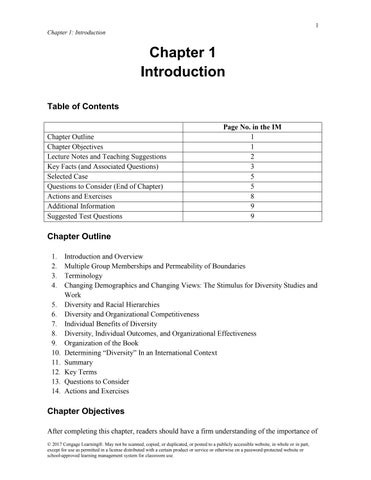
Chapter 1 Introduction Table of Contents
Chapter Outline Chapter Objectives Lecture Notes and Teaching Suggestions Key Facts (and Associated Questions) Selected Case Questions to Consider (End of Chapter) Actions and Exercises Additional Information Suggested Test Questions
Page No. in the IM 1 1 2 3 5 5 8 9 9
Chapter Outline 1. 2. 3. 4.
Introduction and Overview Multiple Group Memberships and Permeability of Boundaries Terminology Changing Demographics and Changing Views: The Stimulus for Diversity Studies and Work 5. Diversity and Racial Hierarchies 6. Diversity and Organizational Competitiveness 7. Individual Benefits of Diversity 8. Diversity, Individual Outcomes, and Organizational Effectiveness 9. Organization of the Book 10. Determining ―Diversity‖ In an International Context 11. Summary 12. Key Terms 13. Questions to Consider 14. Actions and Exercises
Chapter Objectives After completing this chapter, readers should have a firm understanding of the importance of © 2017 Cengage Learning®. May not be scanned, copied, or duplicated, or posted to a publicly accessible website, in whole or in part, except for use as permitted in a license distributed with a certain product or service or otherwise on a password-protected website or school-approved learning management system for classroom use.
2 Chapter 1: Introduction
diversity in organizations. Specifically, they should be able to: explain what ―diversity‖ encompasses in the United States and some of the considerations used in determining the relevant diversity concerns in other areas. discuss changing population demographics and associated effects on workforce and customer diversity. explain interrelationships among diversity, discrimination, and inclusion. discuss research on the individual and organizational benefits of diversity and inclusion.
Lecture Notes and Teaching Suggestions This chapter introduces ―diversity in organizations‖ to the reader, laying the groundwork for the concepts and terminology that will be investigated throughout the book. The meaning of diversity and its importance to individuals and organizations are emphasized. The instructor should emphasize to students that a firm understanding of the concepts introduced in this chapter (for example, Cox and Blake‘s rationale for valuing diversity) will help them synthesize and understand material provided in the following chapters. The instructor should discuss Johnston & Packer‘s book, Workforce 2000, which spurred much of the interest in diversity issues. Many younger students were not born in 1987 when the work was published, but older students will likely be familiar with Workforce 2000. The instructor should point out the misunderstandings about Johnston and Packer‘s original projections, but emphasize that the workforce is indeed changing and becoming considerably more diverse than ever before. Among the workforce, Whites and men were the most recognized and highly rewarded workers, but the scenario is considerably different now. As more types of workers join the workforce, what worked with a more homogenous workforce will no longer be effective in organizations today. The instructor should provide examples of this, such as an employer‘s assumption that a man was the sole provider and would have no responsibilities to family and childcare because he had a wife doing it; that a woman was working for pin money rather than as a committed provider for her family, seeking a career; that people of color were only suited for low-level, menial, low-wage, or other devalued jobs; or that older workers would soon be leaving the workforce and training them would simply add on to the organization‘s cost. The purpose of the book is to provide readers with a comprehensive source of information about diversity issues relevant to work, workers, and organizations. Emphasize that an understanding of diversity issues is crucial for individuals and organizations to succeed in today‘s increasingly diverse society. Diversity does not only include women and minorities, but it also includes everyone. Everyone needs to know about the history, the current status of certain groups, and the implications of increasing diversity for individuals and organizations. © 2017 Cengage Learning®. May not be scanned, copied, or duplicated, or posted to a publicly accessible website, in whole or in part, except for use as permitted in a license distributed with a certain product or service or otherwise on a password-protected website or school-approved learning management system for classroom use.
3 Chapter 1: Introduction
Emphasize that everyone has multiple group memberships, and although some combinations are more negative for people‘s outcomes, experiences, and opportunities, diversity remains relevant to everyone. The instructor should point out to students that it is differences among people that make a group diverse. In an all-male group, adding a woman would bring some diversity to the group; in an all-female group, adding a man would bring some diversity into the group. An all-Black group is as racially homogenous as an all White group. An all-female group is just as homogeneous as an all-male group. The textbook is written from the perspective that moral and social reasons should be included as reasons for supporting diversity, in addition to business reasons. Reduction of inequality, poverty, and discrimination can benefit society and organizations.
Key Facts (and Associated Questions) Questions following some ―Key Facts‖ are helpful in stimulating a class discussion. (Selected key facts include discussion points in this Instructors‘ Manual. Instructors may choose different questions to emphasize a particular key fact depending on the needs/interests of students and instructors.) Instructors may wish to have students formulate questions of their own which are relevant to the key facts and use them for class discussion.
Changing population demographics and changing attitudes toward diversity have considerably increased diversity in many organizations, yet discrimination, inequality, and exclusion persist. Many organizations are more diverse than in the past, yet sexual harassment and segregation, glass ceilings and walls, and social hierarchies remain. Question: What role does education of employees and managers play in the reduction of discrimination, exclusion, and sexual harassment? The instructor should emphasize that most people are unaware of the persistence of discrimination, inequality, and exclusion. Many people are unaware of the content and requirement of diversity-related legislation. The instructor should also mention how education helps in changing people‘s perception toward sexual harassment.
Organizational context is important in determining diversity‘s effect on performance. Question: What other specific areas are affected by effective diversity management? Instructors should emphasize that apart from performance, diversity shows both
© 2017 Cengage Learning®. May not be scanned, copied, or duplicated, or posted to a publicly accessible website, in whole or in part, except for use as permitted in a license distributed with a certain product or service or otherwise on a password-protected website or school-approved learning management system for classroom use.
4 Chapter 1: Introduction
positive and negative effects. The kind of effect that diversity has on the organization depends on how effectively it is managed. Diversity can have a considerable amount of effect on an organization‘s cost, resource acquisition, creativity, and system flexibility.
Properly managed, diversity and inclusion can benefit organizations in the areas of cost, resource acquisition, marketing, creativity, problem solving, and system flexibility. Question: In its process of managing diversity effectively, what happens when an organization fails to address a particular group? Problems with recruiting, customer boycotts, low worker morale, and high turnover are some of the many possible outcomes when an organization fails to address a particular group. Also, diversity might have a positive or negative effect in the areas of cost, resource acquisition, marketing, creativity, problem solving, and system flexibility depending on how effectively it is managed.
If an organization develops a reputation for valuing all types of employees and customers, it will become known as an organization in which workers and customers from all backgrounds feel they will be treated fairly. Question: What are the negative consequences of having increased diversity in an organization? What can organizations do to deal with such negative consequences? The negative consequences can include dysfunctional communication processes between different group members, discrimination, and harassment. Also, some may develop perceptions that non-traditional workers are unqualified. Lowered attachment, commitment, and satisfaction among employees may also arise. Interactions between individuals from different racial/ethnic backgrounds can be taxing for employees at times. Usually, these negative outcomes lessen over time. Organizations should take proactive steps to reduce negative outcomes by monitoring dysfunctional behaviors, and managers should confront and dispel common perceptions that certain groups of people may be unqualified while others are qualified. Also, managers should not tolerate discrimination and harassment.
Working in and learning in environments with people who are different can benefit individuals through intellectual engagement, perspective taking, and greater understanding of the implications and benefits of diversity.
© 2017 Cengage Learning®. May not be scanned, copied, or duplicated, or posted to a publicly accessible website, in whole or in part, except for use as permitted in a license distributed with a certain product or service or otherwise on a password-protected website or school-approved learning management system for classroom use.
5 Chapter 1: Introduction
Question: How could these individual benefits be helpful in the workplace? This increasing diversity of workplaces makes it important for people to understand and value diversity. Diversity education in colleges can help prepare students to work effectively in diverse environments.
Selected Case Featured Case 1.1: Case Study of Fictitious Clueless Company, Inc. This case study is useful in demonstrating what might happen to an organization that develops a reputation for valuing only certain workers from specific backgrounds. The use of the terms ―Employees A‖ and ―Employees B‖ might help the instructor while explaining the concept of diversity to the students. Developing a reputation for valuing only a certain group of employees over another, as how the Fictitious Company did, would be detrimental to such an oragnization in many ways. Instructors should emphasize that this can be expensive as it might lead to recruiting costs (e.g., resource acquisition from Cox and Blake proposition), compensation costs (as the employer draws from a smaller pool of workers), turnover costs, and lower employee morale. The organization is likely to have less creativity, flexibility, and innovation than it would otherwise. In addition, marketing will be more difficult and expensive. ―Blunders‖ are also possible.
Questions to Consider (End of Chapter) 1.
What is diversity? Diversity is defined as real or perceived differences among people in such areas as race, ethnicity, sex, religion, age, physical and mental ability, sexual orientation, work and family status, weight and appearance, and other identity-based attributes that affect their interactions and relationships. The instructor should emphasize that the definition of diversity varies with context, but the historical and current factors affect diversity issues in a similar way. The instructor should also emphasize that some research considers differences in functional area, tenure, and education, but those differences are not the focal areas of this book. Emphasize that people‘s most positive or negative social and organizational experiences are not as strongly related to as their functional area, tenure, or education. Also, for non-dominant group members who belong to the most desirable functional area (in an organization) or possess high education, diversity results in lower returns.
© 2017 Cengage Learning®. May not be scanned, copied, or duplicated, or posted to a publicly accessible website, in whole or in part, except for use as permitted in a license distributed with a certain product or service or otherwise on a password-protected website or school-approved learning management system for classroom use.