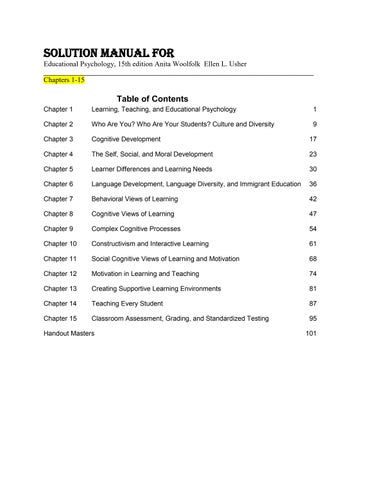
Solution Manual For Educational Psychology, 15th edition Anita Woolfolk Ellen L. Usher _________________________________________________________________________________
Chapters 1-15
Table of Contents Chapter 1
Learning, Teaching, and Educational Psychology
1
Chapter 2
Who Are You? Who Are Your Students? Culture and Diversity
9
Chapter 3
Cognitive Development
17
Chapter 4
The Self, Social, and Moral Development
23
Chapter 5
Learner Differences and Learning Needs
30
Chapter 6
Language Development, Language Diversity, and Immigrant Education
36
Chapter 7
Behavioral Views of Learning
42
Chapter 8
Cognitive Views of Learning
47
Chapter 9
Complex Cognitive Processes
54
Chapter 10
Constructivism and Interactive Learning
61
Chapter 11
Social Cognitive Views of Learning and Motivation
68
Chapter 12
Motivation in Learning and Teaching
74
Chapter 13
Creating Supportive Learning Environments
81
Chapter 14
Teaching Every Student
87
Chapter 15
Classroom Assessment, Grading, and Standardized Testing
95
Handout Masters
101
Chapter 1 Learning, Teaching, and Educational Psychology Chapter Objectives After studying this chapter, students should be able to achieve the following: 1.1
1.2 1.3 1.4
Describe the challenges facing teachers today, including increasing student diversity, requirements of the Every Student Succeeds Act, the continuing impact of testing and accountability for teachers and students, and the emphasis on social and emotional learning. Discuss the essential features of effective teaching, including different frameworks describing what good teachers do. Describe the methods used to conduct research in the field of educational psychology and the kinds of questions each method can address. Recognize how theories and research in development and learning are related to educational practice.
Activities Learning about NCLB and ESSA Many students have heard about the No Child Left Behind Act (NCLB) and its successor, Every Student Succeeds Act (ESSA), but they have never examined the impact of NCLB and ESSA on everyday education. Ask students to collect two or three scholarly articles related to NCLB and ESSA and summarize their findings in three main points. During the next class period, invite students to break into groups of three or four to discuss their findings and compare the effects of these pieces of legislation. They should be able to identify whether their findings matched their beliefs about NCLB and ESSA and determine how they might use educational research to become informed policy consumers. Social and Emotional Learning (SEL) Ask students to conduct their own exploration of social and emotional learning (SEL) outside class by examining the web site of the Collaborative for Academic, Social, and Emotional Learning (CASEL) and determining the purpose of incorporating SEL into the curriculum and the effects of SEL on academic achievement. In class, ask students to share their findings and discuss why SEL is particularly important in diverse settings and inclusive classrooms. What Is Good Teaching? I Objectives Students will recall their own teaching and learning experiences. Students will discuss what inspired them to become teachers. Students will discuss what made their own teachers good or bad and why. Activity
Participants Time
Ask students to form pairs and describe to each other what inspired them to become teachers (if relevant). If they are not
Student pairs
5 minutes
Materials
planning to teach, ask them to discuss their intended profession. Instruct pairs to make sure both members of the pair participate equally during the allotted time. Ask students to think about their own teachers and discuss what made them good or bad and why. (Participate equally.)
Student pairs
5 minutes
Ask students to consider what type of teacher they wish to be and how they plan to develop warm teacher-student relationships with all students they teach. (Participate equally.)
Student pairs
5 minutes
All students Return to the full group and ask students to describe several characteristics of good and bad teachers. Discuss Pianta‘s three domains of teacher-student interactions in the classroom and ask students to share specific examples of the various dimensions (positive/negative climate, teacher sensitivity, regard for students‘ perspectives) in the affective aspect of teaching.
15–20 minutes
Diversity in Classrooms 1) Have students identify the group of students they expect to teach. 2) Ask students to generate a list of ways their students may differ from one another. Encourage students to consider diverse cultural and ethnic backgrounds, native languages, socioeconomic status (SES), interests, and ability levels (including children who have mildto-severe developmental disabilities). 3) Ask students to generate a list of things these students likely have in common. Consider factors such as technological literacy and access to technological resources. 4) Have students form groups of three to four based on the groups they expect to teach. 5) In groups, students share their lists, confer about the challenges and benefits of diversity among students in their classrooms, and discuss the lack of diversity among teachers. [Allow 5-7 minutes for this discussion.] Beginning Teachers 1) Ask students to imagine that they will begin their first teaching assignment in a week. Does this make them anxious? What are some of their primary concerns? 2) Generate a list on the board/projector screen. Make two points: a. Their concerns are not unique—their peers and those who have gone before them have shared these same concerns. b. The content from the text will address many of these concerns. 3) Have students form groups of three to four to discuss strategies that would build their confidence and help them develop their sense of efficacy for teaching. What are their sources of efficacy? 4) Each group shares a few strategies with the larger class.
What Is Good Teaching? II Show students a video clip of an effective teacher (perhaps a video example from the eText) and a video clip of a less-than-effective teacher (perhaps ―The Boring Economics Teacher‖ on YouTube). Ask students to list the effective practices exhibited in the first video. Likewise, ask students to express why the second example illustrates less-than-effective teaching. Psychology and Education Have your students read the following article: Thorndike, E. L. (1910). The contribution of psychology to education. Journal of Educational Psychology, 1, 5-12. Students should be in small groups of four to answer the following questions: What are the roles for education and psychology envisioned by E. L. Thorndike? [Two students should take responsibility for presenting the role of education, and the other two should present the role of psychology.] Have those roles changed? What kinds of methods did Thorndike recommend for use in research? Professional Development Plan Objectives Students will identify what constitutes scholarly research. Students will identify ways to acquire and interpret scholarly research. Students will identify ways to use educational research in their practice. Activity
Participants
Time
Materials
If possible, plan a time with your students to visit your library (or schedule a virtual meeting) and speak with a library specialist about ways to acquire your school‘s professional journal holdings. If you cannot do so, be sure to compose a one-page summary to provide to students.
30–60 minutes in the library (less for virtual meeting); 15–20 minutes for handout
Library-produced directions or instructor-produced directions for finding scholarly research
Students should select two or three pieces of scholarly research and identify ways they may be put to use in a classroom or other educational setting. This activity can be completed immediately after the library orientation, or individually with materials that are accessible electronically.
20 minutes All students, independently
Ask students to create a professional development plan, one or two pages in length (or more), in which they: (1) identify specific ways they will seek new educational research as practitioners; (2) state specific guidelines they might use to evaluate such research; and (3) describe
All students, 30–60 independently minutes (can be outside of class)
how they might implement evidence-based findings from such research in their teaching. As a class or in small groups, ask students to discuss what they learned from the activity. Ask them to answer the discussion questions (in the next section of this Instructor‘s Manual) related to professionalism and research.
All students
15 minutes
What Research Has to Say Have your students consider the statement, ―Students should be grouped according to ability.‖ How could they find out if this is true or false? What would it take to convince you of the truth or error of this statement? Assign students the task of locating an article that addresses this question. The directions should be deliberately ambiguous so that students return with a variety of types of articles (e.g., popular, research) that will provide the basis of a general discussion of what constitutes good evidence. Research Jeopardy Objectives Students will understand various types of research. Students will practice identifying applications of research methods. Students will approach research methodology in terms of key benefits and limitations. Activity
Participants Time
Materials
Select various types of research from Chapter 1. Design ―Jeopardy‖ answers based upon each research method.
10 minutes
List of research methods and applications
Create a ―Jeopardy‖ grid where answers are divided into categories and assigned a point value. The grid may be created in PowerPoint using a template or on a poster board using sticky notes to cover the answers. Write point values on the sticky notes and remove them when students have asked the correct questions.
30 minutes
Poster board or PowerPoint slideshow
Divide students into two groups. Have students compete to answer questions; the team that wins can earn extra credit or take charge of designing the next activity.
All students, divided into two groups
30 minutes
Discussion Questions Describe controversial problems associated with the No Child Left Behind (NCLB) Act of 2001. When the Every Student Succeeds Act (ESSA) passed in 2015, this new legislation brought changes. Explain key changes mandated by ESSA. We hear a lot from educators and politicians today about accountability. Should teachers‘ jobs and salaries depend on how much their students learn? What would happen to curricula and