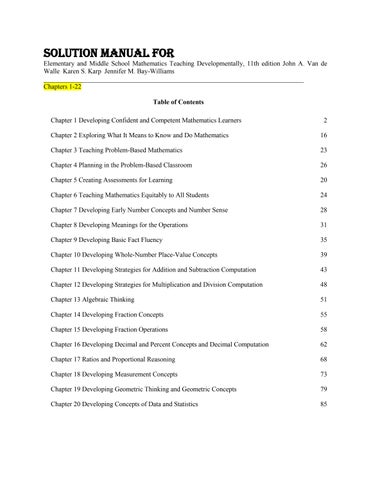
Solution Manual For Elementary and Middle School Mathematics Teaching Developmentally, 11th edition John A. Van de Walle Karen S. Karp Jennifer M. Bay-Williams ______________________________________________________________________________ Chapters 1-22 Table of Contents Chapter 1 Developing Confident and Competent Mathematics Learners
2
Chapter 2 Exploring What It Means to Know and Do Mathematics
16
Chapter 3 Teaching Problem-Based Mathematics
23
Chapter 4 Planning in the Problem-Based Classroom
26
Chapter 5 Creating Assessments for Learning
20
Chapter 6 Teaching Mathematics Equitably to All Students
24
Chapter 7 Developing Early Number Concepts and Number Sense
28
Chapter 8 Developing Meanings for the Operations
31
Chapter 9 Developing Basic Fact Fluency
35
Chapter 10 Developing Whole-Number Place-Value Concepts
39
Chapter 11 Developing Strategies for Addition and Subtraction Computation
43
Chapter 12 Developing Strategies for Multiplication and Division Computation
48
Chapter 13 Algebraic Thinking
51
Chapter 14 Developing Fraction Concepts
55
Chapter 15 Developing Fraction Operations
58
Chapter 16 Developing Decimal and Percent Concepts and Decimal Computation
62
Chapter 17 Ratios and Proportional Reasoning
68
Chapter 18 Developing Measurement Concepts
73
Chapter 19 Developing Geometric Thinking and Geometric Concepts
79
Chapter 20 Developing Concepts of Data and Statistics
85
Chapter 21 Exploring Concepts of Probability
92
Chapter 22 Exploring Exponents, Negative Numbers, and Real Numbers
95
CHAPTER 1 DEVELOPING CONFIDENT AND COMPETENT MATHEMATICS LEARNERS MAIN IDEAS/LEARNER OUTCOMES The main purpose of this chapter is to introduce teacher candidates (and teachers) to the changing world and ongoing revolution in school mathematics and their role in the continuation of this transformation. The four chapters that follow this one will create the foundational ideas for effective teaching in a problem-solving environment. Those chapters are to be seen in the context of the revolution that has been going on since 1989. For more than 25 years, mathematics has constantly undergone change. There are several significant factors in this transformation. Over the years, the pressures influencing school mathematics have become much more complex. The T I M S S data has caused much of the concern with the popular press pointing out that most industrialized countries significantly outperform U.S. students in mathematics and science. The National Assessment of Educational Progress (N A E P) offers ongoing indications of what American students are learning. These data suggest that while we continue to show improvement, we are not near where we want to be. Both T I M S S and N A E P data are referred to throughout the book. This chapter explains briefly how the movement toward shared standards began with the Curriculum and Evaluation Standards for School Mathematics, then in 2010 Common Core State Standards which incorporated ideas from many documents from N C T M, including Principles and Standards for School Mathematics (2000) and Curriculum Focal Points (2006). The Principles to Actions (Appendix B) provide a focus on mathematical teaching practices. Perhaps a poster or bulletin board with these teaching practices would be a powerful reminder to refer to throughout the semester. You should encourage teacher candidates to examine Appendix A of the main text which contains the Standards for Mathematical Practice from the Common Core State Standards and the overarching domains. Although it is difficult to make general statements concerning these influences across states and provinces, teacher candidates should recognize the importance of discussing their own state/provincial standards in light of the vision of N C T M. You will not be able to adequately help your teacher candidates understand the standards documents in any one class or by having them read any chapter in this book. The task at this early juncture in the course is to heighten awareness of the standards and then to consistently refer to them as you travel through your course. It is important to help teachers know that standards, whether Common Core State Standards or state/ province standards are not a curriculum but a statement of what is important in school mathematics. You may want to have teacher candidates contrast the N C T M Standards and Curriculum Focal Points with the Common Core State Standards or local state/province-level standards. Other Factors to Consider about School Mathematics The power of the individual teacher cannot be ignored. The last section in Chapter 1, An Invitation to Learn and Grow points out that the responsibility for excellent teaching and for significant learning by all students falls on the teacher. We added a section on how to create a whole school agreement with a
cohesive mathematics message. How teacher candidates and teachers use this text and your course instruction to enhance their content knowledge develops their ability to persevere and demonstrates their positive attitude and passion for teaching mathematics. Their readiness for accepting change and their reflective disposition will play an important role in how their pre-K–8 students grow as mathematical thinkers. SUGGESTED ACTIVITIES Introduce Principles and Standards Discuss the goals for students or read aloud the first paragraph of Chapter 1 of Principles and Actions (see Appendix B). How is this similar or different from what they experienced as elementary or middle school students? Is this what they are seeing in their field experiences? How possible do they believe this vision is for their classroom? Additionally, point out the structure of standards for your location whether they be the Common Core State Standards or state/ province standards. The standards define what students should understand and be able to do. It is critical that your methods students also read the six principles listed on P P T Slide 1:17 and the five process standards listed on P P T Slide 1:15. Although these are included in the text, it would be much better if your teacher candidates read the full discussion of these in the actual document. With a student membership to N C T M, your teacher candidates can access a Web version of the document or N C T M allows guests to sign up for 120 days of free access which should cover the time frame of most courses. The Content Standards Most importantly for teacher candidates, you want them to be aware of standards documents to get an idea of what content is appropriate at each grade level. Another good discussion to have surrounds the issue of basic skills. What is meant when people say ―basic skills‖ in mathematics? Do the standards documents support students having basic skills? (Absolutely!) A discussion concerning the pressures of high-stakes testing and how this pressure influences what is taught in the classroom is most useful at this early point in the semester. If there are sample-released test items in your state/province, compare those to the standards documents to see whether there are similarities and differences. Introduce Professional Journals and Publications Pass out back issues of Mathematics Teacher: Learning and Teaching P K-12, Teaching Children Mathematics and/or Mathematics Teaching in the Middle School (Note: Teaching Children Mathematics and Mathematics in the Middle School have been discontinued and replaced with Mathematics Teacher: Learning and Teaching P K-12). Point out some of the regular features of each journal that may be of interest. Encourage or require teacher candidates to become e-members of N C T M. This membership allows full-time students to select an electronic subscription to the Mathematics Teacher: Learning and Teaching P K-12 journal and enable them to download 25 journal articles from a non-subscribed journal. They can also attend regional N C T M conferences for FREE! Also show the N C T M Essential Understandings series including the new Essential Understandings in Practice, which provide details of how to teach the essential understandings effectively, Navigations books, and other valuable N C T M publications that they should consider for their personal professional libraries. Several of the publications, such as the Navigations books, each include a CD-ROM with other articles and several good applets that teachers will find quite valuable. POSSIBLE ASSIGNMENTS
1. Select one of the five process standards from Principles and Actions (see Appendix B) or one of the Standards for Mathematical Practice (see Appendix A) and read it carefully. Discuss how this standard reflects a vision of mathematics that is different from the one you experienced as a K-12 student. Decide on two ideas that you think are most important for you as a future teacher to take from this standard. Create a ―to learn‖ list of the things you most need to learn in order to implement that standard as a teacher of mathematics. Use this ―to learn‖ list approach as a first step toward developing a personal professional growth plan. 2. Read Chapters 1 and 2 (Vision and Principles) in the Principles and Standards (pp. 3–26) or pages 3– 8 in the Common Core State Standards (downloadable at www.corestandards.org). After reading these pages, write a three- to five-page reflective paper entitled, ―Personal Reflections on the N C T M Standards (or the Common Core State Standards).‖ In this reflective paper, describe what the N C T M Standards or Common Core State Standards means to you relative to your own personal mathematics education, how you personally perceive the importance of mathematics in schools, and the implications for you as a teacher. You can and should add whatever other thoughts you have about this most important document. There is no ―correct‖ thing to say in this paper. It is important that you read and reflect seriously on these documents that have a major impact on school mathematics in the United States and Canada (explore the provincial standards for this assignment as well). 3. (An alternative to the second assignment.) Read about the five process standards in Chapter 3 of Principles and Standards (pp. 30–70) and/or the Common Core State Standards at a specified grade band. (Repeat the reflective writing assignment from above.) 4. Select a grade level in the Curriculum Focal Points or the Common Core State Standards and compare the suggested focal points or standards and related connections to a textbook in your local schools (examine the Table of Contents) or to your state curriculum guidelines at that grade if you are not in a Common Core State. How are they inclusive of the same mathematics content? What are the differences?
CHAPTER 2 EXPLORING WHAT IT MEANS TO KNOW AND DO MATHEMATICS MAIN IDEAS/LEARNER OUTCOMES This may be the most challenging chapter in the text, but its contents are at the very heart of teaching developmentally—teaching from the perspective of a child who must develop his or her own ideas and understanding. In the spirit of a constructivist approach, the chapter could be titled the ―what and how‖ of teaching mathematics. The most difficult task with teacher candidates is helping them re-conceptualize the nature of mathematics. We have come to believe that an appreciation for what it means to ―do mathematics‖ is critical for teachers to actually engage in standards-based instruction. The chapter begins with a discussion of what it means to be mathematically proficient and how students learn mathematics (P P T Slides 2:3–12). Mathematical proficiency includes the following five strands: conceptual understanding, procedural fluency, strategic competence, productive disposition, and adaptive reasoning. It is important for teacher candidates to recognize the interconnectedness, as well as, expand their view of proficiency. It is important to know mathematics is much more than memorizing procedures or naming shapes. Next the chapter provides an invitation to do mathematics (P P T Slide 2:13). These activities (P P T Slides 2:13; 2:17–20) are important for teacher candidates to explore to help them construct new thinking around the teaching and learning of mathematics. After providing these experiences, the chapter provides basic coverage of two learning theories: constructivist learning theory and sociocultural learning theory (P P T Slide 2:14). Understanding how people learn is critical to the rationale of why using a standardsbased approach to mathematics instruction. The chapter ends with outlining specific implications for teaching (P P T Slide 2:15). Components of Mathematical Proficiency Two of these proficiencies are conceptual and procedural knowledge, which have been well established as distinct and mutually beneficial in learning a concept. In fact, it is worthwhile to engage teacher candidates in experiences to consider how concepts and procedures are related. If knowledge is the possession of an idea, then understanding is a measure of how well this idea is integrated with or connected to other existing ideas in the learner’s cognitive framework. Richard Skemp introduced the terminology of instrumental and relational understanding. If understanding is placed on a continuum (P P T Slide 2:5), at one end is instrumental understanding, knowledge with little or no connections to other ideas. At the other end is relational understanding—ideas that can be related to many others. (Note: instrumental understanding is not the same thing as procedural knowledge—we want students to know procedures and to have them well connected to their conceptual understanding.) There are three components of procedural fluency that need to be examined: efficiency, flexibility, and accuracy (P P T Slides 2:7–9). It would be helpful for teacher candidates to examine student work with different strategies and consider the student’s efficiency, flexibility, and accuracy. A key question to ask is, ―How do the different strategies demonstrate reasonable actions of procedural fluency?‖ Strategic competence is often considered problem solving (P P T Slide 2:10). Strategic competence includes reading a story problem or encountering a mathematical situation and figuring out what the problem is as well as determining a method for solving it. As part of strategic competence, students are able to create useful representations to help them reason about the problem. Included within strategic competence is solving both routine and nonroutine problems. The last two strands of proficiency are adaptive reasoning and productive disposition (P P T Slide 2:11). Adaptive reasoning is the capacity to think logically about the relationships among concepts and situations. An important teacher move to support adaptive reasoning is by asking students to justify their strategies and/or their answers. Productive disposition is a favorable attitude or