February 18, 2022 12:10
ISM-c01Introduction
Sheet number 1 Page number 1
cyan magenta yellow black
© 2021, Boyce Textbooks, Inc., All rights reserv
CHAPTER 1
Introduction 1.1 1.
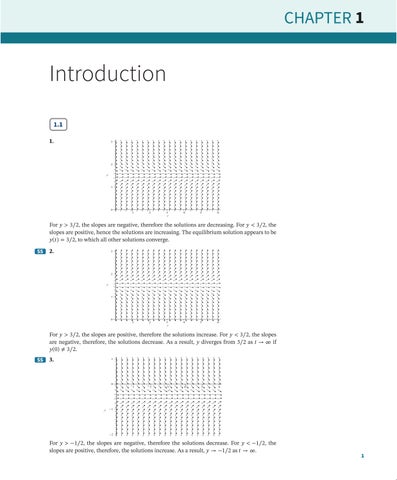
For � > 3∕2, the slopes are negative, therefore the solutions are decreasing. For � < 3∕2, the slopes are positive, hence the solutions are increasing. The equilibrium solution appears to be �(�) = 3∕2, to which all other solutions converge. 2.
For � > 3∕2, the slopes are positive, therefore the solutions increase. For � < 3∕2, the slopes are negative, therefore, the solutions decrease. As a result, � diverges from 3∕2 as � → ∞ if �(0) 3∕2. 3.
For � > −1∕2, the slopes are negative, therefore the solutions decrease. For � < −1∕2, the slopes are positive, therefore, the solutions increase. As a result, � → −1∕2 as � → ∞.
1
February 18, 2022 12:10
2
CHAPTER 1
ISM-c01Introduction
Sheet number 2 Page number 2
cyan magenta yellow black
© 2021, Boyce Textbooks, Inc., All rights reserv
Introduction
4.
For � > −1∕2, the slopes are positive, and hence the solutions increase. For � < −1∕2, the slopes are negative, and hence the solutions decrease. All solutions diverge away from the equilibrium solution �(�) = −1∕2. 5. For all solutions to approach the equilibrium solution �(�) = 2∕3, we must have � ′ < 0 for � > 2∕3, and � ′ > 0 for � < 2∕3. The required rates are satisfied by the differential equation � ′ = 2 − 3�. 6. For solutions other than �(�) = 2 to diverge from � = 2, �(�) must be an increasing function for � > 2, and a decreasing function for � < 2. The simplest differential equation whose solutions satisfy these criteria is � ′ = � − 2. 7.
For � = 0 and � = 4 we have � ′ = 0 and thus � = 0 and � = 4 are equilibrium solutions. For � > 4, � ′ < 0 so if �(0) > 4 the solution approaches � = 4 from above. If 0 < �(0) < 4, then � ′ > 0 and the solutions “grow” to � = 4 as � → ∞. For �(0) < 0 we see that � ′ < 0 and the solutions diverge from 0. 8.
Note that � ′ = 0 for � = 0 and � = 5. The two equilibrium solutions are �(�) = 0 and �(�) = 5. Based on the direction field, � ′ > 0 for � > 5; thus solutions with initial values greater than 5 diverge from the solution �(�) = 5. For 0 < � < 5, the slopes are negative, and hence solutions with initial values between 0 and 5 all decrease toward the solution �(�) = 0. For � < 0, the slopes are all positive; thus solutions with initial values less than 0 approach the solution �(�) = 0.
February 18, 2022 12:10
ISM-c01Introduction
Sheet number 3 Page number 3
cyan magenta yellow black
© 2021, Boyce Textbooks, Inc., All rights reserv
1.1
9.
Since � ′ = � 2 , � = 0 is the only equilibrium solution and � ′ > 0 for all �. Thus � → 0 if the initial value is negative; � diverges from 0 if the initial value is positive. 10.
Observe that � ′ = 0 for � = 0 and � = 2. The two equilibrium solutions are �(�) = 0 and �(�) = 2. Based on the direction field, � ′ > 0 for � > 2; thus solutions with initial values greater than 2 diverge from �(�) = 2. For 0 < � < 2, the slopes are also positive, and hence solutions with initial values between 0 and 2 all increase toward the solution �(�) = 2. For � < 0, the slopes are all negative; thus solutions with initial values less than 0 diverge from the solution �(�) = 0. 11. -(�) � ′ = 2 − �. 12. From Figure 1.1.6 we can see that � = 2 is an equilibrium solution and thus (c) and (j) are the only possible differential equations to consider. Since ��∕�� > 0 for � > 2, and ��∕�� < 0 for � < 2 we conclude that (c) is the correct answer: � ′ = � − 2. 13. -(�) � ′ = −2 − �. 14. -(�) � ′ = 2 + �. 15. From Figure 1.1.9 we can see that � = 0 and � = 3 are equilibrium solutions, so (e) and (h) are the only possible differential equations. Furthermore, we have ��∕�� < 0 for � > 3 and for � < 0, and ��∕�� > 0 for 0 < � < 3. This tells us that (h) is the desired differential equation: � ′ = � (3 − �). 16. -(�) � ′ = � (� − 3). 17. (a) Let �(�) denote the amount of chemical in the pond at time �. The amount � will be measured in grams and the time � will be measured in hours. The rate at which the chemical is entering the pond is given by 300 gal/h ⋅ .01 g/gal = 3 g/h. The rate at which the chemical leaves the pond is given by 300 gal/h ⋅ �∕106 g/gal = (3 × 10⁻⁴ )� g/h. Thus the differential equation is given by ��∕�� = 3 − (3 × 10⁻⁴ )�. (b) The equilibrium solution occurs when �′ = 0, or � = 104 grams. Since �′ > 0 for � < 104 g and �′ < 0 for � > 104 g, all solutions approach the equilibrium solution independent of the amount present at � = 0. (c) Let �(�) denote the amount of chemical in the pond at time �. From part (a) the function �(�) satisfies the differential equation ��∕�� = 3 − (3 × 10⁻⁴ )�. Thus in terms of the concentration �(�) = �(�)∕106 , ��∕�� = (1∕106 )(��∕��) = (1∕106 )(3 − (3 × 10⁻⁴ )�) = (3 × 10⁻⁶ ) − (10−6 )(3 × 10⁻⁴ )� = (3 × 10⁻⁶ ) − (3 × 10⁻⁴ )�.
3
February 18, 2022 12:10
4
CHAPTER 1
ISM-c01Introduction
Sheet number 4 Page number 4
cyan magenta yellow black
© 2021, Boyce Textbooks, Inc., All rights reserv
Introduction
18. The surface area of a spherical raindrop of radius � is given by � = 4��2 . The volume of a spherical raindrop is given by � = 4��3 ∕3. Therefore, we see that the surface area � = �� 2∕3 for some constant �. If the raindrop evaporates at a rate proportional to its surface area, then ��∕�� = −�� 2∕3 for some � > 0. 19. The difference between the temperature of the object and the ambient temperature is � − 70 (� in ◦ F). Since the object is cooling when � > 70, and the rate constant is � = 0.05 min−1 , the governing differential equation for the temperature of the object is ��∕�� = −.05 (� − 70). 20. (a) Let �(�) be the total amount of the drug (in milligrams) in the patient’s body at any given time � (hr). The drug enters the body at a constant rate of 500 mg/hr. The rate at which the drug leaves the bloodstream is given by 0.4 �(�). Hence the accumulation rate of the drug is described by the differential equation ��∕�� = 500 − 0.4 � (mg/hr). (b)
Based on the direction field, the amount of drug in the bloodstream approaches the equilibrium level of 1250 mg (within a few hours). 21. (a) Following the discussion in the text, the differential equation is �(��∕��) = �� − � � 2 , or equivalently, ��∕�� = � − �� 2 ∕�. (b) After √ a long time, ��∕�� ≈ 0. Hence the object attains a terminal velocity given by �∞ = ��∕� . 2 = ��, the required drag coefficient is � = 2∕49 kg/s. (c) Using the relation � �∞
(d)
22.
All solutions become asymptotic to the line � = � − 3 as � → ∞.
February 18, 2022 12:10
ISM-c01Introduction
Sheet number 5 Page number 5
cyan magenta yellow black
© 2021, Boyce Textbooks, Inc., All rights reserv
1.2
23.
The solutions approach −∞, 0, or ∞ depending upon the value of �(0). 24.
The solutions approach −∞, ∞, or oscillate depending upon the value of �(0). 25.
For all �(0), there is a number �� that depends on the value of �(0) such that �(�� ) = 0 and the solution does not exist for � > �� .
1.2 1. (a) The differential equation can be rewritten as �� = ��. 5−� Integrating both sides of this equation results in − ln |5 − �| = � + �1 , or equivalently, 5 − � = � �−� . Applying the initial condition �(0) = �0 results in the specification of the constant as � = 5 − �0 . Hence the solution is �(�) = 5 + (�0 − 5)�−� .
5