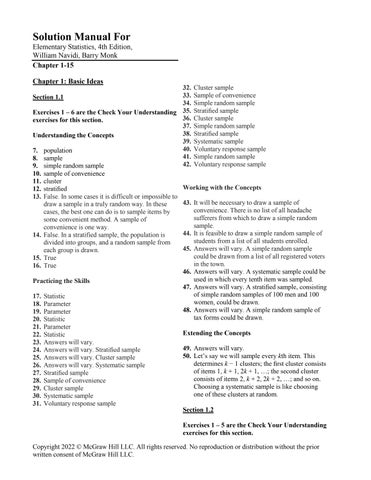
Solution Manual For Elementary Statistics, 4th Edition, William Navidi, Barry Monk Chapter 1-15 Chapter 1: Basic Ideas 32. Cluster sample 33. Sample of convenience Section 1.1 34. Simple random sample Exercises 1 – 6 are the Check Your Understanding 35. Stratified sample 36. Cluster sample exercises for this section. 37. Simple random sample 38. Stratified sample Understanding the Concepts 39. Systematic sample 40. Voluntary response sample 7. population 41. Simple random sample 8. sample 42. Voluntary response sample 9. simple random sample 10. sample of convenience 11. cluster Working with the Concepts 12. stratified 13. False. In some cases it is difficult or impossible to 43. It will be necessary to draw a sample of draw a sample in a truly random way. In these convenience. There is no list of all headache cases, the best one can do is to sample items by sufferers from which to draw a simple random some convenient method. A sample of sample. convenience is one way. 44. It is feasible to draw a simple random sample of 14. False. In a stratified sample, the population is students from a list of all students enrolled. divided into groups, and a random sample from 45. Answers will vary. A simple random sample each group is drawn. could be drawn from a list of all registered voters 15. True in the town. 16. True 46. Answers will vary. A systematic sample could be used in which every tenth item was sampled. Practicing the Skills 47. Answers will vary. A stratified sample, consisting of simple random samples of 100 men and 100 17. Statistic women, could be drawn. 18. Parameter 48. Answers will vary. A simple random sample of 19. Parameter tax forms could be drawn. 20. Statistic 21. Parameter Extending the Concepts 22. Statistic 23. Answers will vary. 49. Answers will vary. 24. Answers will vary. Stratified sample 50. Let‘s say we will sample every kth item. This 25. Answers will vary. Cluster sample determines k − 1 clusters; the first cluster consists 26. Answers will vary. Systematic sample of items 1, k + 1, 2k + 1, …; the second cluster 27. Stratified sample consists of items 2, k + 2, 2k + 2, …; and so on. 28. Sample of convenience Choosing a systematic sample is like choosing 29. Cluster sample one of these clusters at random. 30. Systematic sample 31. Voluntary response sample Section 1.2 Exercises 1 – 5 are the Check Your Understanding exercises for this section. Copyright 2022 © McGraw Hill LLC. All rights reserved. No reproduction or distribution without the prior written consent of McGraw Hill LLC.
Understanding the Concepts 6. variables 7. data 8. qualitative 9. Quantitative 10. nominal; ordinal 11. discrete 12. Continuous H 0 13. False. Quantitative variables describe how much or how many of something there is. 14. True 15. True 16. True Practicing the Skills 17. Qualitative 18. Quantitative 19. Quantitative 20. Qualitative 21. Quantitative 22. Quantitative 23. Qualitative 24. Qualitative 25. Qualitative 26. Quantitative 27. Ordinal 28. Nominal 29. Ordinal 30. Ordinal 31. Nominal 32. Nominal 33. Nominal 34. Ordinal 35. Continuous 36. Continuous 37. Discrete 38. Discrete 39. Continuous 40. Discrete 41. Discrete 42. Continuous 43. Interval 44. Ratio 45. Ratio 46. Interval 47. Interval 48. Ratio 49. Interval 50. Ratio
Working with the Concepts 51. Ordinal; Qualitative 52. Discrete; Quantitative 53. Ordinal 54. Quantitative 55. Nominal 56. Ordinal 57. (A) Game Title, Developer (B) Initial Release Year, Copies Sold (C) Developer (D) Game Title 58. (A) Movie Title, Studio (B) Release Year, Ticket Sales, Running Time (C) Studio (D) Movie Title Extending the Concepts 59. (A) Ordinal (B) Yes, it reflects a more favorable opinion of the construction of a new shopping mall. (C) No, we cannot say that Jason‘s opinion is twice as favorable. (D) Quantitative (E) Yes, Brenda‘s answer reflects the ownership of more cars, and specifically, the ownership of twice as many cars. (F) Nominal (G) No, Brenda‘s answer reflects neither more of something nor twice as much of something.
Section 1.3 Exercises 1 – 4 are the Check Your Understanding exercises for this section. Understanding the Concepts 5. randomized 6. double-blind 7. observational 8. confounder 9. prospective 10. cohort 11. True 12. False. A confounder makes it harder to draw conclusions from a study.
Copyright 2022 © McGraw Hill LLC. All rights reserved. No reproduction or distribution without the prior written consent of McGraw Hill LLC.
13. False. In a randomized experiment, subjects are assigned to treatment groups at random. 14. False. Randomized experiments are generally more reliable than observational studies. 15. True 16. True Practicing the Skills 17. (A) Randomized experiment (B) Yes, because the assignment to treatments is made at random, there is no systematic difference between the groups other than the drug taken that can explain the difference in pain relief. 18. (A) Observational study (B) No, because this is an observational study, the results may be due to confounding. For example, those in the lowexercise group may be older and have higher blood pressure as a result of age. 19. (A) Randomized experiment (B) Yes, because the assignment to treatments is made at random, there is no systematic difference between the groups other than the amount of exercise that can explain the difference in blood pressure. 20. (A) The four types of fertilizer (B ) Randomized experiment (C) Yes, because the assignment to treatment is made at random.
(C) Cohort (D) Prospective (E) Yes. The level of prenatal care may differ between smoking and nonsmoking mothers. 28. (A) Whether respiratory problems were experienced (B) The level of formaldehyde in the classroom (C) A cohort study (D) Cross-sectional (E) It is unlikely. For confounding to be an issue, children with more sensitive respiratory systems would have to have been more likely to be assigned to classrooms with higher exposure. Extending the Concepts 29. (A) Yes, because the subjects were randomly assigned to treatment. (B) If a doctor knew whether a child had received the vaccine, it might influence the diagnosis. (C) It could be due to confounding. The children who received the placebo were more likely to be middle- or upper-income than those who did not participate, and this may be the reason that the rate of polio was higher.
30. (A) No (B) No (C) The treatment group consisted of children Working with the Concepts who had consent to participate; middle- and 21. An observational study will be necessary, because upper-income children were overrepresented one can‘t assign people to live in areas with high in this group. Therefore, the children in the pollution levels. treatment group tended to be more 22. A randomized experiment is possible, with cold susceptible to polio than those in the control sufferers being assigned randomly to the old or group. new drug. 31. Smokers who quit are less healthy than smokers 23. The result may be due to confounding. Areas with who don‘t. Upon quitting smoking, many people denser populations may have both more crime put on weight substituting food for tobacco. and more taxicabs. 32. Smokers tend to drink more alcohol on the 24. The result could be due to confounding. For average than non-smokers. example, more older people may live in larger houses than younger people, and also have less chance of recovering from a heart attack. 25. (A) False (B) True 26. Children with larger vocabularies tend to be older, and thus taller. 27. (A) Heart rate (B) Maternal smoking Copyright 2022 © McGraw Hill LLC. All rights reserved. No reproduction or distribution without the prior written consent of McGraw Hill LLC.
Section 1.4 CHAPTER 1 Quiz Exercises 1 and 2 are the Check Your Understanding exercises for this section. Understanding the Concepts 3. 4. 5. 6.
Voluntary response surveys nonresponders population False. The way that a question is worded in a survey may have a large effect on the responses. 7. True 8. False. A large sample size does not make up for bias in questioning. Practicing the Skills 9. Nonresponse bias 10. Voluntary response bias 11. Self-interest bias 12. Self-interest bias 13. Voluntary response bias 14. Social acceptability bias 15. Nonresponse bias 16. Social acceptability bias
1. 2. 3. 4. 5.
Answers will vary. Qualitative True Continuous False. Ideally a sample should represent the population as much as possible. 6. Stratified sample 7. acceptable 8. Sample of convenience 9. True 10. Observational study 11. Randomized experiment 12. differences in treatment 13. Seniors may be more likely to have better preparation for the class than sophomores. 14. True 15. Not reliable. This is a voluntary response survey, so the people who respond tend to hold stronger opinions than others.
CHAPTER 1 Review Exercises
Quantitative Nominal Continuous 17. (A) No (A) True (B) No. Both questions are leading. The first (B) True question leads to a ‗‗yes‘‘ response, and the (C) False second leads to a ‗‗no‘‘ response. 5. Stratified sample 18. Yes. People may be less likely to answer the 6. Voluntary response sample phone when they don‘t recognize the number that 7. Cluster sample is calling them. 8. Simple random sample 19. Yes. People who do not have landline phones 9. (A) Observational study may tend to have different opinions on some (B) Yes. People who live in areas with issues than people who do have landline phones. fluoridated water may have different 20. Yes, people may be more likely to pick the first dental habits than those who live in areas choice. without fluoridated water. 10. (A) Randomized experiment (B) Because this is a randomized experiment, the Extending the Concepts results are unlikely to be due to confounding. 21. (A) The poll oversampled higher-income 11. (A) Observational study people. (B) Yes. People who use the phone while driving (B) The response rate was low — only may be more careless in general than those 23%. This results in nonresponse bias. who do not. (C) A sample that is not drawn by a valid method 12. (A) Randomized experiment can produce misleading results, even when it (B) Because this is a randomized experiment, the is large. results are unlikely to be due to confounding. 13. The sample is a voluntary response sample. Working with the Concepts
1. 2. 3. 4.
Copyright 2022 © McGraw Hill LLC. All rights reserved. No reproduction or distribution without the prior written consent of McGraw Hill LLC.
14. Nonresponse bias; living people are not included. People who are still alive are not included in the sample. 15. There is a considerable level of nonresponse bias. 9. (A) This is an example of leading question bias. It highly encourages a ―yes‖ response because of the phrase ―or continue their wasteful spending.‖ A more appropriate question would be ―What is Write About It your opinion of Americans saving more money? 1. In both cluster sampling and stratified sampling, Choices: Strongly disagree, Somewhat disagree, the population is divided into groups. In stratified Neither agree nor disagree, Somewhat agree, sampling, a simple random sample is chosen from Strongly agree.‘‘ each group. In cluster sampling, a random sample (B) This is an example of leading question bias. It of groups is chosen, and every member of the highly encourages a ―yes‖ response because of chosen groups is sampled. the word ―reputable.‖ A more appropriate 2. A potential problem with samples of convenience question would be ―What is your opinion of the is that they may differ systematically in some way current level of funding for charities?‖ from the population. For this reason, samples of convenience should not be used, except in CHAPTER 1 Case Study situations where it is not feasible to draw a random sample. When it is necessary to draw a 1. 450 sample of convenience, it is important to think 2. 41 carefully about all the ways in which the sample 41 9.1% might differ systematically from the population. If 3. 450 it is reasonable to believe that no important 4. 43 systematic difference exists, then it may be 5. 2 acceptable to use a sample of convenience. 2 3. Answer will vary. 6. 4.7% 43 4. Answers will vary. 5. Some qualitative variables may be numeric when 7. Yes, 9.1% is considerably larger than 4.7%. 8. The high-exposure people and the school-return the number represents a label. Examples include people are the same people. numbers on a football jersey or on a racecar. 9. The low-exposure people and the mail-return people are the same people. 6. A randomized experiment is a study in which the 10. People who respond by mail will be responding investigator assigns the treatments to the during a period of lower PM. experimental units at random. An observational study is one in which the assignment to treatment 11. People with symptoms may tend to respond earlier; therefore, people with symptoms are more groups is not made by the investigator. The main likely to be school-return people. advantage to conducting a randomized 12. There would be no tendency for people with experiment is that if there are large differences in symptoms to respond earlier. outcomes among the treatment groups, we may conclude that the differences are due to the treatments. 7. The main advantage to conducting a double-blind study is that it is an impartial experiment which eliminates the potential for bias from the investigator or the subject. There are various limitations. A double-blind experiment requires a third party to be involved in the experiment. Also, there may be factors that may influence the outcome that are not known when the experiment is double-blinded. 8. Answers will vary. Copyright 2022 © McGraw Hill LLC. All rights reserved. No reproduction or distribution without the prior written consent of McGraw Hill LLC.