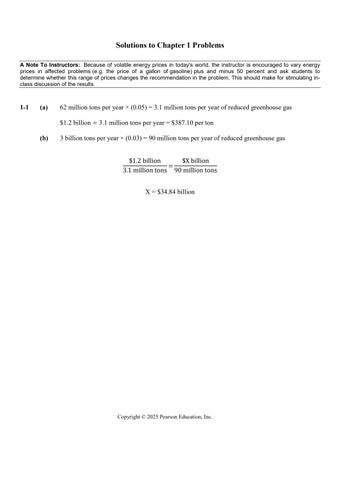
Solutions to Chapter 1 Problems A Note To Instructors: Because of volatile energy prices in today's world, the instructor is encouraged to vary energy prices in affected problems (e.g. the price of a gallon of gasoline) plus and minus 50 percent and ask students to determine whether this range of prices changes the recommendation in the problem. This should make for stimulating inclass discussion of the results.
1-1
(a)
62 million tons per year × (0.05) = 3.1 million tons per year of reduced greenhouse gas $1.2 billion ÷ 3.1 million tons per year = $387.10 per ton
(b)
3 billion tons per year × (0.03) = 90 million tons per year of reduced greenhouse gas $1.2 billion $X billion = 3.1 million tons 90 million tons X = $34.84 billion
Copyright © 2025 Pearson Education, Inc.
1-2
The primary disadvantage is the installed cost of $8,000 (rather expensive!). A key advantage of synthetic turf is the annual savings due to lawn maintenance. This may be worth up to $1,000 per year when periodic lawn mowing, watering, and feeding are avoided. See what other monetized advantages and disadvantages members of your class can identify. Be creative!
Copyright © 2025 Pearson Education, Inc.
1-3
Cost per Watt-hour = $0.75/1.5 Watt-hours = $0.50 per Watt-hour At a cost of $0.50 per Watt-hour, it would cost (1,000)($0.50 per Watt-hour) = $500 per kilo Watt-hour for power from a single AAA battery. This is 5,000 times more costly than energy from your local utility. No wonder we turn off our battery operated devices when we're not using them!
Copyright © 2025 Pearson Education, Inc.
1-4
At first glance, Tyler’s options seem to be: (1) immediately pay $803 to the owner of the other person’s car or (2) submit a claim to the insurance company. If Tyler keeps his Nissan for five more years (an assumption), the cost of option 2 is $500 + ($60 × 2 payments/year) × 5 years = $1,100. This amount is more than paying $803 out-of-pocket, so Tyler appears to have made the most economical choice. What we don’t know in this problem is the age and condition of the other person’s car. If we assume it’s a clunker, another option for Tyler is to offer to buy the other person’s car and fix it himself and then sell it over the internet. Or Tyler could donate the unrepaired (or repaired) car to his favorite charity.
Copyright © 2025 Pearson Education, Inc.
1-5
(a)
15,000 miles per year / 25 mpg = 600 gallons per year of E20 Savings = 600 gallons per year ($4.00 − $3.37) = $378 per year
(b)
Gasoline saved = 0.20 (600 gal/yr)(1,000,000 people) = 120 million gallons per year
Copyright © 2025 Pearson Education, Inc.