Solutions Chapter 1
11. a. 11-Cyclohexylundecanoate is a lipid. b. Selenocysteine is an amino acid. c. Galactose is a monosaccharide. d. O6-Methylguanosine monophosphate is a nucleotide.
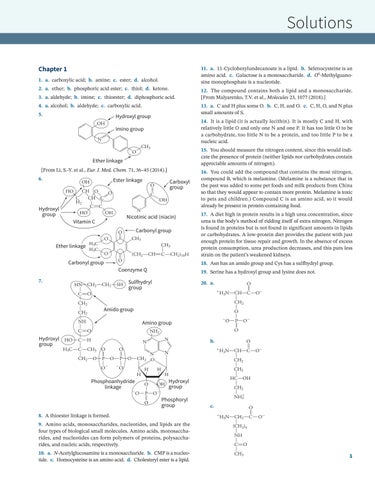
1. a. carboxylic acid; b. amine; c. ester; d. alcohol. 2. a. ether; b. phosphoric acid ester; c. thiol; d. ketone. 3. a. aldehyde; b. imine; c. thioester; d. diphosphoric acid. 4. a. alcohol; b. aldehyde; c. carboxylic acid. 5.
13. a. C and H plus some O. b. C, H, and O. c. C, H, O, and N plus small amounts of S.
Hydroxyl group OH
14. It is a lipid (it is actually lecithin). It is mostly C and H, with relatively little O and only one N and one P. It has too little O to be a carbohydrate, too little N to be a protein, and too little P to be a nucleic acid.
Imino group
N CH3
O
15. You should measure the nitrogen content, since this would indicate the presence of protein (neither lipids nor carbohydrates contain appreciable amounts of nitrogen).
Ether linkage [From Li, S.-Y. et al., Eur. J. Med. Chem. 71, 36–45 (2014).] 6.
Ester linkage
OH HO C H2
Hydroxyl group
C
C
C
HO
Nicotinic acid (niacin)
Vitamin C
Carbonyl group
O
CH3
O
H3C
O
CH3
(CH2
O
Carbonyl group
OH
N
OH
Ether linkage H3C
Carboxyl group
O
CH O O CH C
CH
CH2)10H
C
HN C
CH2
CH2
SH
O
CH2
19. Serine has a hydroxyl group and lysine does not.
Sulfhydryl group
20. a.
C
O
C
H
C
CH3 O
N
N P
O O
O−
P
CH2
O
−O
H
Phosphoanhydride linkage
C
O−
−O
H O P O
O−
b.
O +H N 3
N
N O
P O
NH2
O
CH
O −O
Amino group
CH2
O +H N 3
CH2
NH
H3C
17. A diet high in protein results in a high urea concentration, since urea is the body’s method of ridding itself of extra nitrogen. Nitrogen is found in proteins but is not found in significant amounts in lipids or carbohydrates. A low-protein diet provides the patient with just enough protein for tissue repair and growth. In the absence of excess protein consumption, urea production decreases, and this puts less strain on the patient’s weakened kidneys.
Amido group
CH2
Hydroxyl HO group
16. You could add the compound that contains the most nitrogen, compound B, which is melamine. (Melamine is a substance that in the past was added to some pet foods and milk products from China so that they would appear to contain more protein. Melamine is toxic to pets and children.) Compound C is an amino acid, so it would already be present in protein-containing food.
18. Asn has an amido group and Cys has a sulfhydryl group.
Coenzyme Q 7.
12. The compound contains both a lipid and a monosaccharide. [From Malyarenko, T.V. et al., Molecules 23, 1077 (2018).]
CH
C
O−
CH2 H
H
OH O−
CH2 HC
Hydroxyl group
Phosphoryl group
8. A thioester linkage is formed. 9. Amino acids, monosaccharides, nucleotides, and lipids are the four types of biological small molecules. Amino acids, monosaccharides, and nucleotides can form polymers of proteins, polysaccharides, and nucleic acids, respectively. 10. a. N-Acetylglucosamine is a monosaccharide. b. CMP is a nucleotide. c. Homocysteine is an amino acid. d. Cholesteryl ester is a lipid.
OH
CH2 NH+ 3
c.
O +H N 3
CH2
C
O−
(CH2)4 NH C
O
CH3
1
2 21.
SOLU TION S 34. a. decrease; b. increase.
O
Carbonyl group
C
H
H
OH
HO
H
H
OH
H
Hydroxyl group
OH CH2 OH
22. a. Fructose has the same molecular formula, C 6 H 12 O 6 , as glucose. b. Fructose is a ketone, whereas glucose is an aldehyde. 23. Uracil has a carbonyl functional group, whereas cytosine has an amino functional group. 24. Nucleotides consist of a five-carbon sugar, a nitrogenous ring, and one or more phosphoryl groups linked covalently together. 25. a. glycosidic; b. peptide; c. phosphoester. 26. Aspartame consists of two amino acids linked by a peptide bond. 27. As described in the text, palmitate and cholesterol are highly nonpolar and are therefore insoluble in water. Both are highly aliphatic. Alanine is water soluble because its amino group and c arboxylate groups are ionized, which render the molecule “saltlike.” Glucose is also water soluble because its carbonyl group and many hydroxyl groups are able to form hydrogen bonds with water. 28. Glucose has several hydroxyl groups and is a polar molecule. As such, it will have difficulty crossing the nonpolar membrane. The 2,4-dinitrophenol molecule consists of a substituted benzene ring and has a greater nonpolar character. Of the two molecules, the 2 ,4-dinitrophenol will traverse the membrane more easily. 29. DNA forms a more regular structure because DNA consists of only four different nucleotides, whereas proteins are made up of as many as 20 different amino acids. In addition, the 20 amino acids have much more individual variation in their structures than do the four nucleotides. Both of these factors result in a more regular structure for DNA. The cellular role of DNA relies on the sequence of the nucleotides that make up the DNA, not on the overall shape of the DNA molecule itself. Proteins, on the other hand, fold into unique shapes, as illustrated by endothelin in Figure 1.4. The ability of proteins to fold into a wide variety of shapes means that proteins can also serve a wide variety of biochemical roles in the cell. According to Table 1.2, the major roles of proteins in the cell are to carry out metabolic reactions and to support cellular structures. 30. Polysaccharides serve as fuel-storage molecules and can also serve as structural support for the cell. 31. Pancreatic amylase is unable to digest the glycosidic bonds that link the glucose residues in cellulose. Figure 1.6 shows the structural differences between starch and cellulose. Pancreatic amylase binds to starch prior to catalyzing the hydrolysis of the glycosidic bond; thus the enzyme and the starch must have shapes that are complementary. The enzyme would be unable to bind to the cellulose, whose structure is very different from that of starch. 32. Cellulose cannot be digested in mammals and therefore the energy yield is 0 kilocalories per gram. Although both starch and cellulose are polymers of glucose, the glucose residues are linked differently in the two molecules, and pancreatic amylase is unable to hydrolyze the glycosidic bonds in cellulose (see Solution 31). C ellulose provides no energy to the diet but is an important component of the diet as fiber. 33. A positive entropy change indicates that the system has become more disordered; a negative entropy change indicates that the system has become more ordered: a. negative; b. positive; c. positive; d. positive; e. negative.
35. The polymeric molecule is more ordered and thus has less entropy. A mixture of constituent monomers has a large number of different arrangements (like the balls scattered on a pool table) and thus has greater entropy. 36. Entropy increases as the reactants (7 molecules) are converted to products (12 molecules). 37. The dissolution of ammonium nitrate in water is a highly endothermic process, as indicated by the positive value of ∆H. This means that when ammonium nitrate dissolves in water, the system absorbs heat from the surroundings and the surroundings become cold. The plastic bag containing the ammonium nitrate becomes cold and can be used as a cold pack to treat an injury. 38. The dissolution of calcium chloride in water is a highly exothermic process, as indicated by the negative value of ∆H. This means that when calcium chloride dissolves in water, the system loses heat to the surroundings and the surroundings become warm. The plastic bag holding the calcium chloride solution becomes warm and can be used as a hot pack by the camper at cold temperatures. 39. The dissolution of urea in water is an endothermic process and has a positive ∆H value. In order for the process to be spontaneous, the process must also have a positive ∆S value in order for the free energy change of the process to be negative. Solutions have a higher degree of entropy than the solvent and solute alone. 40. As combustion reactions proceed with a release of free energy, the reaction shown in Problem 36 is expected to be exergonic. 41. Calculate ∆H and ∆S, as described in Sample Calculation 1.1: ∆H = HB − HA
∆H = 60 kJ · mol−1 − 54 kJ · mol−1 ∆H = 6 kJ · mol−1 ∆S = SB − SA
∆S = 43 J · K−1 · mol−1 − 22 J · K−1 · mol−1 ∆S = 21 J · K−1 · mol−1 42. a. ∆G = ∆H − T∆S ∆G = (6000 J · mol−1) − (4 + 273 K) (21 J · K−1 · mol−1) ∆G = 180 J · mol−1 The reaction is not favorable at 4°C. b. ∆G = (6000 J · mol−1) − (37 + 273 K) (21 J · K−1 · mol−1) ∆G = −510 J · mol−1 The reaction is favorable at 37°C. 43. ∆G = ∆H − T∆S 0 > 15,000 J · mol−1 − (T) (51 J · K−1 · mol−1) −15,000 > −(T) (51 K−1) 15,000 < (T) (51 K−1) 294 K < T The reaction is favorable at temperatures of 21°C and higher. 44. Process a. is always spontaneous; processes b. and c. are likely to be spontaneous, depending on the temperature, and process d. is never spontaneous. 45. Since the process is spontaneous, ∆G must be negative. As the value of ∆H is positive, the value of ∆S must be sufficiently positive in order to result in a negative value of ∆G. This is consistent with the observation that ions in solution have a greater entropy than ionic solids. ∆G = ∆H − T∆S 0 > 26.4 kJ · mol−1 − (273 + 25 K) (∆S) −26.4 kJ · mol−1 > − (298 K) (∆S) 89 J · K−1 · mol−1 > ∆S
SO LUTI O NS ∆S must be greater than 89 J · K−1 · mol−1 to be consistent with the prediction. 46. Since the process is spontaneous, ∆G must be negative. As the value of ∆H is negative, the value of ∆S could be either positive or negative as long as the value of ∆G is negative. As ions in solution have a greater entropy than ionic solids, ∆S is predicted to be positive. ∆G = ∆H − T∆S 0 > −81 kJ · mol−1 − (273 + 25 K) (∆S) 81 kJ · mol−1 > − (298 K) (∆S) −272 J · K−1 · mol−1 > ∆S ∆S could be any positive value or it could be a negative number with a magnitude less than −272 J · K−1 · mol−1. However, given that the process involves the dissolution of an ionic salt to form ions in solution, ∆S must be positive. 47. ∆G = ∆H − T∆S 0 > −14.3 kJ · mol−1 − (273 + 25 K) (∆S) 14.3 kJ · mol−1 > − (298 K) (∆S) −48 J · K−1 · mol−1 > ∆S ∆S could be any positive value or it could be a negative number with a magnitude less than −48 J · K−1 · mol−1. 48. ∆G = ∆H − T∆S −63 kJ · mol−1 = ∆H − (273 + 25 K) (190 J · K−1 · mol−1) ∆H = −63 kJ · mol−1 + 56.6 kJ · mol−1 ∆H = −6.4 kJ · mol−1 The reaction releases heat to the surroundings. 49. a. Entropy decreases when the antibody–protein complex binds because the value of ∆S is negative. b. ∆G = ∆H − T∆S ∆G = −87,900 J · mol−1 − (298 K) (−118 J · K−1 · mol−1) ∆G = −52.7 kJ · mol−1 T he negative value of ∆G indicates that the complex forms spontaneously. c. The second antibody binds to cytochrome c more readily than the first because the change in free energy of binding is a more negative value. [From Raman, C.S. et al., Biochemistry 34, 5831–5838 (1995).] 50. a. The reaction releases heat to the surroundings because the value of ∆H is negative. b. ∆G = ∆H − T∆S
−17,200 J · mol−1 = −9500 J · mol−1 − (37 + 273 K) (∆S) ∆S = 25 J · K−1 · mol−1 The positive value of ∆S indicates that the reaction proceeds with an increase in entropy. c. The ∆H term makes a greater contribution to the ∆G value. This indicates that the reaction is spontaneous largely because the reaction is exothermic. 51. a. The conversion of glucose to glucose-6-phosphate is not favorable because the ∆G value for the reaction is positive, indicating an endergonic process. b. If the two reactions are coupled, the overall reaction is the sum of the two individual reactions. The ∆G value would be the sum of the ∆G values for the two individual reactions. ATP + glucose → ADP + glucose-6-phosphate ∆G = −16.7 kJ · mol−1
3
b.
GAP + Pi + NAD+ → 1,3BPG + NADH ΔG = 6.7 kJ · mol−1 1,3BPG + ADP → 3PG + ATP ΔG = −18.8 kJ · mol−1 _______________________________________________________________
GAP + Pi + NAD+ + ADP → 3PG + NADH + ATP ΔG = −12.1 kJ · mol−1
The coupled reaction is spontaneous because the ∆G value is negative. 53. C (most oxidized), A, B (most reduced). 54. a. reduction; b. oxidation. 55. a. oxidized; b. oxidized; c. oxidized; d. reduced. 56. a. oxidizing agent; b. oxidizing agent; c. oxidizing agent; d. reducing agent. 57. Retinoic acid is most oxidized, followed by retinal and then retinol, which is most reduced. 58. The coenzyme NAD+ is reduced to NADH, which means that GAP is oxidized to 1,3BPG. Therefore 1,3BPG is more oxidized than GAP. 59. a. Palmitate’s carbon atoms, which have the formula —CH2—, are more reduced than CO2, so their reoxidation to CO2 releases free energy. b. Because the —CH2— groups of palmitate are more reduced than those of glucose (—HCOH—), their conversion to the fully oxidized CO2 would be even more thermodynamically favorable (have a larger negative value of ∆G) than the conversion of glucose carbons to CO2. Therefore, palmitate carbons provide more energy than glucose carbons. 60. The complete oxidation of stearate to CO2 yields more energy because 17 of the 18 carbons of stearate are fully reduced. The conversion of these carbons to CO2 provides more free energy than some of the carbons of α-linolenate, which participate in double bonds and are therefore already partially oxidized. 61. The folded protein is more ordered than the random coil. However, the solution in which the protein folding takes place is less ordered. When the entire system is considered, a loss of entropy results, consistent with the laws of thermodynamics. 62. When the substrate binds to the enzyme, entropy decreases. However, this binding has a negative enthalpy change because favorable interactions form between the enzyme and the substrate. When both the enthalpy change and the entropy change are considered, the process occurs with an overall decrease in free energy, consistent with the laws of thermodynamics. 63. Morphological differences, which are useful for classifying large organisms, are not useful for bacteria, which often look alike. Furthermore, microscopic organisms do not leave an easily interpreted imprint in the fossil record, as vertebrates do. Thus, molecular information is often the only means for tracing the evolutionary history of bacteria. 64. It is difficult to envision how a single engulfment event could have given rise to a stable and heritable association of the eukaryotic host and the bacterial dependent within a single generation. It is much more likely that natural selection gradually promoted the interdependence of the cells. Over many generations, genetic information supporting the association would have become widespread. 65.
A
B C
Coupling the conversion of glucose to glucose-6-phosphate with the hydrolysis of ATP converts an unfavorable reaction to a favorable reaction. The ∆G value of the coupled reaction is negative, which indicates that the reaction as written is favorable. 52. a. The reaction is not favorable because the ∆G value for the reaction is positive, indicating an endergonic process.
66. a. H15 and H7 are closely related, as are H4 and H14. b. H4 and H14 are most closely related to H3.
4
SOLU TION S
67. The antibiotics kill some of the bacteria normally growing in the intestine, creating an opportunity for the pathogenic species to grow. 68. The patient’s microbiota modifies the drug to convert it to an active form.
Solutions Chapter 2 1. The water molecule is not perfectly tetrahedral because the electrons in the nonbonding orbitals repel the electrons in the bonding orbitals more than the bonding electrons repel each other. The angle between the bonding orbitals is therefore slightly less than 109°. 2. Because the partial negative charges are arranged symmetrically (and the shape of the molecule is linear), the molecule as a whole is not polar. −
δ
O
δ
+
C
−
δ
O
3. Water has the higher boiling point because, although each molecule has the same geometry and can form hydrogen bonds with its neighbors, the hydrogen bonds formed between water molecules are stronger than those formed between H2S molecules. The electronegativity difference between H and O is greater than that between H and S and results in greater differences in the partial charges on the atoms in the water molecule. 4. Water has the highest melting point because each water molecule forms hydrogen bonds with four neighboring water molecules and hydrogen bonds are among the strongest intermolecular forces. Ammonia is also capable of forming hydrogen bonds, but they are not as strong (due to the smaller electronegativity difference between hydrogen and nitrogen). Methane cannot form hydrogen bonds; the molecules are attracted to their neighbors only via weak London dispersion forces.
6. Arrows point toward hydrogen acceptors and away from hydrogen donors. [From Kubiny, H., in 3D QSAR in Drug Design: Volume 1: Theory Methods and Application, Springer Science & Business Media (1993).] H
N
R
N
N
N+
H
H
H
N
F
N
O
CH2
N H
COO−
CH
C
N
H
O
HN
NH
O
N
O
H
H
H
N
N
N
O
H
O H2N
S
NH2
O
Sulfanilamide
N
H
COOH
DHI
O N
H
N
10. [From Chen, D. et al., Sci. Adv. 2, e1501240 (2016).]
H N
N
O
Melamine cyanurate
Aspartame O
H
9. [From Puschner, P. et al., J. Vet. Diagn. Invest. 19, 616–624 (2007).]
H
CH3
O
DHF
H
H
CH2 O
C
N
8. [From Taylor, R., Acta Cryst B 73, 474–488 (2017).]
N
CH
R
7. Identical hydrogen bonding patterns in the two molecules are shown as open arrows in Solution 6.
H
+H N 3
N
H
5. The arrows point toward hydrogen acceptors and away from hydrogen donors.
O
N
N
N
N
MTX
H
O
H
N
N H
H H3C
N H
Uric acid
O
N
H
H
H
O
N
O
HN
O
NH
CYA
O
1