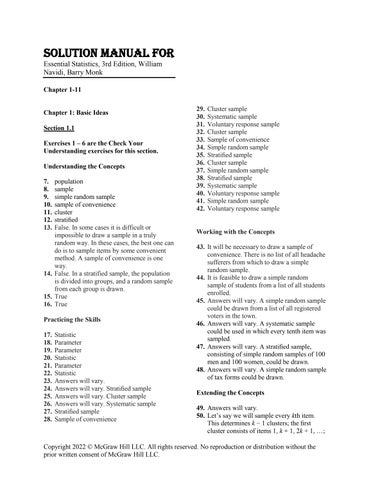
Solution Manual For Essential Statistics, 3rd Edition, William Navidi, Barry Monk Chapter 1-11
Chapter 1: Basic Ideas Section 1.1 Exercises 1 – 6 are the Check Your Understanding exercises for this section. Understanding the Concepts 7. population 8. sample 9. simple random sample 10. sample of convenience 11. cluster 12. stratified 13. False. In some cases it is difficult or impossible to draw a sample in a truly random way. In these cases, the best one can do is to sample items by some convenient method. A sample of convenience is one way. 14. False. In a stratified sample, the population is divided into groups, and a random sample from each group is drawn. 15. True 16. True Practicing the Skills 17. Statistic 18. Parameter 19. Parameter 20. Statistic 21. Parameter 22. Statistic 23. Answers will vary. 24. Answers will vary. Stratified sample 25. Answers will vary. Cluster sample 26. Answers will vary. Systematic sample 27. Stratified sample 28. Sample of convenience
29. Cluster sample 30. Systematic sample 31. Voluntary response sample 32. Cluster sample 33. Sample of convenience 34. Simple random sample 35. Stratified sample 36. Cluster sample 37. Simple random sample 38. Stratified sample 39. Systematic sample 40. Voluntary response sample 41. Simple random sample 42. Voluntary response sample
Working with the Concepts 43. It will be necessary to draw a sample of convenience. There is no list of all headache sufferers from which to draw a simple random sample. 44. It is feasible to draw a simple random sample of students from a list of all students enrolled. 45. Answers will vary. A simple random sample could be drawn from a list of all registered voters in the town. 46. Answers will vary. A systematic sample could be used in which every tenth item was sampled. 47. Answers will vary. A stratified sample, consisting of simple random samples of 100 men and 100 women, could be drawn. 48. Answers will vary. A simple random sample of tax forms could be drawn. Extending the Concepts 49. Answers will vary. 50. Let‘s say we will sample every kth item. This determines k − 1 clusters; the first cluster consists of items 1, k + 1, 2k + 1, …;
Copyright 2022 © McGraw Hill LLC. All rights reserved. No reproduction or distribution without the prior written consent of McGraw Hill LLC.
the second cluster consists of items 2, k + 2, 2k + 2, …; and so on. Choosing a systematic sample is like choosing one of these clusters at random. Section 1.2 Exercises 1 – 5 are the Check Your Understanding exercises for this section.
41. Discrete 42. Continuous 43. Interval 44. Ratio 45. Ratio 46. Interval 47. Interval 48. Ratio 49. Interval 50. Ratio
Understanding the Concepts 6. variables 7. data 8. qualitative 9. Quantitative 10. nominal; ordinal 11. discrete 12. Continuous 13. False. Quantitative variables describe how much or how many of something there is. 14. True 15. True 16. True Practicing the Skills 17. Qualitative 18. Quantitative 19. Quantitative 20. Qualitative 21. Quantitative 22. Quantitative 23. Qualitative 24. Qualitative 25. Qualitative 26. Quantitative 27. Ordinal 28. Nominal 29. Ordinal 30. Ordinal 31. Nominal 32. Nominal 33. Nominal 34. Ordinal 35. Continuous 36. Continuous 37. Discrete 38. Discrete 39. Continuous 40. Discrete
Working with the Concepts 51. Ordinal; Qualitative 52. Discrete; Quantitative 53. Ordinal 54. Quantitative 55. Nominal 56. Ordinal 57. (A) Game Title, Developer (B) Initial Release Year, Copies Sold (C) Developer (D) Game Title 58. (A) Movie Title, Studio (B) Release Year, Ticket Sales, Running Time (C) Studio (D) Movie Title Extending the Concepts 59. (A) Ordinal (B) Yes, it reflects a more favorable opinion of the construction of a new shopping mall. (C) No, we cannot say that Jason‘s opinion is twice as favorable. (D) Quantitative (E) Yes, Brenda‘s answer reflects the ownership of more cars, and specifically, the ownership of twice as many cars. (F) Nominal (G) No, Brenda‘s answer reflects neither more of something nor twice as much of something.
Section 1.3
Copyright 2022 © McGraw Hill LLC. All rights reserved. No reproduction or distribution without the prior written consent of McGraw Hill LLC.
Exercises 1 – 4 are the Check Your Understanding exercises for this section. Understanding the Concepts 5. randomized 6. double-blind 7. observational 8. confounder 9. prospective 10. cohort 11. True 12. False. A confounder makes it harder to draw conclusions from a study. 13. False. In a randomized experiment, subjects are assigned to treatment groups at random. 14. False. Randomized experiments are generally more reliable than observational studies. 15. True 16. True Practicing the Skills 17. (A) Randomized experiment (B) Yes, because the assignment to treatments is made at random, there is no systematic difference between the groups other than the drug taken that can explain the difference in pain relief. 18. (A) Observational study (B) No, because this is an observational study, the results may be due to confounding. For example, those in the low-exercise group may be older and have higher blood pressure as a result of age. 19. (A) Randomized experiment (B) Yes, because the assignment to treatments is made at random, there is no systematic difference between the groups other than the amount of exercise that can explain the difference in blood pressure.20. (A) The four types of fertilizer (B ) Randomized experiment (C) Yes, because the assignment to treatment is made at random. Working with the Concepts
21. An observational study will be necessary, because one can‘t assign people to live in areas with high pollution levels. 22. A randomized experiment is possible, with cold sufferers being assigned randomly to the old or new drug. 23. The result may be due to confounding. Areas with denser populations may have both more crime and more taxicabs. 24. The result could be due to confounding. For example, more older people may live in larger houses than younger people, and also have less chance of recovering from a heart attack. 25. (A) False (B) True 26. Children with larger vocabularies tend to be older, and thus taller. 27. (A) Heart rate (B) Maternal smoking (C) Cohort (D) Prospective (E) Yes. The level of prenatal care may differ between smoking and nonsmoking mothers. 28. (A) Whether respiratory problems were experienced (B) The level of formaldehyde in the classroom (C) A cohort study (D) Cross-sectional (E) It is unlikely. For confounding to be an issue, children with more sensitive respiratory systems would have to have been more likely to be assigned to classrooms with higher exposure. Extending the Concepts 29. (A) Yes, because the subjects were randomly assigned to treatment. (B) If a doctor knew whether a child had received the vaccine, it might influence the diagnosis. (C) It could be due to confounding. The children who received the placebo were more likely to be middle- or upperincome than those who did not participate, and this may be the reason that the rate of polio was higher.
Copyright 2022 © McGraw Hill LLC. All rights reserved. No reproduction or distribution without the prior written consent of McGraw Hill LLC.
30. (A) No (B) No (C) The treatment group consisted of children who had consent to participate; middle- and upper-income children were overrepresented in this group. Therefore, the children in the treatment group tended to be more susceptible to polio than those in the control group. 31. Smokers who quit are less healthy than smokers who don‘t. Upon quitting smoking, many people put on weight substituting food for tobacco. 32. Smokers tend to drink more alcohol on the average than non-smokers.
Section 1.4 Exercises 1 and 2 are the Check Your Understanding exercises for this section.
(B) No. Both questions are leading. The first question leads to a ‗‗yes‘‘ response, and the second leads to a ‗‗no‘‘ response. 18. Yes. People may be less likely to answer the phone when they don‘t recognize the number that is calling them. 19. Yes. People who do not have landline phones may tend to have different opinions on some issues than people who do have landline phones. 20. Yes, people may be more likely to pick the first choice. Extending the Concepts 21. (A) The poll oversampled higher-income people. (B) The response rate was low — only 23%. This results in nonresponse bias. (C) A sample that is not drawn by a valid method can produce misleading results, even when it is large.
Understanding the Concepts 3. 4. 5. 6.
Voluntary response surveys nonresponders population False. The way that a question is worded in a survey may have a large effect on the responses. 7. True 8. False. A large sample size does not make up for bias in questioning. Practicing the Skills 9. Nonresponse bias 10. Voluntary response bias 11. Self-interest bias 12. Self-interest bias 13. Voluntary response bias 14. Social acceptability bias 15. Nonresponse bias 16. Social acceptability bias
CHAPTER 1 Quiz 1. 2. 3. 4. 5.
Answers will vary. Qualitative True Continuous False. Ideally a sample should represent the population as much as possible. 6. Stratified sample 7. acceptable 8. Sample of convenience 9. True 10. Observational study 11. Randomized experiment 12. differences in treatment 13. Seniors may be more likely to have better preparation for the class than sophomores. 14. True 15. Not reliable. This is a voluntary response survey, so the people who respond tend to hold stronger opinions than others.
Working with the Concepts 17. (A) No
CHAPTER 1 Review Exercises 1. Quantitative
Copyright 2022 © McGraw Hill LLC. All rights reserved. No reproduction or distribution without the prior written consent of McGraw Hill LLC.
2. Nominal 3. Continuous 4. (A) True (B) True (C) False 5. Stratified sample 6. Voluntary response sample 7. Cluster sample 8. Simple random sample 9. (A) Observational study (B) Yes. People who live in areas with fluoridated water may have different dental habits than those who live in areas without fluoridated water. 10. (A) Randomized experiment (B) Because this is a randomized experiment, the results are unlikely to be due to confounding. 11. (A) Observational study (B) Yes. People who use the phone while driving may be more careless in general than those who do not. 12. (A) Randomized experiment (B) Because this is a randomized experiment, the results are unlikely to be due to confounding. 13. The sample is a voluntary response sample. 14. Nonresponse bias; living people are not included. People who are still alive are not included in the sample. 15. There is a considerable level of nonresponse bias.
Write About It 1. In both cluster sampling and stratified sampling, the population is divided into groups. In stratified sampling, a simple random sample is chosen from each group. In cluster sampling, a random sample of groups is chosen, and every member of the chosen groups is sampled. 2. A potential problem with samples of convenience is that they may differ systematically in some way from the population. For this reason, samples of convenience should not be used, except in situations where it is not feasible to draw a random sample. When it is necessary to draw a sample of convenience, it is
important to think carefully about all the ways in which the sample might differ systematically from the population. If it is reasonable to believe that no important systematic difference exists, then it may be acceptable to use a sample of convenience. 3. Answer will vary. 4. Answers will vary. 5. Some qualitative variables may be numeric when the number represents a label. Examples include numbers on a football jersey or on a racecar. 6. A randomized experiment is a study in which the investigator assigns the treatments to the experimental units at random. An observational study is one in which the assignment to treatment groups is not made by the investigator. The main advantage to conducting a randomized experiment is that if there are large differences in outcomes among the treatment groups, we may conclude that the differences are due to the treatments. 7. The main advantage to conducting a doubleblind study is that it is an impartial experiment which eliminates the potential for bias from the investigator or the subject. There are various limitations. A doubleblind experiment requires a third party to be involved in the experiment. Also, there may be factors that may influence the outcome that are not known when the experiment is double-blinded. 8. Answers will vary. 9. (A) This is an example of leading question bias. It highly encourages a ―yes‖ response because of the phrase ―or continue their wasteful spending.‖ A more appropriate question would be ―What is your opinion of Americans saving more money? Choices: Strongly disagree, Somewhat disagree, Neither agree nor disagree, Somewhat agree, Strongly agree.‘‘ (B) This is an example of leading question bias. It highly encourages a ―yes‖ response because of the word ―reputable.‖ A more appropriate question would be ―What is your opinion of the current level of funding for charities?‖
Copyright 2022 © McGraw Hill LLC. All rights reserved. No reproduction or distribution without the prior written consent of McGraw Hill LLC.