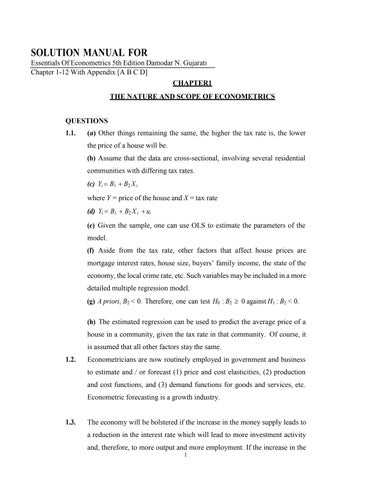
SOLUTION MANUAL FOR Essentials Of Econometrics 5th Edition Damodar N. Gujarati Chapter 1-12 With Appendix [A B C D] CHAPTER1 THE NATURE AND SCOPE OF ECONOMETRICS QUESTIONS 1.1.
(a) Other things remaining the same, the higher the tax rate is, the lower the price of a house will be. (b) Assume that the data are cross-sectional, involving several residential communities with differing tax rates. (c) Yi B1 B2 X i where Y = price of the house and X = tax rate (d) Yi B1 B2 X i ui (e) Given the sample, one can use OLS to estimate the parameters of the model. (f) Aside from the tax rate, other factors that affect house prices are mortgage interest rates, house size, buyers’ family income, the state of the economy, the local crime rate, etc. Such variables may be included in a more detailed multiple regression model. (g) A priori, B2 < 0. Therefore, one can test H0 : B2 0 against H1 : B2 < 0. (h) The estimated regression can be used to predict the average price of a house in a community, given the tax rate in that community. Of course, it is assumed that all other factors stay the same.
1.2.
Econometricians are now routinely employed in government and business to estimate and / or forecast (1) price and cost elasticities, (2) production and cost functions, and (3) demand functions for goods and services, etc. Econometric forecasting is a growth industry.
1.3.
The economy will be bolstered if the increase in the money supply leads to a reduction in the interest rate which will lead to more investment activity and, therefore, to more output and more employment. If the increase in the 1
money supply, however, leads to inflation, the preceding result may not occur. The job of the econometrician will be to develop a model to predict the effect of the increase in the money supply on inflation, interest rate, employment, etc. Sure! I’ll expand on the topics related to "Taxation of Business Entities," providing a more detailed exploration. This overview will cover fundamental concepts, applications, and implications relevant to the study of business taxation.---### Overview of Business Entities#### 1. Types of Business EntitiesBusiness entities can be categorized based on ownership structure and tax treatment. Understanding these types is crucial for determining tax obligations and benefits.- **Sole Proprietorships**:
- Owned by a single
individual, this is the simplest form of business entity. Income is reported on the owner’s personal tax return (Form 1040, Schedule C), which simplifies tax filing but also means personal liability for debts and obligations.- **Partnerships**: - Consisting of two or more individuals, partnerships do not pay federal income taxes. Instead, they are considered pass-through entities, meaning income is taxed at the partners' individual rates. Form 1065 is used to report partnership income, while partners receive Schedule K-1 to report their share on their returns.- **Corporations**: - Corporations are separate legal entities that provide limited liability protection to their owners (shareholders). C-Corporations face double taxation: once at the corporate level on profits and again at the individual level when dividends are distributed. S-Corporations, on the other hand, are pass-through entities but have restrictions on ownership and number of shareholders.- **Limited Liability Companies (LLCs)**:
- LLCs combine the flexibility of partnerships with the liability
protection of corporations. An LLC can choose to be taxed as a sole proprietorship, partnership, or corporation, allowing for strategic tax planning. ### 2. Tax Implications of Each Entity TypeUnderstanding the tax implications of each entity type is critical for effective business planning.- **Sole Proprietorships**: - Income is taxed at the owner’s individual tax rate. All profits and losses are reported on the owner’s tax return. This simplicity, however, can expose owners to significant personal risk.- **Partnerships**: - Each partner reports their share of income and losses on their personal returns, allowing for loss deductions. Partners are also subject to self-employment taxes on their share of the income, which can significantly impact tax liability.- **Corporations**: - C-Corporations are taxed at the corporate tax rate (currently 21%). Dividends are taxed again at the shareholder level. S-Corporations avoid double taxation, but there are restrictions on the number and type of shareholders.- **Limited Liability Companies (LLCs)**: - By default, singlemember LLCs are treated as sole proprietorships for tax purposes, while multi-member LLCs are treated as partnerships. However, they can elect to be taxed as a corporation if beneficial.### Key Tax Concepts#### 1. Income RecognitionIncome recognition is a fundamental principle in taxation, determining when income must be reported.- **Cash vs. Accrual Accounting**:
- Businesses can choose between cash and accrual methods. Cash accounting recognizes income when received and expenses when paid, making it
straightforward. Accrual accounting recognizes income when earned and expenses when incurred, aligning revenue with the period it relates to, but can complicate cash flow management.#### 2. DeductionsDeductions reduce taxable income, directly impacting tax liability.- **Ordinary and Necessary Expenses**:
- The IRS allows deductions for
expenses that are ordinary (common in the industry) and necessary (helpful and appropriate for the business). Common deductions include rent, utilities, salaries, and professional fees.- **Limits on Deductions**: - Certain expenses, such as meals and entertainment, have specific limits (e.g., meals are typically only 50% deductible). Understanding these limits is vital for effective tax planning.#### 3. Tax CreditsTax credits directly reduce the tax liability, providing a dollar-for-dollar reduction of taxes owed.- **Types of Tax Credits**:
- Examples include the Research and Development (R&D) tax credit, which encourages innovation, and the Work Opportunity Tax Credit (WOTC) for hiring
individuals from certain target groups.### Specific Business Entity Taxation####
1.4.
As a matter of fact, on October 1, 1993 the Federal Government did increase the gasoline tax by 4 cents. Since gasoline and cars are complementary products, economic theory suggests that an increase in the price of gasoline will not only lead to a decline in the demand for gasoline but also in the demand for cars, ceteris paribus. The Ford Motor Companymay be advised to produce more fuel-efficient cars to stave off a serious decline in the demand for its cars. An automobile demand function will provide numerical estimates of the effect of gasoline tax on the demandfor automobiles.
1.5. There are many alternative designs possible. However, to keep things simple, and discuss just a basic idea of the design, we could think of using an econometric model known as Autoregressive Distributed Lag (ARDL) of the form: y y t
g g t 1
0
t
1
p p c c u t 1
0
t
where Yt Yt 1 = real GDP growth rate in year t; yt Yt 1 2
1
t 1
0
t
1
t 1
t
Expected signs and magnitudes of the parameters the regression model:
real government infrastructure investment growth rate in t
year t;
th rate in year t; t;p t t t t 0 1; 0,1 0;
0 , 1 , 0 , 1 0. Note that a more realistic model would include a larger number of lags of the regressors than included in our model, and would also include additional regressors known as control variables which could be determined based on economic theory. Now, based on our specified model above,p short runcand long run economic consequence of 1 unit increase in g , , and , respectively, can be t
t
determined by using partial derivatives as follows. 3
t
Short run economic consequences of a 1 unit increase in gt are given by: yt 0; gt yt 1 (yt 1gt ) 0 1 ; gt gt yt 2 (yt 1) ( 0 1 ); gt gt yt 3 (yt 2 ) (yt 2 ) 2 ( 0 1 ); gt gt gt and so on.
Long run consequence is the sum of short run consequences 0 ( 0 )1 ( 0 )1 2 ( 0 )1 ... 0 0 1 2 0 1 3 0 2 1 ...
0 (1 2 3 ...) 1(1 2 ...) 0 1 1 1 0 1. 1 Analogously, short run economic consequences of a 1 unit increase in tp are given by: yt 0; tp (y p ) y t 1 t 1 t 0 1; p p t t
Sure! I’ll expand on the topics related to "Taxation of Business Entities," providing a more detailed exploration. This overview will cover fundamental concepts, applications, and implications relevant to the study of business taxation.---### Overview of Business Entities#### 1. Types of Business EntitiesBusiness entities can be categorized based on ownership structure and tax treatment. Understanding these types is crucial for determining tax obligations and benefits.- **Sole Proprietorships**: - Owned by a single individual, this is the simplest form of business entity. Income is reported on the owner’s personal tax return (Form 1040, Schedule C), which simplifies tax filing but also means personal liability for debts and obligations.- **Partnerships**: - Consisting of two or more individuals, partnerships do not pay federal income taxes. Instead, they are considered pass-through entities, meaning income is taxed at the partners' individual rates. Form 1065 is used to report partnership income, while partners receive Schedule K-1 to report their share on their returns.- **Corporations**: - Corporations are separate legal entities that provide limited liability protection to their owners (shareholders). C-Corporations face double taxation: once at the corporate level on profits and again at the individual level when dividends are distributed. S-Corporations, on the other hand, are pass-through entities but have restrictions on ownership and number of shareholders.- **Limited Liability Companies (LLCs)**: - LLCs combine the flexibility of partnerships with the liability protection of corporations. An LLC can choose to be taxed as a sole proprietorship, partnership, or corporation, allowing for strategic tax planning. ### 2. Tax Implications of Each Entity TypeUnderstanding the tax implications of each entity type is critical for effective business planning.- **Sole Proprietorships**: Income is taxed at the owner’s individual tax rate. All profits and losses are reported on the owner’s tax return. This simplicity, however, can expose owners to significant personal risk.- **Partnerships**: - Each partner reports their share of income and losses on their personal returns, allowing for loss deductions. Partners are also subject to self-employment taxes on their share of the income, which can significantly impact tax liability.- **Corporations**: - C-Corporations are taxed at the corporate tax rate (currently 21%). Dividends are taxed again at the shareholder level. S-Corporations avoid double taxation, but there are restrictions on the number and type of shareholders.- **Limited Liability Companies (LLCs)**: - By default, single-member LLCs are treated as sole proprietorships for tax purposes, while multi-member LLCs are treated as partnerships. However, they can elect to be taxed as a corporation if beneficial.### Key Tax Concepts#### 1. Income RecognitionIncome recognition is a fundamental principle in taxation, determining when income must be reported.- **Cash vs. Accrual Accounting**: - Businesses can choose between cash and accrual methods. Cash accounting recognizes income when received and expenses when paid, making it straightforward. Accrual accounting recognizes income when earned and expenses when incurred, aligning revenue with the period it relates to, but can complicate cash flow management.#### 2. DeductionsDeductions reduce taxable income, directly impacting tax liability.- **Ordinary and Necessary Expenses**: - The IRS allows deductions for expenses that are ordinary (common in the industry) and necessary (helpful and appropriate for the business). Common deductions include rent, utilities, salaries, and professional fees.- **Limits on Deductions**: - Certain expenses, such as meals and entertainment, have specific limits (e.g., meals are typically only 50% deductible). Understanding these limits is vital for effective tax planning.#### 3. Tax CreditsTax credits directly reduce the tax liability, providing a dollar-for-dollar reduction of taxes owed.- **Types of Tax Credits**: - Examples include the Research and Development (R&D) tax credit, which encourages innovation, and the Work Opportunity Tax Credit (WOTC) for hiring individuals from certain target groups.### Specific Business Entity Taxation####
4
yt 2 (yt 1) ( 0 1 ); p p t t yt 3 (yt 2 ) (yt 2 ) 2 ( 1 ); p 0 t p t tp and so on.
Long run consequence is the sum of short run consequences 0 ( 0 )1 ( 0 )1 2 ( 0 )1 ... 0 0 1 2 0 1 3 0 2 1 ... 0(1 2 3 ...) (1 2 ...) 1
0 1 1 1 0 1. 1 Short run economic consequences of a 1 unit increase in ct are given by:
yt 0 ; ct (y c ) y t 1 t 1 t 0 1; c c t t yt 2 (yt 1) ( 0 1 ); c c t t (yt 2 ) 2 ( 1 ); yt 3 (yt 2 ) c c 0 t t ct and so on.
Long run consequence is the sum of short run consequences 0 ( 0 )1 ( 0 )1 2 ( 0 )1 ... 0 0 1 2 0 1 3 0 2 1 ... 0 (1 2 3 ...) 1(1 2 ...)
0 1 1 1 0 1. 1
5