To print these pages, be sure to choose "Document and Markups" in the Acrobat dialog. Name ___________________________________________________
Chapter 1 Investigation Worksheet
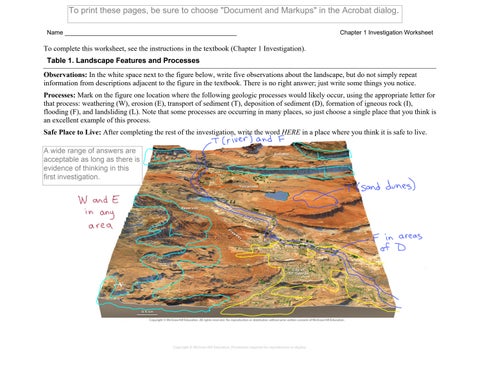
To complete this worksheet, see the instructions in the textbook (Chapter 1 Investigation). Table 1. Landscape Features and Processes Observations: In the white space next to the figure below, write five observations about the landscape, but do not simply repeat information from descriptions adjacent to the figure in the textbook. There is no right answer; just write some things you notice. Processes: Mark on the figure one location where the following geologic processes would likely occur, using the appropriate letter for that process: weathering (W), erosion (E), transport of sediment (T), deposition of sediment (D), formation of igneous rock (I), flooding (F), and landsliding (L). Note that some processes are occurring in many places, so just choose a single place that you think is an excellent example of this process. Safe Place to Live: After completing the rest of the investigation, write the word HERE in a place where you think it is safe to live. A wide range of answers are acceptable as long as there is evidence of thinking in this first investigation.
Copyright © McGraw‐Hill Education. Permission required for reproduction or display.
Chapter 1 Investigation Worksheet; page 2
Table 2. Ways that Geology Might Influence the Lives of the People In this Region Propose one or more ways that each landscape feature or aspect might influence people. The bottom two rows in the table are for other features or aspects that you might recognize but that are not listed. Name of Feature Proposed Influence of this Feature or Process Dry climate
Limits agriculture, drinking water scarcity
Steep cliffs in mountain range
Not suitable for building sites or farming, danger from landslides
Rainfall in mountain range
Source of water, potential for flooding, erosion produces sediment
Hot springs
Recreation, possible source of energy, such as heating houses
Volcanoes
Potential hazard, influences type of soil, possible building materials
Hurricane Cliffs
Potential for landslides, source of building materials
Hurricane fault
Potential for earthquakes, possibly controls groundwater (springs)
Oil field
Source of energy and pollution
Main river
Source of water, good soils for farming, possible transportation, potential for flooding
Other: Other:
Copyright © McGraw‐Hill Education. Permission required for reproduction or display.
Name ________________________________________________
Chapter 2 Investigation Worksheet
To complete this worksheet, see the instructions in the textbook (Chapter 2 Investigation). Table 1. Observations and Questions About Upheaval Dome In the empty space around this figure, write at least three short observations about this landscape. Next, use both the stratigraphic section and the cross section from the Investigation (Chapter 2) to determine the order in which these layers formed. The units are labeled A through G in these figures. Write your answers to the right of this figure. Order in which the rock units formed (oldest at bottom, youngest at top)
A _______ Youngest B
_______
C
_______
D
_______
E
_______
F
_______
G
_______ Oldest
In the space below, record two questions you might ask about how this landscape came to look like it does.
How did circular feature form? Why are there cliffs and valleys? What types of rocks are present? How are Question 1: _________________________________________________________________________________________________ the rock layers oriented? What sequence of geologic events occurred here? Question 2: _________________________________________________________________________________________________
Copyright © McGraw-Hill Education. Permission required for reproduction or display.
Chapter 2 Investigation Worksheet; page 2
Table 2. Testing Explanations for the Origin of Upheaval Dome For each of the three possible explanations for the origin of Upheaval Dome, (1) draw a sketch that illustrates the type of rocks you might find at depth, and (2) list a prediction for each explanation, and explain how you might test that prediction. Next, list additional information you might need to investigate the origin of Upheaval Dome. Explanation 1: Explanation 2: Explanation 3: Dome warped by rising mass of salt Dome is the result of rising magma Dome formed by meteoroid impact Sketch Sketch Sketch
Prediction and test of prediction:
Prediction and test of prediction:
Prediction and test of prediction:
Salt would be present beneath dome; could be tested by observing outcrops or by drilling.
Igneous rocks would be present at depth; could look for igneous rocks or evidence of baking (heating) by magma.
Fragments of meteorites might be within dome or on surrounding areas; could look for pieces of meteorites or minerals formed by high pressures.
Additional information needed to explain origin:
Copyright © McGraw-Hill Education. Permission required for reproduction or display.
Name _______________________________
Chapter 2 Investigation Worksheet; page 3
Reference Page (you can print out this page for reference, but you will not turn it in)
Copyright © McGraw-Hill Education. Permission required for reproduction or display.