Scott, Financial Accounting Theory, 6th Edition Instructor’s Manual
Chapter 2
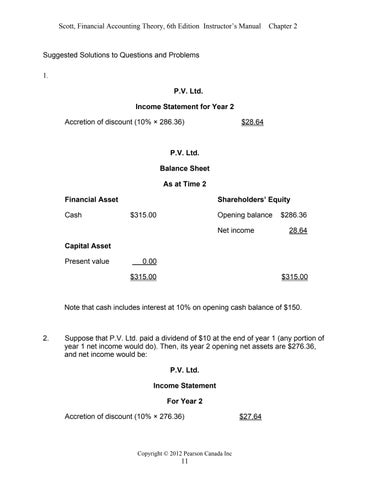
Suggested Solutions to Questions and Problems 1. P.V. Ltd. Income Statement for Year 2 Accretion of discount (10% × 286.36)
$28.64
P.V. Ltd. Balance Sheet As at Time 2 Financial Asset Cash
Shareholders’ Equity $315.00
Opening balance Net income
$286.36 28.64
Capital Asset Present value
0.00 $315.00
$315.00
Note that cash includes interest at 10% on opening cash balance of $150.
2.
Suppose that P.V. Ltd. paid a dividend of $10 at the end of year 1 (any portion of year 1 net income would do). Then, its year 2 opening net assets are $276.36, and net income would be: P.V. Ltd. Income Statement For Year 2 Accretion of discount (10% × 276.36)
Copyright © 2012 Pearson Canada Inc
11
$27.64
Scott, Financial Accounting Theory, 6th Edition Instructor’s Manual
Chapter 2
P.V.’s balance sheet at time 2 would be: P.V. Ltd. Balance Sheet As at Time 2 Financial Asset
Shareholders’ Equity
Cash: (140 + 14 + 150)
$304.00
Opening balance:
$276.36
(286.36 - 10.00 dividend) Capital Asset, at Present value
Net income
27.64
0.00 $304.00
$304.00
Thus, at time 2 the shareholders have: Cash from dividend
$10.00
Interest at 10% on cash dividend, for year 2 Value of firm per balance sheet
1.00 304.00
$315.00
This is the same value as that of the firm at time 2, assuming P.V. Ltd. paid no dividends (see Question 1). Consequently, the firm’s dividend policy does not matter to the shareholders under ideal conditions. It may be worth noting that a crucial requirement here, following from ideal conditions, is that the investors and the firm both earn interest on financial assets at the same rate. 3.
Year 1 At time 0, you know that if the bad economy state is realized, ex post net income for year 1 will be a loss of $23.97. If the good economy state is realized, ex post net income will be $76.03. Since the probability of each state is 0.50, expected net income for year 1, evaluated at time 0, is: Copyright © 2012 Pearson Canada Inc
12
Scott, Financial Accounting Theory, 6th Edition Instructor’s Manual
Chapter 2
0.50 (-23.97) + 0.50 (76.03) = -11.98 + 38.01 = $26.03. This agrees with the direct calculation of accretion of discount for year 1 in Example 2.2. Year 2 Assume that you are at time 1, after the state realization for year 1 has been observed. Suppose the year 1 state realization is bad economy. Then expected net income for year 2 is accretion of discount on opening net asset value of $236.36: 236.36 × .10 = 23.64 Note that this amount includes $10 interest on opening cash balance of $100. Now suppose the state realization for year 1 is good economy. Expected net income for year 2 then is: 336.36 × .10 = 33.64, including interest income of $20 on opening cash balance. Thus expected net income for year 2 is $23.64 or $33.64, depending on which state is realized in period 1. The above assumes the year 2 expected net income is calculated after year 1 state realization is observed. The question could also be interpreted as asking for expected year 2 net income before the state realization is observed at time 1. Then, expected year 2 net income would be, at time 1: 0.50 (23.64) + 0.50 (33.64) = 11.82 + 16.82 Copyright © 2012 Pearson Canada Inc
13
Scott, Financial Accounting Theory, 6th Edition Instructor’s Manual
Chapter 2
= $28.64 Expected net income is also called accretion of discount because the firm’s expected future cash flows are one year closer at year end than at the beginning. Consequently, the opening firm value is rolled forward or “accreted” at the 10% discount rate used in the present value calculations. Note: further discussion of accretion of discount would bring out: The amount of accretion of discount is driven by the principle of arbitrage, and risk-neutral valuation. Under these conditions, the market will force a beginning of year valuation of the firm such that the expected net income is 10% of this value. To illustrate, the present value of the firm at time 0 is $260.33 and expected net income is $26.03 for year 1. Similarly, the present value of the firm at time 1 is $236.36 or $336.36 depending on state realization, and expected net income for year 2 is $23.64 or $33.64. In each case the market expects the firm to earn 10% on opening value. This 10% of opening value is accretion of discount.
Copyright © 2012 Pearson Canada Inc
14
Scott, Financial Accounting Theory, 6th Edition Instructor’s Manual
4.
Chapter 2
The procedure here is similar to that used in Question 2. Assume that the good economy state is realized for year 1. Assume also that P.V. Ltd. pays a dividend of, say, $40 at time 1. If the good economy state is also realized in year 2, P.V.’s year 2 net income will then be: P.V. Ltd. Income Statement For Year 2 (good economy in year 2) Accretion of discount [(336.36 – 40) ×.10]
29.64
Abnormal earnings, as a result of good state realization in year 2 (200 – 150)
50.00
Net income year 2
$79.64
PV’s balance sheet at the end of year 2 will then be: P.V. Ltd. Balance Sheet As at Time 2 Financial Asset
Shareholders’ Equity
Cash (200 - 40 + 200 + 16)
$376.00
Opening balance
$336.36
Less: Dividend end Capital Asset
0.00
of year 1
40.00 $296.36
Add: Net income $376.00
Copyright © 2012 Pearson Canada Inc
15
79.64 $376.00