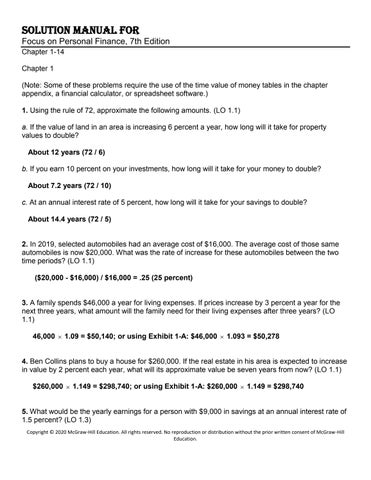
Solution Manual for Focus on Personal Finance, 7th Edition Chapter 1-14 Chapter 1 (Note: Some of these problems require the use of the time value of money tables in the chapter appendix, a financial calculator, or spreadsheet software.) 1. Using the rule of 72, approximate the following amounts. (LO 1.1) a. If the value of land in an area is increasing 6 percent a year, how long will it take for property values to double? About 12 years (72 / 6) b. If you earn 10 percent on your investments, how long will it take for your money to double? About 7.2 years (72 / 10) c. At an annual interest rate of 5 percent, how long will it take for your savings to double? About 14.4 years (72 / 5)
2. In 2019, selected automobiles had an average cost of $16,000. The average cost of those same automobiles is now $20,000. What was the rate of increase for these automobiles between the two time periods? (LO 1.1) ($20,000 - $16,000) / $16,000 = .25 (25 percent)
3. A family spends $46,000 a year for living expenses. If prices increase by 3 percent a year for the next three years, what amount will the family need for their living expenses after three years? (LO 1.1) 46,000 1.09 = $50,140; or using Exhibit 1-A: $46,000 1.093 = $50,278
4. Ben Collins plans to buy a house for $260,000. If the real estate in his area is expected to increase in value by 2 percent each year, what will its approximate value be seven years from now? (LO 1.1) $260,000 1.149 = $298,740; or using Exhibit 1-A: $260,000 1.149 = $298,740
5. What would be the yearly earnings for a person with $9,000 in savings at an annual interest rate of 1.5 percent? (LO 1.3) Copyright © 2020 McGraw-Hill Education. All rights reserved. No reproduction or distribution without the prior written consent of McGraw-Hill Education.
$9,000 0.015 = $135 6. Using time value of money tables (Exhibit 1–3 or chapter appendix tables), calculate the following. (LO 1.3) a. The future value of $550 six years from now at 7 percent. $550 1.501 = $825.55 (Exhibit 1-A) b. The future value of $900 saved each year for 10 years at 8 percent. $900 14.487 = $13,038.30 (Exhibit 1-B) c. The amount a person would have to deposit today (present value) at a 5 percent interest rate to have $1,000 five years from now. $1,000 0.784 = $784 (Exhibit 1-C) d. The amount a person would have to deposit today to be able to take out $500 a year for 10 years from an account earning 8 percent. $500 6.710 = $3,355 (Exhibit 1-D) 7. If you desire to have $12,000 for a down payment for a house in five years, what amount would you need to deposit today? Assume that your money will earn 4 percent. (LO 1.3) $12,000 0.822 = $9,864 (Exhibit 1-C)
8. Pete Morton is planning to go to graduate school in a program of study that will take three years. Pete wants to have $8,000 available each year for various school and living expenses. If he earns 3 percent on his money, how much must he deposit at the start of his studies to be able to withdraw $8,000 a year for three years? (LO 1.3) $8,000 2.829 = $22,632 (Exhibit 1-D)
9. Carla Lopez deposits $2,800 a year into her retirement account. If these funds have an average earning of 7 percent over the 40 years until her retirement, what will be the value of her retirement account? (LO 1.3) $2,800 199.635 = $558,978 (Exhibit 1-B)
10. If a person spends $10 a week on coffee (assume $500 a year), what would be the future value of that amount over 10 years if the funds were deposited in an account earning 3 percent? (LO 1.3) $500 11.464 = $5,732 (Exhibit 1-B) Copyright © 2020 McGraw-Hill Education. All rights reserved. No reproduction or distribution without the prior written consent of McGraw-Hill Education.
11. A financial company that advertises on television will pay you $60,000 now for annual payments of $10,000 that you are expected to receive for a legal settlement over the next 10 years. If you estimate the time value of money at 10 percent, would you accept this offer? (LO 1.3) The present value of the annual payment is calculated as: $10,000 X 6.145 = $61,450 The $60,000 being offered now is less than the present value of the future flow.
12. Tran Lee plans to set aside $2,600 a year for the next seven years, earning 3 percent. What would be the future value of this savings amount? (LO 1.3) $2,600 X 7.662 = (future value of a series) = $19,921.20 (Exhibit 1-B)
13. If you borrow $8,000 with a 5 percent interest rate to be repaid in five equal payments at the end of the next five years, what would be the amount of each payment? (Note: Use the present value of an annuity table in the chapter appendix.) (LO 1.3) $8,000 / 4.329 = $1,848
(Note: Some of these problems require the use of the time value of money tables in the Chapter 1 Appendix, a financial calculator, or spreadsheet software.)
Problems Chapter 2 - SOLUTIONS 1. Based on the following data, determine the amount of total assets, total liabilities, and net worth. (LO 2.2) Liquid assets, $3,870 Investment assets, $8,340 Current liabilities, $2,670 Household assets, $87,890 Long-term liabilities, $76,230 a. Total assets $________________ b. Total liabilities $______________ c. Net worth $__________________ Total assets = $100,100 ($3,870 + 8,340 + 87,890) Total liabilities = $78,900 ($2,670 + $76,230) Net worth = $21,200 ($100,100 - $78,900) Copyright © 2020 McGraw-Hill Education. All rights reserved. No reproduction or distribution without the prior written consent of McGraw-Hill Education.
2. Using the following balance sheet items and amounts, calculate the total liquid assets and total current liabilities: (LO 2.2) Money market account $2,600 Medical bills $262 Mortgage $158,000 Checking account $780 Retirement account $87,400 Credit card balance $489 a. Total liquid assets $___________________ b. Total current liabilities $_________________
a. Total liquid assets $3,380 b. Total current liabilities $751
3. Use the following items to determine the total assets, total liabilities, net worth, total cash inflows, and total cash outflows. (LO 2.2) Rent for the month, $650 Spending for food, $345 Savings account balance, $1,890 Current value of automobile, $8,800 Credit card balance, $235 Auto insurance, $230 Video equipment, $2,350 Lunches/parking at work, $180 Personal computer, $1,200 Clothing purchase, $110
Monthly take-home salary, $2,185 Cash in checking account, $450 Balance of educational loan, $2,160 Telephone bill paid for month, $65 Loan payment, $80 Household possessions, $3,400 Payment for electricity, $90 Donations, $160 Value of stock investment, $860 Restaurant spending, $130
a. Total assets $___________________ b. Total liabilities $___________________ c. Net worth $___________________ d. Total cash inflows $___________________ e. Total cash outflows $___________________
Total assets = $18,950 ($450 + 1,890 + 8,800 + 2,350 + 1,200 + 3,400 + 860) Total liabilities = $2,395 ($235 + $2,160) Net worth = $16,555 ($18,950 - $2,395) Total cash inflows = $2,235 Total cash outflows = $2,040 ($650 + 345 + 230 + 180 + 110 + 65 + 80 + 90 + 160 + 130) Copyright © 2020 McGraw-Hill Education. All rights reserved. No reproduction or distribution without the prior written consent of McGraw-Hill Education.
4. For each of the following situations, compute the missing amount. (LO 2.2) a. Assets $65,000; liabilities $18,000; net worth $47,000 b. Assets $86,500; liabilities $67,800 ; net worth $18,700 c. Assets $34,280; liabilities $12,965; net worth $21,315 d. Assets $90,999; liabilities $38,345; net worth $52,654
5. Based on this financial data, calculate the ratios requested: (LO 2.2) Liabilities, $7,800 Liquid assets, $4,600 Monthly credit payments, $640 Monthly savings, $130
Net worth, $58,000 Current liabilities, $1,300 Take-home pay, $2,575 Gross income, $2,850
a. Debt ratio ___________________
b. Current ratio ___________________
c. Debt-payments ratio _______________
d. Savings ratio ___________________
a. Debt ratio 7,800/58,000 = 0.134
b. Current ratio 4,600/1,300 = 3.54
c. Debt-payments ratio 640/2,575 = 0.2485
d. Savings ratio 130/2,850 = 0.046
6. The Fram family has liabilities of $128,000 and a net worth of $340,000. What is the debt ratio? How would you assess this? (LO 2.2) $128,000 / $340,000 = .376 represents a ratio of less than 40 percent, which would need to be assessed in relation to previous trends and the ratio of comparable households.
7. Carl Lester has liquid assets of $2,680 and current liabilities of $2,436. What is his current debt ratio? What comments do you have about this financial position? (LO 2.2) $2,680 / $2,436 = 1.1, which could be viewed as lower than would be desirable. 8. For the following situations, calculate the cash surplus or deficit: (LO 2.2) Cash Inflows $3,460 $4,693 $4,287
Cash Outflows $3,306 $4,803 $4,218
Difference (surplus or deficit) $154 surplus $110 deficit $69 surplus
Copyright © 2020 McGraw-Hill Education. All rights reserved. No reproduction or distribution without the prior written consent of McGraw-Hill Education.