Student Solution Manual Student Solution Manual: Skoog et al., Fundamentals of Analytical Chemistry, 10e, © 2022, 978-0-357-45055-0, Chapter 2: Calculations Used in Analytical Chemistry Some of the answers below may differ in format but have the same value as your result. Please check with your instructor if a specific format is desired.
Chapter 2 2-1.
Define Answers: (a) molar mass. The molar mass is the mass in grams of one mole of a chemical species. (c)
millimolar mass. The millimolar mass is the mass in grams of one millimole of a chemical species.
2-3.
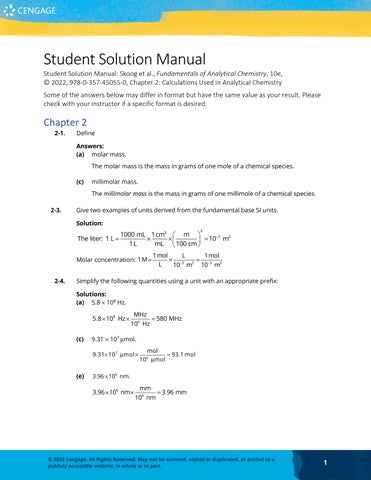
Give two examples of units derived from the fundamental base SI units. Solution: 3
1000 mL 1 cm3 m 3 −3 × × The liter: 1 L = = 10 m 1L mL 100 cm Molar concentration: 1 M = 2-4.
1 mol L 1 mol × −3 3 = −3 3 L 10 m 10 m
Simplify the following quantities using a unit with an appropriate prefix: Solutions: (a) 5.8 × 10⁸ Hz.
5.8 × 10⁸ Hz × (c)
MHz = 580 MHz 106 Hz
9.31 × 10⁷ μmol. 9.31× 10 7 μmol ×
(e)
mol = 93.1 mol 10 μmol 6
3.96 × 10⁶ nm.
3.96 × 10⁶ nm ×
mm = 3.96 mm 106 nm
© 2022 Cengage. All Rights Reserved. May not be scanned, copied or duplicated, or posted to a publicly accessible website, in whole or in part.
1
Student Solution Manual: Skoog et al., Fundamentals of Analytical Chemistry, 10e, © 2022, 978-0-357-45055-0, Chapter 2: Calculations Used in Analytical Chemistry
2-5.
Why is 1 g no longer exactly 1 mole of unified atomic mass units? Answer: The dalton is defined as 1/12 the mass of a neutral 12C atom. With the redefinition of SI base units in 2019, the definition of the dalton remained the same. However, the definition of the mole and the kilogram changed in such a way that the molar mass unit is no longer exactly 1 g/mol.
2-7.
Find the number of Na+ ions in 2.75 g of Na3PO4? Solution: 2.75 g Na3PO4 ×
2-9.
1 mol Na3PO4 3 mol Na+ 6.022 × 10²³ Na+ × × = 3.03 × 10²² Na+ 163.94 g mol Na3PO4 mol Na+
Find the amount of the indicated element (in moles) in Solutions: (a) 5.32 g of B2O3. 5.32 g B2O3 ×
(b)
mol B2O3 2 mol B × = 0.153 mol B mol B2O3 69.62 g B2O3
195.7 mg of Na2B4O7 ⋅ 10H2O. 195.7 mg Na2B4O7 ⋅ 10H2O × ×
(c)
mol Na2B4O7 ⋅ 10H2O = 3.59 × 10⁻³ mol O = 3.59 mmol 381.37 g
4.96 g of Mn3O4. 4.96 g Mn3O4 ×
(d)
mol Mn3O4 3 mol Mn × = 6.50 × 10 −2 mol Mn 228.81 g Mn3O4 mol Mn3O4
333 mg of CaC2O4.
333 mg CaC2O4 × = 5.20 mmol 2-11.
g 7 mol O × 1000 mg mol Na2B4O7 ⋅ 10H2O
mol CaC2O4 g 2 mol C × × = 5.20 × 10⁻³ mol C 1000 mg 128.10 g CaC2O4 mol CaC2O4
Find the number of millimoles of solute in
Solutions: (a) 2.00 L of 0.0449 MKMnO . 4
0.0449 mol KMnO4 1000 mmol × × 2.00 L = 89.8 mmol KMnO4 L mol
© 2022 Cengage. All Rights Reserved. May not be scanned, copied or duplicated, or posted to a publicly accessible website, in whole or in part.
2
Student Solution Manual: Skoog et al., Fundamentals of Analytical Chemistry, 10e, © 2022, 978-0-357-45055-0, Chapter 2: Calculations Used in Analytical Chemistry
(b)
750 mL of 5 .35 × 1023 M KSCN. 5.35 × 10 −3 M KSCN 1000 mmol L × × × 750 mL = 4.01 mmol KSCN L mol 1000 mL
(c)
3.50 L of a solution that contains 6.23 ppm of CuSO4 . 6.23 mg CuSO4 L
(d)
×
mol CuSO4 g 1000 mmol × × × 3.50 L = 0.137 mmol CuSO4 mol 1000 mg 159.61 g CuSO4
250 mL of 0.414 mM KCl.
0.414 mmol KCl 1L × × 250 mL = 0.104 mmol KCl L 1000 mL 2-13.
What is the mass in milligrams of
Solutions: (a) 0.367 mol of HNO3? 0.367 mol HNO3 ×
(b)
245 mmol of MgO? 245 mmol MgO ×
(c)
63.01 g HNO3 1000 mg × = 2.31× 10⁴ mg HNO3 mol HNO3 g
40.30 g MgO 1000 mg mol × × = 9.87 × 10 3 mg MgO 1000 mmol mol MgO g
12.5 mol of NH4NO3 ? 12.5 m ol NH 4 NO 3 ×
(d)
80.04 g NH 4 NO 3 m ol NH 4 NO 3
×
1000 m g = 1.00 × 10 6 m g NH 4 NO 3 g
4.95 mol of (NH4 )2 e (NO3 )6 ( 548.23 g/mol) ? 4.95 mol (NH4 ) 2 Ce(NO 3 )6 ×
548.23 g (NH4 )2 Ce(NO 3 )6 mol (NH4 ) 2 Ce(NO 3 )6
×
1000 mg g
= 2.71× 10 6 mg (NH4 ) 2 Ce(NO 3 )6
2-15.
What is the mass in milligrams of solute in
Solutions: (a) 16.0 mL of 0.350 M sucrose (342 g/mol)? 0.350 mol sucrose L 342 g sucrose 1000 mg × × × L 1000 mL mol sucrose g × 16.0 mL = 1.92 × 10 3 mg sucrose
© 2022 Cengage. All Rights Reserved. May not be scanned, copied or duplicated, or posted to a publicly accessible website, in whole or in part.
3
Student Solution Manual: Skoog et al., Fundamentals of Analytical Chemistry, 10e, © 2022, 978-0-357-45055-0, Chapter 2: Calculations Used in Analytical Chemistry
(b)
1.92 L of 3.76 × 10²³ M H2O2 ? 3.76 × 10 − 3 m ol H 2 O 2 34.02 g H 2 O 2 1000 m g × × × 1.92 L = 246 m g H 2 O 2 L m ol H 2 O 2 g
2-16.
What is the mass in grams of solute in
Solutions: (a) 250 mL of 0.264 M H2O2 ? 0.264 mol H2 O 2 L
(b)
×
34.02 g H2 O 2 L × × 250 mL = 2.25 g H2 O 2 1000 mL mol H2 O 2
37.0 mL of 5.75 × 10⁻⁴ M benzoic acid (122 g/mol)?
5.75 ×10⁻⁴ mol benzoicacid 122 g benzoicacid L × × L 1000 mL mol benzoicacid × 37.0 mL = 2.60 ×10⁻³ g benzoicacid 2-17.
Calculate the p-value for each of the listed ions in the following:
Solutions: (a)
− − Na1 , Cl , and OH in a solution that is 0.0635 M in NaCl and 0.0403 M in NaOH.
pNa = − log (0.0635 + 0.0403) = −log(0.1038) = 0.9838 pCl = −log(0.0635) = 1.197 pOH = − log (0.0403) = 1.395
(c)
H+, Cl−, and Zn21 in a solution that is 0.400 M in HCl and 0.100 M in ZnCl2 . pH = − log(0.400) = 0.398 pCl = − log(0.400 + 2 × 0.100) = − log(0.600) = 0.222 pZn = − log(0.100) = 1.00
(e)
K+, OH−, and Fe ( CN )6
42
in a solution that is 1.62 × 10⁻⁷ M in K 4Fe ( CN)6 and 5.12 × 10⁻⁷ M
in KOH.
pK = − log(4 × 1.62 × 10−7 + 5.12 × 10⁻⁷ ) = − log(1.16 × 10⁻⁶ ) = 5.94 pOH = − log(5.12 × 10⁻⁷ ) = 6.291 pFe(CN)6 = − log(1.62 × 10⁻⁷ ) = 6.790
© 2022 Cengage. All Rights Reserved. May not be scanned, copied or duplicated, or posted to a publicly accessible website, in whole or in part.
4
Student Solution Manual: Skoog et al., Fundamentals of Analytical Chemistry, 10e, © 2022, 978-0-357-45055-0, Chapter 2: Calculations Used in Analytical Chemistry
2-18.
Calculate the molar H3O+ ion concentration of a solution that has a pH of
Solutions: (a) 3.73. pH = 3.73, log[H3O+] = −3.73, [H3O+] = 1.9 × 10⁻⁴ M as in part (a)
(c)
0.59. [H3O+] = 0.26 M
(e)
7.62. [H3O+] = 2.4 × 10⁻⁸ M
(g)
20.76. [H3O+] = 5.8 M
2-19.
Calculate the p-functions for each ion in a solution that is
Solutions: (a) 0.0200 M in NaBr. pNa = pBr = −log(0.0200) = 1.699
(c)
4.5 × 10²³ M in Ba ( OH) . 2
pBa = −log(4.5 × 10⁻³) = 2.35; pOH = −log(2 × 4.5 × 10−3) = 2.05
(e)
7.2 × 10²³ M in CaCl and 8.2 × 10²³ M in BaCl . 2 2 pCa = −log(7.2 × 10⁻³) = 2.14; pBa = −log(8.2 × 10⁻³) = 2.09 pCl = −log(2 × 7.2 × 10−3 + 2 × 8.2 × 10−3) = −log(0.0308) = 1.51
2-20.
Convert the following p-functions to molar concentrations:
Solutions: (a) pH = 1.102. pH = 1.102; log[H3O+] = −1.102; [H3O+] = 0.0791 M
(c)
pBr = 7.77.
pBr = 7.77; log[Br−] = −7.77; [Br−] = 1.70 × 10⁻⁸ M
(e)
pLi = 12.35.
pLi = 12.35; log[Li+] = −12.35; [Li+] = 4.5 × 10⁻¹³ M
© 2022 Cengage. All Rights Reserved. May not be scanned, copied or duplicated, or posted to a publicly accessible website, in whole or in part.
5