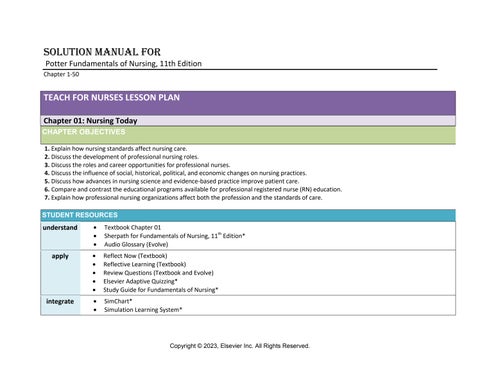
Solution Manual for Potter Fundamentals of Nursing, 11th Edition Chapter 1-50
TEACH FOR NURSES LESSON PLAN Chapter 01: Nursing Today CHAPTER OBJECTIVES 1. Explain how nursing standards affect nursing care. 2. Discuss the development of professional nursing roles. 3. Discuss the roles and career opportunities for professional nurses. 4. Discuss the influence of social, historical, political, and economic changes on nursing practices. 5. Discuss how advances in nursing science and evidence-based practice improve patient care. 6. Compare and contrast the educational programs available for professional registered nurse (RN) education. 7. Explain how professional nursing organizations affect both the profession and the standards of care. STUDENT RESOURCES
understand
Textbook Chapter 01 Sherpath for Fundamentals of Nursing, 11th Edition* Audio Glossary (Evolve)
apply
Reflect Now (Textbook) Reflective Learning (Textbook) Review Questions (Textbook and Evolve) Elsevier Adaptive Quizzing* Study Guide for Fundamentals of Nursing*
integrate
SimChart* Simulation Learning System*
Copyright © 2023, Elsevier Inc. All Rights Reserved.
CLINICAL JUDGMENT CLASSROOM TOOLS in text
Reflective Learning Exercise #3
lesson focus
Clinical Judgment awareness
INSTRUCTOR RESOURCES before class
Nursing Curriculum Standards (below)
in class
PowerPoint Presentations (Evolve) Image Collection (Evolve) Learning Activities (below) Discussion Topics (below) Next-Generation NCLEX® (NGN) Examination–Style Case Studies for Fundamentals
after class
Test Bank (Evolve) HESI Practice Tests* for Fundamentals
* Sold separately from textbook.
TEACHING STRATEGIES Content Focus
Content Highlights
1. Explain how nursing standards affect nursing care.
Discuss the definitions of nursing presented in the text. Explain how professional nursing organizations impact educational standards and certifications, specialty practice, consumerism, and patient advocacy.
Learning Activities
Discussion Topic: What is a code of ethics? Why is it important to incorporate your own values and ethics into your practice? Online Activity: Visit the ANA website (https://www.nursingworld.org/practice-policy/nursingexcellence/ethics/code-of-ethics-for-nurses/) and review one aspect of the ANA’s code of ethics to present to the class. State the ANA position and any challenges you may face with that position. Interprofessional Activity: Invite a non-nursing member of the healthcare team to visit the class to talk about
Copyright © 2023, Elsevier Inc. All Rights Reserved.
Resources
Box 1.1 Box 1.2 Box 1.3 Fig. 1.1 Reflect Now Box
TEACHING STRATEGIES Content Focus
2. Discuss the development of professional nursing roles.
3. Discuss the roles and career opportunities for professional nurses.
Content Highlights
Discuss the limitlessness of nursing as a profession and why nursing is a science and an art. Explain how roles and responsibilities influence the nurse’s scope of practice. Explain that the nurse may take multiple professional career paths, such as advanced practice, nurse educator, research, and administration, to advance within the discipline.
Learning Activities
4. Discuss the influence of social, historical, political, and economic changes on nursing practices.
Discuss the historical evolution of the nursing profession. Review current influences such as the health reform and an increasingly older population.
what he or she thinks defines nursing. If the visiting speaker’s profession has a formalized code of ethics, invite a discussion about the similarities and differences between the two. Discussion Topic: What are the five levels of proficiency that a nurse passes through when acquiring and developing generalist or specialized nursing skills? Activity: Have students write a paragraph explaining how roles and responsibilities influence the nurse’s scope of practice.
Pre-Class Activity: Have students journal about their own career goals. Which roles and career paths appeal to them the most? Students should be prepared to discuss the career path that most interests them. Discussion Topic: If students completed the pre-class activity for objective 3, ask students to discuss their career goals. How can these goals be met? Activity: Using their identified career goals, have students create a list of the associated educational requirements to meet that goal. Pre-Class Activity: Have students journal about their own self-care routines and stress-management techniques. What activities help them alleviate stress and decompress from a difficult day? If students do not have a self-care routine, have students write about activities they plan to incorporate in the future. Discussion Topic: How can Florence Nightingale’s influence be seen in modern day nursing? Discussion Topic: If students completed the pre-class activity for objective 4, discuss students’ self-care and stress-relieving techniques. What technique is the most
Copyright © 2023, Elsevier Inc. All Rights Reserved.
Resources
TEACHING STRATEGIES Content Focus
Content Highlights
5. Discuss how advances in nursing science and evidence-based practice improve patient care.
Explain that advances in nursing’s scientific knowledge base and the application of evidencebased practice have improved nursing practice and patient outcomes.
6. Compare and contrast the educational programs available for professional registered nurse (RN) education.
Discuss prelicensure and graduate education and continuing and in-service education. Review licensure requirements.
7. Explain how
Professional nursing
Learning Activities popular? If school-provided resources, like workout facilities or student counselors, are available to students, make sure students are aware of these resources. Interprofessional Activity: With which other providers could you collaborate in order to provide care to an older patient in poor health who wishes to remain in her home? Discussion Topic: What is genomic information? How can genomics be used to improved patient care? Activity: Have students write a summary on why the use of genomics is controversial and how genetic information can be used ethically. Clinical Judgment Activity: To introduce the idea of clinical judgment to students, present them with a simple case study of a student nurse asked to take a patient’s vital signs. The student faithfully takes the vital signs every two hours and records a steady increase in the patient’s temperature. Discuss how clinical judgment differs from simply preforming the required nursing actions (taking the temperature and accurately recording it) and influences patient care (noticing the steady increase in temperature and recognizing its significance). Discussion Topic: Why is in-service education important? How does it differ from continuing education? Online Activity: Direct students to your state board website to research your state’s Nurse Practice Act. Ask them to describe at least one item with which they agree and at least one item that they did not anticipate would be included. Large Group Activity: Divide the class into four groups to discuss what is require for each of the four areas of advanced practice nursing. Then have each group share their findings with the class. Online Activity: Have students locate the websites for
Copyright © 2023, Elsevier Inc. All Rights Reserved.
Resources
Table 1.1 QSEN Box Reflect Now Box
Box 1.4
TEACHING STRATEGIES Content Focus professional nursing organizations affect both the profession and the standards of care.
Content Highlights organizations have an impact on educational standards and certifications, specialty practice, consumerism, and patient advocacy.
Learning Activities
Resources
professional nursing organizations and mark them as favorites so they can use them as resources throughout the course.
NURSING CURRICULUM STANDARDS
QSEN / NLN COMPETENCIES
Patient-Centered Care/Human Flourishing o QSEN Box: Building Competency in Patient-Centered Care Evidence-Based Practice/Spirit of Inquiry o Evidence-Based Practice Quality Improvement/Spirit of Inquiry o Quality and Safety Education for Nurses o Table 1.1 Quality and Safety Education for Nurses Safety/Nursing Judgment o Quality and Safety Education for Nurses o Table 1.1 Quality and Safety Education for Nurses Informatics/Nursing Judgment o Impact of Emerging Information Technologies
NURSING CONCEPTS The following conceptual themes and specific concepts match those presented in Giddens, J. R. (2021). Concepts for nursing practice (3rd ed.). St. Louis: Elsevier. The specific exemplars chosen and listed below for each concept have been tailored specifically to correspond to the Potter, Perry, Stockert & Hall: Fundamentals of Nursing, Eleventh Edition, textbook.
Copyright © 2023, Elsevier Inc. All Rights Reserved.