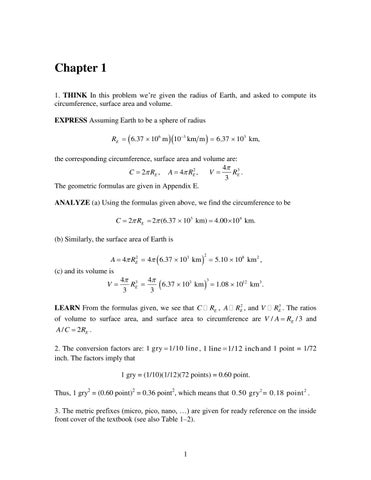
Chapter 1 1. THINK In this problem we’re given the radius of Earth, and asked to compute its circumference, surface area and volume. EXPRESS Assuming Earth to be a sphere of radius RE 6.37 106 m 103 km m 6.37 103 km,
the corresponding circumference, surface area and volume are: 4 3 C 2 RE , A 4 RE2 , V RE . 3 The geometric formulas are given in Appendix E. ANALYZE (a) Using the formulas given above, we find the circumference to be C 2 RE 2 (6.37 103 km) 4.00 104 km.
(b) Similarly, the surface area of Earth is
A 4 RE2 4 6.37 103 km
(c) and its volume is V
5.10 10 km , 2
8
2
3 4 3 4 6.37 103 km 1.08 1012 km3 . RE 3 3
LEARN From the formulas given, we see that C RE , A RE2 , and V RE3 . The ratios of volume to surface area, and surface area to circumference are V / A RE / 3 and A / C 2RE . 2. The conversion factors are: 1 gry 1/10 line , 1 line 1/12 inch and 1 point = 1/72 inch. The factors imply that 1 gry = (1/10)(1/12)(72 points) = 0.60 point. Thus, 1 gry2 = (0.60 point)2 = 0.36 point2, which means that 0.50 gry2 = 0.18 point 2 . 3. The metric prefixes (micro, pico, nano, …) are given for ready reference on the inside front cover of the textbook (see also Table 1–2).
1
2
CHAPTER 1
(a) Since 1 km = 1 103 m and 1 m = 1 106 m,
1km 103 m 103 m 106 m m 109 m.
The given measurement is 1.0 km (two significant figures), which implies our result should be written as 1.0 109 m. (b) We calculate the number of microns in 1 centimeter. Since 1 cm = 102 m,
1cm = 102 m = 102 m 106 m m 104 m.
We conclude that the fraction of one centimeter equal to 1.0 m is 1.0 104. (c) Since 1 yd = (3 ft)(0.3048 m/ft) = 0.9144 m,
1.0 yd = 0.91m 106 m m 9.1 105 m.
4. (a) Using the conversion factors 1 inch = 2.54 cm exactly and 6 picas = 1 inch, we obtain 1 inch 6 picas 0.80 cm = 0.80 cm 1.9 picas. 2.54 cm 1 inch (b) With 12 points = 1 pica, we have
1 inch 6 picas 12 points 0.80 cm = 0.80 cm 23 points. 2.54 cm 1 inch 1 pica 5. THINK This problem deals with conversion of furlongs to rods and chains, all of which are units for distance. EXPRESS Given that 1 furlong 201.168 m, 1 rod 5.0292 m and 1 chain 20.117 m , the relevant conversion factors are 1 rod 1.0 furlong 201.168 m (201.168 m ) 40 rods, 5.0292 m and 1 chain 1.0 furlong 201.168 m (201.168 m ) 10 chains . 20.117 m Note the cancellation of m (meters), the unwanted unit. ANALYZE Using the above conversion factors, we find (a) the distance d in rods to be d 4.0 furlongs 4.0 furlongs
40 rods 160 rods, 1 furlong
3 (b) and in chains to be d 4.0 furlongs 4.0 furlongs
10 chains 40 chains. 1 furlong
LEARN Since 4 furlongs is about 800 m, this distance is approximately equal to 160 rods ( 1 rod 5 m ) and 40 chains ( 1 chain 20 m ). So our results make sense. 6. We make use of Table 1-6. (a) We look at the first (“cahiz”) column: 1 fanega is equivalent to what amount of cahiz? We note from the already completed part of the table that 1 cahiz equals a dozen fanega. Thus, 1 fanega = Fehler! cahiz, or 8.33 102 cahiz. Similarly, “1 cahiz = 48 cuartilla” (in the already completed part) implies that 1 cuartilla = Fehler!cahiz, or 2.08 102 cahiz. Continuing in this way, the remaining entries in the first column are 6.94 103 and 3.47 103 . (b) In the second (“fanega”) column, we find 0.250, 8.33 102, and 4.17 102 for the last three entries. (c) In the third (“cuartilla”) column, we obtain 0.333 and 0.167 for the last two entries. (d) Finally, in the fourth (“almude”) column, we get Fehler! = 0.500 for the last entry. (e) Since the conversion table indicates that 1 almude is equivalent to 2 medios, our amount of 7.00 almudes must be equal to 14.0 medios. (f) Using the value (1 almude = 6.94 103 cahiz) found in part (a), we conclude that 7.00 almudes is equivalent to 4.86 102 cahiz. (g) Since each decimeter is 0.1 meter, then 55.501 cubic decimeters is equal to 0.055501 m3 or 55501 cm3. Thus, 7.00 almudes = Fehler! fanega = Fehler!(55501 cm3) = 3.24 104 cm3. 7. We use the conversion factors found in Appendix D.
1 acre ft = (43,560 ft 2 ) ft = 43,560 ft 3 Since 2 in. = (1/6) ft, the volume of water that fell during the storm is
V (26 km2 )(1/6 ft) (26 km2 )(3281ft/km) 2 (1/6 ft) 4.66 107 ft 3. Thus, V
4.66 107 ft 3 11 . 103 acre ft. 4 3 4.3560 10 ft acre ft
4
CHAPTER 1
8. From Fig. 1-4, we see that 212 S is equivalent to 258 W and 212 – 32 = 180 S is equivalent to 216 – 60 = 156 Z. The information allows us to convert S to W or Z. (a) In units of W, we have
258 W 50.0 S 50.0 S 60.8 W 212 S (b) In units of Z, we have
156 Z 50.0 S 50.0 S 43.3 Z 180 S 9. The volume of ice is given by the product of the semicircular surface area and the thickness. The area of the semicircle is A = r2/2, where r is the radius. Therefore, the volume is V r2 z 2 where z is the ice thickness. Since there are 103 m in 1 km and 102 cm in 1 m, we have
103 m 102 cm 5 r 2000 km 2000 10 cm. 1km 1m In these units, the thickness becomes
102 cm 2 z 3000 m 3000 m 3000 10 cm 1m which yields V
2 2000 105 cm 3000 102 cm 1.9 1022 cm3 . 2
10. Since a change of longitude equal to 360 corresponds to a 24 hour change, then one expects to change longitude by 360 / 24 15 before resetting one's watch by 1.0 h. 11. (a) Presuming that a French decimal day is equivalent to a regular day, then the ratio of weeks is simply 10/7 or (to 3 significant figures) 1.43. (b) In a regular day, there are 86400 seconds, but in the French system described in the problem, there would be 105 seconds. The ratio is therefore 0.864. 12. A day is equivalent to 86400 seconds and a meter is equivalent to a million micrometers, so 3.7 m 106 m m . m s. 31 14 day 86400 s day
b gc b gb
h g
5
13. The time on any of these clocks is a straight-line function of that on another, with slopes 1 and y-intercepts 0. From the data in the figure we deduce tC
2 594 , tB 7 7
tB
33 662 . tA 40 5
These are used in obtaining the following results. (a) We find t B t B
when t'A tA = 600 s. (b) We obtain tC tC
b
33 t A t A 495 s 40
g bg
2 2 495 141 s. t B t B 7 7
(c) Clock B reads tB = (33/40)(400) (662/5) 198 s when clock A reads tA = 400 s. (d) From tC = 15 = (2/7)tB + (594/7), we get tB 245 s. 14. The metric prefixes (micro (), pico, nano, …) are given for ready reference on the inside front cover of the textbook (also Table 1–2).
100 y 365 day 24 h 60 min (a) 1 century 106 century 52.6 min. 1 century 1 y 1 day 1 h
(b) The percent difference is therefore 52.6 min 50 min 4.9%. 52.6 min
15. A week is 7 days, each of which has 24 hours, and an hour is equivalent to 3600 seconds. Thus, two weeks (a fortnight) is 1209600 s. By definition of the micro prefix, this is roughly 1.21 1012 s. 16. We denote the pulsar rotation rate f (for frequency). f
1 rotation 1.55780644887275 103 s
(a) Multiplying f by the time-interval t = 7.00 days (which is equivalent to 604800 s, if we ignore significant figure considerations for a moment), we obtain the number of rotations: