Solution Manual for Leifer: Growth and Development Across the Lifespan, 3rd Edition Chapter 1-16
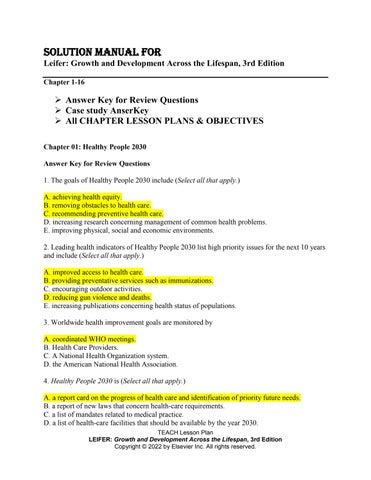
Answer Key for Review Questions Case study AnserKey All CHAPTER LESSON PLANS & OBJECTIVES Chapter 01: Healthy People 2030 Answer Key for Review Questions 1. The goals of Healthy People 2030 include (Select all that apply.) A. achieving health equity. B. removing obstacles to health care. C. recommending preventive health care. D. increasing research concerning management of common health problems. E. improving physical, social and economic environments. 2. Leading health indicators of Healthy People 2030 list high priority issues for the next 10 years and include (Select all that apply.) A. improved access to health care. B. providing preventative services such as immunizations. C. encouraging outdoor activities. D. reducing gun violence and deaths. E. increasing publications concerning health status of populations. 3. Worldwide health improvement goals are monitored by A. coordinated WHO meetings. B. Health Care Providers. C. A National Health Organization system. D. the American National Health Association. 4. Healthy People 2030 is (Select all that apply.) A. a report card on the progress of health care and identification of priority future needs. B. a report of new laws that concern health-care requirements. C. a list of mandates related to medical practice. D. a list of health-care facilities that should be available by the year 2030. TEACH Lesson Plan LEIFER: Growth and Development Across the Lifespan, 3rd Edition Copyright © 2022 by Elsevier Inc. All rights reserved.
Chapter XX: Chapter Title 2
E. published by the U.S. Department of Health and Human Services. 5. Health care workers play an important role in helping to achieve the goals of Healthy People 2030 by A. treating the poor population who are ill. B. promoting breastfeeding and early prenatal care. C. agreeing to work overtime to meet patient needs. D. working in community-based clinics.
Leifer: Growth and Development Across the Lifespan, 3rd Edition Chapter 02: Government Influences on Health Care Answer Key for Review Questions 1. Match the following agencies on the left with their primary functions described on the right. Agency Function Managed Care Organization (MCO) A Health Maintenance Organization (HMO) B Preferred Provider Organization (PPO) C A. Controls the cost of Health care. B. Provides care for prepaid members. C. Provides care to a specialized group for a fee-for-service-rate. 2. The “Plan of Care” for a multidisciplinary health care team is (Select all that apply.) A. a tool for communication between health care providers concerning a patient/client/family. B. a description of standards of care for a client. C. identification of health care providers for a client/patient. D. a compilation of goals or needs of a client and planned approach to meet those goals. 3. Which of the following is true of the Nurse Practice Act? (Select all that apply.) A. Defines the scope of practice for a nurse nationwide B. Defines the scope of practice of a nurse within one state C. May include a multistate licensing agreement D. Defines the functions and limitations of nursing actions E. Includes patient’s bill of rights 4. The functions of the United States Department of Health and Human Services (USDHHS) include (Select all that apply.) A. Operating clinics for poor/indigent patients TEACH Lesson Plan AUTHOR: Product Title, XX Edition Copyright 20XX by Elsevier Inc. All rights reserved.
Chapter XX: Chapter Title 3
B. Writing most health care legislation C. Overseeing Health People 2030 document D. Establishing criteria for hospital excellence E. Overseeing licensing e for most health care professionals 5. Political Action Committees (PACs) influence health care by A. writing health-care laws. B. supporting legislators who vote on health-care policies. C. studying the needs of local communities. D. promoting higher salaries for nurses.
Leifer: Growth and Development Across the Lifespan, 3rd Edition Chapter 03: Cultural Considerations Across the Lifespan and in Health and Illness Answer Key for Review Questions 1. Mark the appropriate box in the table to distinguish between Alternative medicine, Complementary medicine, and Cultural intervention. Alternative Med Complementary Cultural Med Intervention Use of an antinausea X bracelet during chemotherapy Suggesting a plasma X expander to a patient who refuses a blood transfusion for religious reasons Patient chooses to use X acupuncture instead of prescribed medication A patient chooses to X undergo chiropractic care instead of prescribed physical therapy Offering a patient X room-temperature water instead of cold, due to a cultural belief Having a midwife or X doula present during childbirth in a TEACH Lesson Plan AUTHOR: Product Title, XX Edition Copyright 20XX by Elsevier Inc. All rights reserved.
Chapter XX: Chapter Title 4
hospital setting
2. Which of the following are roles of the government in promoting culturally competent care? A. Research and report the effectiveness of CAM therapies. B. Enact laws to require that all patients with the same diagnosis receive the same treatments. C. Set guidelines for which religious holidays are recognized in the health-care environment. D. Promote behaviors and policies related to cultural competence in health care. E. Provide information concerning linguistically appropriate health services. F. Require health-care workers to speak a minimum of two languages fluently. 3. If a patient refuses to take his vitamin pill because he believes the gelatin base is unhealthy, the nurse should A. challenge his belief. B. educate him concerning the need and value of that vitamin pill. C. obtain the help of a clergyman to persuade him to take the pill. D. respect his belief and find a similar vitamin preparation that does not contain gelatin. 4. When providing health-care information, the health-care worker should (Select all that apply.) A. speak only with the patient. B. include the family member who is the decision maker of the family. C. always provide instructions clearly written in English. D. include resources to call if there are further questions. 5. Match the terms with the correct definitions. Term Definition Cultural competence D Culture E Cultural sensitivity C Cultural stereotyping B Ethnocentric A A. Evaluating a person’s cultural beliefs and values according to standards of one’s own practices. B. Most all people of specific cultures believe and practice specific behaviors. C. Awareness and respect for beliefs and values that may be different from one’s own. D. Use of appropriate verbal and body language and personal space. E. Learned values, beliefs, and customs that influence food choices, parenting styles, and treatment preferences.
Leifer: Growth and Development Across the Lifespan, 3rd Edition Chapter 04: The Influence of Family on Developing a Lifestyle Answer Key for Review Questions TEACH Lesson Plan AUTHOR: Product Title, XX Edition Copyright 20XX by Elsevier Inc. All rights reserved.
Chapter XX: Chapter Title 5
1. According to the American Academy of Pediatrics, social networking sites used by children and teens (Select all that apply.) A. under 13 years of age should be prohibited. B. should be monitored by adults. C. can cause depression and isolation. D. offer opportunities for learning and collaborating with peers. 2. A family is defined as A. a structure consisting of two parents and at least one child. B. a social system involving commitment and interaction. C. genetically related groups of people. D. a group of people living together. 3. Factors within the family that affect the growth and development of the child include (Select all that apply.) A. size of the family. B. spacing of siblings. C. divorce. D. state in which they live. E. political views of the parents. 4. The Children’s Television Act of 1990 defined television “prime time” as (Select all that apply.) A. times during which children are likely to watch TV. B. times most popular shows should air. C. times the current newscast should be broadcast. D. mealtimes when most families are together. E. times during which families may be able to watch TV together. 5. A developmental task is a competency or skill that (Select all that apply.) A. helps one cope with the environment. B. occurs in sequence. C. occurs at a specific age. D. involves motor skills.
Leifer: Growth and Development Across the Lifespan, 3rd Edition Chapter 05: Theories of Development Answer Key for Review Questions TEACH Lesson Plan AUTHOR: Product Title, XX Edition Copyright 20XX by Elsevier Inc. All rights reserved.