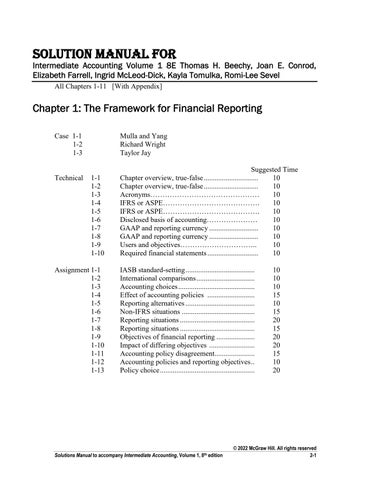
Solution Manual for
Intermediate Accounting Volume 1 8E Thomas H. Beechy, Joan E. Conrod, Elizabeth Farrell, Ingrid McLeod-Dick, Kayla Tomulka, Romi-Lee Sevel All Chapters 1-11 [With Appendix]
Chapter 1: The Framework for Financial Reporting Case 1-1 1-2 1-3 Technical
Mulla and Yang Richard Wright Taylor Jay 1-1 1-2 1-3 1-4 1-5 1-6 1-7 1-8 1-9 1-10
Assignment 1-1 1-2 1-3 1-4 1-5 1-6 1-7 1-8 1-9 1-10 1-11 1-12 1-13
Suggested Time Chapter overview, true-false .............................. 10 Chapter overview, true-false .............................. 10 Acronyms……………………………………… 10 IFRS or ASPE…………………………………. 10 IFRS or ASPE…………………………………. 10 Disclosed basis of accounting………………… 10 GAAP and reporting currency ........................... 10 GAAP and reporting currency ........................... 10 Users and objectives………………………….. 10 Required financial statements ............................ 10 IASB standard-setting ...................................... International comparisons ................................ Accounting choices .......................................... Effect of accounting policies .......................... Reporting alternatives ...................................... Non-IFRS situations ........................................ Reporting situations ......................................... Reporting situations ......................................... Objectives of financial reporting ..................... Impact of differing objectives ......................... Accounting policy disagreement...................... Accounting policies and reporting objectives .. Policy choice ....................................................
Solutions Manual to accompany Intermediate Accounting, Volume 1, 8th edition
10 10 10 15 10 15 20 15 20 20 15 10 20
© 2022 McGraw Hill. All rights reserved 2-1
Cases Case 1-1 (LO1.2, LO1.3, LO1.4, LO1.5) Notes for Discussion With Elicia: There is a conflict of interest between the objectives of Elicia and Dabika due to the buyout clause in the shareholder agreement. Elicia will have a motivation to decrease shareholders‘ equity since this will reduce the amount that she will be required to pay to buy out Dabika. Dabika will be interested in increasing shareholders‘ equity to increase the amount she will receive. It must be clarified who I am working for since I may have a conflict of interest since I know both parties. It is important that all accounting policies are ‗fair‘ to both sides. What is considered ‗fair‘? From Dabika‘s perspective, fair could be accounting policies consistent with prior years. From Elicia‘s perspective, fair could be if the economic events change the accounting policy would change. Fair could be both sides split the difference where Dabika and Elicia disagree on value. In the future it is important that the shareholders agreement is more specific. Due to the choices allowed within GAAP a policy could be selected that would be more beneficial to one of the parties. It is assumed since this is a small private company that they are using ASPE. There is no indication that neither Elicia or Dabika would be using IFRS nor that the bank requires it. Inventory Elicia wants to write off the inventory value for the garden gnomes and statues and this will decrease the amount of the payment to Dabika. According to ASPE, inventory would be valued at the lower of cost and net realizable value. Even though this inventory has been sitting in the gardening centre there is still a few being sold each year. This indicates there is still some value associated with the inventory and therefore it should not be written down to zero. It should be determined what the net realizable value of this inventory is to determine the amount of the write off. If it is all written off and then sold at a later date this would not be fair to Dabika since Elicia would get the benefit of a reduced shareholders‘ equity and thus a lower payment required to Dabika. The purchase of this inventory would have been a decision made by both Dabika and Elicia so if the inventory is unsellable they should both bear the impact of this decision. Warranty According to ASPE the accounting policy is appropriate and a warranty expense should be included for the guarantee. The impact is that this would decrease shareholders‘ equity and the amount of the payment to Dabika. This is a new policy that did not exist until this year. The estimate of 5% was only based on sales from the fall. Since it is a new policy that was made by Elicia on her own it may be appropriate that the impact of this is excluded from the calculation of shareholders‘ equity. At a minimum the estimate should
©2022 McGraw Hill. All rights reserved 2-2 Solutions Manual to accompany Intermediate Accounting, Volume 1, 8th edition
be reviewed to determine if it is reasonable. Furthermore, the estimate, if included in the shareholders‘ equity calculation, should be agreed upon by both Elicia and Dabika. Computer Equipment ASPE is flexible in the method used to depreciate assets. The declining balance method using 40% would write off the value of the computers in approximately two years. This is very fast especially for a small company that is likely to use a computer for a longer period of time due to limited resources as compared to a larger company. Just because the computer may become obsolete quickly does not mean the business will not continue to derive benefit from the continued use of the computer. The impact of higher depreciation is a reduction in the payment to Dabika. If we look at consistency with other assets it would be appropriate to use the straight line method. We should inquire with Elicia as to her rationale for choosing declining balance instead of the straight-line depreciatoin method used for all other assets and determine the declining method reflects the actual usage of the asset (i.e. more of the asset used earlier on). Since again since this was a decision made only be Elicia maybe it should be excluded from the calculation or maybe the policy should be consistent with their other assets but further information is required. Case 1-2 (LO1.2, LO1.3, LO1.4, LO1.5) Dear Richard Wright: I am happy to respond to your questions regarding the accounting changes that the new banker has requested. It is important that you realize that the needs of the banker are different than your needs. The bank is interested in your ability to make loan payments; therefore, the banker wants to assess future cash flows, collateral and your ability to pay back the loan. First, there is the issue of moving to the accrual basis. While it‘s true that, ultimately, what you earn is the net cash in your pocket, the cash basis of accounting doesn‘t wholly capture all of the cash flows that will happen in the future. Your banker wants to know what liabilities you‘ll have to pay in the coming months (and years), and what amounts you currently are owed that will be collected in the future weeks or months. The accrual method really gives a clear picture of future ―cash flow‖. It‘s for much the same reason that he wishes you to show your cattle at market value. I‘m sure he recognizes that both your dairy cattle and your breeders are intended for continued use and are not for sale in the normal course of business.As saleable stock, the cattle represent a potential cash resource in the event of bankruptcy or default. After all, you probably use the cattle as collateral for loans, and he needs to know the value of that collateral. You should not try to estimate the value of your stock by yourself. For credibility, you should obtain an independent estimate. The valuation will require a professional evaluation (and the cost thereof), but will be necessary in order to satisfy the bank.
Solutions Manual to accompany Intermediate Accounting, Volume 1, 8th edition
© 2022 McGraw Hill. All rights reserved 2-3
Sincerely, Andriana Case 1-3 (LO1.1, LO1.2, LO1.3, LO1.4, LO1.5) Overview This case is intended to get students to focus on the differences between companies and the various factors that have a bearing on their financial reporting objectives. Students are asked to prioritize the factors or characteristics that are most likely to affect each company‘s financial reporting. Company Characterics All three companies are private enterprises. Significant characteristics of each are as follows: Business Owners Other capital sources
Breeze Inc. New mobile phone network Private investors and venture capitalists Egyptian fund
Saturn Software Custom software development Two entrepreneurs, not wealthy Pension fund—pref. shares Bank line of credit
Capital requirements
Capital intensive start-up
Salary-based operation; working capital needed
Constraints
Egypt fund has 3 board seats
Reporting requirements IPO probable?
CRTC Egypt fund; Japan partner Not in the foreseeable future
Bank covenants: – restrictions on dividend/salary payouts – new debt Preferred dividend required Pension fund Bank Unlikely
Intern’l Auto Parts Auto parts for international auto makers Wealthy family Debt through investment funds and by U.S. and Cdn. banks Established manufacturer; expanding to gain foreign customers Probable debt covenants
Investment funds and banks Potential new customers Yes, anticipated in 2-3 years
©2022 McGraw Hill. All rights reserved 2-4 Solutions Manual to accompany Intermediate Accounting, Volume 1, 8th edition
Prioritization A possible ranking of significant factors may look as shown below from most significant to least significant. This listing is not definitive, but students should exhibit some logic as to why they rank some factors as more important than others. Breeze Inc. Major foreign investor must be kept happy—ASPE may not be understood so IFRS may be more appropriate Important Japanese partner (Telyu) – there may be a bias to decrease revenue to decrease payment to Telyu Need for major capital investment, major competitors are public Clear reporting of revenues on which 2% fee is based CRTC requirements
Saturn Software Liquidity requirements—cash flow prediction primary objective
Intern’l Auto Parts IPO likely in near future— compliance with IFRS will be necessary (ASPE not appropriate)
Bank covenants—protect lines of credit to be able to pay preferred dividends
Reflect good management performance to help attract new auto companies as customers
Complex reporting not necessary; ASPE probably best, plus disclosure of salary information Continuously profitable— minimize income taxes to conserve cash Employee profit sharing plan
Satisfy investment funds‘ reporting expections (e.g., re covenants) Exhibit success in attracting new customers Show strong profitability to attract high stock price on IPO
Assignments Technical Review TR 1-1 (LO1.1, LO1.2, LO1.3, LO1.4, LO1.5, LO1.6, LO1.7) The question statement has been repeated below followed by the correct statement in instances where the question statement is false. F
F
T T T
T
1. The International Accounting Standards Board has authority for setting Canadian accounting standards. Canadian standards are set and or endorsed the Accounting Standards Board in Canada. 2. All Canadian corporations must comply with international accounting standards. This only applies for publicly accountable enterprises. Private enterprises have a choice between ASPE and IFRS. 3. Most public Canadian corporations are listed on the Toronto Stock Exchange. 4. IFRS must be used for the financial statements of every Canadian public corporation. 5. The objective of general purpose financial reporting is to serve the information needs of a wide variety of users, including lenders, shareholders, employees and regulators. 6. The primary objective of financial accounting is to reveal information about an enterprise’s financial performance.
Solutions Manual to accompany Intermediate Accounting, Volume 1, 8th edition
© 2022 McGraw Hill. All rights reserved 2-5