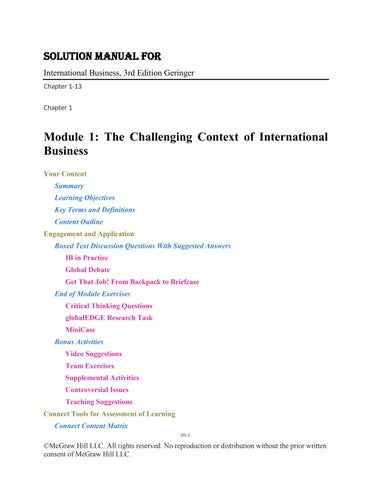
Solution Manual for International Business, 3rd Edition Geringer Chapter 1-13 Chapter 1
Module 1: The Challenging Context of International Business Your Content Summary Learning Objectives Key Terms and Definitions Content Outline Engagement and Application Boxed Text Discussion Questions With Suggested Answers IB in Practice Global Debate Get That Job! From Backpack to Briefcase End of Module Exercises Critical Thinking Questions globalEDGE Research Task MiniCase Bonus Activities Video Suggestions Team Exercises Supplemental Activities Controversial Issues Teaching Suggestions Connect Tools for Assessment of Learning Connect Content Matrix 01-1
©McGraw Hill LLC. All rights reserved. No reproduction or distribution without the prior written consent of McGraw Hill LLC.
Connect Activities
Your Content Summary This module provides an overview of international business (IB) and some of the ways that IB differs from domestic business, including the three environments of IB: domestic, foreign, and international. Although the kinds of forces are the same in the domestic and foreign environments, their values often differ and changes in the values of the foreign forces can be at times more difficult to assess. In addition to providing a brief review of the history of IB, the module discusses the internationalization of business in recent decades and the driving forces that are leading firms to internationalize their operations. The increasing internationalization of business requires managers to have a global perspective gained through experience and education. Because global competition continues to increase at a rapid pace, both in terms of trade and foreign direct investment, we also present key arguments for and against the globalization of business, helping to foster a more balanced view on this important topic.
Learning Objectives LO 1-1
Show how international business differs from domestic business.
LO 1-2
Describe the history and future of international business.
LO 1-3
Discuss the dramatic internationalization of business.
LO 1-4
Identify the kinds of drivers that are leading firms to internationalize their operations.
LO 1-5
Compare the key arguments for and against the globalization of business.
Key Terms and Definitions controllable forces (p. 6)
Internal forces that management administers to adapt to changes in the uncontrollable forces
domestic environment (p. 6)
All the uncontrollable forces originating in the home country that surround and influence the life and development of the firm
economic globalization (p. 17)
The tendency toward an international integration and interdependency of goods, technology, information, labor and capital, or the process of making this integration happen
environment (p. 5)
All the forces influencing the life and development of the firm 01-2
©McGraw Hill LLC. All rights reserved. No reproduction or distribution without the prior written consent of McGraw Hill LLC.
exporting (p. 12) foreign affiliate (p. 6)
The transportation of any domestic good or service to a destination outside a country or region A company controlled by another company that is located in a foreign land, and this control may be exercised by a variety of means, both those involving stock ownership and those involving nonownership mechanisms
foreign business (p. 5)
The operations of a company outside its home or domestic market
foreign direct (FDI) (p. 12)
Direct investments in equipment, structures, and organizations in a foreign country at a level sufficient to obtain significant management control; does not include mere foreign investment in stock markets
investment
foreign environment (p. 6)
All the uncontrollable forces originating outside the home country that surround and influence the firm
importing (p. 12)
The transportation of any good or service into a country or region, from a foreign origination point
international business (p. 4)
Business that is carried out across national borders
international company (IC) (p. 5)
A company with operations in multiple nations
international environment (p. Interaction between domestic and foreign environmental forces, as well as interactions between the foreign 7) environmental forces of two countries multinational corporation (p. A corporation that owns or controls the production of goods or services in at least one nation outside its home 10) nation An enterprise made up of entities in more than one nation, multinational enterprise (p. operating under a decision-making system that allows a 11) common strategy and coherent policies self-reference criterion (p. 8)
Unconscious reference to your own cultural values when judging behaviors of others in a new and different environment
uncontrollable forces (p. 5)
The external forces that management has no direct control over
01-3
©McGraw Hill LLC. All rights reserved. No reproduction or distribution without the prior written consent of McGraw Hill LLC.
Content Outline The following section provides the flow of information using the Learning Objectives as a guide, Key Terms learners will need to take away from the course, and Lecture Notes to drive home teaching points. LO 1- Show how international business differs from domestic 1 business Introduction
I.
What Is International Business and What Is Different about It?
The Influence of External and Internal Environmental Forces
The Domestic Environment
The Foreign Environment
The International Environment
Key Terms: international business
foreign business
international company (IC)
environment
uncontrollable forces
controllable forces
domestic environment
foreign environment
international environment
self-reference criterion
Introduction
A. Our lives are fundamentally intertwined with international business (IB), and all managers need to have a basic knowledge of IB in order to meet the growing challenges of global competition. II.
What Is International Business and What Is Different About It?
1. IB is business that is carried out across national borders, including international trade, foreign manufacturing, and the growing service industries. 2. Foreign business refers to the operations of a company outside its home or domestic market. 3. An international company is a company with operations in multiple nations. 4. IB differs from domestic business because firms operating across borders must deal with forces of three kinds of environments—domestic, foreign, and international. 5. Although firms that only operate within the domestic environment must essentially be concerned with the domestic environment, no domestic firm is entirely free from foreign or international forces due to the potential for competition from foreign imports or foreign competitors setting up operations in the firm‘s domestic market. 01-4
©McGraw Hill LLC. All rights reserved. No reproduction or distribution without the prior written consent of McGraw Hill LLC.
A. The Influence of External and Internal Environmental Forces Environment includes all forces influencing the firm, both external and internal. External forces, commonly called uncontrollable forces, are those forces outside the firm that management has no direct control over, including: a. competitive b. distributive c. economic d. financial e. socioeconomic f. labor g. sociocultural h. political i. legal j. technological k. physical Internal forces, called controllable forces, are the forces that management does have some control over, such as factors of production and activities of the organization. Changes in an external force, such as the political force associated with the expansion of the European Union (EU), can affect all of the controllable forces of firms that do business in or with the 28 EU nations. B. The Domestic Environment 1. All the uncontrollable forces originating in the home country that surround and influence the firm‘s life and development. Even if a domestic force, it can still affect foreign operations, such as when a domestic labor strike disrupts the supply of parts to a company‘s assembly operations in another nation. C. The Foreign Environment 1. All the uncontrollable forces originating outside the home country that surround and influence the firm. The same forces as those in the domestic environment, except they occur outside the firm‘s home country. a. Although forces in the domestic and foreign environment are identical, their values often differ widely and can even be completely opposed to each other. b. Foreign forces are frequently difficult to assess, especially for legal and political forces. c. The forces are often interrelated. Although this can happen also for domestic 01-5
©McGraw Hill LLC. All rights reserved. No reproduction or distribution without the prior written consent of McGraw Hill LLC.