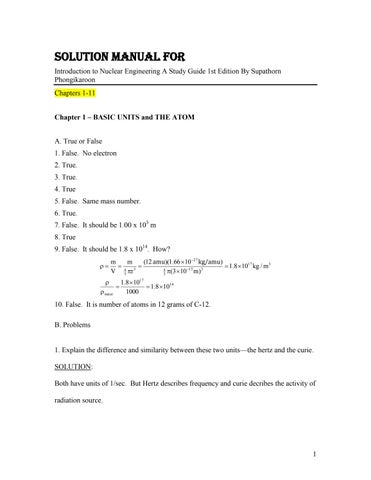
Solution Manual For Introduction to Nuclear Engineering A Study Guide 1st Edition By Supathorn Phongikaroon Chapters 1-11 Chapter 1 – BASIC UNITS and THE ATOM A. True or False 1. False. No electron 2. True. 3. True. 4. True 5. False. Same mass number. 6. True. 7. False. It should be 1.00 x 10³ m 8. True 9. False. It should be 1.8 x 10¹⁴. How?
m m (12 amu)(1.66 10 27 kg/amu) 4 3 1.8 1017 kg / m 3 15 3 4 V 3 r ( 3 10 m ) 3
water
1.8 1017 1.8 1014 1000
10. False. It is number of atoms in 12 grams of C-12. B. Problems
1. Explain the difference and similarity between these two units—the hertz and the curie. SOLUTION: Both have units of 1/sec. But Hertz describes frequency and curie decribes the activity of radiation source.
1
2. What is the number of neutrons in 240Pu? 208Pb? SOLUTION: You can use the chart of nuclides or periodic table. Pu has 94 protons. So, # n = 240 – 94 = 146 Pb has 82 protons. So, # n = 208 – 82 = 126
3. What is the mass in kg of a molecule of uranium oxide U3O8? SOLUTION: We can approximate this MW of U3O8 is 3(238) + 8(16) = 842 g/mol or 0.842 kg/mol So, mass of one molecule = 0.842 (1 mol/6.022E23 molecules) = 1.398x10⁻²⁴ kg/molecule
4. How many atoms of 235U are there in 1 g of natural uranium? SOLUTION: 1 kg U x 1000 g/1 kg x 1 mol/238 g x 6.022E23 atoms/1mole = 2.53 x 1024 atoms U Isotopic abundance U-235 = 0.72%. Thus, 2.53 x 1024 x 0.72/100 = 1.8216 x 10²² atom U-235. 5. The density of natural uranium oxide (UO2) is about 10.50 g/cm3. Natural uranium is composed of three isotope 234U, 235U, and 238U. a. Compute the atomic weight of natural uranium (g/mol). b. What is the molecular weight of UO2 fuel (g/mol)? c. What is the atomic density of 234U in the UO2 fuel (atoms/cm3)? SOLUTION:
2
Part a. Isotope 234
U U 238 U 235
Isotopic Abundance (atom %) 0.0057 0.72 99.27
Atomic Weight (g/mol) 234.0409 235.0439 238.0508
MW of uranium = (0.0057/100)(234.0409)+(0.72/100)(235.0439)+(99.27/100)(238.0508) = 238.0186 g/mol. Part b: MW of UO2 is 238.0186 + 2(16) = 270.0186 g UO2/mol. Part c: Atomic density of UO2 is (10.5 g/cc)/(270.0186 g/mol)*6.022E23 molecules/mol = 2.341E22 molecules UO2/cm3 So, for U-234 = (0.0057 atom U-234/100 atom U) * 2.341E22 = 1.334 x 10¹⁸ atoms U-234/cm3.
6. How many atoms of deuterium are there in 2 kg of water assuming the natural abundance of deuterium in atom percent is 0.0115%? SOLUTION: Molecular weight of H2O (assuming all the hydrogen is 1H1, that is, ignoring the deuterium contribution) = 2AH + AO = 2(1 g/mol) + 16 g/mol = 18 g/mol Natoms/m = NA/A Therefore, Nwater = mwaterNA/Awater = (2000 g)( 0.60221024 molecules/mol)/(18 g/mol) Nwater = 6.691025 molecules of water NH = 2Nwater = (2 atoms/molecule)(6.691025 molecules) = 1.341026 H atoms
3
ND = D NH = (0.000115 deuterium atom/H atom)(1.341026 H atoms) = 1.541022 atoms
7. Mars has a radius of about 3396 km and a mass of 6.417×10²³ kg. Determine the radius of Mars (m) when it has the same mass density as matter in a nucleus. SOLUTION: From the definition of mass density of a sphere, = m/(4r3/3) Solving for the radius r cubed gives r3 = 3m/(4) Substituting for the mass of the earth and the mass density of a nucleus r3 = (3)(6.4171023 kg)(1000 g/kg)/[4(2.41014 g/cm3)] r3 = 6.383 1011 cm3 Taking the cube root gives the equivalent radius of the earth r = 8610.15 cm or
86.1 m
8. A uranium sample is enriched to 3.2 atom-percent in 235U. Determine the enrichment of 235U in weight-percent. Consider 234U to be very small that can be ignored for the calculation. [ Ans. 3.16 w/o ] SOLUTION: w235 = m235/mU where mi = NiAi/NA w235 =
N 235 A253 N 235 A235 N 238 A238
where Avogadro‘s number, NA, has cancelled.
Dividing the numerator and denominator by N235, w235 =
Now
A235 N A235 ( 238 ) A238 N 235 N235/(N235 + N238) = 0.032
Eq. 1
(235U atom fraction)
Therefore 0.032N238 = (1 – 0.032)N235 N238/N235 = 0.968/0.032 4
Substituting for N238/N235 into Eq. (1) gives w235 =
235 = 0.0316 = 3.16% 0.968 235 ( )238 0.032
Chapter 2 – BASIC MODERN PHYSICS A. True or False 1. True. 2. True. 3. True. 4. False. The de Broglie wavelength should be = 6.63E-34 Js/(0.01 kg x 50 m/s) = 2.65 E-34 m. 5. True 6. False. It is the description of the Compton Scattering effect. 7. True. That is the definition. 8. False. 9. False. Three should be two. 10. True.
5