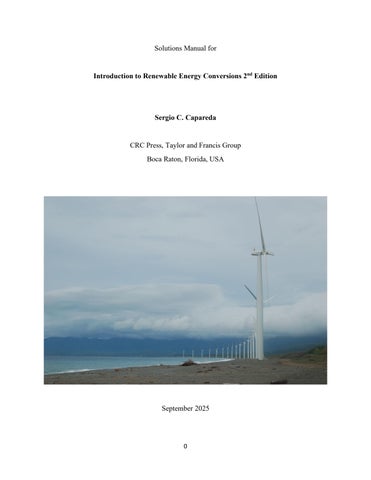
Solutions Manual for Introduction to Renewable Energy Conversions 2nd Edition
Sergio C. Capareda CRC Press, Taylor and Francis Group Boca Raton, Florida, USA
September 2025
0
1
Chapter 1 Introduction to Renewable Energy 1.7 Solved Problems Problem 1.7.1 Carbon Dioxide Required to Make Carbohydrates Problem 1.7.1 Determine the amount of carbohydrate or glucose produced (in tonnes) for every tonne of carbon dioxide used by way of Equation 1.2. Solution: a. Equation 1.2 may be converted into units of weight using the molecular weights of the compounds involved. The molecular weights of carbon is 12 g/mole and that for hydrogen is 1 g/mol and oxygen is 16 g/mol. b. 6𝐶𝐶𝑂𝑂2 + 6𝐻𝐻2 𝑂𝑂 + 𝑆𝑆𝑆𝑆𝑆𝑆𝑆𝑆𝑆𝑆 𝐸𝐸𝐸𝐸𝐸𝐸𝐸𝐸𝐸𝐸𝐸𝐸 → 𝐶𝐶6 𝐻𝐻12 𝑂𝑂6 + 6𝑂𝑂2
c. Thus, the amount of glucose (C6H12O6) produced per tonne of CO2 consumed is calculated as follows: 𝐶𝐶6 𝐻𝐻12 𝑂𝑂6 1 × [(6 × 12) + (12 × 1) + (6 × 16)] 180 𝑔𝑔 𝑡𝑡𝑡𝑡𝑡𝑡𝑡𝑡𝑡𝑡 𝐶𝐶6 𝐻𝐻12 𝑂𝑂6 �= =� = 0.75 6𝐶𝐶𝑂𝑂2 𝑡𝑡𝑡𝑡𝑡𝑡𝑡𝑡𝑡𝑡 𝐶𝐶𝑂𝑂2 364 𝑔𝑔 6 × �12 + 2 × (16)�
d. Theoretically, it would require about one-and-a-half tonnes of CO2 to generate a tonne of carbohydrate (glucose) sugar.
Problem 1.7.2. Kinetic Energy of a Mass of Wind Problem 1.7.2 Determine the kinetic energy available from a 100 kg of air moving at a speed of 12 m/s. Report the answer in units of Joules and in Btu. Solution a. Using Equation 1.1, the given values are simply plugged in the equation as follows: b. 𝐾𝐾𝐾𝐾 =
1 2
× 100 𝑘𝑘𝑘𝑘 × �
12 𝑚𝑚 2 𝑠𝑠
𝑁𝑁×𝑠𝑠 2
� × 𝑘𝑘𝑘𝑘×𝑚𝑚 = 7,200 𝑁𝑁 − 𝑚𝑚 = 7.2 𝑘𝑘𝑘𝑘 2
c. Thus, the equivalent unit in English system is shown below. 𝐾𝐾𝐾𝐾 = 7,200 𝐽𝐽 ×
𝐵𝐵𝐵𝐵𝐵𝐵 = 6.82 𝐵𝐵𝐵𝐵𝐵𝐵 1055 𝐽𝐽
d. Note the difference in the order of magnitude of Joules and Btu. One should always remember the conversion of Joules to Btu using the relationship 1055 Joules/Btu.
Problem 1.7.3 Carbon Dioxide Production During Ethanol Fermentation Problem 1.7.3 Determine the amount of carbon dioxide produced (kgs) for every kg of glucose (𝐶𝐶6 𝐻𝐻12 𝑂𝑂6 ) consumed in its conversion into ethanol. Use Equation 1.4 shown below in your calculations. Convert these units into English units of lbs CO2 per lb glucose. 𝐶𝐶6 𝐻𝐻12 𝑂𝑂6 + 𝑦𝑦𝑦𝑦𝑦𝑦𝑦𝑦𝑦𝑦 → 2𝐶𝐶2 𝐻𝐻5 𝑂𝑂𝑂𝑂 + 2𝐶𝐶𝑂𝑂2 + ℎ𝑒𝑒𝑒𝑒𝑒𝑒
Solution:
a. The amount of carbon dioxide produced per weight of glucose is given as follows: 𝑘𝑘𝑘𝑘 𝐶𝐶𝐶𝐶2 2𝐶𝐶𝑂𝑂2 2 × [(1 × 12) + (2 × 16)] 88 𝑔𝑔 �= = =� [(6 × 12) + (12 × 1) + (6 × 16)] 𝑘𝑘𝑘𝑘 𝐶𝐶6 𝐻𝐻12 𝑂𝑂6 𝐶𝐶6 𝐻𝐻12 𝑂𝑂6 180 𝑔𝑔 = 0.49
𝑘𝑘𝑘𝑘 𝐶𝐶𝑂𝑂2 𝑘𝑘𝑘𝑘 𝐶𝐶6 𝐻𝐻12 𝑂𝑂6
b. The amount of CO2 produced per lb of glucose consumed should also be equal to 0.49 kg/kg or lb/lb. Problem 1.7.4. Theoretical and Actual Power from Water Stream Problem 1.7.4 Determine the theoretical and actual power that can be derived from a water stream with a volumetric flow rate of 55 L/s and with a dynamic head of 2.0 m. Assume an overall conversion efficiency of 45%. Solution:
3
a. Equation 1.5 will be used and the density of water value at 1 kg/L and other conversion factors to arrive at the correct units of power in Watts. This will require the use of gravitational constant 9.8 m/s2 as well as the Newton’s Law relationship as shown below. 𝑇𝑇ℎ𝑒𝑒𝑒𝑒𝑒𝑒𝑒𝑒𝑒𝑒𝑒𝑒𝑒𝑒𝑒𝑒𝑒𝑒 𝑃𝑃𝑃𝑃𝑃𝑃𝑃𝑃𝑃𝑃 (𝑊𝑊 ) =
55 𝐿𝐿 1 𝑘𝑘𝑘𝑘 2 𝑚𝑚 𝑁𝑁𝑠𝑠 2 9.8 𝑚𝑚 𝑊𝑊𝑊𝑊 × × × × 2 × = 1,078 𝑊𝑊 𝑠𝑠 𝐿𝐿 𝑘𝑘𝑘𝑘 × 𝑚𝑚 𝑠𝑠 𝑁𝑁𝑁𝑁
b. The actual power that could be derived will be less due to conversion efficiencies as shown below. 𝐴𝐴𝐴𝐴𝐴𝐴𝐴𝐴𝐴𝐴𝐴𝐴 𝑃𝑃𝑃𝑃𝑃𝑃𝑃𝑃𝑃𝑃 (𝑊𝑊 ) = 𝑇𝑇ℎ𝑒𝑒𝑒𝑒𝑒𝑒𝑒𝑒𝑒𝑒𝑒𝑒𝑒𝑒𝑒𝑒𝑒𝑒 𝑃𝑃𝑃𝑃𝑃𝑃𝑃𝑃𝑃𝑃 × 𝐸𝐸𝐸𝐸𝐸𝐸𝐸𝐸𝐸𝐸𝐸𝐸𝐸𝐸𝐸𝐸𝐸𝐸𝐸𝐸 = 1,078 𝑊𝑊 × 0.45 = 485 𝑊𝑊
Problem 1.7.5 Theoretical Thermal Conversion Efficiency of Rankine Cycle Problem 1.7.5 Determine the theoretical thermal conversion efficiency of a Rankine Cycle with the following data: (a) Wout = 650 kJ/kg, (b) Win = 3.5, and (c) the heat input from the steam, Qin = 2,500 kJ/kg. The mass flow rate of the steam is around 22,000 kg/hr. Solution: a. It will be intuitive to convert all values in energy units rather than energy per unit of weight, even though the energy per unit of weight may also be used for efficiency calculations. Thus, the work output may be converted into kW as follows: 𝑊𝑊𝑜𝑜𝑜𝑜𝑜𝑜 = 650
𝑘𝑘𝑘𝑘 22,000 𝑘𝑘𝑘𝑘 1 ℎ𝑟𝑟 𝑘𝑘𝑘𝑘 × × × = 3,972 𝑘𝑘𝑘𝑘 𝑘𝑘𝑘𝑘 ℎ𝑟𝑟 3600 𝑠𝑠 𝑘𝑘𝑘𝑘/𝑠𝑠
b. Likewise, Win and Qin will be converted the same way as follows: 𝑊𝑊𝑖𝑖𝑖𝑖 = 3.5
𝑘𝑘𝑘𝑘 22,000 𝑘𝑘𝑘𝑘 1 ℎ𝑟𝑟 𝑘𝑘𝑘𝑘 × × × = 21.39 𝑘𝑘𝑘𝑘 𝑘𝑘𝑘𝑘 ℎ𝑟𝑟 3600 𝑠𝑠 𝑘𝑘𝑘𝑘/𝑠𝑠
𝑄𝑄𝑖𝑖𝑖𝑖 = 2,500
𝑘𝑘𝑘𝑘 22,000 𝑘𝑘𝑘𝑘 1 ℎ𝑟𝑟 𝑘𝑘𝑘𝑘 × × × = 15,278 𝑘𝑘𝑘𝑘 𝑘𝑘𝑘𝑘 ℎ𝑟𝑟 3600 𝑠𝑠 𝑘𝑘𝑘𝑘/𝑠𝑠 4