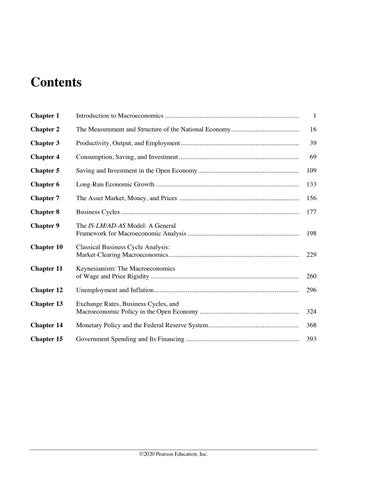
Contents Chapter 1
Introduction to Macroeconomics .............................................................................
1
Chapter 2
The Measurement and Structure of the National Economy .......................................
16
Chapter 3
Productivity, Output, and Employment ....................................................................
39
Chapter 4
Consumption, Saving, and Investment .....................................................................
69
Chapter 5
Saving and Investment in the Open Economy ..........................................................
109
Chapter 6
Long-Run Economic Growth ..................................................................................
133
Chapter 7
The Asset Market, Money, and Prices .....................................................................
156
Chapter 8
Business Cycles ......................................................................................................
177
Chapter 9
The IS-LM/AD-AS Model: A General Framework for Macroeconomic Analysis ................................................................
198
Classical Business Cycle Analysis: Market-Clearing Macroeconomics...........................................................................
229
Keynesianism: The Macroeconomics of Wage and Price Rigidity .....................................................................................
260
Chapter 12
Unemployment and Inflation ...................................................................................
296
Chapter 13
Exchange Rates, Business Cycles, and Macroeconomic Policy in the Open Economy .........................................................
324
Chapter 14
Monetary Policy and the Federal Reserve System....................................................
368
Chapter 15
Government Spending and Its Financing .................................................................
393
Chapter 10 Chapter 11
©2020 Pearson Education, Inc.
Chapter 1 Introduction to Macroeconomics n
Learning Objectives
I.
Goals of Part I A. Introduce students to the main concepts in macroeconomics (Ch. 1) B. Introduce national income accounting and major economic magnitudes (Ch. 2)
II. Section Goals A. Summarize the primary issues addressed in macroeconomics (Sec. 1.1) B. Describe the activities and objectives of macroeconomists (Sec. 1.2) C. Differentiate between the classical and Keynesian approaches to macroeconomics (Sec. 1.3) III. Notes to Ninth Edition Users: This chapter is little changed; the data were updated.
©2020 Pearson Education, Inc.
2
Abel/Bernanke/Croushore • Macroeconomics, Tenth Edition
n
Teaching Notes
I.
What Macroeconomics Is About (Sec. 1.1) Macroeconomics: the study of structure and performance of national economies and government policies that affect economic performance. Macroeconomists study: A. Long-run economic growth 1. Growth of output in United States over time a. Text Fig. 1.1: Output of United States since 1869 b. Note decline in output during recessions; increase in output during some wars 2. Sources of growth—population, average labor productivity growth This may be a good place to introduce students to the calculation of a growth rate, which is used throughout the textbook. You can write it first in general terms, as %DX = [(Xt+1 - Xt)/Xt] ´ 100% = [(Xt+1/Xt) - 1] ´ 100%. Then you might use an example with something you’re talking about, such as real GDP growth over the past year, or the inflation rate. Throughout the text, students may come across mathematical calculations that are unfamiliar to them. The appendix to the textbook contains some helpful basic guidance to mathematical topics, including discussions of functions and graphs, slopes of functions, elasticities, functions of several variables, shifts of a curve, exponents, and growth-rate formulas. 3. Average labor productivity a. Average labor productivity: output produced per employed worker b. Text Fig. 1.2: Average labor productivity of United States since 1900 c. Average labor productivity growth: (1) 2.6% per year from 1949 to 1973 (2) 1.1% per year from 1973 to 1995 (3) 1.9% per year from 1995 to 2007 (4) 0.9% per year from 2007 to 2017 Working with Macroeconomic Data Problem 1 gives students practice in calculating average labor productivity and dealing with growth rates. B. Business cycles 1. Business cycle: short-run contractions and expansions in economic activity 2. Downward phase is called recession C. Unemployment 1. Unemployment: the number of people who are available for work and actively seeking work but cannot find jobs 2. U.S. experience shown in text Fig. 1.3, showing unemployment rate (unemployment as a percent of labor force) 3. Recessions cause unemployment rate to rise Analytical Problem 1 asks students to think about average labor productivity and unemployment and their relationship to output. Working with Macroeconomic Data Problem 2 has students examine data on the unemployment rate and to see how it behaves in recessions.
©2020 Pearson Education, Inc.
Chapter 1 Introduction to Macroeconomics
D. Inflation Analytical Problem 2 asks students to think about the welfare consequences of having a higher price level. 1. U.S. experience shown in text Fig. 1.4 2. Deflation: when prices of most goods and services decline 3. Inflation rate: the percentage increase in the level of prices 4. Hyperinflation: an extremely high rate of inflation You may wish to discuss how to calculate the inflation rate, which is just the growth rate of the price level. It can be expressed as p = [(Pt+1/Pt) - 1] ´ 100%. Numerical Problem 1 gives students practice calculating growth rates, including the growth rate of average labor productivity and the inflation rate. Working with Macroeconomic Data Problem 3 requires students to examine and analyze historical movements in inflation. E. The international economy 1. Open vs. closed economies a. Open economy: an economy that has extensive trading and financial relationships with other national economies b. Closed economy: an economy that does not interact economically with the rest of the world Working with Macroeconomic Data Problem 4 requires students to compare GDP growth rates across countries.
F.
2. Trade imbalances a. U.S. experience shown in text Fig. 1.5 b. Trade surplus: exports exceed imports c. Trade deficit: imports exceed exports Macroeconomic policy 1. Fiscal policy: government spending and taxation a. Effects of changes in federal budget b. U.S. experience in text Fig. 1.6 c. Relation to trade deficit? Numerical Problem 2 serves two purposes: (1) to get students to look at some real data on the economy and (2) to give them some idea about how large the trade deficit and government budget deficit are. Working with Macroeconomic Data Problem 5 has students look at the ratio of federal government debt to GDP and to think about what causes it to rise.
2. Monetary policy: growth of money supply; determined by central bank; the Fed in United States G. Aggregation 1. Aggregation: summing individual economic variables to obtain economywide totals 2. Distinguishes microeconomics (disaggregated) from macroeconomics (aggregated)
©2020 Pearson Education, Inc.
3
4
Abel/Bernanke/Croushore • Macroeconomics, Tenth Edition
II.
What Macroeconomists Do (Sec. 1.2) A. Macroeconomic forecasting 1. Relatively few economists make forecasts
Data Application There are many firms that provide forecasts for some macroeconomic variables, but only a few firms have complete, large-scale macroeconomic models that include details on every sector of the economy. The main forecasting firms in the United States are Macroeconomic Advisers and IHS Global Insight. These firms produce new forecasts every month and analyze the current economic situation. You do not have to subscribe to one of these services to keep up-to-date on forecasts. There are several surveys of forecasters available to the general public, including the Blue Chip survey, the NABE (National Association of Business Economists) survey, a survey run by the Wall Street Journal, the Livingston survey, and the Survey of Professional Forecasters. (The latter two are free of charge and run by the Federal Reserve Bank of Philadelphia.) However, these surveys will not give you the level of detail that the large forecasting firms provide. 2. Forecasting is very difficult
Data Application Alan Meltzer gives a graphic example of how difficult it is to forecast the macroeconomy in his article, “Limits of Short-Run Stabilization Policy,” Economic Inquiry, January 1987, pp. 1–14. He shows that the forecast errors for real output made at the beginning of the quarter are very large, making it almost impossible to use the forecasts to make policy. However, he looked only at the volatile time period from mid-1980 to early 1985. More recent current-quarter forecasts seem to be better. B. Macroeconomic analysis 1. Private and public sector economists—analyze current conditions
Data Application Wall Street hires a large number of economists, most of whom are engaged in data analysis on a daily basis. Their job is to tell traders what newly released economic data mean for financial markets in general, as well as for the prices of individual assets. Many Wall Street economists also make their own detailed forecasts of the economy. 2. Public sector employs many macroeconomic analysts who provide policy advice C. Macroeconomic research 1. Goal: to make general statements about how the economy works 2. Theoretical and empirical research are necessary for forecasting and economic analysis 3. Economic theory: a set of ideas about the economy, organized in a logical framework 4. Economic model: a simplified description of some aspect of the economy This is a good point for you to talk about your own research interests. Students are very interested in learning about the kinds of research their professors do. You may want to talk about your research later, when you come to a section of the textbook that discusses the topic on which you do your research.
©2020 Pearson Education, Inc.