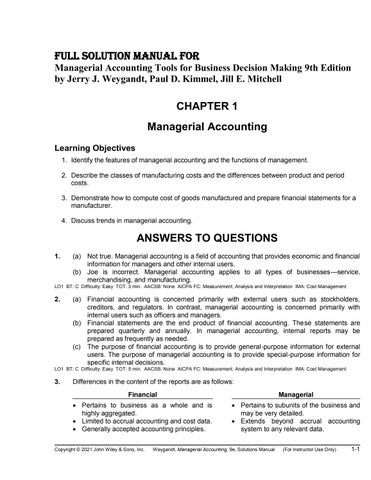
Full Solution Manual For Managerial Accounting Tools for Business Decision Making 9th Edition by Jerry J. Weygandt, Paul D. Kimmel, Jill E. Mitchell
CHAPTER 1 Managerial Accounting Learning Objectives 1. Identify the features of managerial accounting and the functions of management. 2. Describe the classes of manufacturing costs and the differences between product and period costs. 3. Demonstrate how to compute cost of goods manufactured and prepare financial statements for a manufacturer. 4. Discuss trends in managerial accounting.
ANSWERS TO QUESTIONS 1.
(a) Not true. Managerial accounting is a field of accounting that provides economic and financial information for managers and other internal users. (b) Joe is incorrect. Managerial accounting applies to all types of businesses—service, merchandising, and manufacturing.
LO1 BT: C Difficulty: Easy TOT: 3 min. AACSB: None AICPA FC: Measurement, Analysis and Interpretation IMA: Cost Management
2.
(a) Financial accounting is concerned primarily with external users such as stockholders, creditors, and regulators. In contrast, managerial accounting is concerned primarily with internal users such as officers and managers. (b) Financial statements are the end product of financial accounting. These statements are prepared quarterly and annually. In managerial accounting, internal reports may be prepared as frequently as needed. (c) The purpose of financial accounting is to provide general-purpose information for external users. The purpose of managerial accounting is to provide special-purpose information for specific internal decisions.
LO1 BT: C Difficulty: Easy TOT: 5 min. AACSB: None AICPA FC: Measurement, Analysis and Interpretation IMA: Cost Management
3.
Differences in the content of the reports are as follows: Financial
Managerial
Pertains to business as a whole and is highly aggregated. Limited to accrual accounting and cost data. Generally accepted accounting principles.
Pertains to subunits of the business and may be very detailed. Extends beyond accrual accounting system to any relevant data.
Copyright © 2021 John Wiley & Sons, Inc.
Weygandt, Managerial Accounting, 9e, Solutions Manual
(For Instructor Use Only)
1-1
Standard is relevance to decisions. In financial accounting, financial statements are verified annually through an independent audit by certified public accountants. There are no independent audits of internal reports prepared by managerial accountants. LO1 BT: C Difficulty: Easy TOT: 5 min. AACSB: None AICPA FC: Measurement, Analysis and Interpretation IMA: Cost Management
4.
Linda should know that the management of an organization performs three broad functions: (1) Planning requires management to look ahead and to establish objectives. (2) Directing involves coordinating the diverse activities and human resources of a company to produce a smooth-running operation. (3) Controlling is the process of keeping the company’s activities on track.
LO1 BT: C Difficulty: Easy TOT: 3 min. AACSB: None AICPA FC: Measurement, Analysis and Interpretation IMA: Cost Management
5.
Not true. Decision-making is not a separate management function. Rather, decision-making involves the exercise of good judgment in performing the three management functions explained in the answer to question four above.
LO1 BT: C Difficulty: Easy TOT: 2 min. AACSB: None AICPA FC: Measurement, Analysis and Interpretation IMA: Cost Management
6.
Employees with line positions are directly involved in the company’s primary revenue generating operating activities. Examples would include factory managers and supervisors, and the vice president of operations. In contrast, employees with staff positions are not directly involved in revenue-generating operating activities, but rather serve in a support capacity to line employees. Examples include employees in finance, legal, and human resources.
LO1 BT: C Difficulty: Easy TOT: 3 min. AACSB: None AICPA FC: Measurement, Analysis and Interpretation IMA: Cost Management
Questions Chapter 1 (Continued) 7.
The difference in balance sheets pertains to the presentation of inventories in the current asset section. In a merchandising company, only inventory is shown. In a manufacturing company, three inventory accounts are shown: finished goods, work in process, and raw materials.
LO3 BT: C Difficulty: Easy TOT: 2 min. AACSB: None AICPA FC: Measurement, Analysis and Interpretation IMA: Cost management
8.
Manufacturing costs are classified as either direct materials, direct labor, or manufacturing overhead.
LO2 BT: C Difficulty: Easy TOT: 1 min. AACSB: None AICPA FC: Measurement, Analysis and Interpretation IMA: Cost management
9.
No, Mel is not correct. The distinction between direct and indirect materials is based on two criteria: (1) physical association and (2) the convenience of making the physical association. Materials which cannot be easily associated with the finished product are considered indirect materials.
LO2 BT: C Difficulty: Easy TOT: 2 min. AACSB: None AICPA FC: Measurement, Analysis and Interpretation IMA: Cost management
10.
Product costs, or inventoriable costs, are costs that are a necessary and integral part of producing the finished product, they are classified as manufacturing costs. Period costs are costs that are identified with a specific time period rather than with a salable product. These costs relate to nonmanufacturing activities and therefore are not inventoriable costs, they are expensed as incurred.
LO2 BT: K Difficulty: Easy TOT: 2 min. AACSB: None AICPA FC: Measurement, Analysis and Interpretation IMA: Cost management
11.
A merchandising company that uses the periodic inventory system reports beginning inventory, cost of goods purchased, and ending inventory in the cost of goods section of the income statement. A manufacturing company reports beginning finished goods inventory, cost of goods manufactured, and ending finished goods inventory in its determination of cost of goods sold.
LO3 BT: C Difficulty: Easy TOT: 5 min. AACSB: None AICPA FC: Measurement, Analysis and Interpretation IMA: Cost management
12.
(a) (b)
X = total cost of work in process. X = cost of goods manufactured.
LO3 BT: C Difficulty: Easy TOT: 2 min. AACSB: None AICPA FC: Measurement, Analysis and Interpretation IMA: Cost management
13.
Raw materials inventory, beginning ...................................................................... Raw materials purchases......................................................................................
$12,000 170,000
Less: Total raw materials available for use ............................................................ Raw materials inventory, ending ............................................................................ Direct materials used ....................................................................................
182,000 15,000 $167,000
LO3 BT: AP Difficulty: Easy TOT: 3 min. AACSB: Analytic AICPA FC: Measurement, Analysis and Interpretation IMA: Cost management ($12,000 + $170,000 - $15,000 = $167,000) (Beg. RM + RM purch. – End. RM = DM used)
14.
Direct materials used ............................................................................................. Direct labor ........................................................................................................... Total manufacturing overhead ............................................................................... Total manufacturing costs .............................................................................
$240,000 220,000 180,000 $640,000
LO3 BT: AP Difficulty: Easy TOT: 2 min. AACSB: Analytic AICPA FC: Measurement, Analysis and Interpretation IMA: Cost management ($240,000 + $220,000 + $180,000 = $640,000) (DM used + DL used + Tot. MOH = Tot. mfg. costs)
15.
(a) (b)
Total cost of work in process ($26,000 + $640,000) ...................................... Cost of goods manufactured ($666,000 – $32,000) ......................................
$666,000 $634,000
LO3 BT: AP Difficulty: Easy TOT: 2 min. AACSB: Analytic AICPA FC: Measurement, Analysis and Interpretation IMA: Cost management [(a: $26,000 + $640,000 = $666,000); (b: $666,0000 - $32,000 = $634,000)] [(a: Beg. WIP + Tot. mfg. costs = Tot. cost of WIP); (b: Tot. cost of WIP – End. WIP = COGM)]
16. The order of reporting is finished goods inventory, work in process inventory, and raw materials inventory. LO3 BT: K Difficulty: Easy TOT: 1 min. AACSB: None AICPA FC: Measurement, Analysis and Interpretation IMA: Cost management
Questions Chapter 1 (Continued) 17.
The products differ in how each are consumed by the customer. Services are consumed as they are provided; and not capitalized into inventory. Meals at a restaurant are the best example where they are consumed immediately by the customer. There could be a long lead time before the product is sold to a customer in a manufacturing environment.
LO4 BT: C Difficulty: Easy TOT: 3 min. AACSB: None AICPA FC: Measurement, Analysis and Interpretation IMA: Cost management
18.
The product costing techniques apply equally well to manufacturers and service companies. Each needs to keep track of the cost of production or services in order to know whether it is generating a profit. The techniques shown in this chapter, to accumulate manufacturing costs to determine manufacturing inventory, are equally useful for determining the cost of services.
LO4 BT: K Difficulty: Easy TOT: 3 min. AACSB: None AICPA FC: Measurement, Analysis and Interpretation IMA: Cost management
19.
The value chain refers to all activities associated with providing a product or service. For a manufacturer, these include research and development, product design, acquisition of raw materials, production, sales and marketing, delivery, customer relations, and subsequent service. The value chain includes both manufacturing and nonmanufacturing activities and costs.
LO4 BT: C Difficulty: Easy TOT: 3 min. AACSB: None AICPA FC: Decision Modeling IMA: Strategic Planning
20. An enterprise resource planning (ERP) system is an integrated software system that provides a comprehensive, centralized resource for information. Its primary benefits are that it replaces the many individual systems typically used for receivables, payables, inventory, human resources, etc. Also, it can be used to get information from, and provide information to, the company’s customers and suppliers. LO4 BT: C Difficulty: Easy TOT: 3 min. AACSB: None AICPA FC: System and Process Management IMA: Strategic Planning
21.
In a just-in-time inventory system, the company has no extra inventory stored. Consequently, if some units that are produced are defective, the company will not have enough units to deliver to customers.
LO4 BT: C Difficulty: Easy TOT: 2 min. AACSB: None AICPA FC: System and Process Management IMA: Strategic Planning
Copyright © 2021 John Wiley & Sons, Inc.
Weygandt, Managerial Accounting, 9e, Solutions Manual
(For Instructor Use Only)
1-3
22. The balanced scorecard is called ―balanced‖ because it strives to not over emphasize any one performance measure, but rather uses both financial and non-financial measures to evaluate all aspects of a company’s operations in an integrated fashion. LO4 BT: C Difficulty: Easy TOT: 3 min. AACSB: None AICPA FC: System and Process Management IMA: Strategic Planning
23. Budgets are prepared by companies to provide future direction. Because the budget is also used as an evaluation tool, some managers may try to game the budgeting process by underestimating their division’s predicted performance so that it will be easier to meet their performance targets. On the other hand, if the budget is set at unattainable levels, managers sometimes take unethical actions to meet targets to receive higher compensation or in some cases to keep their jobs. LO4 BT: C Difficulty: Easy TOT: 3 min. AACSB: Ethics AICPA PC: Ethical Conduct IMA: Business Applications
24. According to the Sarbanes-Oxley Act of 2002, CEOs and CFOs must now certify that financial statements give a fair presentation of the company’s operating results and its financial condition and that the company maintains an adequate system of internal controls. In addition, the composition of the board of directors and audit committees receives more scrutiny, and penalties for misconduct have increased. LO4 BT: C Difficulty: Easy TOT: 3 min. AACSB: Ethics AICPA FC: Measurement, Analysis and Interpretation AICPA PC: Ethical Conduct IMA: FSA, Business Applications
25. Activity-based costing is an approach used to allocate overhead based on each product’s relative use of activities in making the product. Activity-based costing is beneficial because it results in more accurate product costing and in more careful scrutiny of all activities in the value chain. LO4 BT: C Difficulty: Easy TOT: 3 min. AACSB: None AICPA FC: Measurement, Analysis and Interpretation IMA: Cost management
SOLUTIONS TO BRIEF EXERCISES BRIEF EXERCISE 1.1 Financial Accounting
Managerial Accounting
Primary users
External users
Internal users
Types of reports
Financial statements Quarterly and annually
Internal reports As frequently as needed
Frequency of reports
Quarterly and annually
As frequently as needed
Purpose of reports
General-purpose
Special-purpose information for specific decisions
Content of reports
Pertains to business as a whole. Highly aggregated. Limited to accrual accounting and cost data. Generally accepted accounting principles
Pertains to subunits of the business. Very detailed. Extends beyond accrual accounting to any relevant data. Evaluated based on relevance to decisions
Verification process
Annual audit by certified public accountant
No independent audits
LO1 BT: C Difficulty: Easy TOT: 3 min. AACSB: None AICPA FC: Measurement, Analysis and Interpretation IMA: Cost Management
BRIEF EXERCISE 1.2 (a) 1. Planning. (b) 2. Directing. (c) 3. Controlling. LO1 BT: C Difficulty: Easy TOT: 1 min. AACSB: None AICPA FC: Measurement, Analysis and Interpretation IMA: Cost Management
BRIEF EXERCISE 1.3 (a) (b) (c) (d)
DM DL MO MO
Frames and tires used in manufacturing bicycles. Wages paid to production workers. Insurance on factory equipment and machinery. Depreciation on factory equipment.
LO2 BT: C Difficulty: Easy TOT: 2 min. AACSB: None AICPA FC: Measurement, Analysis and Interpretation IMA: Cost Management
Copyright © 2021 John Wiley & Sons, Inc.
Weygandt, Managerial Accounting, 9e, Solutions Manual
(For Instructor Use Only)
1-5