Solution Manual for Marketing Management 4th EditionMark Johnston Greg Marshall
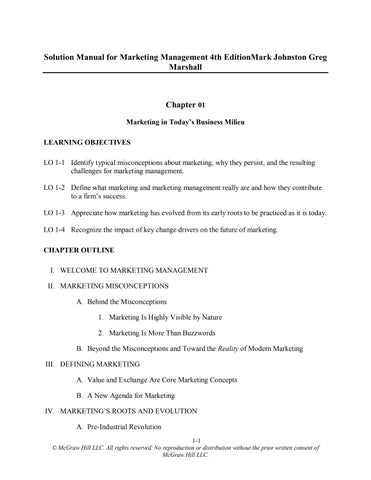
Chapter 01 Marketing in Today’s Business Milieu LEARNING OBJECTIVES LO 1-1 Identify typical misconceptions about marketing, why they persist, and the resulting challenges for marketing management. LO 1-2 Define what marketing and marketing management really are and how they contribute to a firm’s success. LO 1-3 Appreciate how marketing has evolved from its early roots to be practiced as it is today. LO 1-4 Recognize the impact of key change drivers on the future of marketing. CHAPTER OUTLINE I. WELCOME TO MARKETING MANAGEMENT II. MARKETING MISCONCEPTIONS A. Behind the Misconceptions 1. Marketing Is Highly Visible by Nature 2. Marketing Is More Than Buzzwords B. Beyond the Misconceptions and Toward the Reality of Modern Marketing III. DEFINING MARKETING A. Value and Exchange Are Core Marketing Concepts B. A New Agenda for Marketing IV. MARKETING’S ROOTS AND EVOLUTION A. Pre-Industrial Revolution 1-1 © McGraw Hill LLC. All rights reserved. No reproduction or distribution without the prior written consent of McGraw Hill LLC.
B. Focus on Production and Products C. Focus on Selling D. Advent of the Marketing Concept 1. The Marketing Mix E. Post-Marketing Concept Approaches 1.
Differentiation Orientation
2.
Market Orientation
3.
Relationship Orientation
4.
One-to-One Marketing
V. CHANGE DRIVERS IMPACTING THE FUTURE OF MARKETING A. Shift to Product Glut and Customer Shortage B. Shift in Information Power from Marketer to Customer C. Shift in Generational Values and Preferences D. Shift to Distinguishing Marketing (Big M) from marketing (little m) 1.
Marketing (Big M)
2.
marketing (little m)
E. Shift to Justifying the Relevance and Payback of the Marketing Investment VI. YOUR MARKETING MANAGEMENT JOURNEY BEGINS VII. SUMMARY
KEY TERMS marketing management The leading and managing of the facets of marketing to improve individual, unit, and organizational performance. marketing’s stakeholders Any person or entity inside or outside a firm with whom marketing interacts, impacts, and is impacted by. 1-2 © McGraw Hill LLC. All rights reserved. No reproduction or distribution without the prior written consent of McGraw Hill LLC.
societal marketing The concept that, at the broadest level, members of society at large can be viewed as a stakeholder for marketing. sustainability The practicing of business that meet humanity’s needs without harming future generations. value A ratio of the bundle of benefits a customer receives from an offering compared to the costs incurred by the customer in acquiring that bundle of benefits. exchange The giving up of something of value for something desired. production orientation The maximization of production capacity through improvements in products and production activities without much regard for what is going on in the marketplace. sales orientation The increase of sales and consequently production capacity utilization by having salespeople ―push‖ product into the hands of customers. marketing concept Business philosophy that emphasizes an organization-wide customer orientation with the objective of achieving long-run profits. marketing mix (4Ps of marketing) Product, price, place, and promotion—the fundamental elements that comprise the marketer’s tool kit that can be developed in unique combinations to set the product or brand apart from the competition. offering A product or service that delivers value to satisfy a need or want. solution A bundle of benefits from an offering that solves a problem or fills a need of a customer. differentiation Communicating and delivering value in different ways to different customer groups. customer orientation Placing the customer at the core of all aspects of the enterprise. market orientation The implementation of the marketing concept, based on the understanding of competitors and listening to the market. relationship orientation Investing in keeping and cultivating profitable current customers instead of constantly having to invest in gaining new ones. one-to-one marketing Directing energy and resources into establishing a learning relationship with each customer and connecting that knowledge with the firm’s production and service capabilities to fulfill that customer’s needs in as custom a manner as possible. mass customization Combining flexible manufacturing with flexible marketing to greatly enhance customer choice. Marketing (Big M) The dimension of marketing that focuses on external forces that affect the organization and serves as the driver of business strategy. 1-3 © McGraw Hill LLC. All rights reserved. No reproduction or distribution without the prior written consent of McGraw Hill LLC.
strategic marketing The long-term, firm-level commitment to investing in marketing— supported at the highest organization level—for the purpose of enhancing organizational performance. market creation Approaches that drive the market toward fulfilling a whole new set of needs that customers did not realize was possible or feasible before. marketing (little m) The dimension of marketing that focuses on the functional or operational level of the organization. tactical marketing Marketing activities that take place at the functional or operational level of a firm. marketing metrics Tools and processes designed to identify, track, evaluate, and provide key benchmarks for improvement of marketing activities. marketing analytics The practice of measuring, managing, and analyzing marketing performance to maximize marketing effectiveness and optimize return on marketing investment (ROMI). return on marketing investment (ROMI) What impact an investment in marketing has on a firm’s success, especially financially.
APPLICATION QUESTIONS 1. Consider the various marketing misconceptions introduced in this chapter. a. Pick any two of the misconceptions and develop a specific example of each from your own experience with firms and brands. •
Catchy and entertaining advertisements — or perhaps the opposite, incessant and boring advertisements.
•
Pushy salespeople trying to persuade someone to buy it right now.
•
Famous brands and their celebrity spokespeople, such as Nike’s athlete endorsers.
•
Product claims that turn out to be overstated or just plain false, causing doubt about the trustworthiness of a company.
•
Marketing departments ―own‖ an organization’s marketing initiative.
b. How will it be beneficial for a new marketing manager to understand the misconceptions that exist about marketing? Effective marketing management isn’t about buzzwords or quick fixes. In today’s business milieu, the reality of marketing is that it is a central function and set of processes essential to any enterprise. Moreover, leading and managing the facets of marketing in 1-4 © McGraw Hill LLC. All rights reserved. No reproduction or distribution without the prior written consent of McGraw Hill LLC.
order to improve individual, unit, and organizational performance – marketing management – is a core business activity, worthy of any student’s study and mastery. c. Can you come up with some other marketing misconceptions of your own – ones that are not addressed in the chapter? Student answers to this question will vary.
2. In the chapter we make a strong case for the relevance of Peter Drucker’s key themes today, even though much of his writing was done decades ago. Do you agree that his message was ahead of its time and is still relevant? Why or why not? Assume you are the CEO of a firm that wants to practice a market orientation. How will Drucker’s advice help you to accomplish this goal? Peter Drucker’s key themes included a business built around the customer with resources and processes aligned to maximize customer value. He also believed that marketing is the central core of the firm, and it should therefore be the concern and responsibility of the entire organization. This business philosophy was well ahead of its time. Excerpts from Drucker’s advice that would impact an executives’ effort to enact a market orientation: What the customer thinks he is buying, what he considers ―value‖ is decisive—Because it is the [purpose of a business] to create a customer, [the] business enterprise has two – and only two – business functions: marketing and innovation.1
3. Put yourself in the role of a marketing manager – from this perspective, do you agree with the concepts of societal marketing and sustainability? Why or why not? How does a focus on sustainability affect the marketing manager’s role and activities? Identify two organizations that you believe do a great job of paying attention to sustainability and present the evidence that leads you to this conclusion. Marketing’s stakeholders include any person or entity inside or outside a firm with whom marketing interacts, impacts, and is impacted by. At the broadest conceptual level, members of society at large can be viewed as a stakeholder for marketing – a concept called societal marketing. Sustainability refers to business practices that meet humanity’s needs without harming future generations. 2 Sustainability practices have helped socially responsible organizations incorporate doing well by doing good into their overarching business models so that both the success of the firm and the success of society at large are sustained over the long term. Example of an organization that is doing a great job of paying attention to sustainability: Unilever: 1-5 © McGraw Hill LLC. All rights reserved. No reproduction or distribution without the prior written consent of McGraw Hill LLC.