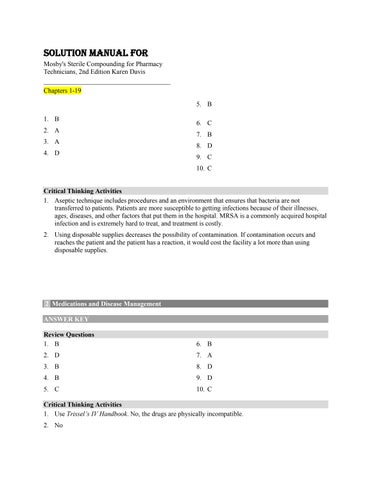
Solution Manual For Mosby's Sterile Compounding for Pharmacy Technicians, 2nd Edition Karen Davis ______________________________________ Chapters 1-19 5. B 1. B 2. A 3. A 4. D
6. C 7. B 8. D 9. C 10. C
Critical Thinking Activities 1. Aseptic technique includes procedures and an environment that ensures that bacteria are not transferred to patients. Patients are more susceptible to getting infections because of their illnesses, ages, diseases, and other factors that put them in the hospital. MRSA is a commonly acquired hospital infection and is extremely hard to treat, and treatment is costly. 2. Using disposable supplies decreases the possibility of contamination. If contamination occurs and reaches the patient and the patient has a reaction, it would cost the facility a lot more than using disposable supplies.
2 Medications and Disease Management ANSWER KEY Review Questions 1. B
6. B
2. D
7. A
3. B
8. D
4. B
9. D
5. C
10. C
Critical Thinking Activities 1. Use Trissel’s IV Handbook. No, the drugs are physically incompatible. 2. No
3. Physically incompatible 4. No 5. No, it must be light protected along with room temperature. There is no way to verify that it was light protected. 6. Yes, it is good for 14 days refrigerated. 7. Use IV because of the nausea and vomiting and the inability to keep down medications. Also, the average adult dose would not be appropriate because of decreased function of the kidneys, which causes drugs to not be excreted as quickly, and a lower dose is needed. Also, cardiac output in elderly patients in general is lower, and drugs distribution is also slower. The dose needs to be lower than the normal adult dose. Weight is also low, and this is another reason to use a lower dose possibly. 8. This is a classic case of toxicity from phenobarbital in pediatrics (slurring). Also, adverse reactions are rash, irritability, and sleep disturbances in children. Recommend changing the medications immediately. 9. Because of the aging process, poor circulation and age-related decreased renal clearance occur in this population. This is one of the considerations to look at when administering IV medications such as digoxin. 10. ●
The generic name for Synagis is palivizumab. Synagis is used to treat a severe lung (lower respiratory tract) disease caused by respiratory syncytial virus (RSV). This medication is packaged and prepared in single-dose vials: 50 mg/0.5 mL and 100 mg/1 mL. Contraindications for using Synagis include bleeding, blood clotting disorder, and low platelet level. Yes, this medication is used in children. Synagis should be stored between 2° C and 8° C (36° F and 46° F) in its original container. It should not be frozen or used beyond the expiration date.
Lab Activities 1. What is the pH of premixed cimetidine HCl? 5 to 7 pH How does it come (mg in solution)? 300 mg/NS 50 ml If mixed with warfarin, describe what visual precipitate occurs? Haze forms in 1 hr 2. Name two solutions that vancomycin can be mixed in? D5W, NS How long does the manufacturer state that it is good for when mixed with D5NS? 14 days refrigerated If mixed with methotrexate, describe what precipitate occurs? Dark yellow in 4 hours 3. How is Rocephin packaged? 250-mg, 500-mg, 1-g, and 2-g vials. Also 1-g and 2-g PB bottles and 10g bulk containers For intramuscular injection, how much diluent would you use for a 500-mg vial? 0.9 mL If using SWFI and the concentration is 250 mg/mL, how long is it stable at 4° C? 3 days How long is the frozen premixed solution stable for? 90 days at –20° C 4. How is amphotericin B administered normally? IV slow infusion over 2 to 6 hours Name any special considerations used when preparing an infusion. Protect from light; must be filtered; use only sterile water for injection without preservatives to dilute. Bacteriostatic agents in NS may cause precipitation. Name two solutions that are incompatible and describe what occurs. NS, LR, D5NS, and D%LR; precipitate forms 5. Answers will vary. 6. Answers may vary depending on website updates. 7. Answers may vary depending on website updates. 3 Communication Within and Beyond the Pharmacy ANSWER KEY Review Questions 1. B
6. D
2. D
7. A
3. D
8. B
4. C
9. C
5. C
10. B
Critical Thinking Activities 1. Examples: Does the individual have personal goals and align them with the team’s goals? Does the individual have mutual respect for their colleagues? Does the individual share their skills and knowledge and well as appreciate knowledge from others? Does the individual appreciate input from others and have a willingness to learn from their mistakes? Does the individual strive to stay current in their field and changes in practice? Does the individual use effective listening skills with others? 2. Call the nurse back to double check the order. When in doubt, ask for a repeat or a clarification of information—don’t assume anything. A patient’s well-being is on the line.
Chapter 1: The Dental Team in the Business of Dentistry
4 Infection Control and Waste Management ANSWER KEY Review Questions 1. D
6. B
2. A
7. A
3. A
8. B
4. A
9. A
5. A
10. B
Critical Thinking Activities 1. The steps related are as follows: Infectious agent – A pathogen or disease-causing agent that you may have inside. Reservoir – You may be carrying the disease-causing agent. Portal of exit – In compounding, you could transfer the agent through touch of the needle Mode of transmission – While performing aseptic technique, this can be transferred from you (preparer) to the product and then to the patient. Portal of entry – The patient gets the IV you prepared through the opening into the skin made with a needle or catheter for an IV line. Susceptible host – Your patient is at risk for infection. Since parenteral therapy requires an opening into the skin, the patient is venerable because they have a ready portal of entry directly into the blood stream. 5 Calculations Used in Intravenous Preparations ANSWER KEY Review Questions 1. First calculate the final volume: Convert 4 grams into milligrams: 4000 mg = 250 mg x mL 4000 mg (mL) = 250 mg (X) 250 mg 250 mg x = 16 mL Calculate PV: PV = FV - DV PV = 16 mL – 11.7 mL PV = 4.3 mL 2. 2800 mL = x 24 hr hr x = 116.7 mL hr 3.
75 mL = x 45 min 60 min X = 100 mL
4
hr 4. 60 mg = x 75 mL 100 mL X = 80 mg
5. (10 mL/hr)(10 gtt/mL) = gtt 60 min/hr min 1.6 gtt/min; rounded to 2 gtt/min 6. B 7. A 8. C 9. A Critical Thinking Activities 1. Infuse 1000 mls over 10 hrs. 1000 mL = X 10 hr hr X = 100 mL
hr