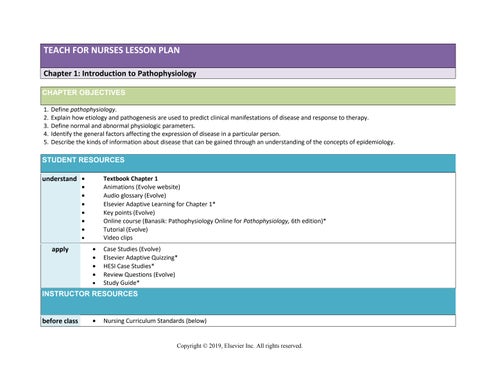
TEACH FOR NURSES LESSON PLAN Chapter 1: Introduction to Pathophysiology CHAPTER OBJECTIVES 1. Define pathophysiology. 2. Explain how etiology and pathogenesis are used to predict clinical manifestations of disease and response to therapy. 3. Define normal and abnormal physiologic parameters. 4. Identify the general factors affecting the expression of disease in a particular person. 5. Describe the kinds of information about disease that can be gained through an understanding of the concepts of epidemiology.
STUDENT RESOURCES understand
Textbook Chapter 1 Animations (Evolve website) Audio glossary (Evolve) Elsevier Adaptive Learning for Chapter 1* Key points (Evolve) Online course (Banasik: Pathophysiology Online for Pathophysiology, 6th edition)* Tutorial (Evolve) Video clips
apply
Case Studies (Evolve) Elsevier Adaptive Quizzing* HESI Case Studies* Review Questions (Evolve) Study Guide*
INSTRUCTOR RESOURCES
before class
Nursing Curriculum Standards (below)
Copyright © 2019, Elsevier Inc. All rights reserved.
35-2
in class
PowerPoint Presentations (Evolve) Image Collection (Evolve) Learning Activities (below) Discussion Topics (below) In-Class/Online Case Study (below)
after class
Test Bank (Evolve)
* Sold separately from textbook.
TEACHING STRATEGIES Content Focus
Content Highlights
Learning Activities
Discuss the principles of pathophysiology and its four interrelated topics (etiology, pathogenesis, clinical manifestations, and treatment implications).
Discussion Topic: Have students identify diseases with idiopathic, iatrogenic, and multifactorial causes and discuss the importance of identifying risk factors for diseases
Statistical Normality
Explain how measurements of structural, physiologic, biochemical, and genetic parameters provide a basis for disease screening and identification of risk factors.
Activity: Have students shadow a nurse at a clinic or medical facility who is providing care to a diverse population. Instruct students to identify patients’ individual factors of relevance in determining what is abnormal or in making a diagnosis
Individual Factors Influencing Normality PATTERNS OF DISEASE IN POPULATIONS
Discuss epidemiology and how it relates to disease susceptibility and distribution.
Online Activity: Have students visit http://www.cdc.gov/chronicdisease/ index.htm and explore the Centers for Disease Control and Prevention’s resources dealing with the prevention of chronic diseases. Activity: Have students identify the agency in their area that provides epidemiology services; then have an epidemiologist visit the class.
FRAMEWORK FOR PATHOPHYSIOLOGY Etiology Pathogenesis Clinical Manifestations Treatment Implications CONCEPTS OF NORMALITY IN HEALTH AND DISEASE
Concepts of Epidemiology
Copyright © 2019, Elsevier Inc. All rights reserved.
35-3
IN-CLASS / ONLINE CASE STUDY JT is a 34-year-old woman who comes to the clinic for a wellness exam. Her friend has just been found to have heart disease. She asks you what type of diseases she might be at risk for. She has heard that a C-reactive protein (CRP) test measures inflammation and would help diagnose whether she is a risk for cardiovascular disease. You counsel her on the following: 1. You know that the CRP test is very sensitive but that is not specific. Explain what this means for JT. Answer: Sensitivity and specificity will help determine whether she will be at risk. Because CRP is highly sensitive, it will tell her that she has inflammation going on and that any inflammation could increase her CRP level. You will need to search for evidence of other causes of, and look at other markers for, cardiovascular disease.
2. You decide to also discuss with JT individual factors that could affect her risks for cardiovascular disease. Discuss how each of the following variables may affect her. a. Cultural Answer: Cultural beliefs change how we look at symptoms of disease. What we eat and drink often directly relates to our cultural beliefs. Furthermore, in an area where health care is not readily available, such as an impoverished area, people may not seek health care. b. Age Answer: As we age, we are more affected by the aging process and become more at risk for select disease processes. Cholesterol levels rise as we age, and our diets change when we enter the work force, often when we add more fast food or quick meals containing more fats to our diets. In the aging years, our level of activity generally decreases, carrying with it its own effects on our risk for disease. c.
Ethnic Answer: Certain ethnicities are predisposed to different diseases. Understanding which diseases you are at risk for can help you decide how to best prevent them or diagnose and treat them.
Copyright © 2019, Elsevier Inc. All rights reserved.
35-4
NURSING CURRICULUM STANDARDS
QSEN/NLN COMPETENCIES
Patient-Centered Care o Individual Factors Influencing Normality o Cultural Considerations o Age Differences o Gender Differences o Situational Differences o Time Variations
NURSING CONCEPTS The following conceptual themes and specific concepts match those presented in Giddens, J. F. (2017). Concepts for nursing practice (2nd ed.). St. Louis: Elsevier. The specific exemplars chosen and listed below for each concept have been tailored specifically to correspond to the Banasik textbook. A full Concept-Based Curriculum Map covering the entire book can be found in the “Download by Resource Type” folder on Evolve. HEALTH CARE RECIPIENT CONCEPTS THEME: Attributes and Resources CONCEPT: Development o Exemplar: Age Differences THEME: Personal Preferences CONCEPT: Culture o Exemplar: Cultural Considerations
BSN ESSENTIALS
Essential VII: Clinical Prevention and Population Health o Patterns of Disease in Populations o Concepts of Epidemiology
Copyright © 2019, Elsevier Inc. All rights reserved.
35-5 o o
Aggregate Factors Levels of Prevention
TEACH FOR NURSES LESSON PLAN Chapter 2: Homeostasis, Allostasis, and Adaptive Responses to Stressors CHAPTER OBJECTIVES 1. Describe the relationship between homeostasis and allostasis. 2. Describe how the sympathetic nervous system and neuroendocrine system respond to stress. 3. Identify the key features of Selye’s General Adaptation Syndrome. 4. Identify factors affecting the stress response. 5. Describe how allostatic overload contributes to the development of disease.
STUDENT RESOURCES understand
Textbook Chapter 2 Animations (Evolve website) Audio glossary (Evolve) Elsevier Adaptive Learning for Chapter 2* Key points (Evolve) Online course (Banasik: Pathophysiology Online for Pathophysiology, 6th edition)* Tutorial (Evolve) Video clips
apply
Case Studies (Evolve) Elsevier Adaptive Quizzing* HESI Case Studies* Review Questions (Evolve) Study Guide*
Copyright © 2019, Elsevier Inc. All rights reserved.