SM 5-1
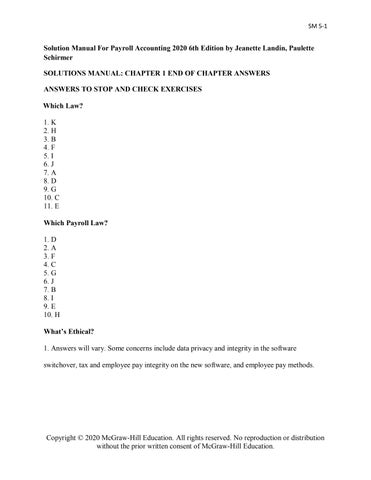
Solution Manual For Payroll Accounting 2020 6th Edition by Jeanette Landin, Paulette Schirmer SOLUTIONS MANUAL: CHAPTER 1 END OF CHAPTER ANSWERS ANSWERS TO STOP AND CHECK EXERCISES Which Law? 1. K 2. H 3. B 4. F 5. I 6. J 7. A 8. D 9. G 10. C 11. E Which Payroll Law? 1. D 2. A 3. F 4. C 5. G 6. J 7. B 8. I 9. E 10. H What’s Ethical? 1. Answers will vary. Some concerns include data privacy and integrity in the software switchover, tax and employee pay integrity on the new software, and employee pay methods.
Copyright © 2020 McGraw-Hill Education. All rights reserved. No reproduction or distribution without the prior written consent of McGraw-Hill Education.
SM 5-2
2. Answers will vary. Liza could choose to ignore her sorority sister’s request, claiming Confidentiality. She could also discontinue active participation in the sorority. In any case, Liza must not consent to her sorority sister’s request for confidential information.
Confidential Records As a payroll clerk, your task is to protect the privacy and confidentiality of the information you maintain for the company. If a student group—or any personnel aside from the company’s payroll employees and officers—wishes to review confidential records, you should deny their request. If needed, you should refer the group to your department’s manager to discuss the matter in more depth. The laws that apply to this situation are the Privacy Act of 1974, the Freedom of Information Act, and potentially HIPAA.
Large vs. Small 1. Large companies face issues with multiple departments, employee access to online personnel portals, employee data security, and timekeeping accuracy. 2. For small companies, the cost of outsourcing the payroll function needs to be considered. On one hand, a small company may not have personnel who are proficient with payroll regulations and tax reporting requirements, which leaves a company vulnerable to legal actions and stringent fines. However, engaging a payroll service company may be cost prohibitive. The decision to outsource the payroll for a small company should consider the number of personnel, locations, and types of operations in which the company engages.
Copyright © 2020 McGraw-Hill Education. All rights reserved. No reproduction or distribution without the prior written consent of McGraw-Hill Education.
SM 5-3
What Is the Difference? a.
Manual payroll systems involve the use of paper and pencil recordkeeping or a
spreadsheet program, such as Microsoft Excel. This is most appropriate for very small firms. b. Computerized payroll systems can be used by any company, regardless of size. Examples of computerized systems include, QuickBooks, Sage 100, and Microsoft Dynamics GP. These computer packages range in price, depending on the company size and operational scope. c. Outsourced payroll involves the engagement of a third party to manage a company’s payroll data, issue employee compensation, and prepare tax forms. d. Certified payroll pertains to companies with employees who work on federal government contracts. Certified payroll ensures that a company reports payroll expenditures of contractually allocated money.
ANSWERS TO END-OF-CHAPTER MATERIALS REVIEW QUESTIONS 1. What is the purpose of a payroll system? a. Provide for internal and external reporting of employee wages and associated taxes, payment of employee compensation, and monitoring of benefits to employees. It also serves as a means of tracking labor costs that managers use for decision-making, budgeting, and planning. 2. What are two differences between large- and small-company payroll practices? a. Small companies would have fewer employees and reporting requirements, and would be less likely to be required to have automated payroll systems. Copyright © 2020 McGraw-Hill Education. All rights reserved. No reproduction or distribution without the prior written consent of McGraw-Hill Education.
SM 5-4
b. Large companies have more employees and greater departmentalization. This increase in employees leads to a higher level of complexity in payroll accounting, disbursements, and reporting. Larger companies may also provide Intranet portals for employee self-service options. Additionally, larger companies may need additional accuracy checks. 3. What is certified payroll? Which companies must use it? a. Certified payroll is a reporting requirement for companies that work with federal contracts that are subject to Davis-Bacon wages. Only those companies that have these types of employees would be required to complete a certified payroll. 4. Why might it be a good idea to let employees manage their pay records? What are some of the pitfalls? a. An advantage of allowing individuals to self-manage their payroll records would be the employee would be able to answer some simple questions on their own without having to come to the payroll accountant for answers. If employees have access to their payroll records, there would be the need to allow multiple access points to the confidential information. These open channels would require security settings to ensure the requirements of confidentiality are maintained. 5. What are two ways that a payroll system may protect a company in the event of a visit from a government auditor? Answers may vary, but should contain: a. Through the establishment and maintenance of an accurate payroll system. Through timely and accurately reporting wages and withholdings. 6. What is payroll outsourcing? When might a company consider outsourcing its payroll? Copyright © 2020 McGraw-Hill Education. All rights reserved. No reproduction or distribution without the prior written consent of McGraw-Hill Education.
SM 5-5
a. Payroll outsourcing is the process of contracting another company for the preparation, reporting, and filing of employee payroll. Companies may consider this option if the company sees a benefit to the company that outweighs the cost of outsourcing. 7. What are three examples of federal laws that are essential to ensure legal, fair hiring practices? Answers should contain the following: a. American with Disabilities Act b. Age Discrimination in Employment Act c. Fair Labor Standards Act d. Civil Rights Act 8. What are the major types of payroll processing methods? a. Manual b. Computerized c. Outsourced d. Certified 9. What are two laws governing the taxes that employers must withhold from employees? a. 16th Amendment of the U.S. Constitution b. Social Security Insurance Act 10. What are the guidelines for FLSA, in terms of overtime and pay rate? a. Maximum hours that covered individuals can work b. Minimum pay for covered individuals c. Minimum age for workers d. Mandatory break times for covered employees Copyright © 2020 McGraw-Hill Education. All rights reserved. No reproduction or distribution without the prior written consent of McGraw-Hill Education.