Solution Manual For Personal Finance, 2nd Edition Vickie L. Bajtelsmit Chapter 1-14 CHAPTER 1 Instructor Manual and Solutions
The Financial Planning Process LEARNING OBJECTIVES LO 1.1 Describe the personal financial planning process, and explain how the elements of a comprehensive financial plan fit together. LO 1.2 Describe how individual characteristics and economic factors influence personal financial planning. LO 1.3 Create a prioritized list of short-term and long-term personal financial goals. LO 1.4 Know when and how to find qualified financial planning professionals. LO 1.5 Consider opportunity costs and marginal effects in making personal finance decisions.
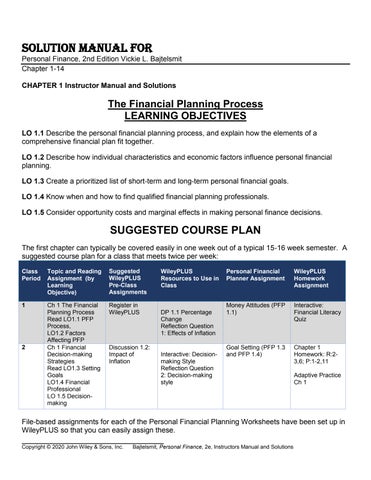
SUGGESTED COURSE PLAN The first chapter can typically be covered easily in one week out of a typical 15-16 week semester. A suggested course plan for a class that meets twice per week: Class Period
Topic and Reading Assignment (by Learning Objective)
Suggested WileyPLUS Pre-Class Assignments
1
Ch 1 The Financial Planning Process Read LO1.1 PFP Process, LO1.2 Factors Affecting PFP Ch 1 Financial Decision-making Strategies Read LO1.3 Setting Goals LO1.4 Financial Professional LO 1.5 Decisionmaking
Register in WileyPLUS
2
Discussion 1.2: Impact of Inflation
WileyPLUS Resources to Use in Class
DP 1.1 Percentage Change Reflection Question 1: Effects of Inflation
Interactive: Decisionmaking Style Reflection Question 2: Decision-making style
Personal Financial Planner Assignment
WileyPLUS Homework Assignment
Money Attitudes (PFP 1.1)
Interactive: Financial Literacy Quiz
Goal Setting (PFP 1.3 and PFP 1.4)
Chapter 1 Homework: R:23,6; P:1-2,11 Adaptive Practice Ch 1
File-based assignments for each of the Personal Financial Planning Worksheets have been set up in WileyPLUS so that you can easily assign these. Copyright © 2020 John Wiley & Sons, Inc.
Bajtelsmit, Personal Finance, 2e, Instructors Manual and Solutions
CHAPTER OUTLINE AND SUMMARY LO 1.1 Describe the personal financial planning process, and explain how the elements of a comprehensive financial plan fit together.
WHAT IS PERSONAL FINANCIAL PLANNING? I.
WHY STUDY PERSONAL FINANCIAL PLANNING? A. What Are the Benefits of Personal Financial Planning? B. Why Do People Avoid Financial Planning? C. What Problems Can Be Caused by Poor Financial Planning?
II.
THE PERSONAL FINANCIAL PLANNING PROCESS A. Step 1: Organize Your Financial Information and Set Short-Term and Long-Term Goals B. Step 2: Analyze Your Current Financial Status C. Step 3: Identify and Evaluate Alternative Strategies for Achieving Your Goals D. Step 4: Implement Your Financial Plan E. Step 5: Monitor Your Progress and Revise Your Plan as Needed
III.
ELEMENTS OF A COMPREHENSIVE FINANCIAL PLAN
LO 1.2 Describe how individual characteristics and economic factors influence personal financial planning.
FACTORS THAT INFLUENCE FINANCIAL PLANNING I.
INDIVIDUAL CHARACTERISTICS AND YOUR FINANCIAL PLAN A. Life Cycle Factors B. Demographic Characteristics C. Values and Attitudes
II.
ECONOMIC FACTORS AND YOUR FINANCIAL PLAN A. Inflation B. Interest Rates C. The Economy and the Job Market D. Political Unrest and Global Issues
LO 1.3
Create a prioritized list of short-term and long-term personal financial goals.
SETTING SHORT-TERM AND LONG-TERM FINANCIAL GOALS I. II. LO 1.4
WHY GOALS ARE IMPORTANT THE GOAL-SETTING PROCESS Know when and how to find qualified financial planning professionals.
SELECTING QUALIFIED FINANCIAL PLANNING PROFESSIONALS I. II. III.
LO 1.5
WHEN DO YOU NEED A FINANCIAL PLANNER? FACTORS TO CONSIDER IN CHOOSING A FINANCIAL PLANNER HOW ARE PLANNERS PAID?
Consider opportunity costs and marginal effects in making personal finance decisions.
MAKING EFFECTIVE DECISIONS I. II. III. IV. V.
MAKE REASONABLE ASSUMPTIONS APPLY MARGINAL REASONING CONSIDER OPPORTUNITY COSTS USE SENSITIVITY ANALYSIS DECISION-MAKING STYLES
EACHING SUGGESTIONS 1. Ask students to take the Personal Financial Literacy quiz (Interactive Figure 1.1) before the first class or during the first week. Although you will not see their scores or count their actual grades on the quiz, it can be a helpful baseline for students and can also help to preview topics that will be covered in the course. Have a discussion in class about what components of the course they think will be most helpful to them. You may want them to retake that same quiz at the end of the course to compare results.
2. Most personal finance instructors ask students to develop a personal financial plan during the semester. The first class is an appropriate time to explain this assignment and to direct the students to the related resources included in WileyPlus Learning Space. 3. Ask students to complete Excel Worksheet 1.1 Money Attitudes Questionnaire and, if possible, to have family members or roommates complete it as well. Follow-up class discussion can center on how differences in attitudes can make joint financial decisions more difficult. 4. Many students take a personal finance class because they have a financial problem they would like to work on, such as overspending or credit card debt. Ask each student to list three short-term personal finance goals that they would like to achieve in the coming year and three long-term goals they would like to achieve in the next five years. Break the class into small groups and have them compare their lists. As a class, compile a list of the most common short-term goals coming out of the small groups. Discuss which is/are more important and why. 5. Illustrate the impact of inflation by comparing the cost of tuition at your university for the current year to that in previous years. If you do not have this information, you can use the average tuition costs available at trends.collegeboard.org. This example is a good way to illustrate the concept of percentage change and annualized percentage change. Copyright © 2020 John Wiley & Sons, Inc.
Bajtelsmit, Personal Finance, 2e, Instructors Manual and Solutions
6. Use Interactive Figure 1.4 Socioeconomic Differences in Risk Aversion in class, asking students to vote by show of hands on each of the questions. Use this to open up a discussion about why people have different attitudes and risk aversion and how that might affect their personal finances in the future. 7. Ask students to complete Interactive Figure 1.6 Decision-Making Styles. This could be the springboard for a discussion related to good and bad personal finance habits and the influence that personality traits can have on financial outcomes.
CONCEPT REVIEW QUESTIONS 1. Allen has just graduated from college and is considering the purchase of a new or used
car. Describe how Allen can use the personal financial planning process in making this purchase. Answer: When making a decision about buying a new or used car, Allen should know his future financial goals and how he will fund them based on his current financial position. If his car payments are too high or he is laid off unexpectedly, he will not be able to meet his basic needs nor achieve his longer-term goals. He needs to make only those financial choices that are consistent with his financial plan and will not place undue stress or burden on him. Sec 1.1; LO 1.1; BT: C; Difficulty: E; TOT: 2 min; AACSB: Reflective Thinking
2. For each component of a comprehensive financial plan, identify a decision that must be made. Answer: Establish a firm foundation: What financial goals are most appropriate for you given your personal needs and preferences? Securing basic needs: Should you borrow or pay from savings for acquiring certain assets, such as a car, television, furniture? Wealth building and protection: How should you diversify your investments to minimize the risk of losing your entire investment nest egg? Sec 1.1; LO 1.1; BT: C; Difficulty: E; TOT: 3 min; AACSB:
3. Why is it important to establish a establish a firm foundation and secure your basic needs before beginning to invest? Answer: Before you can begin investing, you need to establish the necessary foundations by learning about the personal financial planning process, evaluating your current financial situation, and securing your basic needs such as transportations, housing, an emergency fund and insurance. Once your basic needs are taken care of, you can determine what you have available to apply to long-term goals. Sec 1.1; LO 1.1; BT: C; Difficulty: E; TOT: 2 min; AACSB: Reflective Thinking
4. Under what circumstances might the Federal Reserve take action to increase short-term interest rates? Answer: The Federal Reserve is likely to raise interest rates if the economy is growing at a fast pace, employment is at a high level, and there is an increased risk that inflation will increase. The increased rates will slow business and household spending, which will, in turn, slow economic growth and price inflation. Sec 1.2; LO 1.2; BT: C; Difficulty: M; TOT: 2 min; AACSB:
5. What are the steps in the goal-setting process? Answer: (1) Make a wish list (2) Prioritize your list (3) Break large goals into subgoals (4) Reevaluate regularly Sec 1.3; LO 1.3; BT: K; Difficulty: E; TOT: 2 min; AACSB: Copyright © 2020 John Wiley & Sons, Inc.
Bajtelsmit, Personal Finance, 2e, Instructors Manual and Solutions