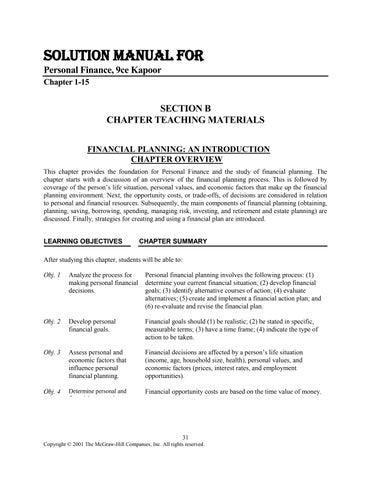
Solution Manual for Personal Finance, 9ce Kapoor Chapter 1-15
SECTION B CHAPTER TEACHING MATERIALS FINANCIAL PLANNING: AN INTRODUCTION CHAPTER OVERVIEW This chapter provides the foundation for Personal Finance and the study of financial planning. The chapter starts with a discussion of an overview of the financial planning process. This is followed by coverage of the person‘s life situation, personal values, and economic factors that make up the financial planning environment. Next, the opportunity costs, or trade-offs, of decisions are considered in relation to personal and financial resources. Subsequently, the main components of financial planning (obtaining, planning, saving, borrowing, spending, managing risk, investing, and retirement and estate planning) are discussed. Finally, strategies for creating and using a financial plan are introduced. LEARNING OBJECTIVES
CHAPTER SUMMARY
After studying this chapter, students will be able to: Obj. 1
Analyze the process for making personal financial decisions.
Personal financial planning involves the following process: (1) determine your current financial situation; (2) develop financial goals; (3) identify alternative courses of action; (4) evaluate alternatives; (5) create and implement a financial action plan; and (6) re-evaluate and revise the financial plan.
Obj. 2
Develop personal financial goals.
Financial goals should (1) be realistic; (2) be stated in specific, measurable terms; (3) have a time frame; (4) indicate the type of action to be taken.
Obj. 3
Assess personal and economic factors that influence personal financial planning.
Financial decisions are affected by a person‘s life situation (income, age, household size, health), personal values, and economic factors (prices, interest rates, and employment opportunities).
Obj. 4
Determine personal and financial opportunity costs associated with personal financial decisions.
Financial opportunity costs are based on the time value of money. Future value and present value calculations enable you to measure the increased value (or lost interest) that results from a saving, investing, borrowing, or purchasing decision. 31
Copyright © 2001 The McGraw-Hill Companies, Inc. All rights reserved.
Obj. 5
Identify strategies for achieving personal financial goals for different life situation.
Successful financial planning requires specific goals combined with spending, savings, investing, and borrowing strategies based on your personal situation and various social and economic factors.
INTRODUCTORY ACTIVITIES
Ask students to comment on the opening case for the chapter.
Point out the learning objectives in an effort to highlight the key points in the chapter.
Ask students to provide examples of social and economic factors that have increased the importance of personal financial planning today.
Have students answer these three questions as individuals or in small discussion groups: 1. What do you currently know about personal financial planning? 2. What questions do you need answers for about personal finance? 3. How and where might you obtain answers to the questions you have about personal finance?
CHAPTER 1 OUTLINE I.
The Financial Planning Process Step 1: Determine Your Current Financial Situation Step 2: Develop Financial Goals Step 3: Identify Alternative Courses of Action Step 4: Evaluate Alternatives Step 5: Create and Implement a Financial Action Plan Step 6: Re-evaluate and Revise Your Plan
II.
Developing Personal Financial Goals A. Factors that Influence Your Financial Goals B. Life Situation C. Goal-Setting Guidelines
III.
The Influence of Economic Factors
A. Market Forces B. Financial Institutions C. Global Influences D. Economic Conditions IV.
Time Value of Money A. Interest Calculations 11-2 Copyright © 2024 McGraw Hill Education Ltd. All Rights Reserved. Instructor‘s Manual for Kapoor et al. Personal Finance 9CE.
B. Future Value C. Present Value V.
Achieving Financial Goals A. Components of Personal Financial Planning B. Developing a Flexible Financial Plan C. Implementing Your Financial Plan
VI.
Appendix 1A: Financial Planners and Other Financial Planning Information Sources
VII.
Appendix 1B: The Time Value of Money: Future Value and Present Value Computations.
CHAPTER 1 LECTURE OUTLINE
Instructional Suggestions
THE FINANCIAL PLANNING PROCESS
Personal financial planning is the process of managing your money to achieve personal economic satisfaction.
Discussion Question: Why do some decisions require more time and effort than others?
Class Exercise: Select a situation (such as obtaining funds to start a business or getting work-related experience without a job) and have students create a list of alternatives for this problem.
Text Highlight: Exhibit 12 provides information on four
Step 1. Determine Your Current Financial Situation
Determine your current financial situation with regard to income, savings, living expenses, and debts.
Step 2. Develop Financial Goals
Analyze your financial values and goals to set a course for action.
Step 3. Identify Alternative Courses of Action
Various alternatives associated with financial decision making are usually based on deciding to: Continue the same course of action; for example, you may determine that the amount saved each month is still appropriate. Expand the current situation; you may choose to save a greater amount each month. Change the current situation; you may decide to buy Canadian savings bonds instead of using a regular savings account. Take a new course of action; you conclude to use your monthly saving budget to pay off credit card debts. Creativity in decision making is vital to making effective choices. The more alternatives that are considered, the more likely a person or household will make wise financial choices.
Step 4. Evaluate Alternatives 11-3
Copyright © 2024 McGraw Hill Education Ltd. All Rights Reserved. Instructor‘s Manual for Kapoor et al. Personal Finance 9CE.
Every decision closes off alternatives. The opportunity cost is what a person gives up by making a choice. This cost, commonly referred to as the trade-off of a decision, sometimes cannot always be measured in dollars. Decision making will be an ongoing part of your personal and financial existence. Thus, you will need to consider the lost opportunities that result from your decisions.
types of risks faced in many financial decisions.
Text Reference: The Appendix provides expanded discussion of financial planning information sources and using a financial planner.
Professional Practice Inquiry 1-1
Uncertainty is a par of every decision. In many financial decisions, identifying and evaluating risk is a difficult task. The best way to consider risk in such decisions is to gather information based on your experiences and those of others and refer to the research of financial planning sources. Relevant information is required at each stage of the financial planning process.
Step 5. Create and Implement A Financial Action Plan
Develop a plan of action to achieve your goals.
Step 6. Re-evaluate and Revise Your Plan
Decision making is a circular, ongoing process in which current decisions influence future choices.
DEVELOPING PERSONAL FINANCIAL GOALS
Many Canadians have money problems due to: poor planning weak financial habits extensive numbers of marketplace influences in the form of advertising, selling efforts, and product availability.
Types of Financial Goals
Short-term goals are those to be achieved within the next year or so, such as saving for an annual vacation or paying off small debts. Intermediate goals have a time frame of two to five years. Long-term goals involve financial plans that may be more than five years off, such as retirement and college savings. Consumable-product goals usually occur on a periodic basis involving items used up relatively quickly, such as food, clothing, or entertainment spending. Durable-product goals usually involve 11-4 Copyright © 2024 McGraw Hill Education Ltd. All Rights Reserved. Instructor‘s Manual for Kapoor et al. Personal Finance 9CE.
infrequent, expensive items, such as appliances, motor vehicles, and sporting equipment. Most durable goals consist of tangible items. In contrast, however, many people overlook intangible goals. These goals may relate to personal relationships, health, education, and leisure. Goal setting for these life circumstances is also necessary for a person‘s overall well-being.
11-5 Copyright © 2024 McGraw Hill Education Ltd. All Rights Reserved. Instructor‘s Manual for Kapoor et al. Personal Finance 9CE.