ANSWER KEY CHAPTER 1: Fundamentals of Pharmacology
TERMS AND DEFINITIONS
Textbook
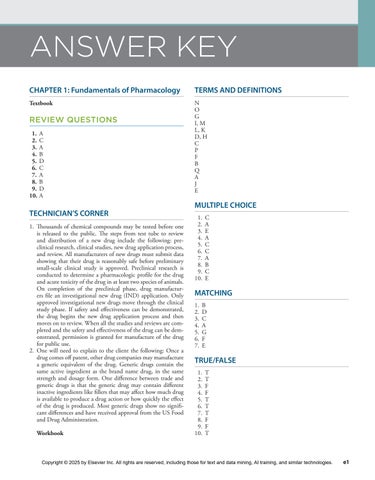
N O G I, M L, K D, H C P F B Q A J E
REVIEW QUESTIONS 1. A 2. C 3. A 4. B 5. D 6. C 7. A 8. B 9. D 10. A
TECHNICIAN’S CORNER 1. Thousands of chemical compounds may be tested before one is released to the public. The steps from test tube to review and distribution of a new drug include the following: preclinical research, clinical studies, new drug application process, and review. All manufacturers of new drugs must submit data showing that their drug is reasonably safe before preliminary small-scale clinical study is approved. Preclinical research is conducted to determine a pharmacologic profile for the drug and acute toxicity of the drug in at least two species of animals. On completion of the preclinical phase, drug manufacturers file an investigational new drug (IND) application. Only approved investigational new drugs move through the clinical study phase. If safety and effectiveness can be demonstrated, the drug begins the new drug application process and then moves on to review. When all the studies and reviews are completed and the safety and effectiveness of the drug can be demonstrated, permission is granted for manufacture of the drug for public use. 2. One will need to explain to the client the following: Once a drug comes off patent, other drug companies may manufacture a generic equivalent of the drug. Generic drugs contain the same active ingredient as the brand name drug, in the same strength and dosage form. One difference between trade and generic drugs is that the generic drug may contain different inactive ingredients like fillers that may affect how much drug is available to produce a drug action or how quickly the effect of the drug is produced. Most generic drugs show no significant differences and have received approval from the US Food and Drug Administration. Workbook
MULTIPLE CHOICE 1. C 2. A 3. E 4. A 5. C 6. C 7. A 8. B 9. C 10. E
MATCHING 1. B 2. D 3. C 4. A 5. G 6. F 7. E
TRUE/FALSE 1. T 2. T 3. F 4. F 5. T 6. T 7. T 8. F 9. F 10. T
Copyright © 2025 by Elsevier Inc. All rights are reserved, including those for text and data mining, AI training, and similar technologies.
e1
e2
Answer Key
CRITICAL THINKING
CASE STUDY
Answers will vary.
Answers will vary.
RESEARCH ACTIVITY Answers will vary.
Copyright © 2025 by Elsevier Inc. All rights are reserved, including those for text and data mining, AI training, and similar technologies.
Answer Key
CHAPTER 2: Principles of Pharmacology
MULTIPLE CHOICE
Textbook
1. C 2. A 3. C 4. D 5. E 6. C 7. B 8. B 9. D 10. C
REVIEW QUESTIONS 1. B 2. D 3. A 4. B 5. C 6. A 7. B 8. C 9. D 10. B
TECHNICIAN’S CORNER 1. Bioavailability describes the extent to which an administered amount of drug reaches the site of action and is available to produce drug effect(s). The bioavailability of a drug is influenced by drug absorption and distribution to the site of action. Bioequivalence is used to assess the equivalence of two preparations of a drug. If the two drugs are said to be bioequivalent, then for all intents and purposes they are the same. Pharmaceutical equivalence in drugs implies that those drugs contain the same amount of the same active substance(s), in the same dosage form, and for the same route of administration and meet the same or comparable standards. A generic drug is bioequivalent if no statistical differences are found in the rate and extent of absorption when the drug is administered in the same strength, dosage form, and route of administration as the brand name product. Workbook
TERMS AND DEFINITIONS 1. E 2. G 3. P 4. I 5. L 6. N, K 7. F 8. S 9. J 10. O, B 11. A 12. H 13. Q 14. R 15. M 16. C 17. D
MATCHING 1. B 2. A 3. C 4. D
MATCHING 1. A 2. C 3. B 4. D
TRUE/FALSE 1. T 2. T 3. T 4. F 5. T 6. F 7. T
CRITICAL THINKING Answers will vary.
RESEARCH ACTIVITY Answers will vary.
CASE STUDY Answers will vary.
Copyright © 2025 by Elsevier Inc. All rights are reserved, including those for text and data mining, AI training, and similar technologies.
e3
e4
Answer Key
CHAPTER 3: Pharmacodynamics
MULTIPLE CHOICE
Textbook
1. D 2. E 3. D 4. A 5. A 6. B 7. A (Given the choices, A is the best answer.) 8. B 9. D 10. B
REVIEW QUESTIONS 1. A 2. C 3. B 4. C 5. D 6. B 7. C 8. D 9. B 10. C
MATCHING
TECHNICIAN’S CORNER 1. Legally, a pharmacy technician is not allowed to counsel a patient. The patient can be told that the Food and Drug Administration requires drugs to be tested for safety and efficacy before release to the public. During the premarketing testing of drugs, adverse reactions must be documented. Documentation of adverse effects continues postmarketing (Phase 4). Patients who take the drug as prescribed can minimize adverse reactions. Patients should immediately inform their physician when they have an unanticipated adverse reaction to see whether dosage adjustments may be necessary. 2. Poverty is a risk factor of increased adverse reactions. Some medications should be taken with food to minimize adverse effects. Poverty may cause patients to skip meals; thus they lose the protective benefit of food. When poverty is combined with lack of education or inability to communicate in the language of the health care provider, the patient may not ask questions or read the Patient Medication Information (PMI) leaflet accompanying the medication and thus not get advice about strategies to minimize adverse effects. Workbook
1. C 2. D 3. A 4. B
MATCHING 1. C 2. A 3. E 4. B 5. D
TRUE/FALSE 1. F 2. F 3. T 4. T 5. F 6. F 7. T
CRITICAL THINKING Answers will vary.
TERMS AND DEFINITIONS
RESEARCH ACTIVITY
1. J 2. E 3. K 4. N 5. D 6. L 7. A 8. G 9. F 10. B 11. H 12. C 13. I 14. M
Answers will vary.
CASE STUDY Answers will vary.
Copyright © 2025 by Elsevier Inc. All rights are reserved, including those for text and data mining, AI training, and similar technologies.
Answer Key
CHAPTER 4: Drug Interactions and Medication Errors Textbook
REVIEW QUESTIONS 1. A 2. B 3. D 4. C 5. B 6. A 7. B 8. B 9. D 10. D
TECHNICIAN’S CORNER 1. Sound-alike and look-alike drug-dispensing errors may be avoided by practicing the follow steps: • Place reminders on the stock bottle or in the computer system to alert staff about these commonly confused drug names. • Place “high alert” or “sound-alike, look-alike” stickers on the drug stock bottle. • Avoid storing these drugs close together in a locked area or on the shelves because many have similar packaging and it becomes easy to grab the wrong one when dispensing. • Double-check spelling, strength, and dose on prescription. 2. Always verify prescriptions with similar drug names. Verify spelling and strength. Become familiar with brand and generic names of commonly dispensed drugs. Become familiar with strength, dosage form, and dosing frequency of commonly dispensed drugs. Consult with your pharmacist and, if still unclear, call the physician who wrote the prescription. Workbook
MULTIPLE CHOICE 1. B 2. C 3. E 4. B 5. E 6. C 7. E 8. B 9. D 10. A
MATCHING 1. C 2. A 3. E 4. B 5. D
MATCHING 1. D 2. A 3. E 4. C 5. B
TRUE/FALSE 1. T 2. T 3. T 4. F 5. T 6. F 7. T 8. T 9. T 10. F
TERMS AND DEFINITIONS
CRITICAL THINKING
1. F 2. E 3. H 4. I 5. D 6. C 7. A 8. G 9. B
Answers will vary.
RESEARCH ACTIVITY Answers will vary.
CASE STUDY Answers will vary.
Copyright © 2025 by Elsevier Inc. All rights are reserved, including those for text and data mining, AI training, and similar technologies.
e5