1
Fundamental Concepts of Thermodynamics
Conceptual Problems Q1.1
The location of the boundary between the system and the surroundings is a choice that must be made by the thermodynamicist. Consider a beaker of boiling water in an airtight room. Is the system open or closed if you place the boundary just outside the liquid water? Is the system open or closed if you place the boundary just inside the walls of the room? If the system boundaries are just outside of the liquid water, the system is open because water can escape from the top surface. The system is closed if the boundary is just inside the walls, because the room is airtight.
Q1.2
Real walls are never totally adiabatic. Order the following walls in increasing order with respect to being diathermal: 1-cm-thick concrete, 1-cm-thick vacuum, 1-cm-thick copper, 1-cm-thick cork. 1-cm-thick vacuum < 1-cm-thick cork < 1-cm-thick concrete < 1-cm-thick copper.
Q1.3
Why is the possibility of exchange of matter or energy a necessary condition for equilibrium between two systems? Equilibrium is a dynamic process in which the rates of two opposing processes are equal. However, if the rate in each direction is zero, no exchange is possible, and therefore the system cannot reach equilibrium.
Q1.4
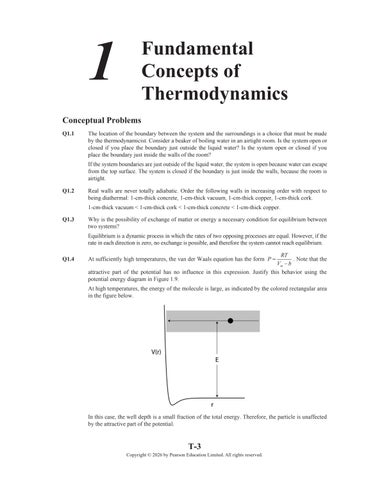
RT . Note that the Vm b attractive part of the potential has no influence in this expression. Justify this behavior using the potential energy diagram in Figure 1.9. At sufficiently high temperatures, the van der Waals equation has the form P
At high temperatures, the energy of the molecule is large, as indicated by the colored rectangular area in the figure below.
In this case, the well depth is a small fraction of the total energy. Therefore, the particle is unaffected by the attractive part of the potential.
T-3
Copyright © 2019Education Pearson Education, Inc. Copyright © 2026 by Pearson Limited. All rights reserved.
T-4
Chapter 1 Fundamental Concepts of Thermodynamics
Q1.5
The parameter a in the van der Waals equation is greater for H2O than for He. What does this say about the form of the potential function in Figure 1.9 for the two gases? It says that the depth of the attractive potential is greater for H2O than for He.
Q1.6
Can temperature be measured directly? Explain your answer. Temperature cannot be measured directly. It is measured indirectly by the effect of temperature on a property such as the volume of a liquid, the pressure of a gas, the electrical resistance of a metal, or the voltage across the junction of two dissimilar metals (a thermocouple).
Q1.7
Give an example of two systems that are in equilibrium with respect to only one of two state variables. The contents of a compressed gas cylinder are in thermal equilibrium with the surroundings, but the pressures are different. A gas enclosed in an adiabatic piston and cylinder assembly can be in equilibrium with respect to pressure, but not to temperature.
Q1.8
Explain how the ideal gas law can be deduced for the measurements shown in Figures 1.5 and 1.8. Figure 1.5 shows that at constant volume, P increases linearly with T, so P f (V ) T . Figure 1.5 shows that the product PV is a constant at constant T. Therefore PV T , where and are constants to be determined from measurements and the units chosen for P, V, and T.
Q1.9
Give an example based on molecule–molecule interactions illustrating how the total pressure upon mixing two real gases could be different from the sum of the partial pressures. We define the partial pressure of a gas as the pressure that the gas would exert if it were the only gas in the vessel. If HCl and NH3 were admitted to the vessel, a reaction would occur and the total pressure would be much less than the sum of the partial pressures.
Q1.10
Which of the following systems are open? (a) a dog, (b) an incandescent light bulb, (c) a tomato plant, (d) a can of tomatoes. Explain your answers. An open system can exchange matter with the surroundings. Using this criterion:
Q1.11
(a)
A dog is an open system because matter can flow between it and the surroundings.
(b)
The light bulb is a closed system because matter cannot flow between the interior and exterior of the bulb.
(c)
A tomato plant is an open system because matter can flow between it and the surrounding.
(d)
A can of tomatoes is a closed system because matter cannot flow between the interior and exterior of the can.
Which of the following systems are isolated? (a) a bottle of wine, (b) a tightly sealed, perfectly insulated thermos bottle, (c) a closed tube of toothpaste, (d) our solar system. Explain your answers. An isolated system cannot exchange matter or energy with the surroundings. Using this criterion: (a)
Q1.12
The bottle of wine is not an isolated system because it can exchange energy with the surroundings.
(b)
The thermos bottle is an isolated system.
(c)
A closed tube of toothpaste is not an isolated system because it can exchange energy with the surroundings.
(d)
Our solar system is not an isolated system because it can exchange energy and mass with the rest of the universe.
Why do the z and y components of the velocity vector not change in the collision depicted in Figure 1.2? The z and y components of the velocity not change in the collision because there is no force acting on the particle in those directions.
Q1.13
If the wall depicted in Figure 1.2 were a movable piston, under what conditions would it move as a result of the molecular collisions? It would move if the momentum transferred to it from the two sides was different. This is the case if there is a pressure difference across the wall. Copyright © 2019 Pearson Education, Copyright © 2026 by Pearson Education Limited. AllInc. rights reserved.
Chapter 1 Fundamental Concepts of Thermodynamics Q1.14
T-5
The mass of a He atom is less than that of an Ar atom. Does that mean that because of its larger mass, Argon exerts a higher pressure on the container walls than He at the same molar density, volume, and temperature? Explain your answer. The pressure exerted on the wall depends on the momentum transfer per unit time, which is proportional to m v 2x kT the product of mass and speed in the form m v 2x . Because , the momentum transfer depends on the 2 2 temperature, but not on the mass of the atom striking the wall. An Ar atom has a larger mass than a He atom, but its speed is less and the product m v 2x is the same for He and Ar at a given temperature.
Q1.15
Explain why attractive interactions between molecules in gas make the pressure less than that predicted by the ideal gas equation of state. The pressure exerted by a gas on the walls which contain it is determined by the force exerted on the wall by molecular collisions. If the molecules nearest the wall experience an attractive interaction to the molecules near them, this will lessen the force that they exert on the wall. Therefore, the pressure will be less.
Q1.16
Q1.17
State whether the following are intensive or extensive variables: (a) temperature, (b) pressure, (c) mass. Explain your answer. (a)
Temperature is an intensive variable because if a system is divided into two parts, the temperature of each part is unchanged.
(b)
Pressure is an intensive variable because if a system is divided into two parts, the pressure of each part is unchanged.
(c)
Mass is an extensive variable because if a system is divided into two parts, the mass of each part is changed.
State whether the following are intensive or extensive variables. (a) density (b) mean square speed v 2x (c) volume. Explain your answers. (a)
Density is an intensive variable because if a system is divided into two parts, the density of each part is unchanged.
(b)
The mean square speed is an intensive variable because if a system is divided into two parts, the mean square speed of each part is unchanged.
(c)
Volume is an extensive variable because if a system is divided into two parts, the volume of each part is changed.
Numerical Problems Section 1.2 P1.1
Devise a temperature scale, abbreviated G, for which the magnitude of the ideal gas constant is 7.41 J G 1 mol 1. Let T and T represent the Kelvin and G scales, and R and R represent the gas constant in each of these scales. Then nRT PV nRT T
R 8.314 T T 1.12T R 7.41
The temperature on the G scale is the value in K multiplied by 1.12. P1.2
Suppose that you measured the product PV of 1 mol of a dilute gas and found that PV 23.60 L atm at 0.00°C and 32.35 L atm at 100.°C. Assume that the ideal gas law is valid, with T t (C) a, and that the values of R and a are not known. Determine R and a from the measurements provided. Expressing the ideal gas law in the form PV R (t a ) m(t a ),
m a
PV (32.35 23.60) l atm mol1 0.0875 L atm mol1 C1 R t 100. 0 C 32.35 l atm mol1 PV 100.C 270.C t 0.0875 atm mol1 C1 R Copyright © 2019Education Pearson Education, Inc. Copyright © 2026 by Pearson Limited. All rights reserved.
T-6
Chapter 1 Fundamental Concepts of Thermodynamics
Section 1.4 P1.3
A sample of propane (C3H8 ) is placed in a closed vessel together with an amount of O 2 that is 3.05 times the amount needed to completely oxidize the propane to CO 2 and H 2O at constant temperature. Calculate the mole fraction of each component in the resulting mixture after oxidation assuming that the H 2O is present as a gas. The reaction is C3H8 (g) 5O 2 (g) 3CO 2 (g) 4H 2O(g). If m mol of propene are present initially, there must be 15m mol of O2 . After the reaction is complete, there are 3m mol of CO 2 , 4m mol of H 2O, and (5 3.05 5) m mol of O2 . Given these relationships, we can calculate the mole fractions. 3m 4m 0.174; xH 2 O 0.232; 3m 4m (5 3.05 5)m 3m 4m (5 3.05 5) m (5 3.05 5) m xO2 0.594 3m 4m (5 3.05 5) m
xCO2
P1.4
A gas sample is known to be a mixture of ethane and butane. A bulb having a 195.0 cm 3 capacity is filled with the gas to a pressure of 103 103 Pa at 17.5C. If the weight of the gas in the bulb is 0.2988 g, what is the mole percent of butane in the mixture? n1
moles of ethane n2
moles of butane
PV 103 103 Pa 0.195 103 m3 n1 n2 8.31 103 mol RT 8.314 J mol1 K 1 (273.15 17.5) K
0.2988 g. The total mass is n1M 1 n2 M 2 Dividing this equation by n1 n2 gives the average molecular mass of the mixture n1M 1 n2 M 2 0.2988 g 35.9 g mol 1 n1 n2 n1 n2 8.31 10 3mol
We also know that x1M 1 x2 M 2 (1 x2 ) M 1 x2 M 2 35.9 g mol 1
Solving for x2
x2
35.9 g mol1 M 1 35.9 g mol1 30.069 g mol1 0.210 M 2 M1 58.123 g mol1 30.069 g mol1
mole % butane = 21.0% P1.5
One liter of fully oxygenated blood can carry 0.210 liters of O2 measured at T 298 K and P 1.00 atm. Calculate the number of moles of O2 carried per liter of blood. Hemoglobin, the oxygen transport protein in blood has four oxygen binding sites. How many hemoglobin molecules are required to transport the O2 in 2.50 L of fully oxygenated blood?
PV 1 atm 0.210 L RT 8.206 102 L atm mol 1 K 1 298 K 8.59 103mol/liter blood nO2 N A VB 8.59 103mol/liter blood 6.022 1023 2.50 liter blood N hemoglobin 4 4 3.23 1021molecules hemoglobin n O2
Copyright © 2019 Pearson Education, Copyright © 2026 by Pearson Education Limited. AllInc. rights reserved.
Chapter 1 Fundamental Concepts of Thermodynamics P1.6
T-7
Yeast and other organisms can convert glucose (C6 H12O6 ) to ethanol (CH3CH 2OH) by a process called alcoholic fermentation. The net reaction is C6 H12O6 (s) 2C2 H 5OH(1) 2CO 2 (g) Calculate the mass of glucose required to produce 3.10 L of CO 2 measured at P 1.00 atm and T 305 K. mglucose M glucose
PV nglucose RT nCO2
180.16 g mol 1 11.2 g
P1.7
1.00 atm 3.10 L 0.5 8.206 102 L atm mol 1 K 1 305 K
A vessel contains 2.25 g H2O(l) in equilibrium with water vapor at 30C. At this temperature, the vapor pressure of H2O is 31.82 torr. What volume increase is necessary for all the water to evaporate? We calculate the volume at which the gas pressure is equal to the partial pressure. For smaller volumes, some of the water will remain as a liquid. 2.25 g 8.206 102 L atm mol1 K 1 (273.15 30.)K nRT 18.02 g V 1 atm P 31.82 Torr 760 Torr 74.2 L
P1.8
Consider a 25.5-L sample of moist air at 60.°C and 1.00 atm in which the partial pressure of water vapor is 0.131 atm. Assume that dry air has the composition 78.0 mole percent N2, 21.0 mole percent O2, and 1.00 mole percent Ar. a.
What are the mole percentages of each of the gases in the sample?
b.
The percent relative humidity is defined as %RH = PH 2O /PH*2O where PH 2 O is the partial pressure of water in the sample and PH2O 0.197 atm is the equilibrium vapor pressure of water at 60.°C. The gas is compressed at 60.°C until the relative humidity is 100.%. What volume does the mixture contain now?
c.
(a)
What fraction of the water will be condensed if the total pressure of the mixture is isothermally increased to 75.0 atm? mol % N 2 = 100 mol % O 2 = 100 mol % Ar = 100 mol % H 2O = 100
(b)
PH 2OV
PO2 Ptotal
100
0.78 0.869 atm 67.8% 1 atm
100
0.21 0.869 atm 18.2% 1 atm
PAr 0.01 0.869 atm 100 0.869% Ptotal 1 atm PH 2 O Ptotal
100
0.131 atm 13.1% 1 atm
nH 2O RT
V PH 2OV PH 2OV where the primed quantities refer to 100% RH V
(c)
PN2 Ptotal
PH 2 OV 0.131 atm 25.5 L 17.0 L 0.197 atm PH 2O
If all the water remained in the gas phase, the partial pressure of water at a total pressure of 75.0 atm would be P Ptotal mol fraction H 2O = 75.0 atm 0.131 = 9.83 atm H 2O
Copyright © 2019Education Pearson Education, Inc. Copyright © 2026 by Pearson Limited. All rights reserved.