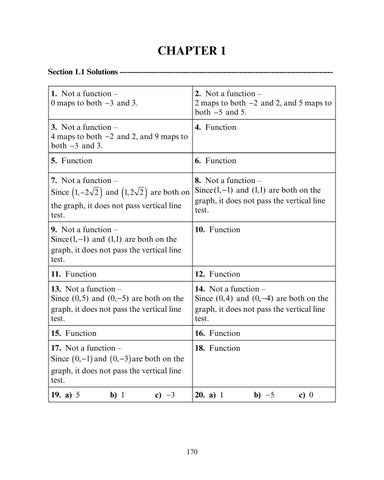
CHAPTER 1 Section 1.1 Solutions -------------------------------------------------------------------------------1. Not a function – 0 maps to both −3 and 3.
2. Not a function – 2 maps to both −2 and 2, and 5 maps to both −5 and 5.
3. Not a function – 4. Function 4 maps to both −2 and 2, and 9 maps to both −3 and 3. 5. Function
6. Function
7. Not a function – 8. Not a function – Since 1, −2 2 and 1,2 2 are both on Since (1,−1) and (1,1) are both on the graph, it does not pass the vertical line the graph, it does not pass vertical line test. test.
(
)
(
)
9. Not a function – Since (1,−1) and (1,1) are both on the graph, it does not pass the vertical line test.
10. Function
11. Function
12. Function
13. Not a function – Since (0,5) and (0,−5) are both on the graph, it does not pass the vertical line test.
14. Not a function – Since (0,4) and (0,−4) are both on the graph, it does not pass the vertical line test.
15. Function
16. Function
17. Not a function – Since ( 0,−1) and ( 0,−3 ) are both on the
18. Function
graph, it does not pass the vertical line test. 19. a) 5
b) 1
c) −3
20. a) 1
170
b) −5
c) 0
Section 1.1
21. a) 3
b) 2
c) 5
22. a) 0
b) 4
c) −5
23. a) −5
b) −5
c) −5
24. a) −2
b) −6
c) −4
25. a) 2
b) −8
c) −5
26. a) 2
b) 0
c) 3
27. 1
28. −1.5 and 3
29. –3 and 1
30. −7
31. For all x in the interval [ −4,4]
32. For all x in the set [ −4,0) ∪ [4]
33. 6
34. −3
35. f ( −2 ) = 2( −2 ) − 3 = −7
36. G( −3) = (−3)2 + 2( −3) − 7 = −4
37. g(1) = 5 + 1 = 6
38. F ( −1) = 4 − ( −1)2 = 3
39. Using #35 and #37, we see that f ( −2 ) + g (1) = −7 + 6 = −1.
40. Using #36 and #38, we see that G ( −3) − F (−1) = −4 − 3 = −7 .
41. Using #35 and #37, we see that 3 f (−2) − 2 g (1) = 3(−7) − 2(6) = −33 .
42. Using #36 and #38, we see that 2F (−1) − 2G (−3) = 2(3) − 2(−4) = 14 .
43. Using #35 and #37, we see that f ( −2 ) 7 = − . g(1) 6
44. Using #36 and #38, we see that G( −3) 4 = − . F ( −1) 3
45.
46.
f (0) − f ( −2) ( 2(0) − 3 ) − (−7) −3 + 7 2 = = = g(1) 6 6 3 G (0) − G ( −3) ( 0 + 2(0) − 7 ) − (−4) −7 + 4 = = = −1 F ( −1) 3 3 2
47. f ( −x ) = 2(−x) − 3 = −2x − 3
48. −F (t ) = −(4 − t 2 ) = t 2 − 4
171
Chapter 1
50. G ( −x ) = ( −x )2 + 2(−x) − 7 = x 2 − 2x − 7
49. −g ( −t ) = −[5 + ( −t )] = −(5 − t) = t − 5 51.
f ( x + 1) − f ( x −1) = [ 2(x + 1) − 3] − [ 2(x −1) − 3] = [ 2 x + 2 − 3] − [ 2 x − 2 − 3] = [ 2x − 1] − [ 2x − 5]
= 2x − 1 − 2x + 5 = 4 52.
F (t + 1) − F (t −1) = 4 − (t +1)2 − 4 − (t − 1)2 = 4 − ( t 2 + 2t +1) − 4 − ( t 2 − 2t +1) = 4 − t 2 − 2t −1 − 4 − t 2 + 2t −1 = 4 − t 2 − 2t −1− 4 + t 2 − 2t +1 = −4t 53.
g( x + a ) − f ( x + a ) = [5 + ( x + a )] − [ 2( x + a ) − 3] = [5 + x + a ] − [ 2 x + 2a − 3]
= 5 + x + a − 2x − 2a + 3 = 8−x −a 54. G ( x + b ) + F (b) = ( x + b )2 + 2(x + b) − 7 + 4 − b 2 = x 2 + 2bx + b 2 + 2 x + 2b − 7 + 4 − b 2 = x 2 + 2bx + 2 x + 2b − 3
55. The domain is . 56. The domain is . This is written using interval notation as This is written using interval notation as ( −∞,∞ ) . ( −∞,∞ ) .
172
Section 1.1
57. The domain is . 58. The domain is . This is written using interval notation as This is written using interval notation as ( −∞, ∞ ) . ( −∞, ∞ ) . 59. The domain is the set of all real numbers x such that x − 5 ≠ 0, that is x ≠ 5. This is written using interval notation as ( −∞,5 ) ∪ (5,∞ ) .
60. The domain is the set of all real numbers t such that t + 3 ≠ 0, that is t ≠ −3. This is written using interval notation as ( −∞, −3 ) ∪ ( −3,∞ ) .
61. The domain is the set of all real 62. The domain is the set of all real numbers x such that numbers x such that 2 x − 4 = ( x − 2)(x + 2) ≠ 0, that is x 2 − 1 = ( x −1)(x +1) ≠ 0, that is x ≠ −1,1. This is written using interval notation as x ≠ −2,2. This is written using interval notation as ( −∞, −1) ∪ ( −1,1) ∪ (1,∞ ) . ( −∞, −2 ) ∪ ( −2,2 ) ∪ ( 2,∞ ) . 63. Since x 2 + 1 ≠ 0, for every real 64. Since x 2 + 4 ≠ 0, for every real number x, the domain is . number x, the domain is . This is written using interval notation as This is written using interval notation as ( −∞,∞ ) . ( −∞, ∞ ) . 65. The domain is the set of all real numbers x such that 7 − x ≥ 0, that is 7 ≥ x. This is written using interval notation as ( −∞,7] .
66. The domain is the set of all real numbers t such that t − 7 ≥ 0, that is t ≥ 7. This is written using interval notation as [7,∞ ) .
67. The domain is the set of all real 68. The domain is the set of all real numbers x such that 2x + 5 ≥ 0, that is numbers x such that 5 − 2x ≥ 0, that is 5 5 x ≥ −2. 2 ≥ x. This is written using interval notation as This is written using interval notation as
− 52 , ∞ ) .
( −∞, 52 .
173
Chapter 1
69. The domain is the set of all real numbers t such that t 2 − 4 ≥ 0, which is equivalent to (t − 2 )(t + 2) ≥ 0. CPs are −2, 2
70. The domain is the set of all real numbers x such that x 2 − 25 ≥ 0, which is equivalent to ( x − 5)( x + 5) ≥ 0. CPs are −5, 5
+ − + | |
+ − + | |
−2
−5
2
5
This is written using interval notation as This is written using interval notation as ( −∞, −2 ] ∪ [2,∞ ) . ( −∞, −5] ∪ [5,∞ ) . 71. The domain is the set of all real numbers x such that x − 3 > 0, that is x > 3. This is written using interval notation as ( 3,∞ ) .
72. The domain is the set of all real numbers x such that 5 − x > 0, that is 5 > x. This is written using interval notation as ( −∞,5 ) .
73. Since 1 − 2 x can be any real number, 74. Since 7 − 5x can be any real there is no restriction on x, so that the number, there is no restriction on x, so domain is ( −∞, ∞) . that the domain is ( −∞, ∞) . 75. The only restriction is that x + 4 ≠ 0, 76. The only restriction is that so that x ≠ −4. So, the domain is x 2 − 9 = ( x − 3)(x + 3) ≠ 0, so that x ≠ ±3 . So, the domain is ( −∞, −4) ∪ (−4,∞) . ( −∞, −3) ∪ (−3,3) ∪ (3,∞) . 77. The domain is the set of all real numbers x such that 3 − 2x > 0, that is 3 2 > x. This is written using interval notation as
( −∞, 32 ) .
78. The domain is the set of all real numbers x such that 25 − x 2 > 0, which is equivalent to (5 − x )(5 + x ) > 0. CPs are −5, 5 − + − | | −5
5
This is written using interval notation as ( −5,5 ) .
174