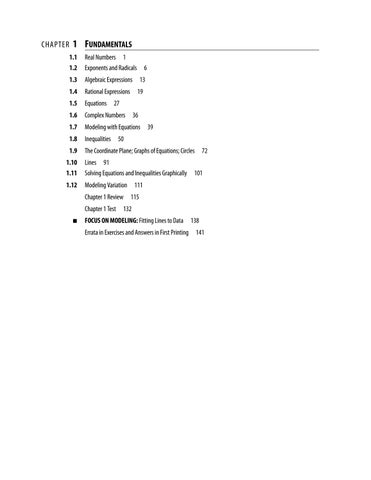
CHAPTER 1
FUNDAMENTALS
1.1 1.2
Real Numbers 1 Exponents and Radicals 6
1.3
Algebraic Expressions 13
1.4
Rational Expressions 19
1.5
Equations 27
1.6
Complex Numbers 36
1.7
Modeling with Equations 39
1.8
Inequalities 50
1.9
The Coordinate Plane; Graphs of Equations; Circles 72
1.10 1.11
Lines 91 Solving Equations and Inequalities Graphically 101
1.12
Modeling Variation 111 Chapter 1 Review 115 Chapter 1 Test 132
¥
FOCUS ON MODELING: Fitting Lines to Data 138 Errata in Exercises and Answers in First Printing 141
1
FUNDAMENTALS
1.1
REAL NUMBERS
1. (a) The natural numbers are 1 2 3 .
(b) The numbers 3 2 1 0 are integers but not natural numbers. p 5 , 1729 . (c) Any irreducible fraction with q 1 is rational but is not an integer. Examples: 32 , 12 23 q p (d) Any number which cannot be expressed as a ratio of two integers is irrational. Examples are 2, 3, , and e. q 2. (a) ab ba; Commutative Property of Multiplication (b) a b c a b c; Associative Property of Addition (c) a b c ab ac; Distributive Property
3. (a) In setbuilder notation: x 3 x 5
(c) As a graph: _3
(b) In interval notation: 3 5
5
4. The symbol x stands for the absolute value of the number x. If x is not 0, then the sign of x is always positive. 5. The distance between a and b on the real line is d a b b a. So the distance between 5 and 2 is 2 5 7. 6. (a) If a b, then any interval between a and b (whether or not it contains either endpoint) contains infinitely many ba numbers—including, for example a n for every positive n. (If an interval extends to infinity in either or both 2 directions, then it obviously contains infinitely many numbers.) (b) No, because 5 6 does not include 5. 7. (a) No: a b b a b a in general.
(b) No; by the Distributive Property, 2 a 5 2a 2 5 2a 10 2a 10.
8. (a) Yes, absolute values (such as the distance between two different numbers) are always positive. (b) Yes, b a a b.
9. (a) Natural number: 100 (b) Integers: 0, 100, 8
(c) Rational numbers: 15, 0, 52 , 271, 314, 100, 8 (d) Irrational numbers: 7,
9 3, 10 (b) Integers: 2, 100 2 50, 9 3, 10 (c) Rational numbers: 45 92 , 13 , 16666 53 , 2, 100 2 , 9 3, 10 (d) Irrational numbers: 2, 314
10. (a) Natural numbers: 2,
11. Commutative Property of addition
12. Commutative Property of multiplication
13. Associative Property of addition
14. Distributive Property
15. Distributive Property
16. Distributive Property
17. Commutative Property of multiplication
18. Distributive Property
19. x 3 3 x
20. 7 3x 7 3 x
21. 4 A B 4A 4B
22. 5x 5y 5 x y
1
2
CHAPTER 1 Fundamentals
23. 2 x y 2x 2y 25. 5 2x y 5 2 x y 10x y 27. 52 2x 4y 52 2x 52 4y 5x 10y
24. a b 5 5a 5b 26. 43 6y 43 6 y 8y
28. 3a b c 2d 3ab 3ac 6ad
15 29 29. (a) 23 57 14 21 21 21
15 1 30. (a) 25 38 16 40 40 40
31. (a) 23 6 32 23 6 23 32 4 1 3 1 5 4 13 1 13 (b) 3 14 1 45 12 4 4 5 5 4 5 20
2 32. (a) 2 3 2 32 23 12 3 13 93 13 83 2
33. (a) 2 3 6 and 2 72 7, so 3 72
34. (a) 3 23 2 and 3 067 201, so 23 067
5 3 10 9 1 (b) 12 8 24 24 24
15 4 25 (b) 32 58 16 36 24 24 24 24
(b) 3 72 (c) 35 72
2
3 2 1 2 1 2 1 45 9 (b) 15 23 51 21 51 21 10 10 12 3 3 10 15 10 5 10 5
(b) 23 067
(c) 06 06
35. (a) False
36. (a) False:
(b) True
(b) False
3 173205 17325.
37. (a) True
(b) False
38. (a) True
(b) True
39. (a) x 0
(b) t 4
40. (a) y 0
(b) z 3
(d) 5 x 13
(c) a (e) 3 p 5
(c) b 8
(d) 0 17
(e) y 2
41. (a) A B 1 2 3 4 5 6 7 8
42. (a) B C 2 4 6 7 8 9 10
(b) A B 2 4 6
(b) B C 8
43. (a) A C 1 2 3 4 5 6 7 8 9 10 (b) A C 7
44. (a) A B C 1 2 3 4 5 6 7 8 9 10 (b) A B C 46. (a) A C x 1 x 5
45. (a) B C x x 5
(b) A B x 2 x 4
(b) B C x 1 x 4
48. 2 8] x 2 x 8
47. 3 0 x 3 x 0 _3
0
8
50. 6 12 x 6 x 12
49. [2 8 x 2 x 8 2
2
8
_6
1
_ _2
SECTION 1.1 Real Numbers
51. [2 x x 2
52. 1 x x 1
2
1
53. x 1 x 1]
54. 1 x 2 x [1 2] 1
1
55. 2 x 1 x 2 1] _2
56. x 5 x [5 _5
1
57. x 1 x 1
58. 5 x 2 x 5 2
_1
59. (a) [3 5]
_5
(b) 3 5]
(c) 3
1
63. [4 6] [0 8 [0 6] 0
6
4
(b) 13 13 69. (a) 6 4 6 4 2 2
71. (a) 2 6 12 12 (b) 13 15 5 5
73. 2 3 5 5
(c) 0]
_1
0
_4
8
66. 6] 2 10 2 6]
67. (a) 50 50
1 1 1 (b) 1 1
(b) 2 0]
64. [4 6] [0 8 [4 8
65. 4 4 _4
60. (a) [0 2
2
62. 2 0 1 1 0
61. 2 0 1 1 2 1 _2
2
2
6
68. (a) 2 8 6 6 (b) 8 2 8 2 6 6 70. (a) 2 12 2 12 10 10 (b) 1 1 1 1 1 1 1 0 1
1 1 72. (a) 6 24 4 4 5 (b) 712 127 5 1 1 74. 25 15 4 4
3
4
CHAPTER 1 Fundamentals
75. (a) 17 2 15 (b) 21 3 21 3 24 24 3 12 55 67 67 (c) 10 11 8 40 40 40 40
7 1 49 5 54 18 18 76. (a) 15 21 105 105 105 35 35 (b) 38 57 38 57 19 19.
(c) 26 18 26 18 08 08.
77. (a) Let x 0777 . So 10x 77777 x 07777 9x 7. Thus, x 79 .
13 (b) Let x 02888 . So 100x 288888 10x 28888 90x 26. Thus, x 26 90 45 . 19 (c) Let x 0575757 . So 100x 575757 x 05757 99x 57. Thus, x 57 99 33 .
78. (a) Let x 52323 . So 100x 5232323 1x 52323 99x 518. Thus, x 518 99 .
62 (b) Let x 13777 . So 100x 1377777 10x 137777 90x 124. Thus, x 124 90 45 .
1057 (c) Let x 213535 . So 1000x 21353535 10x 213535 990x 2114. Thus, x 2114 990 495 . 79. 3, so 3 3. 80. 2 1, so 1 2 2 1.
81. a b, so a b a b b a.
82. a b a b a b b a 2b
83. (a) a is negative because a is positive.
(b) bc is positive because the product of two negative numbers is positive. (c) a b a b is positive because it is the sum of two positive numbers.
(d) ab ac is negative: Each summand is the product of a positive number and a negative number, and the sum of two negative numbers is negative. 84. (a) b is positive because b is negative.
(b) a bc is positive because it is the sum of two positive numbers.
(c) c a c a is negative because c and a are both negative.
(d) ab2 is positive because both a and b2 are positive. 85. Distributive Property
86. (a) When L 150, x 20, and y 15, we have L 2 x y 150 2 20 15 150 70 220. Because 220 274, the post office will accept this package. When L 120, x 60, and y 60, we have L 2 x y 120 2 60 60 120 240 360, and since 360 274, the post office will not accept this package.
(b) If x y 225, then L 2 225 225 274 L 90 274 L 184. So the length can be as long as 184 cm 184 m. m2 m1 m m1n2 m2n1 m1 and y be rational numbers. Then x y 2 , 87. Let x n1 n2 n1 n2 n1 n2 m m m n m 2 n1 m m m m xy 1 2 1 2 , and x y 1 2 1 2 . This shows that the sum, difference, and product n1 n2 n1 n2 n1 n2 n1n2 of two rational numbers are again rational numbers. However the product of two irrational numbers is not necessarily irrational; for example, 2 2 2, which is rational. Also, the sum of two irrational numbers is not necessarily irrational; for example, 2 2 0 which is rational. 88. 12 2 is irrational. If it were rational, then by Exercise 6(a), the sum 12 2 12 2 would be rational, but this is not the case. Similarly, 12 2 is irrational. (a) Following the hint, suppose that r t q, a rational number. Then by Exercise 6(a), the sum of the two rational numbers r t and r is rational. But r t r t, which we know to be irrational. This is a contradiction, and hence our original premise—that r t is rational—was false.